Page 211 of 345
collisions and rollovers.In a rollover crash, an
unbelted or improperly belted person is
significantly more likely to be injured or
killed than a person properly wearing a
seat belt.ON-PAVEMENT AND OFFROAD
DRIVING PRECAUTIONS (AWD)Utility vehicles have a significantly higher
rollover rate than other types of vehicles.
They have higher ground clearance than passen-
ger cars to make them capable of performing in
a variety of on-pavement and offroad applica-
tions. This gives them a higher center of gravity
than ordinary cars. An advantage of higher
ground clearance is a better view of the road,
allowing you to anticipate problems. However,
they are not designed for cornering at the same
speeds as conventional two-wheel drive ve-
hicles any more than low-slung sports cars are
designed to perform satisfactorily under offroad
conditions. If at all possible, avoid sharp turns or
abrupt maneuvers, particularly at high speeds.
As with other vehicles of this type, failure to
operate this vehicle correctly may result in loss
of control or vehicle rollover. Seat belts help
reduce the risk of injury in collisions and roll-
overs. In a rollover crash, an unbelted or improp-
erly belted person is significantly more likely tobe injured or killed than a person properly wear-
ing a seat belt.
Be sure to read the driving safety precautions
later in this section.
DRINKING ALCOHOL/DRUGS AND
DRIVING
WARNING
Never drive under the influence of alco-
hol or drugs. Alcohol in the bloodstream
reduces coordination, delays reaction
time and impairs judgement. Driving af-
ter drinking alcohol increases the likeli-
hood of being involved in an accident
injuring yourself and others. Addition-
ally, if you are injured in an accident,
alcohol can increase the severity of the
injury.
NISSAN is committed to safe driving. You must
not drive under the influence of alcohol. Every
year thousands of people are injured or killed in
alcohol related accidents. Although the local
laws vary on what is considered to be legally
intoxicated, the fact is that alcohol affects all
people differently and most people underesti-mate the effects of alcohol.
Remember, drinking and driving don’t mix!
And that’s true for drugs too (over the counter,
prescription, and illegal drugs). Don’t drive if
your ability to operate your vehicle is impaired by
alcohol, drugs, or some other physical condition.
DRIVING SAFETY PRECAUTIONSPlease observe the following precautions:
WARNING
�Drive carefully when off the road and
avoid dangerous areas. Every person
who drives or rides in this vehicle
should be seated with their seat belt
fastened. This will keep you and your
passengers in position when driving
over rough terrain.
�Before driving up or down grades,
check the road surface for bumps or
potholes. Be sure to climb a gentle
slope and descend a gentle slope.
�Do not drive across steep slopes.
Instead drive either straight up or
5-6
Starting and driving
�
06.7.5/Z50-D/V5.0
�
Page 304 of 345
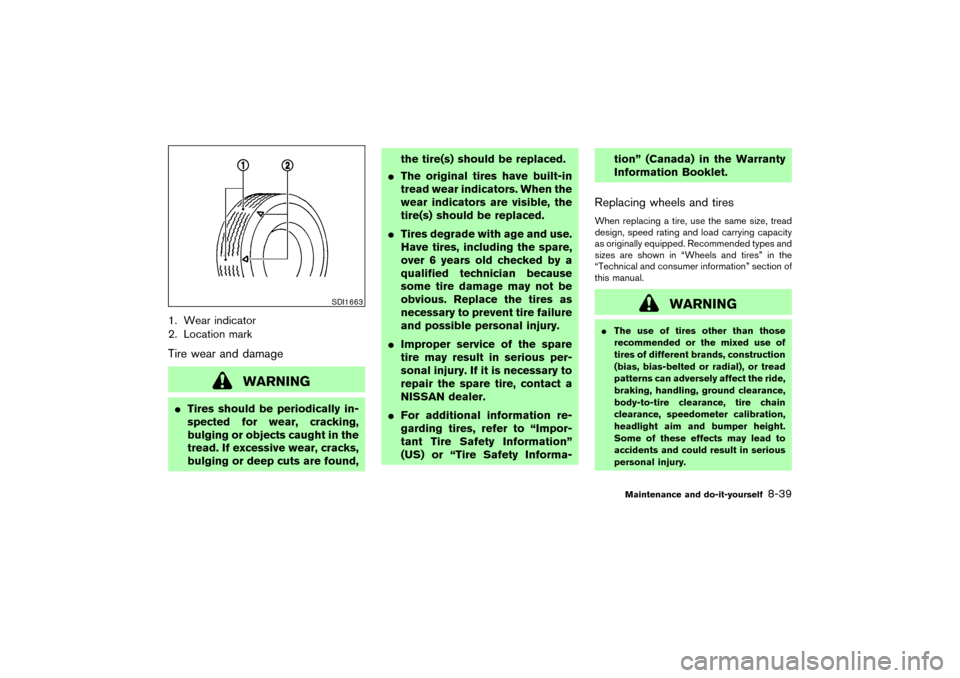
1. Wear indicator
2. Location markTire wear and damage
WARNING
�Tires should be periodically in-
spected for wear, cracking,
bulging or objects caught in the
tread. If excessive wear, cracks,
bulging or deep cuts are found,the tire(s) should be replaced.
�The original tires have built-in
tread wear indicators. When the
wear indicators are visible, the
tire(s) should be replaced.
�Tires degrade with age and use.
Have tires, including the spare,
over 6 years old checked by a
qualified technician because
some tire damage may not be
obvious. Replace the tires as
necessary to prevent tire failure
and possible personal injury.
�Improper service of the spare
tire may result in serious per-
sonal injury. If it is necessary to
repair the spare tire, contact a
NISSAN dealer.
�For additional information re-
garding tires, refer to “Impor-
tant Tire Safety Information”
(US) or “Tire Safety Informa-tion” (Canada) in the Warranty
Information Booklet.
Replacing wheels and tiresWhen replacing a tire, use the same size, tread
design, speed rating and load carrying capacity
as originally equipped. Recommended types and
sizes are shown in “Wheels and tires” in the
“Technical and consumer information” section of
this manual.
WARNING
�The use of tires other than those
recommended or the mixed use of
tires of different brands, construction
(bias, bias-belted or radial), or tread
patterns can adversely affect the ride,
braking, handling, ground clearance,
body-to-tire clearance, tire chain
clearance, speedometer calibration,
headlight aim and bumper height.
Some of these effects may lead to
accidents and could result in serious
personal injury.
SDI1663
Maintenance and do-it-yourself
8-39
�
06.7.5/Z50-D/V5.0
�
Page 306 of 345
WARNING
�The spare tire should be used for
emergency use only. It should be re-
placed with the standard tire at the
first opportunity to avoid possible
tire or differential damage.
�Drive carefully while the TEMPO-
RARY USE ONLY spare tire is in-
stalled. Avoid sharp turns and abrupt
braking while driving.
�Periodically check spare tire inflation
pressure. Always keep the pressure
of the TEMPORARY USE ONLY spare
tire at 60 psi (420 kPa, 4.2 bar).
�With the TEMPORARY USE ONLY
spare tire installed do not drive the
vehicle at speeds faster than 50 MPH
(80 km/h).
�When driving on roads covered with
snow or ice, the TEMPORARY USE
ONLY spare tire should be used on
the rear wheel and the original tire
used on the front wheels (drivewheels). Use tire chains only on the
front (original) tires.
�Tire tread of the TEMPORARY USE
ONLY spare tire will wear at a faster
rate than the standard tire. Replace
the spare tire as soon as the tread
wear indicators appear.
�Do not use the spare tire on other
vehicles.
�Do not use more than one spare tire
at the same time.
�Do not tow a trailer when the TEM-
PORARY USE ONLY spare tire is in-
stalled.
CAUTION
�Do not use tire chains on a TEMPO-
RARY USE ONLY spare tire. Tire
chains will not fit properly and may
cause damage to the vehicle.
�Because the TEMPORARY USE
ONLY spare tire is smaller than theoriginal tire, ground clearance is re-
duced. To avoid damage to the ve-
hicle, do not drive over obstacles.
Also, do not drive the vehicle through
an automatic car wash since it may
get caught.
Maintenance and do-it-yourself
8-41
�
06.7.5/Z50-D/V5.0
�