Page 691 of 720
FUEL PUMP
EC-691
C
D
E
F
G
H
I
J
K
L
MA
EC
Revision: 2006 November2007 350Z
FUEL PUMPPFP:17042
DescriptionNBS000HW
SYSTEM DESCRIPTION
*: ECM determines the start signal status by the signals of engine speed and battery voltage.
The ECM activates the fuel pump for several seconds after the ignition switch is turned ON to improve engine
startability. If the ECM receives a engine speed signal from the camshaft position sensor (PHASE), it knows
that the engine is rotating, and causes the pump to operate. If the engine speed signal is not received when
the ignition switch is ON, the engine stalls. The ECM stops pump operation and prevents battery discharging,
thereby improving safety. The ECM does not directly drive the fuel pump. It controls the ON/OFF fuel pump
relay, which in turn controls the fuel pump.
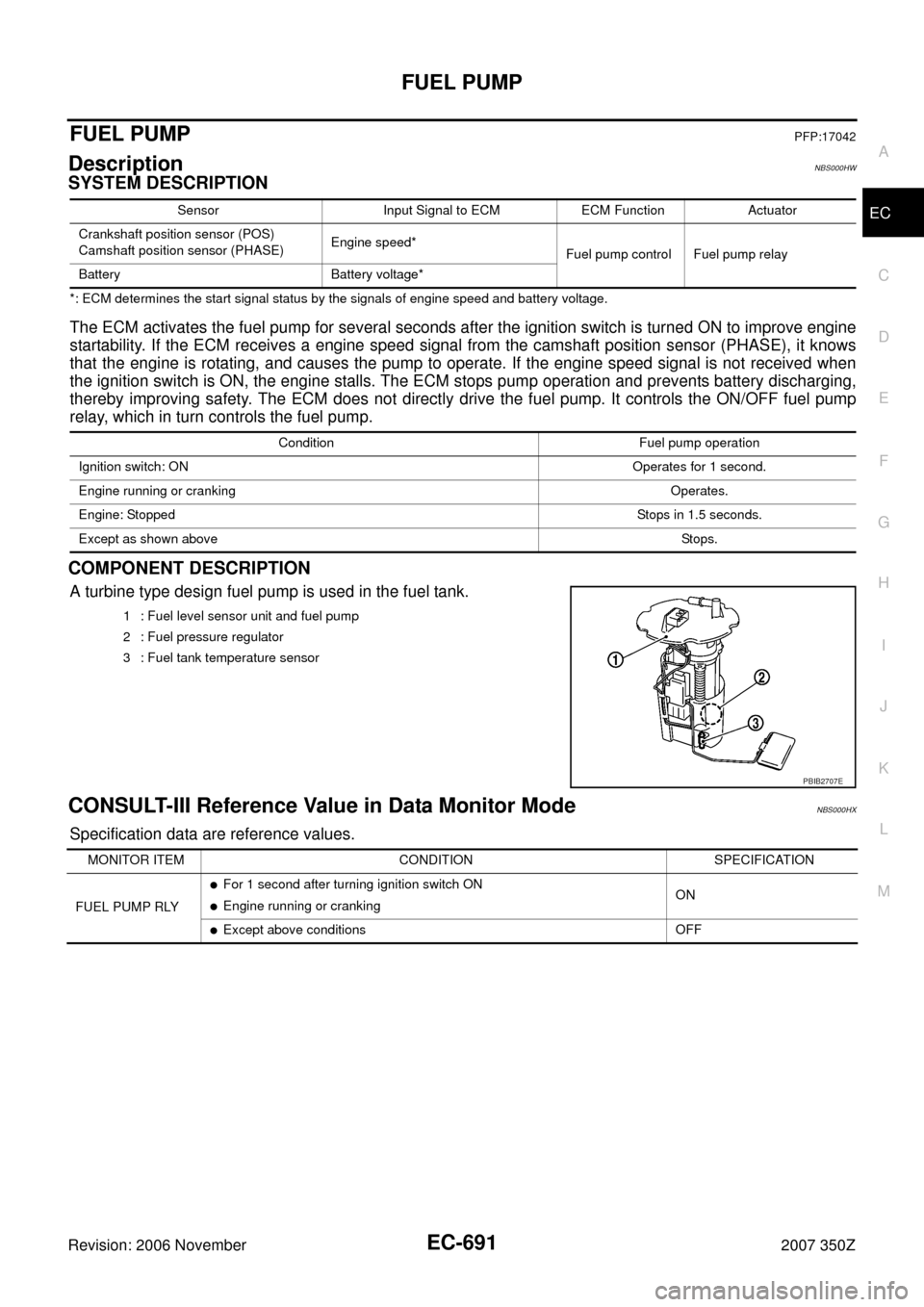
COMPONENT DESCRIPTION
A turbine type design fuel pump is used in the fuel tank.
CONSULT-III Reference Value in Data Monitor ModeNBS000HX
Specification data are reference values.
Sensor Input Signal to ECM ECM Function Actuator
Crankshaft position sensor (POS)
Camshaft position sensor (PHASE)Engine speed*
Fuel pump control Fuel pump relay
Battery Battery voltage*
Condition Fuel pump operation
Ignition switch: ONOperates for 1 second.
Engine running or crankingOperates.
Engine: StoppedStops in 1.5 seconds.
Except as shown aboveStops.
1 : Fuel level sensor unit and fuel pump
2 : Fuel pressure regulator
3 : Fuel tank temperature sensor
PBIB2707E
MONITOR ITEM CONDITION SPECIFICATION
FUEL PUMP RLY
�For 1 second after turning ignition switch ON
�Engine running or crankingON
�Except above conditions OFF
Page 693 of 720
FUEL PUMP
EC-693
C
D
E
F
G
H
I
J
K
L
MA
EC
Revision: 2006 November2007 350Z
Specification data are reference values and are measured between each terminal and ground.
CAUTION:
Do not use ECM ground terminals when measuring input/output voltage. Doing so may result in dam-
age to the ECM's transistor. Use a ground other than ECM terminals, such as the ground.
Diagnostic ProcedureNBS000HZ
1. CHECK OVERALL FUNCTION
1. Turn ignition switch ON.
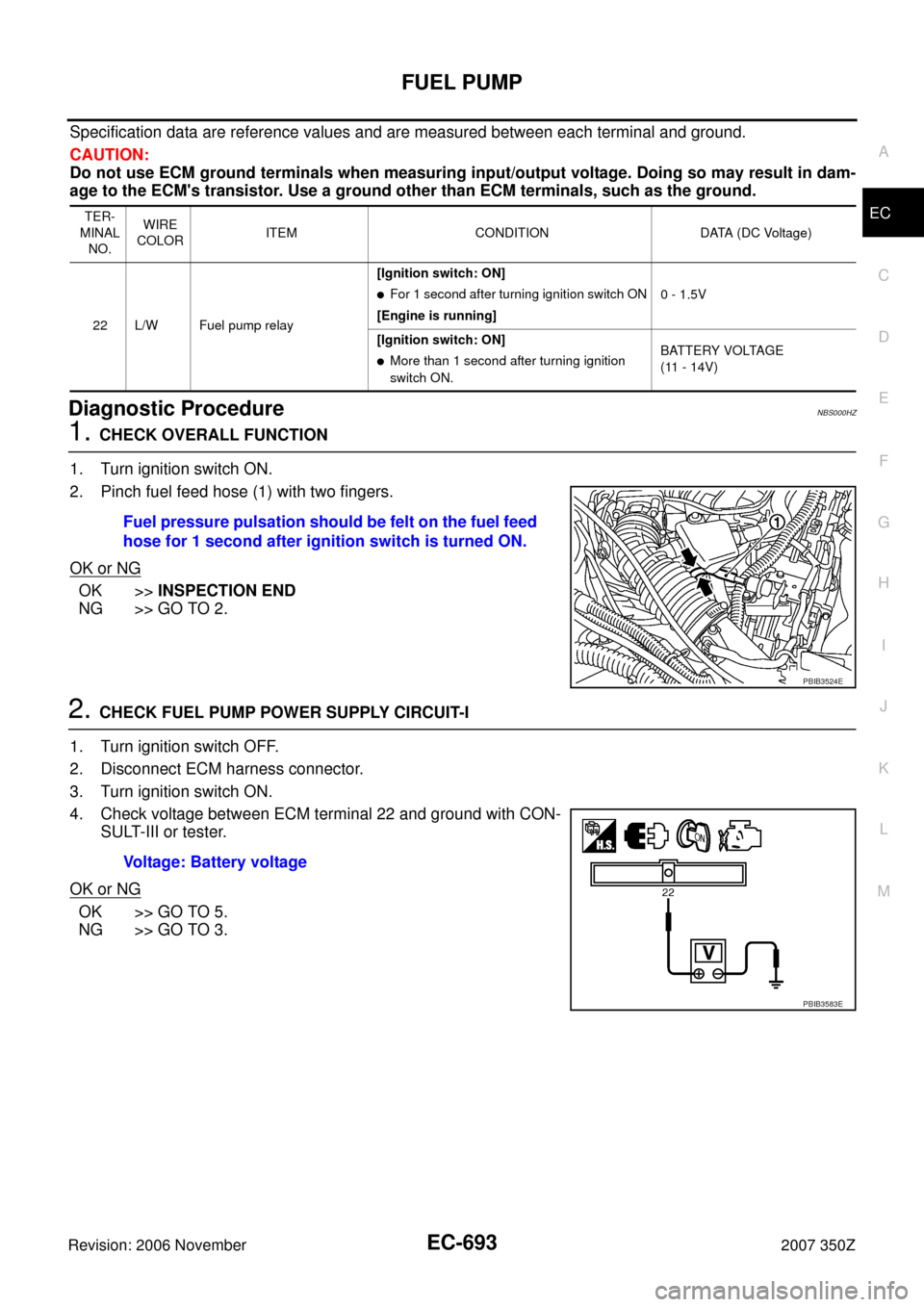
2. Pinch fuel feed hose (1) with two fingers.
OK or NG
OK >>INSPECTION END
NG >> GO TO 2.
2. CHECK FUEL PUMP POWER SUPPLY CIRCUIT-I
1. Turn ignition switch OFF.
2. Disconnect ECM harness connector.
3. Turn ignition switch ON.
4. Check voltage between ECM terminal 22 and ground with CON-
SULT-III or tester.
OK or NG
OK >> GO TO 5.
NG >> GO TO 3.
TER-
MINAL
NO.WIRE
COLORITEM CONDITION DATA (DC Voltage)
22 L/W Fuel pump relay[Ignition switch: ON]
�For 1 second after turning ignition switch ON
[Engine is running]0 - 1.5V
[Ignition switch: ON]
�More than 1 second after turning ignition
switch ON.BATTERY VOLTAGE
(11 - 14V)
Fuel pressure pulsation should be felt on the fuel feed
hose for 1 second after ignition switch is turned ON.
PBIB3524E
Voltage: Battery voltage
PBIB3583E
Page 709 of 720
IGNITION SIGNAL
EC-709
C
D
E
F
G
H
I
J
K
L
MA
EC
Revision: 2006 November2007 350Z
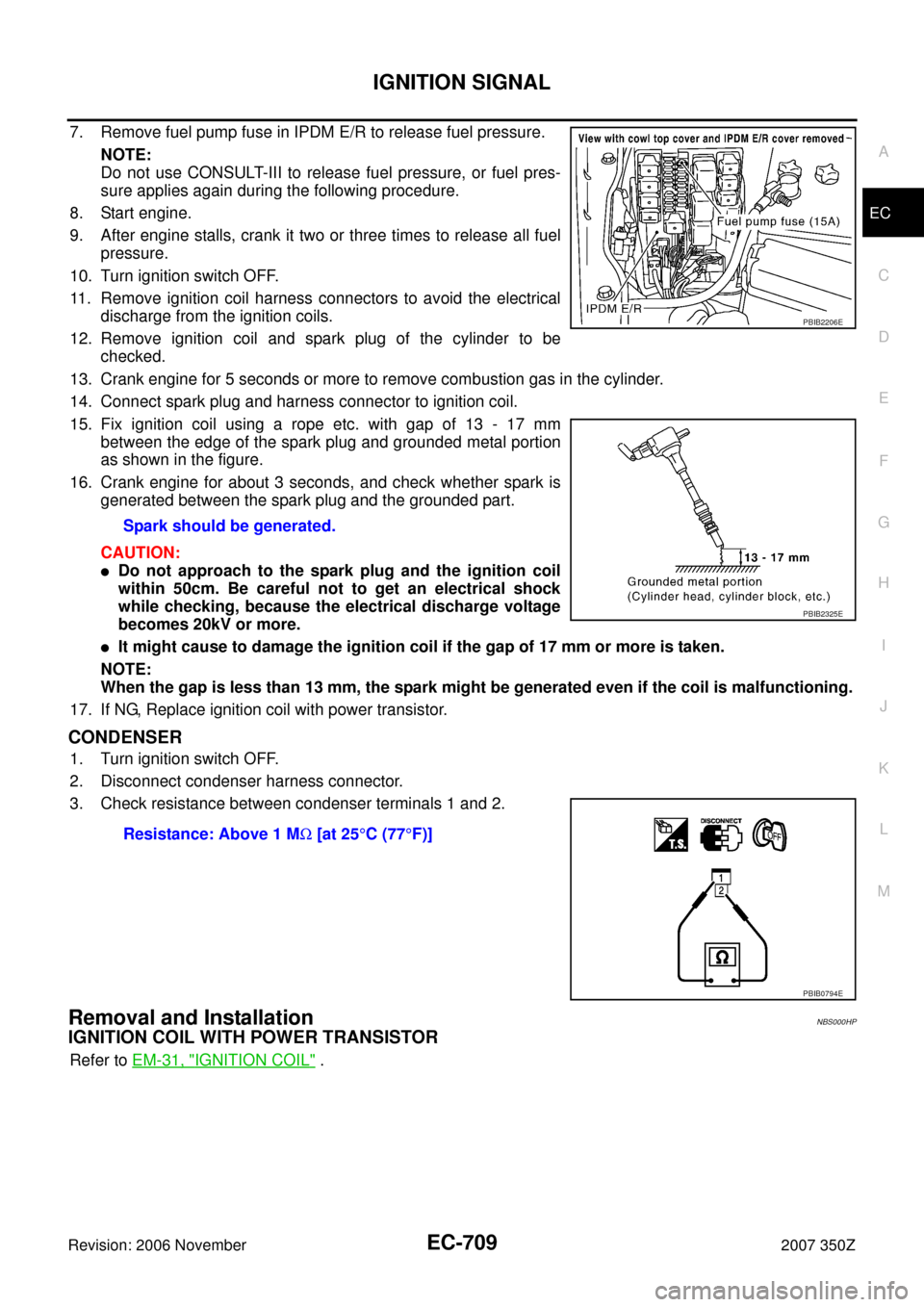
7. Remove fuel pump fuse in IPDM E/R to release fuel pressure.
NOTE:
Do not use CONSULT-III to release fuel pressure, or fuel pres-
sure applies again during the following procedure.
8. Start engine.
9. After engine stalls, crank it two or three times to release all fuel
pressure.
10. Turn ignition switch OFF.
11. Remove ignition coil harness connectors to avoid the electrical
discharge from the ignition coils.
12. Remove ignition coil and spark plug of the cylinder to be
checked.
13. Crank engine for 5 seconds or more to remove combustion gas in the cylinder.
14. Connect spark plug and harness connector to ignition coil.
15. Fix ignition coil using a rope etc. with gap of 13 - 17 mm
between the edge of the spark plug and grounded metal portion
as shown in the figure.
16. Crank engine for about 3 seconds, and check whether spark is
generated between the spark plug and the grounded part.
CAUTION:
�Do not approach to the spark plug and the ignition coil
within 50cm. Be careful not to get an electrical shock
while checking, because the electrical discharge voltage
becomes 20kV or more.
�It might cause to damage the ignition coil if the gap of 17 mm or more is taken.
NOTE:
When the gap is less than 13 mm, the spark might be generated even if the coil is malfunctioning.
17. If NG, Replace ignition coil with power transistor.
CONDENSER
1. Turn ignition switch OFF.
2. Disconnect condenser harness connector.
3. Check resistance between condenser terminals 1 and 2.
Removal and InstallationNBS000HP
IGNITION COIL WITH POWER TRANSISTOR
Refer to EM-31, "IGNITION COIL" . Spark should be generated.
PBIB2206E
PBIB2325E
Resistance: Above 1 MΩ [at 25°C (77°F)]
PBIB0794E
Page 718 of 720

EC-718
SERVICE DATA AND SPECIFICATIONS (SDS)
Revision: 2006 November2007 350Z
SERVICE DATA AND SPECIFICATIONS (SDS)PFP:00030
Fuel PressureNBS000IJ
Idle Speed and Ignition TimingNBS000IK
*: Under the following conditions:
�Air conditioner switch: OFF
�Electric load: OFF (Lights, heater fan & rear window defogger)
�Steering wheel: Kept in straight-ahead position
Calculated Load ValueNBS000IL
Mass Air Flow SensorNBS000IM
*: Engine is warmed up to normal operating temperature and running under no load.
Intake Air Temperature SensorNBS000IN
Engine Coolant Temperature SensorNBS000IO
Air Fuel Ratio (A/F) Sensor 1 HeaterNBS000IP
Heated Oxygen sensor 2 HeaterNBS000IQ
Crankshaft Position Sensor (POS)NBS000IR
Refer to EC-393, "Component Inspection" .
Camshaft Position Sensor (PHASE)NBS000IS
Refer to EC-405, "Component Inspection" .
Fuel pressure at idling kPa (kg/cm2 , psi)Approximately 350 (3.57, 51)
Target idle speedA/T No load* (in P or N position)
650 ± 50 rpm
M/T No load* (in Neutral position)
Air conditioner: ONA/T In P or N position 650 rpm or more
M/T In Neutral position 800 rpm or more
Ignition timingA/T In P or N position
15° ± 5° BTDC
M/T In Neutral position
Conditions Calculated load value % (Using CONSULT-III or GST)
At idle5 - 35
At 2,500 rpm5 - 35
Supply voltageBattery voltage (11 - 14V)
Output voltage at idle0.8 - 1.1V*
Mass air flow (Using CONSULT-III or GST)2.0 - 6.0 g·m/sec at idle*
7.0 - 20.0 g·m/sec at 2,500 rpm*
Temperature °C (°F) Resistance kΩ
25 (77)1.800 - 2.200
Temperature °C (°F) Resistance kΩ
20 (68)2.37 - 2.63
50 (122)0.68 - 1.00
90 (194)0.236 - 0.260
Resistance [at 25°C (77°F)] 1.8 - 2.44Ω
Resistance [at 25°C (77°F)] 3.4 - 4.4Ω