Page 71 of 720
BASIC SERVICE PROCEDURE
EC-71
C
D
E
F
G
H
I
J
K
L
MA
EC
Revision: 2006 November2007 350Z
BASIC SERVICE PROCEDUREPFP:00018
Basic InspectionNBS00034
1. INSPECTION START
1. Check service records for any recent repairs that may indicate a related malfunction, or a current need for
scheduled maintenance.
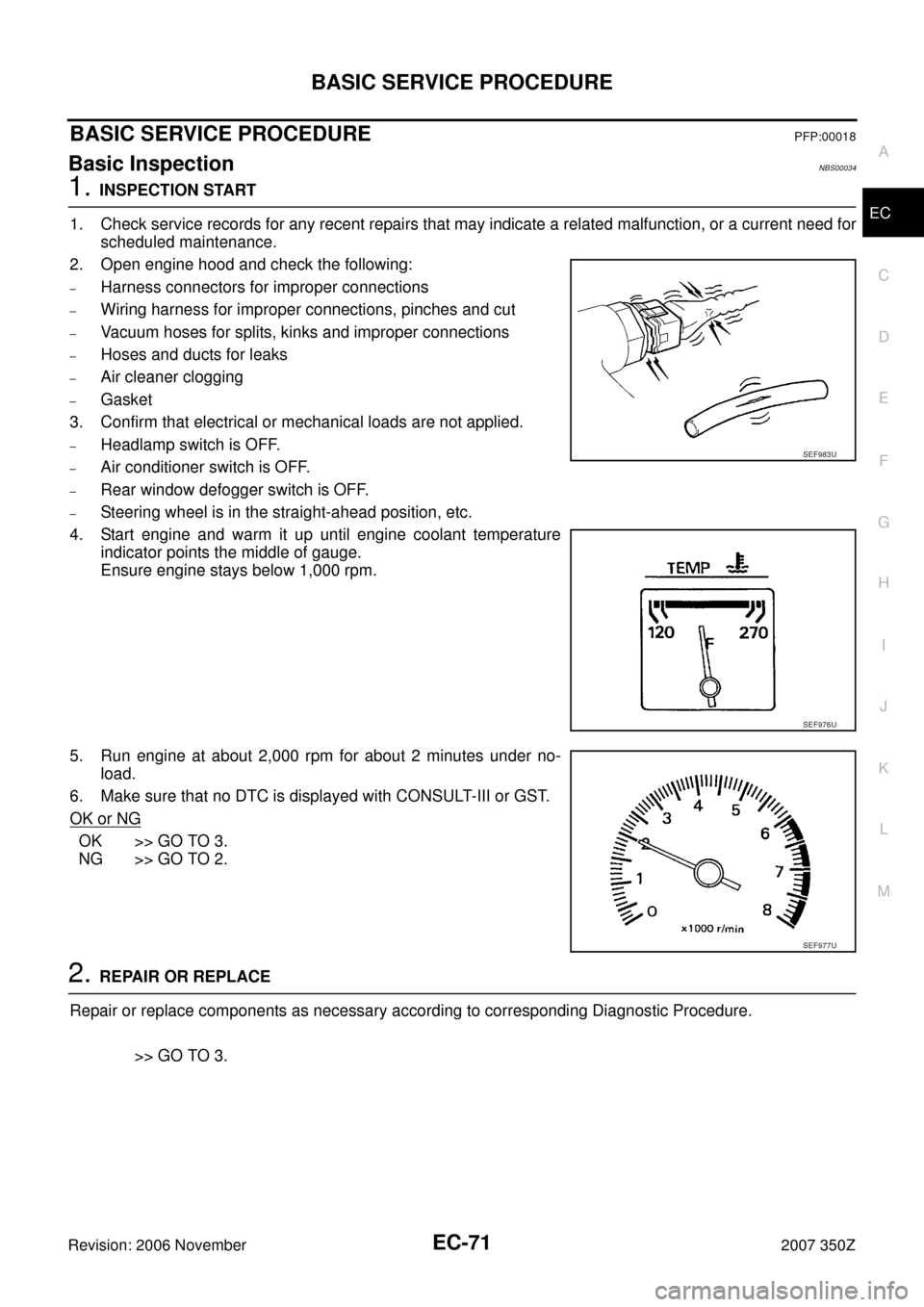
2. Open engine hood and check the following:
–Harness connectors for improper connections
–Wiring harness for improper connections, pinches and cut
–Vacuum hoses for splits, kinks and improper connections
–Hoses and ducts for leaks
–Air cleaner clogging
–Gasket
3. Confirm that electrical or mechanical loads are not applied.
–Headlamp switch is OFF.
–Air conditioner switch is OFF.
–Rear window defogger switch is OFF.
–Steering wheel is in the straight-ahead position, etc.
4. Start engine and warm it up until engine coolant temperature
indicator points the middle of gauge.
Ensure engine stays below 1,000 rpm.
5. Run engine at about 2,000 rpm for about 2 minutes under no-
load.
6. Make sure that no DTC is displayed with CONSULT-III or GST.
OK or NG
OK >> GO TO 3.
NG >> GO TO 2.
2. REPAIR OR REPLACE
Repair or replace components as necessary according to corresponding Diagnostic Procedure.
>> GO TO 3.
SEF983U
SEF976U
SEF977U
Page 81 of 720
TROUBLE DIAGNOSIS
EC-81
C
D
E
F
G
H
I
J
K
L
MA
EC
Revision: 2006 November2007 350Z
TROUBLE DIAGNOSISPFP:00004
Trouble Diagnosis IntroductionNBS0003D
INTRODUCTION
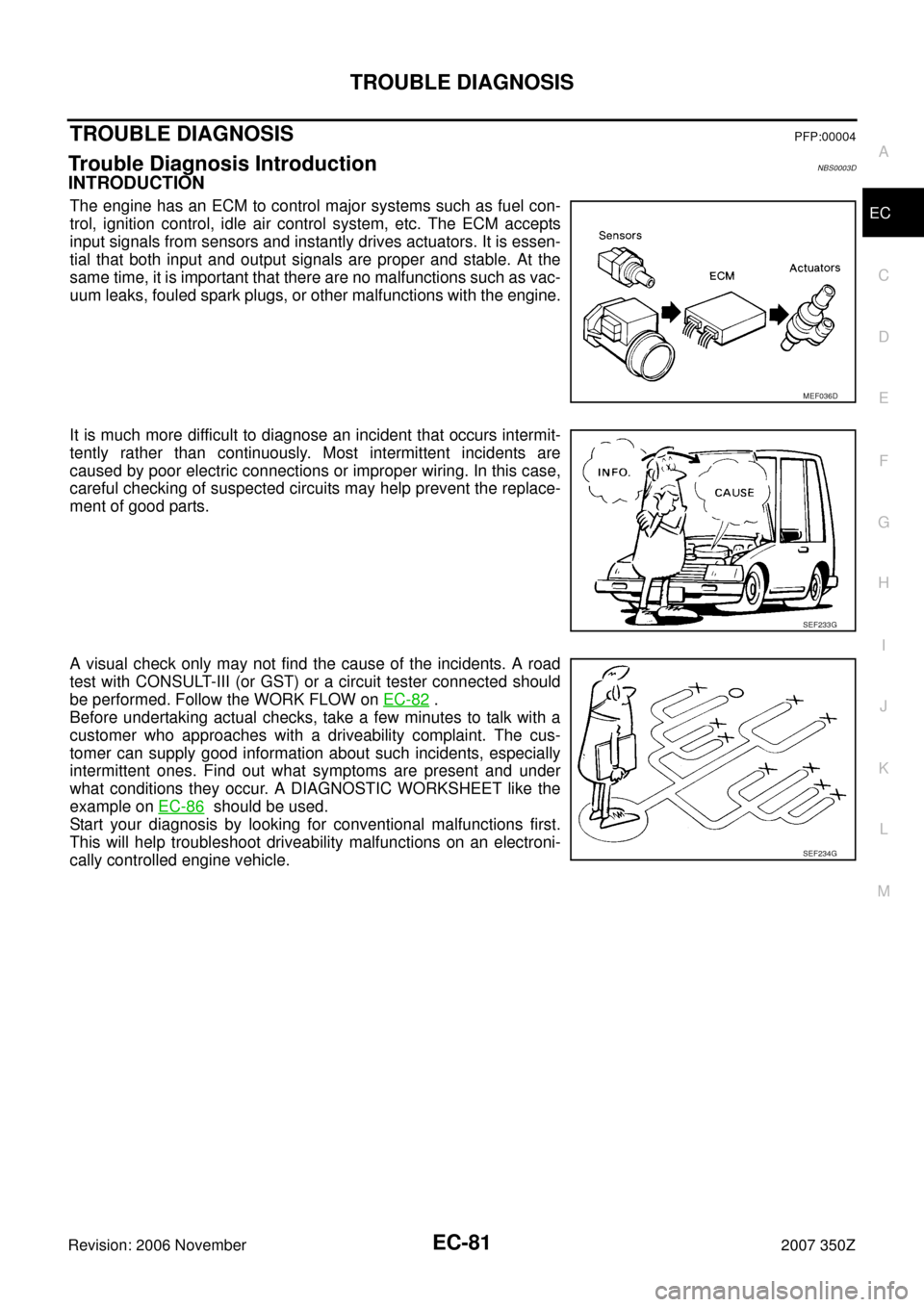
The engine has an ECM to control major systems such as fuel con-
trol, ignition control, idle air control system, etc. The ECM accepts
input signals from sensors and instantly drives actuators. It is essen-
tial that both input and output signals are proper and stable. At the
same time, it is important that there are no malfunctions such as vac-
uum leaks, fouled spark plugs, or other malfunctions with the engine.
It is much more difficult to diagnose an incident that occurs intermit-
tently rather than continuously. Most intermittent incidents are
caused by poor electric connections or improper wiring. In this case,
careful checking of suspected circuits may help prevent the replace-
ment of good parts.
A visual check only may not find the cause of the incidents. A road
test with CONSULT-III (or GST) or a circuit tester connected should
be performed. Follow the WORK FLOW on EC-82
.
Before undertaking actual checks, take a few minutes to talk with a
customer who approaches with a driveability complaint. The cus-
tomer can supply good information about such incidents, especially
intermittent ones. Find out what symptoms are present and under
what conditions they occur. A DIAGNOSTIC WORKSHEET like the
example on EC-86
should be used.
Start your diagnosis by looking for conventional malfunctions first.
This will help troubleshoot driveability malfunctions on an electroni-
cally controlled engine vehicle.
MEF036D
SEF233G
SEF234G
Page 142 of 720
EC-142
POWER SUPPLY AND GROUND CIRCUIT
Revision: 2006 November2007 350Z
POWER SUPPLY AND GROUND CIRCUITPFP:24110
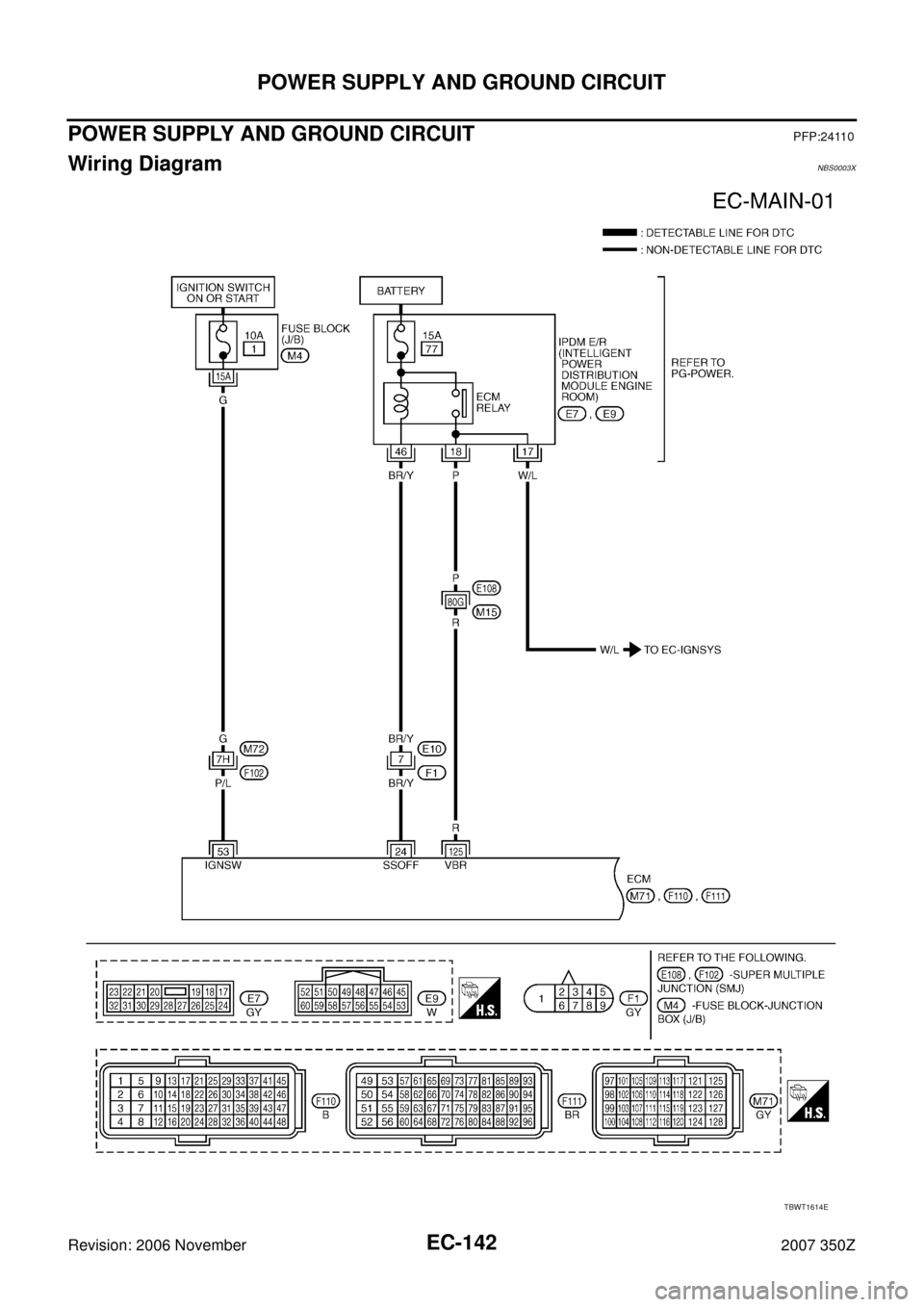
Wiring DiagramNBS0003X
TBWT1614E
Page 146 of 720
EC-146
POWER SUPPLY AND GROUND CIRCUIT
Revision: 2006 November2007 350Z
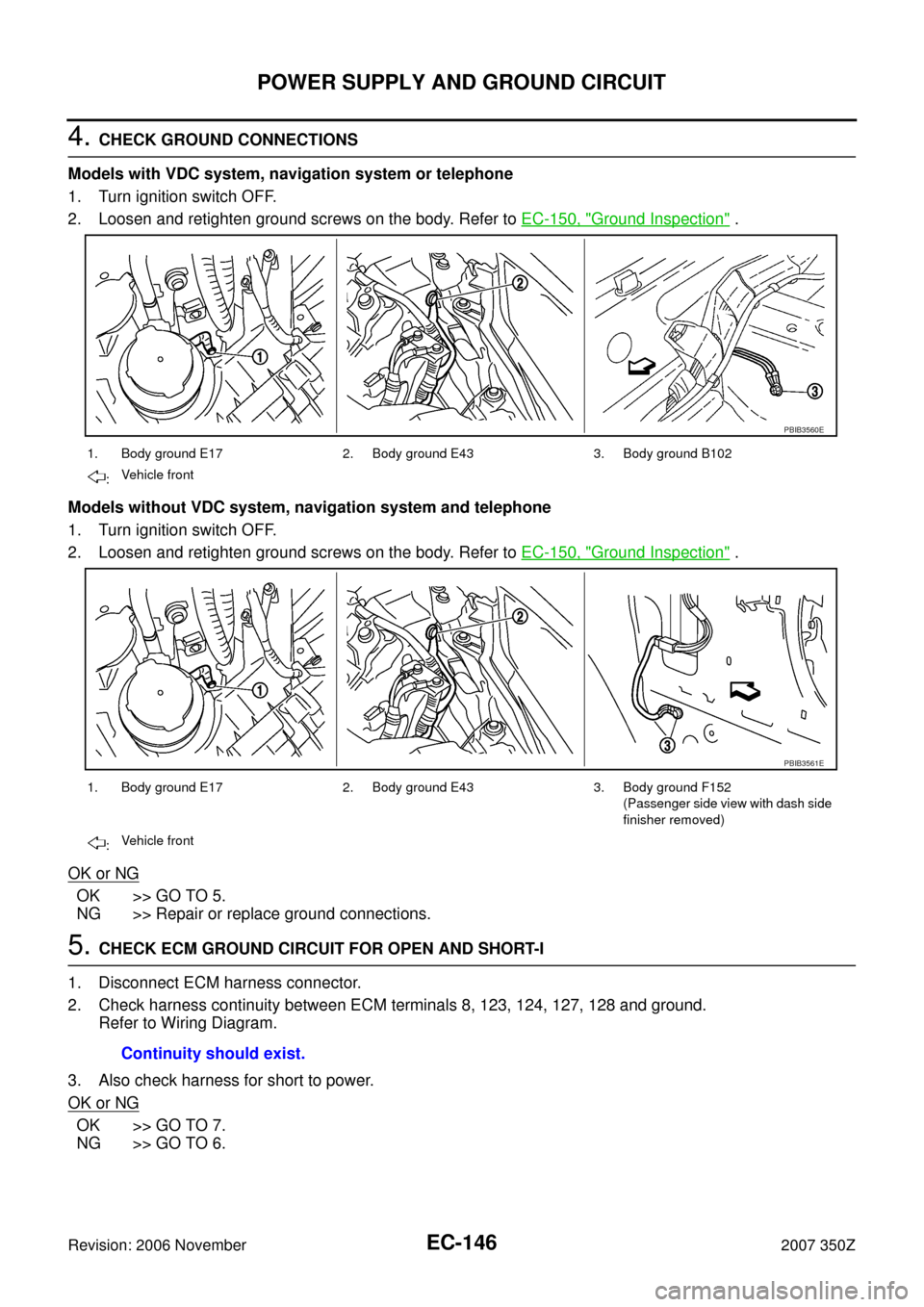
4. CHECK GROUND CONNECTIONS
Models with VDC system, navigation system or telephone
1. Turn ignition switch OFF.
2. Loosen and retighten ground screws on the body. Refer to EC-150, "
Ground Inspection" .
Models without VDC system, navigation system and telephone
1. Turn ignition switch OFF.
2. Loosen and retighten ground screws on the body. Refer to EC-150, "
Ground Inspection" .
OK or NG
OK >> GO TO 5.
NG >> Repair or replace ground connections.
5. CHECK ECM GROUND CIRCUIT FOR OPEN AND SHORT-I
1. Disconnect ECM harness connector.
2. Check harness continuity between ECM terminals 8, 123, 124, 127, 128 and ground.
Refer to Wiring Diagram.
3. Also check harness for short to power.
OK or NG
OK >> GO TO 7.
NG >> GO TO 6.
1. Body ground E17 2. Body ground E43 3. Body ground B102
:Vehicle front
1. Body ground E17 2. Body ground E43 3. Body ground F152
(Passenger side view with dash side
finisher removed)
:Vehicle front
PBIB3560E
PBIB3561E
Continuity should exist.
Page 148 of 720

EC-148
POWER SUPPLY AND GROUND CIRCUIT
Revision: 2006 November2007 350Z
10. CHECK ECM POWER SUPPLY CIRCUIT-V
1. Disconnect ECM harness connector.
2. Disconnect IPDM E/R harness connector E7.
3. Check harness continuity between ECM terminals 125 and IPDM E/R terminal 18.
Refer to Wiring Diagram.
4. Also check harness for short to ground and short to power.
OK or NG
OK >> GO TO 18.
NG >> GO TO 11.
11 . DETECT MALFUNCTIONING PART
Check the following.
�Harness or connectors E108, M15
�Harness for open or short between ECM and IPDM E/R
>> Repair open circuit or short to ground or short to power in harness or connectors.
12. CHECK ECM POWER SUPPLY CIRCUIT-VI
1. Disconnect IPDM E/R harness connector E9.
2. Check harness continuity between ECM terminal 24 and IPDM E/R terminal 46.
Refer to Wiring Diagram.
3. Also check harness for short to ground and short to power.
OK or NG
OK >> GO TO 14.
NG >> GO TO 13.
13. DETECT MALFUNCTIONING PART
Check the following.
�Harness or connectors E10, F1
�Harness for open or short between ECM and IPDM E/R
>> Repair open circuit or short to ground or short to power in harness or connectors.
14. CHECK 15A FUSE
1. Disconnect 15A fuse from IPDM E/R.
2. Check 15A fuse.
OK or NG
OK >> GO TO 18.
NG >> Replace 15A fuse.Continuity should exist.
Continuity should exist.
Page 149 of 720
POWER SUPPLY AND GROUND CIRCUIT
EC-149
C
D
E
F
G
H
I
J
K
L
MA
EC
Revision: 2006 November2007 350Z
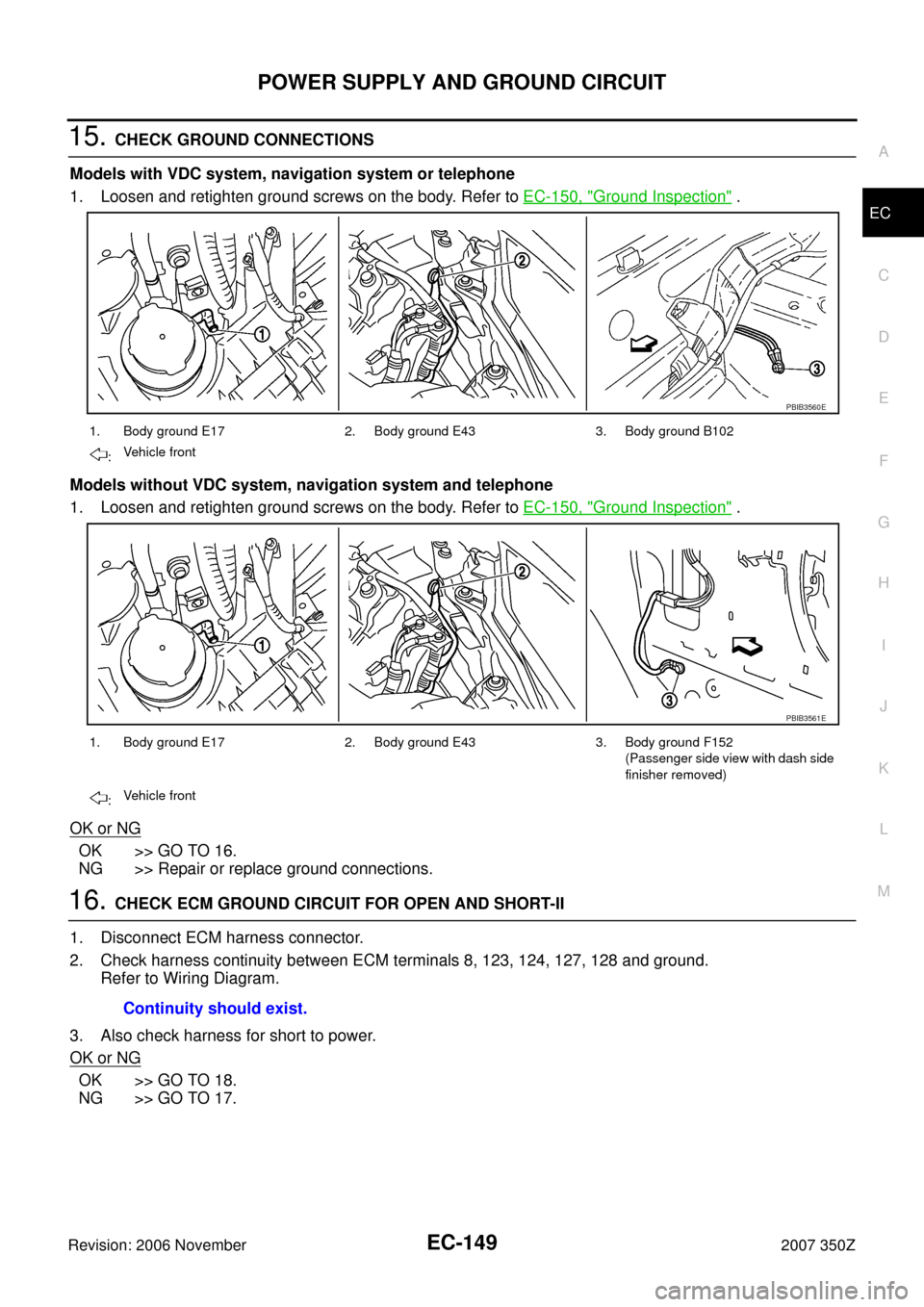
15. CHECK GROUND CONNECTIONS
Models with VDC system, navigation system or telephone
1. Loosen and retighten ground screws on the body. Refer to EC-150, "
Ground Inspection" .
Models without VDC system, navigation system and telephone
1. Loosen and retighten ground screws on the body. Refer to EC-150, "
Ground Inspection" .
OK or NG
OK >> GO TO 16.
NG >> Repair or replace ground connections.
16. CHECK ECM GROUND CIRCUIT FOR OPEN AND SHORT-II
1. Disconnect ECM harness connector.
2. Check harness continuity between ECM terminals 8, 123, 124, 127, 128 and ground.
Refer to Wiring Diagram.
3. Also check harness for short to power.
OK or NG
OK >> GO TO 18.
NG >> GO TO 17.
1. Body ground E17 2. Body ground E43 3. Body ground B102
:Vehicle front
1. Body ground E17 2. Body ground E43 3. Body ground F152
(Passenger side view with dash side
finisher removed)
:Vehicle front
PBIB3560E
PBIB3561E
Continuity should exist.
Page 151 of 720
DTC U1000, U1001 CAN COMMUNICATION LINE
EC-151
C
D
E
F
G
H
I
J
K
L
MA
EC
Revision: 2006 November2007 350Z
DTC U1000, U1001 CAN COMMUNICATION LINEPFP:23710
DescriptionNBS00040
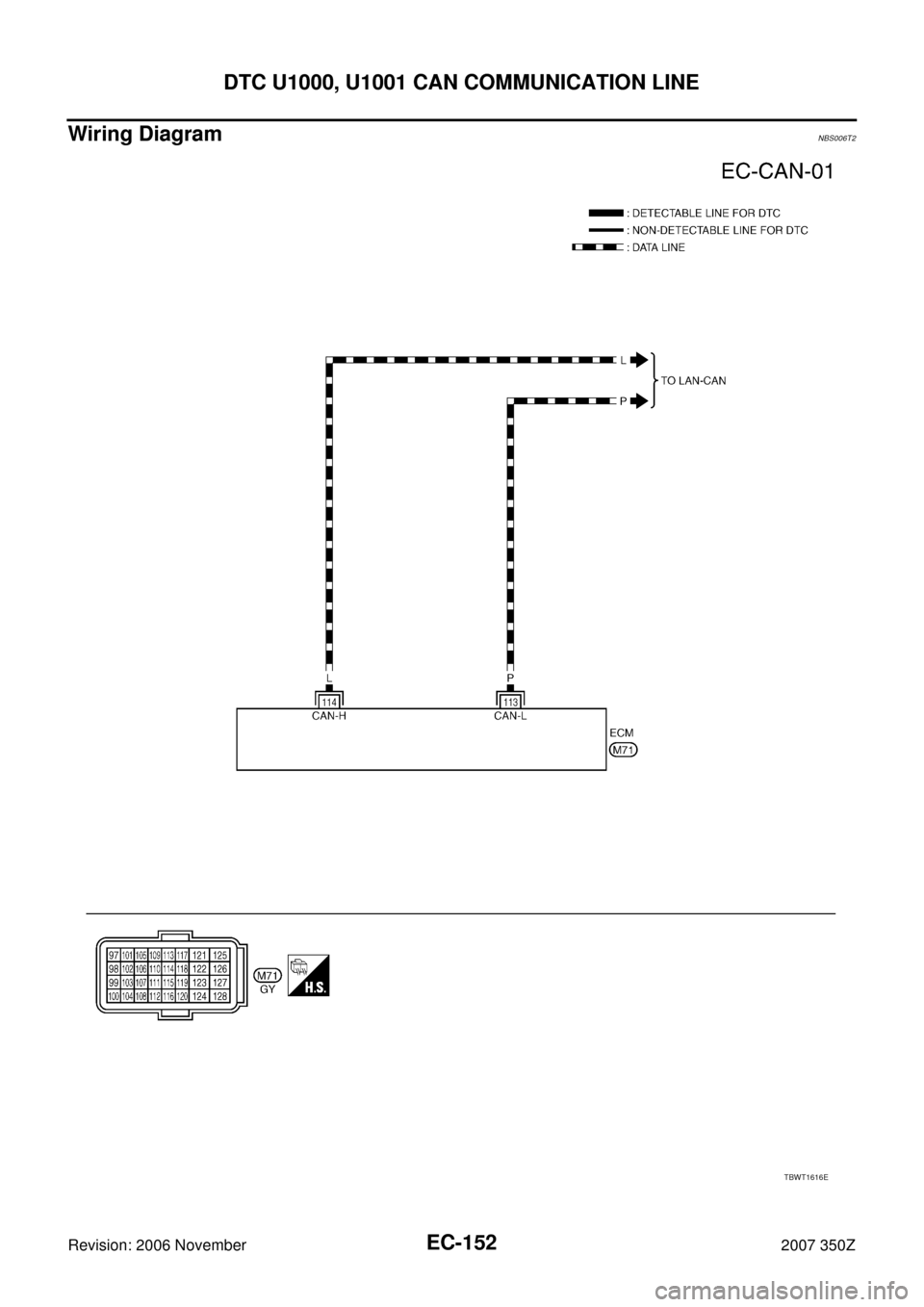
CAN (Controller Area Network) is a serial communication line for real time application. It is an on-vehicle mul-
tiplex communication line with high data communication speed and excellent error detection ability. Many elec-
tronic control units are equipped onto a vehicle, and each control unit shares information and links with other
control units during operation (not independent). In CAN communication, control units are connected with 2
communication lines (CAN H line, CAN L line) allowing a high rate of information transmission with less wiring.
Each control unit transmits/receives data but selectively reads required data only.
On Board Diagnosis LogicNBS006T0
*1: This self-diagnosis has the one trip detection logic.
*2: The MIL will not light up for this self-diagnosis.
DTC Confirmation ProcedureNBS006T1
1. Turn ignition switch ON and wait at least 3 seconds.
2. Check 1st trip DTC.
3. If 1st trip DTC is detected, go to EC-153, "
Diagnostic Procedure" .
DTC No.Trouble diagnosis
nameDTC detecting condition Possible cause
U1000*
1
1000*1
CAN communication
line
�When ECM is not transmitting or receiving
CAN communication signal of OBD (emission-
related diagnosis) for 2 seconds or more.
�Harness or connectors
(CAN communication line is open or
shorted)
U1001*
2
1001*2
�When ECM is not transmitting or receiving
CAN communication signal other than OBD
(emission-related diagnosis) for 2 seconds or
more.
Page 152 of 720
EC-152
DTC U1000, U1001 CAN COMMUNICATION LINE
Revision: 2006 November2007 350Z
Wiring DiagramNBS006T2
TBWT1616E