Page 691 of 1449

ENGINE COOLING -Special Tools/Troubleshooting14-3
SPECIAL TOOLS
ToolNumberNameUse
A
B
C
DMB991223
A: MB991219
B: MB991220
C: MB991221
D: MB991222Harness set
A: Test harness
B: LED harness
C: LED harness
adapter
D: ProbeDMeasurement of terminal voltage
DInspection of radiator fan controller
A: Connector pin contact pressure
inspection
B: Power circuit inspection
C: Power circuit inspection
D: Commercial tester connection
MB991658Test harnessInspection of radiator fan controller
APS
MB991791Throttle cotrollerInspection of radiator fan controller
[Use the accelerator pedal position sensor
disconnected from harness.]
TROUBLESHOOTING
INSPECTION CHART FOR TROUBLE SYMPTOMS
Trouble symptomsInspection procedure
No.Reference page
Radiator fan does not operate.114-3
Radiator fan does not change speed or stop.214-5
INSPECTION PROCEDURE FOR TROUBLE SYMPTOMS
Inspection Procedure 1
Radiator fan does not operate.
Probable cause
Failure may occur on the power supply of the radiator fan controller and the
earth circuit.
Failure may also occur on the radiator fan controller and engine-ECU.DMalfunction of fusible link
DMalfunction of radiator fan relay
DMalfunction of radiator fan controller
DMalfunction of radiator fan motor
DMalfunction of engine-ECU
DMalfunction of harness, connector
Page 696 of 1449
ENGINE COOLING -On-vehicle Service14-8
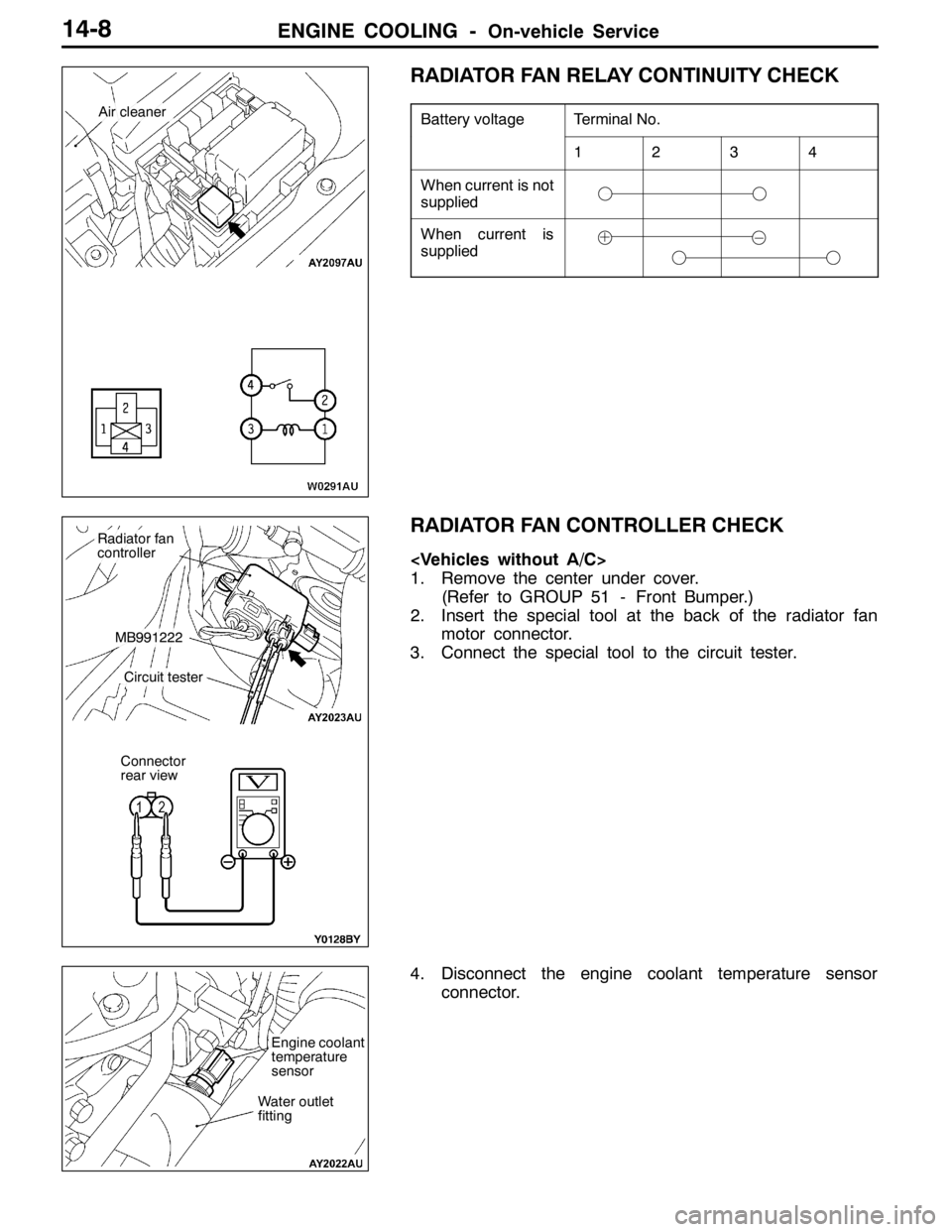
RADIATOR FAN RELAY CONTINUITY CHECK
Battery voltageTerminal No.
1234
When current is not
supplied
When current is
supplied
RADIATOR FAN CONTROLLER CHECK
1. Remove the center under cover.
(Refer to GROUP 51 - Front Bumper.)
2. Insert the special tool at the back of the radiator fan
motor connector.
3. Connect the special tool to the circuit tester.
4. Disconnect the engine coolant temperature sensor
connector.
Air cleaner
Radiator fan
controller
MB991222
Circuit tester
Connector
rear view
Water outlet
fitting
Engine coolant
temperature
sensor
Page 697 of 1449
![MITSUBISHI LANCER EVOLUTION 2007 Service Repair Manual ENGINE COOLING -On-vehicle Service14-9
5. Connect the special tool (MB991658) to the harness side
of the engine coolant temperature sensor connector.
6. Connect the special tool [MB991791(APS)] to the](/manual-img/19/57084/w960_57084-696.png "MITSUBISHI LANCER EVOLUTION 2007 Service Repair Manual ENGINE COOLING -On-vehicle Service14-9
5. Connect the special tool (MB991658) to the harness side
of the engine coolant temperature sensor connector.
6. Connect the special tool [MB991791(APS)] to the")
ENGINE COOLING -On-vehicle Service14-9
5. Connect the special tool (MB991658) to the harness side
of the engine coolant temperature sensor connector.
6. Connect the special tool [MB991791(APS)] to the special
tool (MB991658).
7. Start the engine and let it run at idle.
NOTE
Since the resistance value of the special tool (APS)
indicates a low engine coolant temperature, engine speed
increases.
8. When the lever of the special tool (APS) is turned to
the end, check that the engine speed decreases and
the radiator fan motor rotates.
9. When the lever of the special tool (APS) is turned to
the reverse direction, check that the voltage between
terminals of the radiator fan motor connector gradually
decreases from the battery voltage to 0 V.
10. If inoperable, replace the radiator fan controller.
(Refer to P.14-15.)
11. Install the center under cover.
(Refer to GROUP 51 - Front Bumper.)
12. Connect the engine coolant temperature sensor
connector.
1. Remove the center under cover.
(Refer to GROUP 51 - Front Bumper.)
2. Insert the special tool at the back of the radiator fan
motor connector.
3. Connect the special tool to the circuit tester.
4. Start the engine and run it at idle.
5. Turn the A/C switch to the ON position and hold the
engine coolant temperature at 80_C or lower.
6. When the voltage between the terminals of the radiator
fan motor connector, the following values of (1) - (3)
can be detected at random.
(1) 0 V
(2) 8.22.6 V
(3) Battery voltage2.6 V
7. If inoperable, replace the radiator fan controller.
(Refer to P.14-15.)
8. Install the center under cover.
(Refer to GROUP 51 - Front Bumper.)
Engine coolant
temperature sensor
connector
(harness side)
MB991791(APS)
MB991658
MB991658Lever
MB991791(APS)
Radiator fan
controller
MB991222
Circuit tester
Connector
rear view
Page 702 of 1449
ENGINE COOLING -Water Hose and Water Pipe14-14
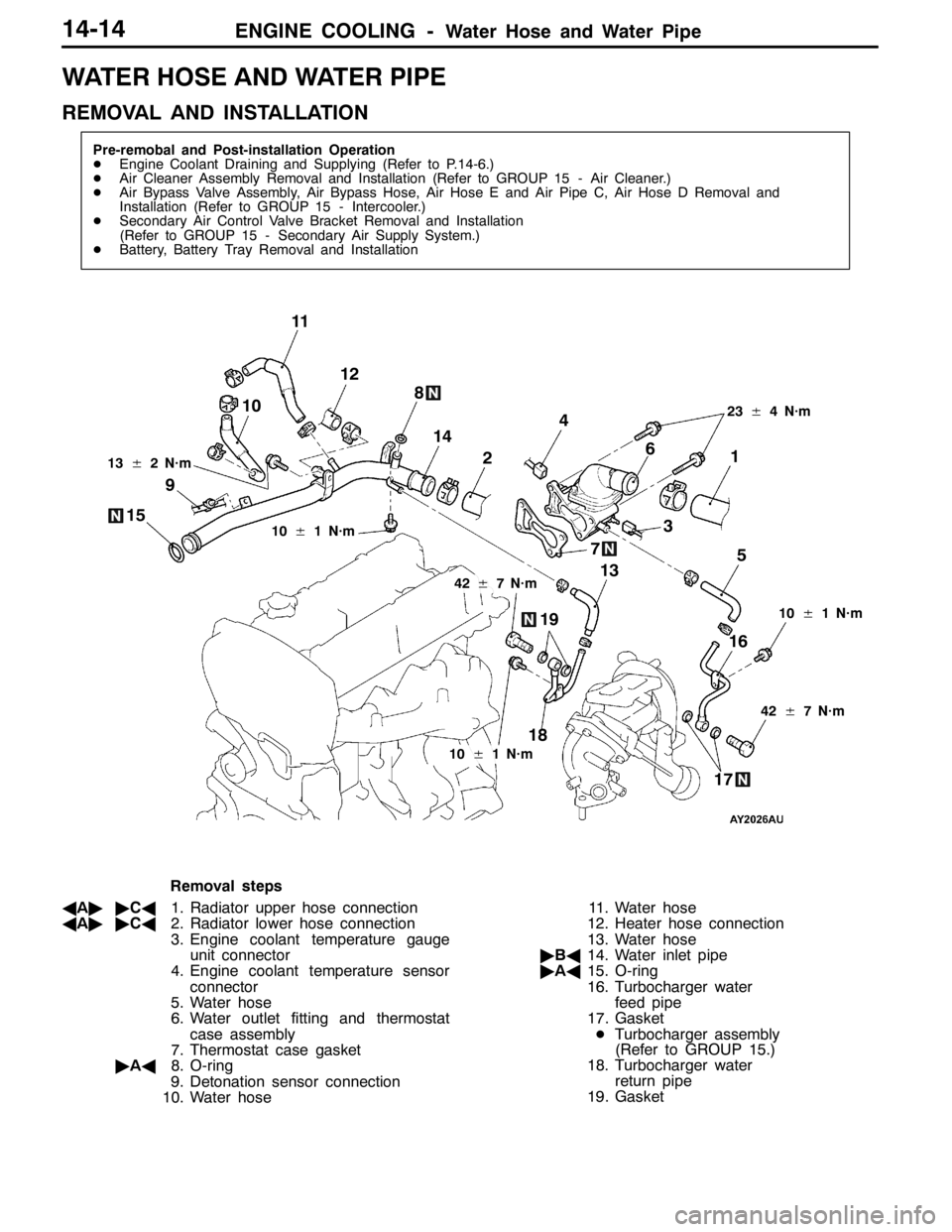
WATER HOSE AND WATER PIPE
REMOVAL AND INSTALLATION
Pre-remobal and Post-installation Operation
DEngine Coolant Draining and Supplying (Refer to P.14-6.)
DAir Cleaner Assembly Removal and Installation (Refer to GROUP 15 - Air Cleaner.)
DAir Bypass Valve Assembly, Air Bypass Hose, Air Hose E and Air Pipe C, Air Hose D Removal and
Installation (Refer to GROUP 15 - Intercooler.)
DSecondary Air Control Valve Bracket Removal and Installation
(Refer to GROUP 15 - Secondary Air Supply System.)
DBattery, Battery Tray Removal and Installation
3 4
5 6
7 8
9
1012
10±1 N·m
42±7 N·m 13±2 N·m
11
1
2
23±4 N·m
18
1716 1514
13
19
10±1 N·m
42±7 N·m
10±1 N·m
Removal steps
AA""CA1. Radiator upper hose connection
AA""CA2. Radiator lower hose connection
3. Engine coolant temperature gauge
unit connector
4. Engine coolant temperature sensor
connector
5. Water hose
6. Water outlet fitting and thermostat
case assembly
7. Thermostat case gasket
"AA8. O-ring
9. Detonation sensor connection
10. Water hose11. Water hose
12. Heater hose connection
13. Water hose
"BA14. Water inlet pipe
"AA15. O-ring
16. Turbocharger water
feed pipe
17. Gasket
DTurbocharger assembly
(Refer to GROUP 15.)
18. Turbocharger water
return pipe
19. Gasket
Page 709 of 1449
INTAKE AND EXHAUST -Service Specifications/Special Tool/On-vehicle Service15-3
SERVICE SPECIFICATIONS
ItemStandard valueLimit
Turbocharger supercharging pressure (waste gate solenoid
valve not operating) kPa59 - 84-
Initial activation pressure of waste gate actuator (at the stroke
of approximately 1 mm) kPaApproximately 100-
Waste gate solenoid valve coil resistance (at 20_C)Ω29 - 35-
Initial activation pressure of air bypass valve kPaApproximately 53-
Secondary air control solenoid valve coil resistance
(at 20_C)Ω29 - 35-
Manifold distortion of the installation surface mm0.15 or less0.20
SPECIAL TOOL
ToolNumberNameUse
MD998770Oxygen sensor wrenchRemoval and installation of oxygen sensor
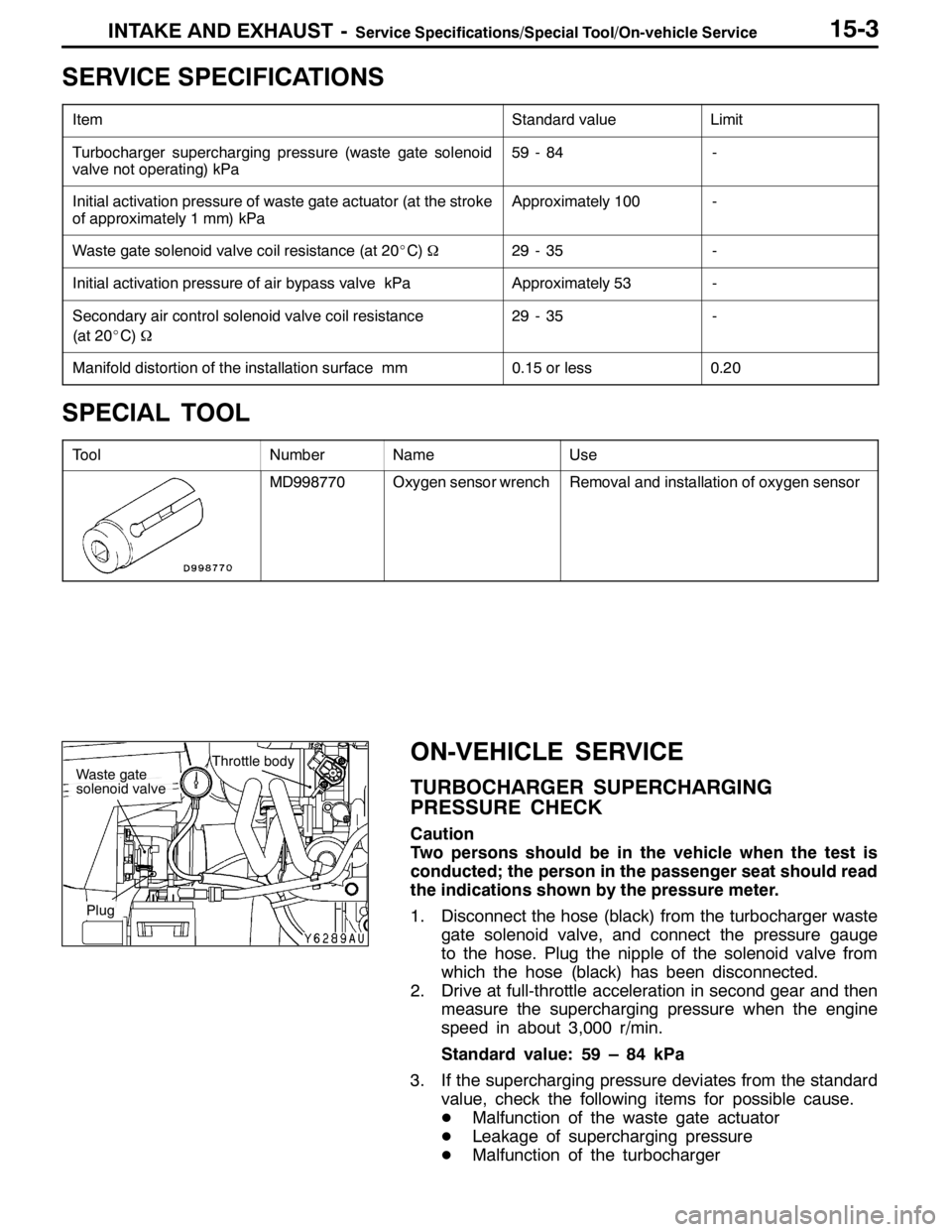
ON-VEHICLE SERVICE
TURBOCHARGER SUPERCHARGING
PRESSURE CHECK
Caution
Two persons should be in the vehicle when the test is
conducted; the person in the passenger seat should read
the indications shown by the pressure meter.
1. Disconnect the hose (black) from the turbocharger waste
gate solenoid valve, and connect the pressure gauge
to the hose. Plug the nipple of the solenoid valve from
which the hose (black) has been disconnected.
2. Drive at full-throttle acceleration in second gear and then
measure the supercharging pressure when the engine
speed in about 3,000 r/min.
Standard value: 59 – 84 kPa
3. If the supercharging pressure deviates from the standard
value, check the following items for possible cause.
DMalfunction of the waste gate actuator
DLeakage of supercharging pressure
DMalfunction of the turbocharger
Throttle bodyWaste gate
solenoid valve
Plug
Page 714 of 1449
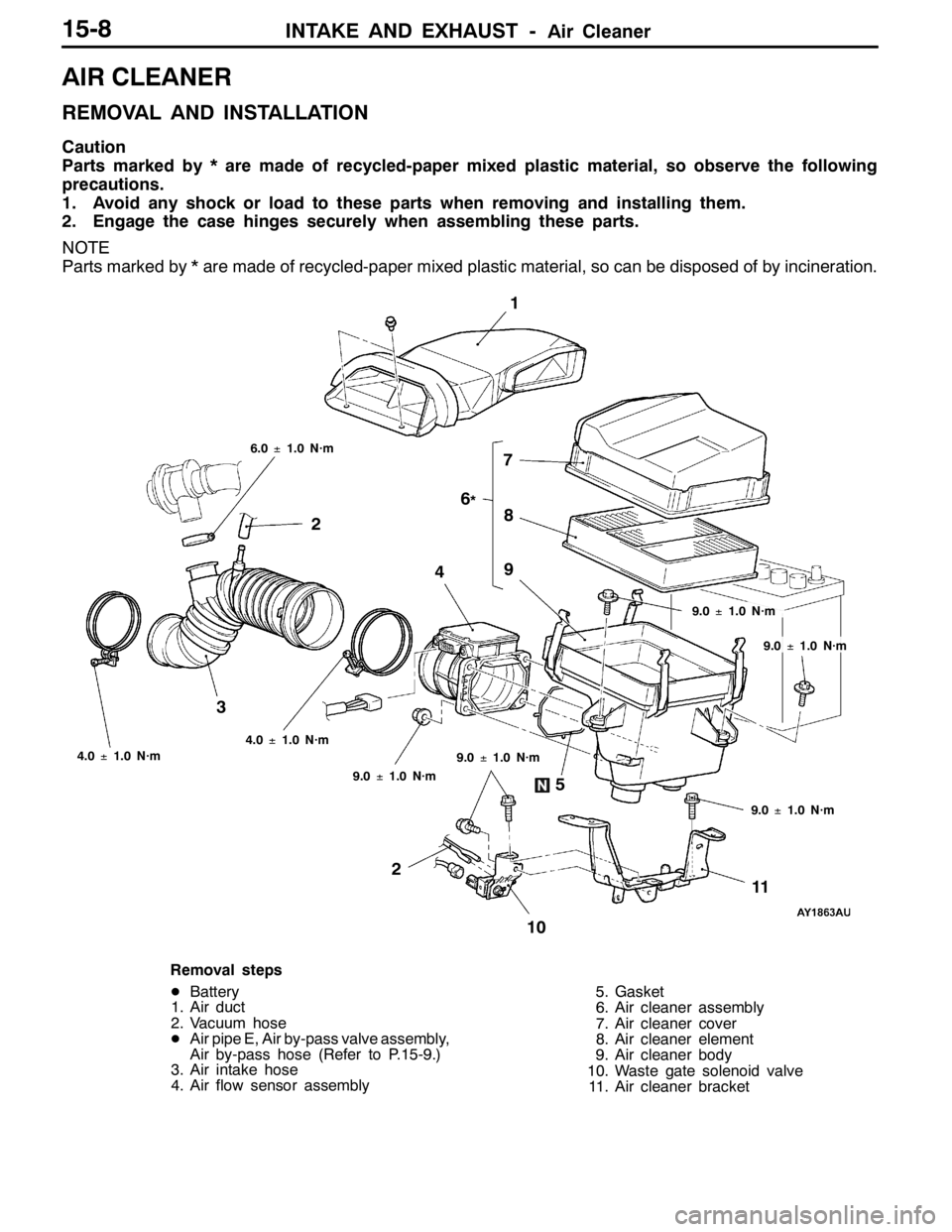
INTAKE AND EXHAUST -Air Cleaner15-8
AIR CLEANER
REMOVAL AND INSTALLATION
Caution
Parts marked by * are made of recycled-paper mixed plastic material, so observe the following
precautions.
1. Avoid any shock or load to these parts when removing and installing them.
2. Engage the case hinges securely when assembling these parts.
NOTE
Parts marked by * are made of recycled-paper mixed plastic material, so can be disposed of by incineration.
1
6
*
37
28
5 4
9.0±1.0 N·m 6.0±1.0 N·m
9.0±1.0 N·m
9.0±1.0 N·m 4.0±1.0 N·m
4.0±1.0 N·m
9.0±1.0 N·m
2
9
1011
9.0±1.0 N·m
Removal steps
DBattery
1. Air duct
2. Vacuum hose
DAir pipe E, Air by-pass valve assembly,
Air by-pass hose (Refer to P.15-9.)
3. Air intake hose
4. Air flow sensor assembly5. Gasket
6. Air cleaner assembly
7. Air cleaner cover
8. Air cleaner element
9. Air cleaner body
10. Waste gate solenoid valve
11. Air cleaner bracket
Page 722 of 1449
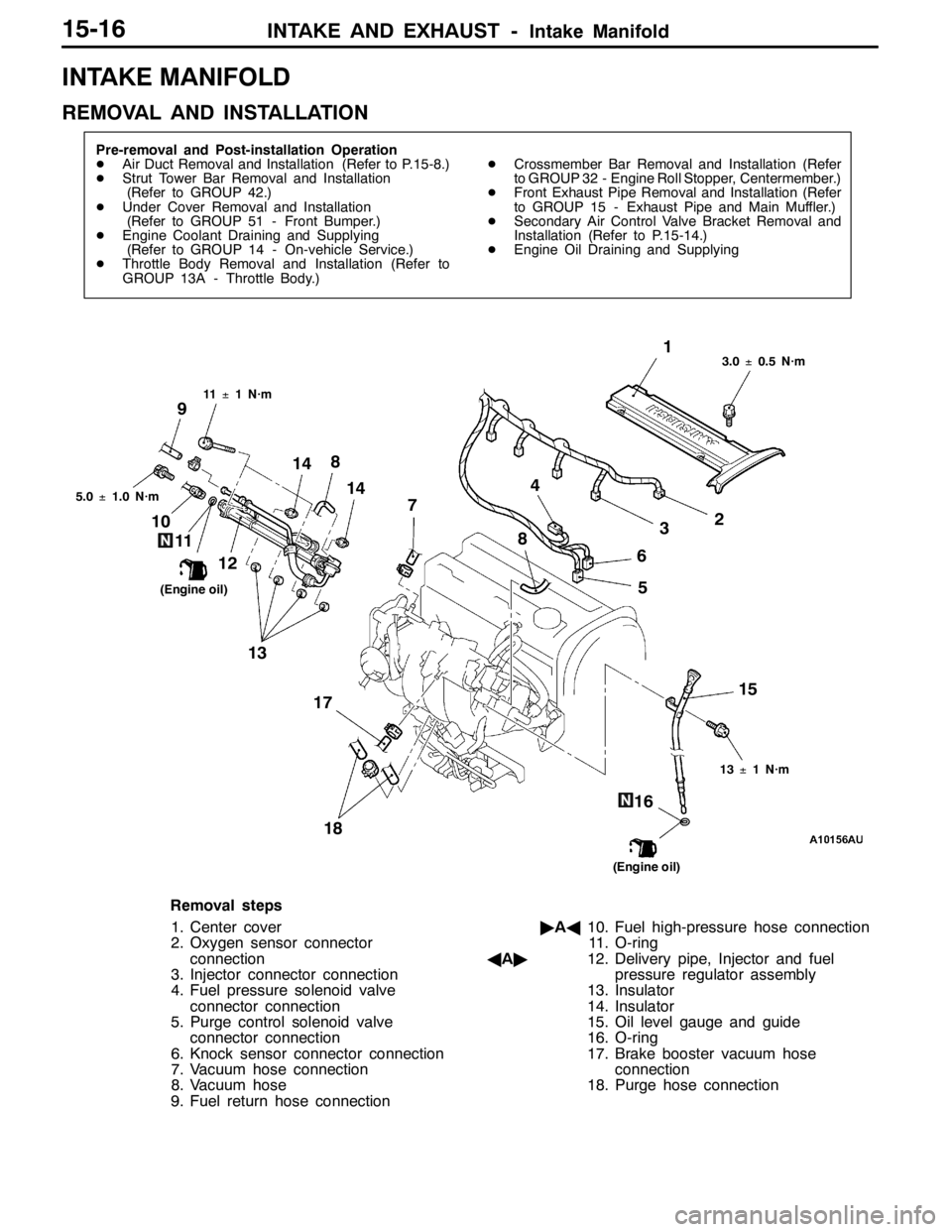
INTAKE AND EXHAUST -Intake Manifold15-16
INTAKE MANIFOLD
REMOVAL AND INSTALLATION
Pre-removal and Post-installation Operation
DAir Duct Removal and Installation (Refer to P.15-8.)
DStrut Tower Bar Removal and Installation
(Refer to GROUP 42.)
DUnder Cover Removal and Installation
(Refer to GROUP 51 - Front Bumper.)
DEngine Coolant Draining and Supplying
(Refer to GROUP 14 - On-vehicle Service.)
DThrottle Body Removal and Installation (Refer to
GROUP 13A - Throttle Body.)DCrossmember Bar Removal and Installation (Refer
to GROUP 32 - Engine Roll Stopper, Centermember.)
DFront Exhaust Pipe Removal and Installation (Refer
to GROUP 15 - Exhaust Pipe and Main Muffler.)
DSecondary Air Control Valve Bracket Removal and
Installation (Refer to P.15-14.)
DEngine Oil Draining and Supplying
1
2
3 4
5 6 7
8 10
11
1214
13
15
16 17
18
9
11±1 N·m3.0±0.5 N·m
13±1 N·m
(Engine oil)
(Engine oil) 5.0±1.0 N·m
14 8
Removal steps
1. Center cover
2. Oxygen sensor connector
connection
3. Injector connector connection
4. Fuel pressure solenoid valve
connector connection
5. Purge control solenoid valve
connector connection
6. Knock sensor connector connection
7. Vacuum hose connection
8. Vacuum hose
9. Fuel return hose connection"AA10. Fuel high-pressure hose connection
11. O-ring
AA"12. Delivery pipe, Injector and fuel
pressure regulator assembly
13. Insulator
14. Insulator
15. Oil level gauge and guide
16. O-ring
17. Brake booster vacuum hose
connection
18. Purge hose connection
Page 725 of 1449
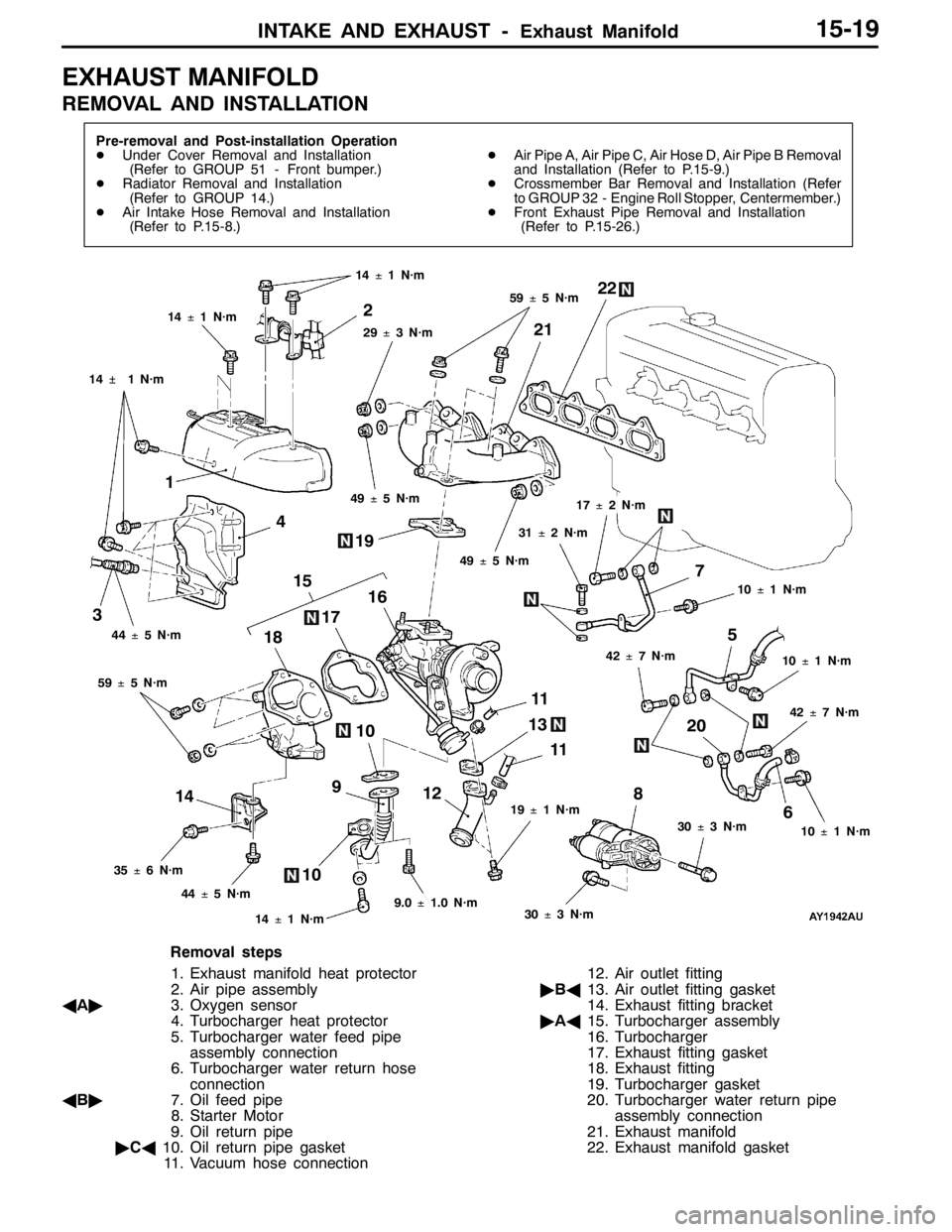
INTAKE AND EXHAUST -Exhaust Manifold15-19
EXHAUST MANIFOLD
REMOVAL AND INSTALLATION
Pre-removal and Post-installation Operation
DUnder Cover Removal and Installation
(Refer to GROUP 51 - Front bumper.)
DRadiator Removal and Installation
(Refer to GROUP 14.)
DAir Intake Hose Removal and Installation
(Refer to P.15-8.)DAir Pipe A, Air Pipe C, Air Hose D, Air Pipe B Removal
and Installation (Refer to P.15-9.)
DCrossmember Bar Removal and Installation (Refer
to GROUP 32 - Engine Roll Stopper, Centermember.)
DFront Exhaust Pipe Removal and Installation
(Refer to P.15-26.)
13 12
3
6 5
8
9
11 192122
14�¶1 N·m
4
7
11
12 15
16
17
18
20
1010
14
14±1 N·m
14±1 N·m
29±3 N·m
59±5 N·m
49±5 N·m
44±5 N·m
59±5 N·m
35±6 N·m
44±5 N·m
14±1 N·m9.0±1.0 N·m30±3 N·m
30±3 N·m10±1 N·m
42±7 N·m
10±1 N·m
10±1 N·m
17±2 N·m
31±2 N·m
49±5 N·m
42±7 N·m
19±1 N·m
Removal steps
1. Exhaust manifold heat protector
2. Air pipe assembly
AA"3. Oxygen sensor
4. Turbocharger heat protector
5. Turbocharger water feed pipe
assembly connection
6. Turbocharger water return hose
connection
AB"7. Oil feed pipe
8. Starter Motor
9. Oil return pipe
"CA10. Oil return pipe gasket
11. Vacuum hose connection12. Air outlet fitting
"BA13. Air outlet fitting gasket
14. Exhaust fitting bracket
"AA15. Turbocharger assembly
16. Turbocharger
17. Exhaust fitting gasket
18. Exhaust fitting
19. Turbocharger gasket
20. Turbocharger water return pipe
assembly connection
21. Exhaust manifold
22. Exhaust manifold gasket