Page 1103 of 1449
ABS <4WD> -Wheel Speed Sensor35B-33
WHEEL SPEED SENSOR
REMOVAL AND INSTALLATION
Caution
If the vehicle is equipped with the Brembo disc brake, during maintenance, take care not to contact
the parts or tools to the caliper because the paint of caliper will be scratched. And if there is
brake fluid on the caliper, wipe out quickly.
Post-installation Operation
Wheel Speed Sensor Output Voltage Check
(Refer to P.35B-26.)
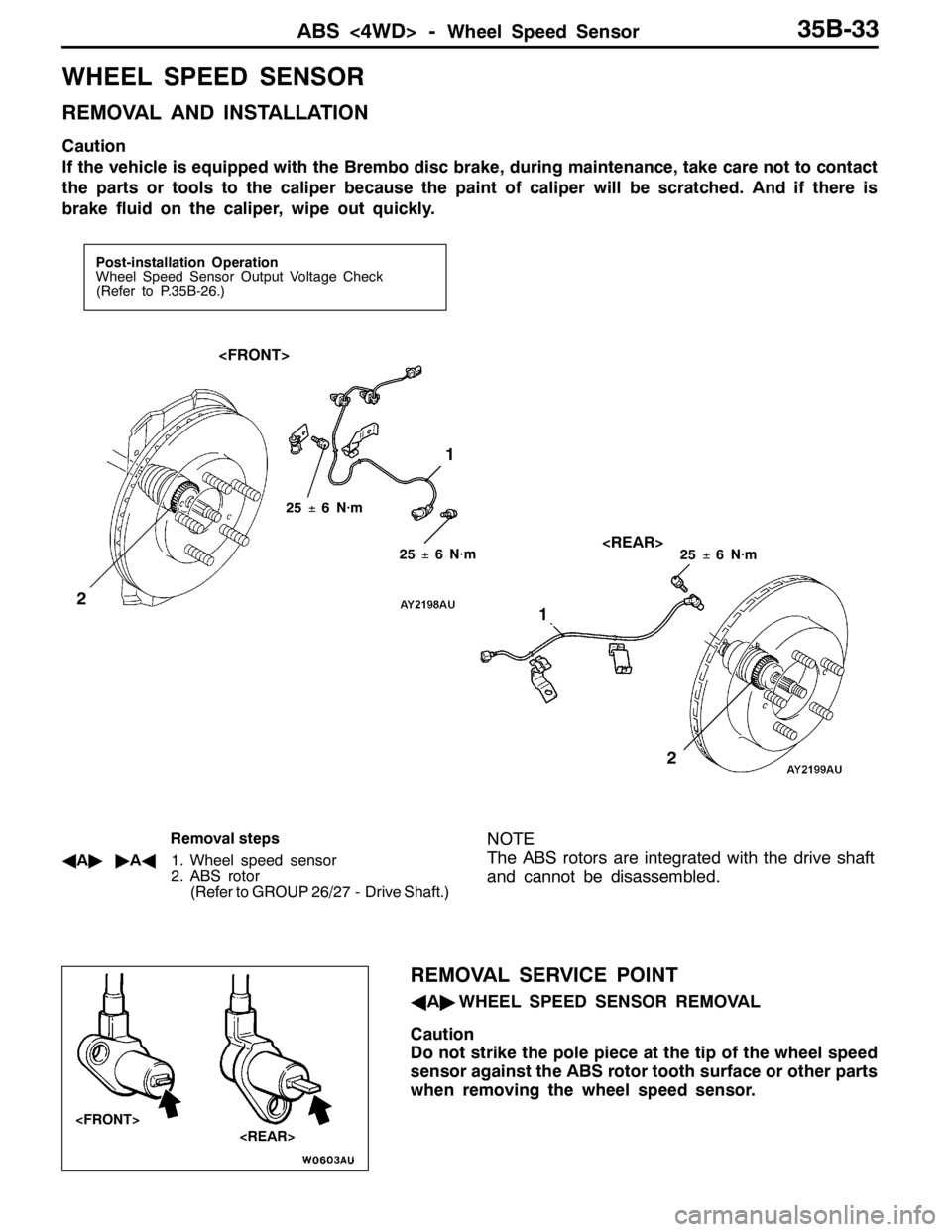
1
2
1
2
25±6 N·m
25±6 N·m25±6 N·m
Removal steps
AA""AA1. Wheel speed sensor
2. ABS rotor
(Refer to GROUP 26/27 - Drive Shaft.)NOTE
The ABS rotors are integrated with the drive shaft
and cannot be disassembled.
REMOVAL SERVICE POINT
AA"WHEEL SPEED SENSOR REMOVAL
Caution
Do not strike the pole piece at the tip of the wheel speed
sensor against the ABS rotor tooth surface or other parts
when removing the wheel speed sensor.
Page 1104 of 1449

ABS <4WD> -Wheel Speed Sensor35B-34
INSTALLATION SERVICE POINT
"AAWHEEL SPEED SENSOR
INSTALLATION
Install the wheel speed sensor crossing with the parking brake
cable.
INSPECTION
CHECK OF RESISTANCE BETWEEN WHEEL SPEED
SENSOR TERMINALS
Caution
The pole piece can become magnetized because of the
magnet built into the wheel speed sensor, with the result
that metallic foreign material easily adheres to it.
Moreover, the pole piece may not be able to function to
correctly sense the wheel rotation speed if it is damaged.
1. Measure the resistance between the wheel speed sensor
terminals.
Standard value: 1.24 - 1.64 kΩ
If the internal resistance of the wheel speed sensor is
not within the standard value, replace with a new wheel
speed sensor.
2. Check the wheel speed sensor cable for breakage,
damage or disconnection; replace with a new one if a
problem is found.
NOTE
When checking for cable damage, remove the cable clamp
part from the body and then bend and pull the cable
near the clamp to check whether or not temporary
disconnection occurs. Also check the connection of the
connector and that the terminals are inserted correctly.
ABS ROTOR CHECK
Check whether ABS rotor teeth are broken or deformed, and,
if so, replace the ABS rotor.
WHEEL SPEED SENSOR INSULATION INSPECTION
1. Remove all connections from the wheel speed sensor,
and then measure the resistance between terminal 1 and
the body of the wheel speed sensor, and terminal 2 and
the body of the wheel speed sensor.
Standard value: 100 kΩor more
2. If the speed sensor insulation resistance is outside the
standard value range, replace with a new speed sensor.
Wheeel speed sensor
Parking brake cable
Page 1105 of 1449
ABS <4WD> -G Sensors and Steering Wheel Sensor35B-35
G SENSORS AND STEERING WHEEL
SENSOR
REMOVAL AND INSTALLATION
Refer to GROUP 22 - Sensor, Switch and Relay.
Parking brake lever
Lateral G sensorLongitudinal G sensor
Steering wheel sensor
Page 1123 of 1449

STEERING -On-vehicle Service37A-9
POWER STEERING FLUID LEVEL CHECK
1. Park the vehicle on a flat, level surface, start the engine,
and then turn the steering wheel several times to raise
the temperature of the fluid to approximately 50 - 60_C.
2. With the engine running, turn the wheel all the way to
the left and right several times.
3. Check the fluid in the oil reservoir for foaming or milkiness.
Check the difference of the fluid level when the engine
is stopped, and while it is running. If the change of the
fluid level is 5 mm or more, air bleeding should be done.
POWER STEERING FLUID REPLACEMENT
1. Raise the front wheels on a jack, and then support them
with rigid racks.
2. Disconnect the return hose connection.
3. Connect a vinyl hose to the return hose, and drain the
oil into a container.
4. Disconnect the ignition coil connectors. (Refer to
GROUP16 - Ignition System.)
5. While operating the starting motor intermittently, turn the
steering wheel all the way to the left and right several
times to drain all of the fluid.
6. Connect the return hoses securely, and then secure it
with the clip.
7. Fill the oil reservoir with specified fluid up to the lower
position of the filter, and then bleed air.
Specified fluid:
Automatic transmission fluid DEXRONII
Caution
Do not use ATF-SPIIM and ATF-SPIII.
POWER STEERING SYSTEM BLEEDING
1. Jack up the vehicle and support the front wheels with
rigid racks.
2. Disconnect the ignition coil connectors. (Refer to
GROUP16 - Ignition System.)
3. Cranking the engine with the starter several times
intermittently (during 15 to 20 seconds), turn the steering
wheel left and right fully five or six times.
Caution
(1) During the bleeding, refill the fluid so that the
level never falls below the lower position of the
filter.
(2) Be sure to bleed air only while cranking. If the
bleeding is done with the engine running, the air
will be broken up and absorbed into the fluid.
4. Connect the ignition coil connectors and idle the engine.
5. Turn the steering wheel left and right fully until no bubbles
comes out in the oil reservoir.
6. See that the fluid is not milky and that the fluid level
is up to the specified position on the level gauge.
7. See that the fluid level changes little when the steering
wheel is turned left and right.
8. Check difference in fluid levels between the engine
stopped and running.
Fluid level change: Within 5 mm
While engine
runningWhile engine
stopped
Return hose
Vinyl hose
Page 1140 of 1449

STEERING - Power Steering Gear Box and Linkage37A-26
"HALOWER OIL SEAL INSTALLATION
Using the special tool, press the oil seal into the valve housing.
The upper surface of the oil seal must project outwards about
1 mm from the housing end surface.
Caution
When the oil seal is flush with or lower than the housing
edge, reassemble the components. Otherwise, oil leaks
will result.
"IAEND PLUG INSTALLATION
1. Apply specified sealant to the threaded section of the
end plug, and then install the end plug to the gear housing.
Specified fluid:
3M ATD Part No.8661, 8663 or equivalent
2. Use a punch to bend over the two tabs on the sides
of the end plug to stop the end plug from turning.
"JARACK SUPPORT COVER/LOCKING NUT
INSTALLATION
1. Apply specified sealant to the rack support cover thread.
Specified fluid:
3M ATD Part No.8661, 8663 or equivalent
2. Using the special tool, tighten the rack support cover
to 23±2 N·m.
3. Return the rack support cover by about 30_.
4. Tighten the locking nut to the specified torque, using
the special tool to prevent the rack support cover from
spinning.
"KAPINION TOTAL ROTATION TORQUE ADJUSTMENT
1. Using the special tool, measure total rotation torque by
turning the pinion gear at a speed of one rotation per
4 to 6 seconds.
Standard value:
Total rotation torque: 0.8-1.8 Nm
Torque fluctuation: 0.49 Nm or lessMB990941 Approx. 1 mmOil
seal
Housing
End plugEnd plug
MB991204
MB991006
Page 1430 of 1449
HEATER, AIR CONDITIONER AND VENTILATION-Heater Unit and Blower Assembly55-28
HEATER UNIT AND BLOWER ASSEMBLY
REMOVAL AND INSTALLATION
Pre-removal and Post-installation Operations
DRefrigerant Draining and Refilling (Refer to P.55-16, 19.)
DCoolant Draining and Refilling (Refer to GROUP 14 – On - vehicle Service.)
DInstrument Panel Removal and Installation (Refer to GROUP 52A – Instrument Panel.)
DFront Seat Removal and Installation (Refer to GROUP 52A – Front Seat.)
DFloor Console Removal and Installation (Refer to GROUP 52A – Floor Console.)
DFloor Carpet Removal and Installation
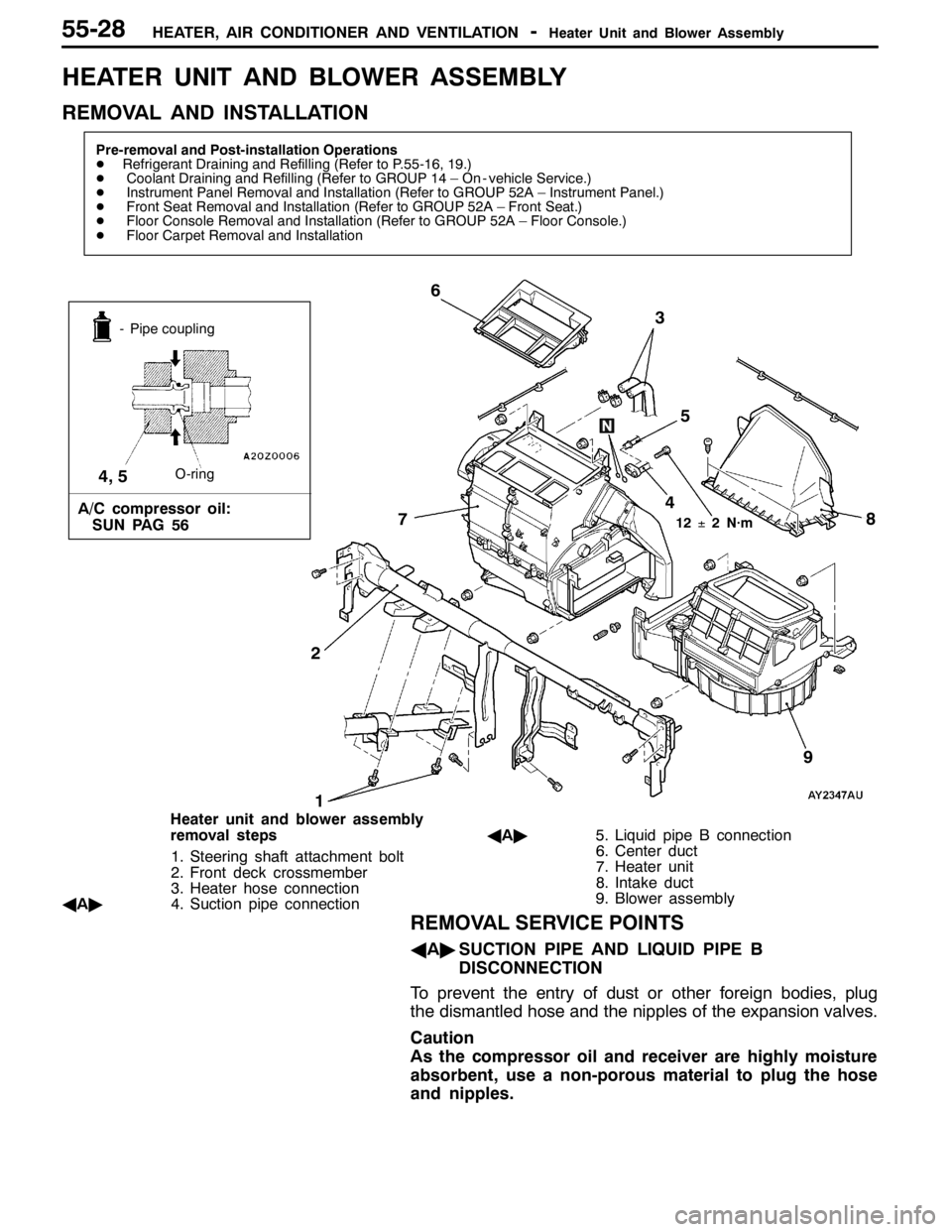
13
5 6
2
12±2 N·m
- Pipe coupling
O-ring
A/C compressor oil:
SUN PAG 56
4, 5
9
7
4
8
Heater unit and blower assembly
removal steps
1. Steering shaft attachment bolt
2. Front deck crossmember
3. Heater hose connection
AA"4. Suction pipe connectionAA"5. Liquid pipe B connection
6. Center duct
7. Heater unit
8. Intake duct
9. Blower assembly
REMOVAL SERVICE POINTS
AA"SUCTION PIPE AND LIQUID PIPE B
DISCONNECTION
To prevent the entry of dust or other foreign bodies, plug
the dismantled hose and the nipples of the expansion valves.
Caution
As the compressor oil and receiver are highly moisture
absorbent, use a non-porous material to plug the hose
and nipples.
Page 1436 of 1449
HEATER, AIR CONDITIONER AND VENTILATION-Evaporator and Air Thermo Sensor55-34
EVAPORATOR AND AIR THERMO SENSOR
REMOVAL AND INSTALLATION
Pre-removal and Post-installation Operations
DRefrigerant Draining and Refilling (Refer to P.55-16, 19.)
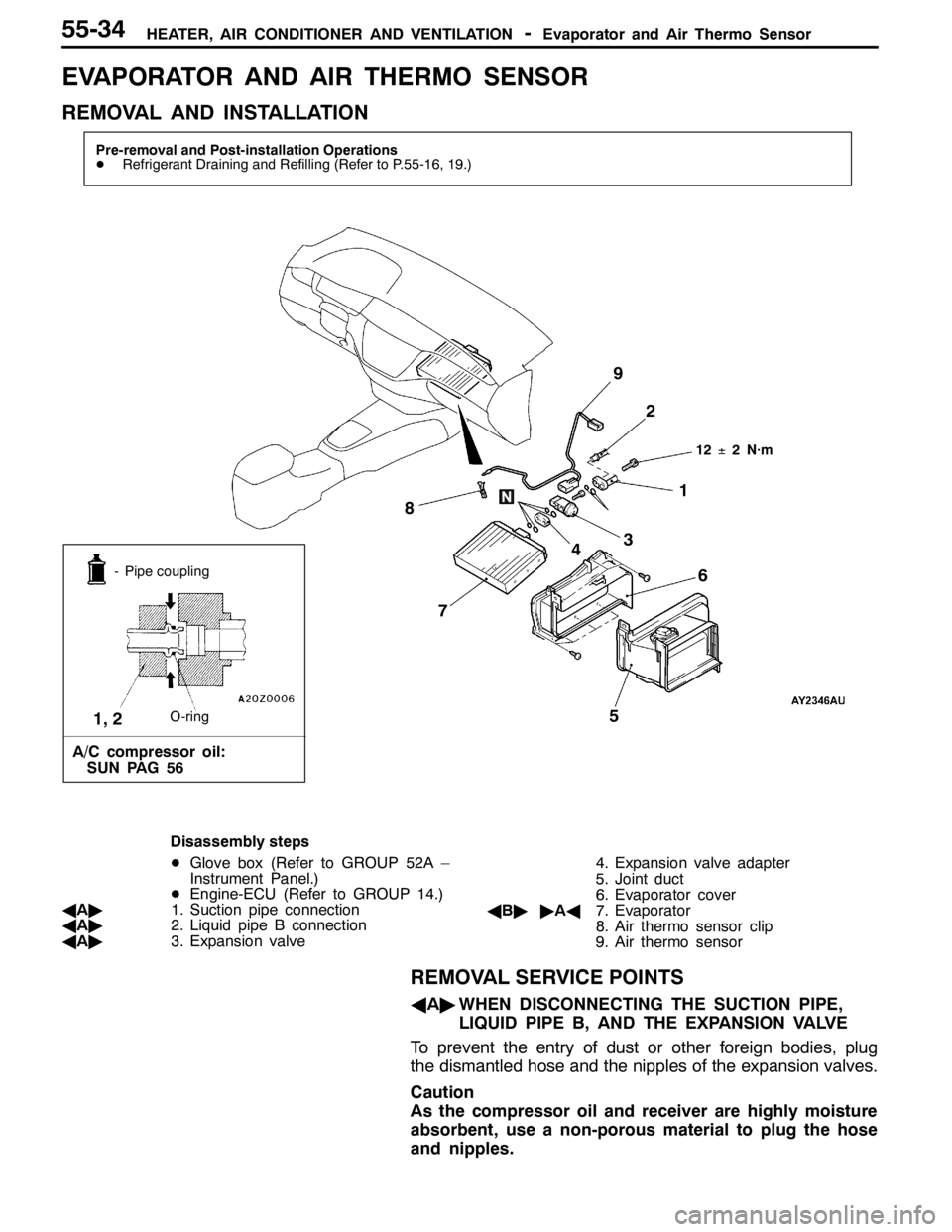
1 2
3
4
56
7 8
12±2 N·m
- Pipe coupling
O-ring
A/C compressor oil:
SUN PAG 56
1, 2
9
Disassembly steps
DGlove box (Refer to GROUP 52A –
Instrument Panel.)
DEngine-ECU (Refer to GROUP 14.)
AA"1. Suction pipe connection
AA"2. Liquid pipe B connection
AA"3. Expansion valve4. Expansion valve adapter
5. Joint duct
6. Evaporator cover
AB""AA7. Evaporator
8. Air thermo sensor clip
9. Air thermo sensor
REMOVAL SERVICE POINTS
AA"WHEN DISCONNECTING THE SUCTION PIPE,
LIQUID PIPE B, AND THE EXPANSION VALVE
To prevent the entry of dust or other foreign bodies, plug
the dismantled hose and the nipples of the expansion valves.
Caution
As the compressor oil and receiver are highly moisture
absorbent, use a non-porous material to plug the hose
and nipples.
Page 1438 of 1449
HEATER, AIR CONDITIONER AND VENTILATION-Compressor55-36
COMPRESSOR
REMOVAL AND INSTALLATION
Before Removal
Refrigerant Draining (Refer to P.55-19.)After Removal
DRefrigerant Replenishing (Refer to P.55-16.)
DDrive Belt Tension Check (Refer to GROUP
11A – Engine Adjustment.)
25±4
N·m
2 4
1
- Pipe coupling
O ring
A/C compressor oil:
SUN PAG 56
1, 2
5
3
Removal steps
AA"1. Flexible suction hose connection
AA"2. Flexible discharge hose connection
AB"3. Drive beltAC""AA4. Compressor
5. Compressor bracket
REMOVAL SERVICE POINTS
AA"DISCONNECTION OF FLEXIBLE SUCTION HOSE
AND FLEXIBLE DISCHARGE HOSE
To prevent the entry of dust or other foreign bodies, plug
the dismantled hoses and compressor nipples.
Caution
As the compressor oil and receiver are highly moisture
absorbent, use a non-porous material to plug the hose
and nipples.