Page 52 of 325
343
Knowing your vehicle
7. Double check that the retractor is inthe “Auto Lock” mode by attempting to
pull more of the safety belt out of the
retractor. If you cannot, the retractor is
in the “Auto Lock” mode.
To remove the child restraint, press the
release button on the buckle and then
pull the lap/shoulder belt out of the
restraint and allow the safety belt to
retract fully.
When the safety belt is allowed to
retract to its fully stowed position, the
retractor will automatically switch
from the “Auto Lock” mode to the
emergency lock mode for normal
adult usage.
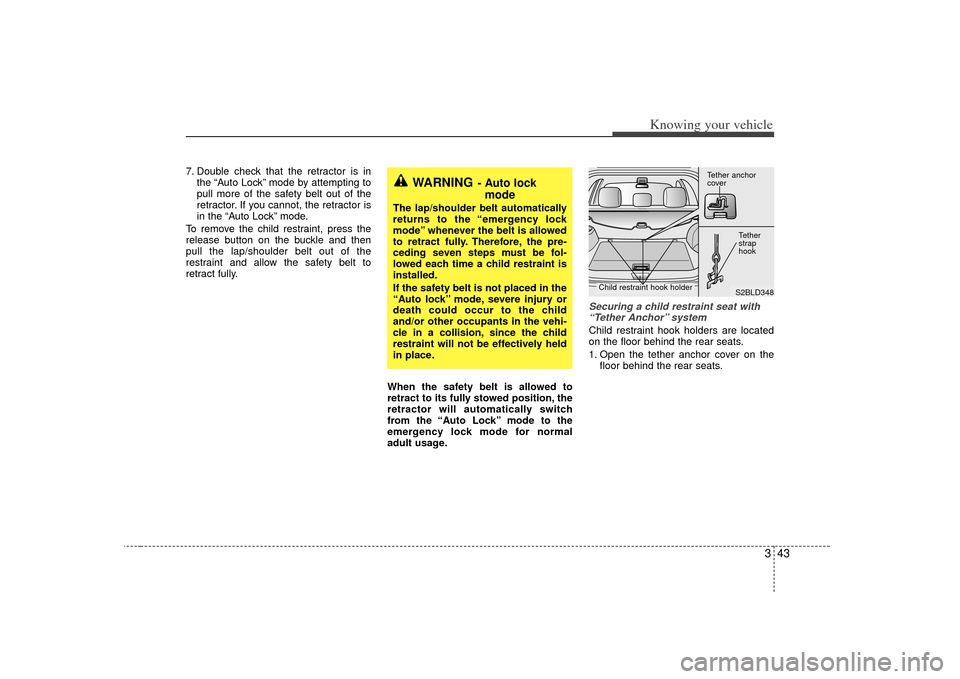
Securing a child restraint seat with“Tether Anchor” system Child restraint hook holders are located
on the floor behind the rear seats.
1. Open the tether anchor cover on the floor behind the rear seats.
WARNING
- Auto lockmode
The lap/shoulder belt automatically
returns to the “emergency lock
mode” whenever the belt is allowed
to retract fully. Therefore, the pre-
ceding seven steps must be fol-
lowed each time a child restraint is
installed.
If the safety belt is not placed in the
“Auto lock” mode, severe injury or
death could occur to the child
and/or other occupants in the vehi-
cle in a collision, since the child
restraint will not be effectively held
in place.
S2BLD348
Tether anchor
coverTether
strap
hook
Child restraint hook holder
Page 53 of 325

Knowing your vehicle44
32. Route the child restraint seat strap
over the seatback.
For vehicles with adjustable headrest,
route the tether strap under the head-
rest and between the headrest posts,
otherwise route the tether strap over
the top of the seatback.
3. Connect the tether strap hook to the appropriate child restraint hook holder
and tighten to secure the seat.
WARNING
- Tether strap
If the tether strap is secured incor-
rectly, the child restraint seat may
not be restrained properly in the
event of a collision. Do not mount
more than one child restraint seat
to a tether anchorage, since the
anchorage can then fail in a colli-
sion.
WARNING
- Child restraintcheck
Check that the child restraint sys-
tem is secure by pushing and
pulling it in different directions.
Incorrectly fitted child restraints
may swing, twist, tip or come away
causing death or injury.
WARNING - Child restraint anchorage
Child restraint anchorages are
designed to withstand only those
loads imposed by correctly fitted
child restraints. Under no circum-
stances are they to be used for
adult seat belts or harnesses or
for attaching other items or
equipment to the vehicle.
The tether strap may not work properly if attached somewhere
other than the correct tether
anchor.
E2BLD349N
Page 54 of 325
345
Knowing your vehicle
Child seat lower anchorsSome child seat manufacturers make
child restraint seats that are labeled as
LATCH or LATCH compatible. LATCH
stands for "Lower Anchors and Tethers
for Children". These seats include two
rigid or webbing mounted attachments
that connect to two LATCH anchors at
specific seating positions in your vehicle.
This type of child restraint seat elimi-
nates the need to use seat belts to attach
the child seat in the rear seats.LATCH anchors have been provided in
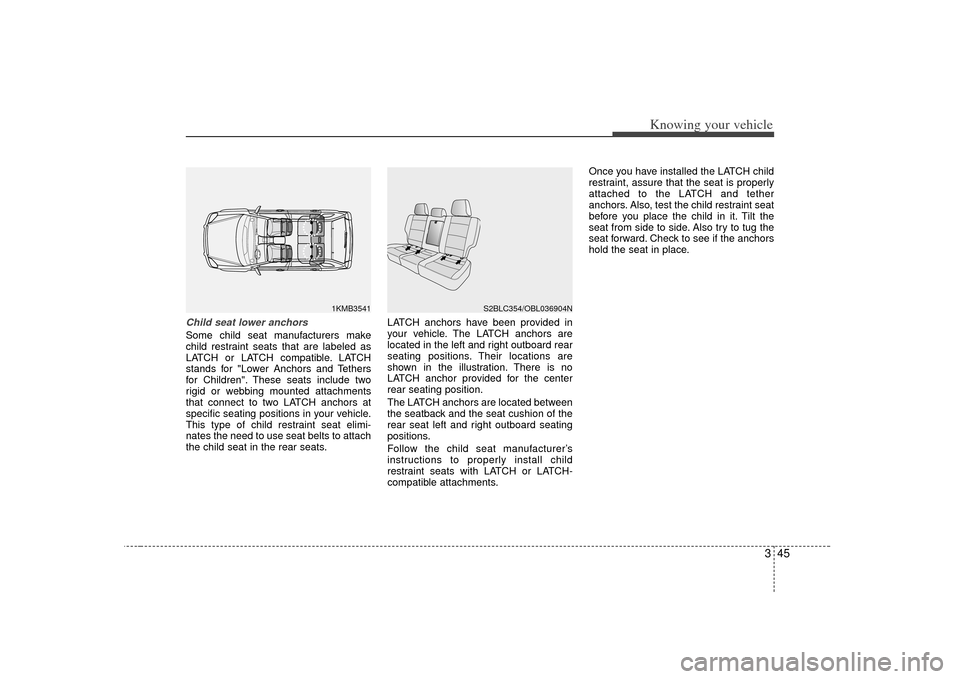
your vehicle. The LATCH anchors are
located in the left and right outboard rear
seating positions. Their locations are
shown in the illustration. There is no
LATCH anchor provided for the center
rear seating position.
The LATCH anchors are located between
the seatback and the seat cushion of the
rear seat left and right outboard seating
positions.
Follow the child seat manufacturer’s
instructions to properly install child
restraint seats with LATCH or LATCH-
compatible attachments.Once you have installed the LATCH child
restraint, assure that the seat is properly
attached to the LATCH and tether
anchors. Also, test the child restraint seat
before you place the child in it. Tilt the
seat from side to side. Also try to tug the
seat forward. Check to see if the anchors
hold the seat in place.
1KMB3541
S2BLC354/OBL036904N
Page 59 of 325

Knowing your vehicle50
3
Driver’s air bagThe driver’s air bag is stored in the cen-
ter of the steering wheel.
WARNING
Ignoring the SRS indictor light
(air bag indicator and passenger
air bag off indicator) can result in
serious or fatal injury if the air
bags occupant classification sys-
tem or pretensioners do not work
properly. Have your car checked
by a dealer as soon as possible if
the SRS warning light alerts you
to a potential problem.
Sitting improperly or out of posi- tion can result in serious or fatal
injury in a crash. All occupants
should sit upright in their seats
with their feet on the floor until
the vehicle is parked and the igni-
tion key is removed.
E2BLA422BHLZ2120
WARNING
You must always sit as far backfrom the steering wheel air bag as
possible (chest at least 250 mm
(10 inches) away from the steer-
ing wheel), while still maintaining
a comfortable seating position for
good vehicle control, in order to
reduce the risk of injury or death
in a collision.
Never place objects over the air bag storage compartments or
between the air bags and your-
self. Due to the speed and force of
the air bag inflation, such objects
could hit your body at high speed
and cause severe bodily injury
and even death.
Do not put stickers or ornaments on the steering wheel cover.
These may interfere with the
deployment of the air bag.
Page 69 of 325

Knowing your vehicle60
3
WARNING
Do not hit or allow any objects to
impact the locations where air
bag or sensors are installed.
This may cause unexpected air
bag deployment, which could
result in severe personal injury or
death.
If the installation location or angle of the sensors is altered in
any way, the air bags may deploy
when they should not or they may
not deploy when they should,
causing severe injury or death.
Therefore, do not try to perform
maintenance on or around the air
bag sensors. Have the vehicle
checked and repaired by the
authorized Kia dealer.
Problems may arise if the sensor installation angles are changed
due to the deformation of front
bumper, body or B pillar where
side collision sensors are
installed. Have the vehicle
checked and repaired by the
authorized Kia dealer.
(Continued)
(Continued)
Your vehicle has been designedto absorb impact and deploy the
air bag(s) in certain collisions.
Installing aftermarket bumper
guards or replacing a bumper
with non-genuine parts may
adversely affect your vehicles
collision and air bag deployment
performance.
Air bag inflation conditionFront air bag
Front air bags (driver’s and front passen-
ger’s air bags and driver’s knee air bag)
are designed to inflate when the impact
is delivered to front collision sensors
depending on the intensity, speed or
angles of impact of the front collision -
generally from an area a little to the left to
a little to the right of straight ahead.
OBL0367001N
Page 75 of 325

Knowing your vehicle66
3
Air bag warning lightThe purpose of air bag warning light in
your instrument panel is to alert you of a
potential problem with your air bag -
Supplemental Restraint System (SRS).
When the ignition switch is turned ON,
the indicator light should blink or illumi-
nate for approximately 6 seconds, then
go off.
Have the system checked if:
The light does not turn on briefly when
you turn the ignition ON.
The light stays on after the engine starts.
The light comes on while the vehicle is in motion.
Air bag (Supplemental Restraint
System) service Your Supplemental Restraint System is
virtually maintenance-free. There are no
parts which you can service.
You must have the system serviced
under the following circumstances:
If an air bag ever inflates, the air bagmust be replaced. Do not try to remove
or discard the air bag by yourself. This
must be done by an authorized Kia
dealer.
If the air bag warning indicator light alerts you to a problem, have the air
bag system checked as soon as possi-
ble. Otherwise, your air bag system
may be ineffective.
WARNING
Never put child restraint in thefront passenger seat. If the front
passenger air bag inflates, it may
cause severe or fatal injuries.
When children are seated in the rear outboard seats in which cur-
tain air bags are equipped, be
sure to put the child restraint sys-
tem as far away from the door
side as possible, and secure the
child restraint system to be
locked in position.
Inflation of curtain air bag could
cause severe injury or death due
to the expansion impact.
AIR
BAG
CAUTION
Do not modify any part of the air bag system. Modification could make the air bag system ineffectiveor could cause unnecessary deployment.
Page 76 of 325
367
Knowing your vehicle
Repairing or scrapping the vehi-
cles Repairing steering wheel, instrumentpanel, center console or roofs, or
installing car audio around center con-
sole or painting front sheet metal could
disable the air bag system. Have them
checked by an authorized Kia dealer.
When leaving the vehicle at an autho- rized Kia dealer, inform that the vehicle
is equipped with air bag system, and
leave the owner’s manual in the vehi-
cle.
Since air bag system contains explo- sive chemical substances, contact an
authorized Kia dealer when scrapping
the vehicle.
WARNING
Do not modify your steeringwheel, seat or any other part of
the Supplemental Restraint
System. Modification could make
the system inoperable.
Do not work on the system’s com- ponents or wiring. This could
cause the air bags to inflate inad-
vertently, possibly seriously injur-
ing someone. Working on the sys-
tem could also disable the sys-
tem so that the air bags would not
deploy in a collision.
Any work on the SRS system, such as removing, installing,
repairing, or any work on the
steering wheel must be per-
formed by a qualified Kia techni-
cian. Improper handling of the air
bag system may result in serious
personal injury.
Page 79 of 325
Knowing your vehicle70
3Closing the hood1. Before closing the hood, check the fol-
lowing:
must be correctly installed.
bustible material must be removed
from the engine compartment.
2. Lower the hood halfway and push down to securely lock in place.
Make sure the hood is properly locked
before driving.
WARNING -
Hood
Before closing the hood, makesure that all engine parts and
tools have been removed from
the engine area and that no one’s
hands are near the hood opening.
Do not leave gloves, rags or any other combustible material in the
engine compartment. Doing so
may cause a heat-induced fire.
