2007 KIA Sorento ECU
[x] Cancel search: ECUPage 42 of 325
333
Knowing your vehicle
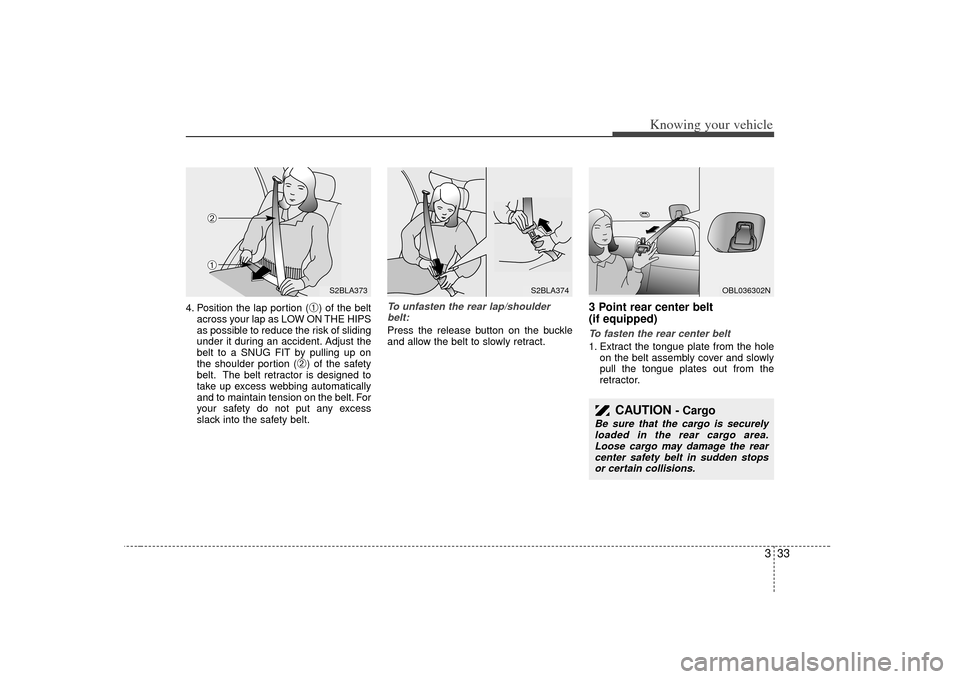
4. Position the lap portion (
➀) of the belt
across your lap as LOW ON THE HIPS
as possible to reduce the risk of sliding
under it during an accident. Adjust the
belt to a SNUG FIT by pulling up on
the shoulder portion (
➁) of the safety
belt. The belt retractor is designed to
take up excess webbing automatically
and to maintain tension on the belt. For
your safety do not put any excess
slack into the safety belt.
To unfasten the rear lap/shoulder belt:Press the release button on the buckle
and allow the belt to slowly retract.
3 Point rear center belt
(if equipped) To fasten the rear center belt1. Extract the tongue plate from the hole on the belt assembly cover and slowly
pull the tongue plates out from the
retractor.
CAUTION
- Cargo
Be sure that the cargo is securelyloaded in the rear cargo area. Loose cargo may damage the rearcenter safety belt in sudden stopsor certain collisions.
OBL036302N
S2BLA374
S2BLA373
➀➁
Page 48 of 325
339
Knowing your vehicle
Child restraint system For small children and babies, the use of
a child seat or infant seat is strongly rec-
ommended and is required by law in
almost all states. This child seat or infant
seat should be of appropriate size for the
child and should be installed in accor-
dance with the manufacturer's instruc-
tions.
Children riding in the car should sit on
the rear seat and must always be proper-
ly restrained to minimize the risk of injury
in an accident, sudden stop or sudden
maneuver. According to accident statis-
tics, children are safer when properly
restrained in the rear seats than in the
front seat.
Children could be injured or killed in a
crash if their restraints are not properly
secured. For small children and babies, a
child seat or infant seat must be used.
Before buying a particular child restraint
system, make sure it fits your car and
seat belts, and fits your child. Follow all
the instructions provided by the child
seat manufacturer when installing the
child restraint system.
WARNING
- Child
restraints
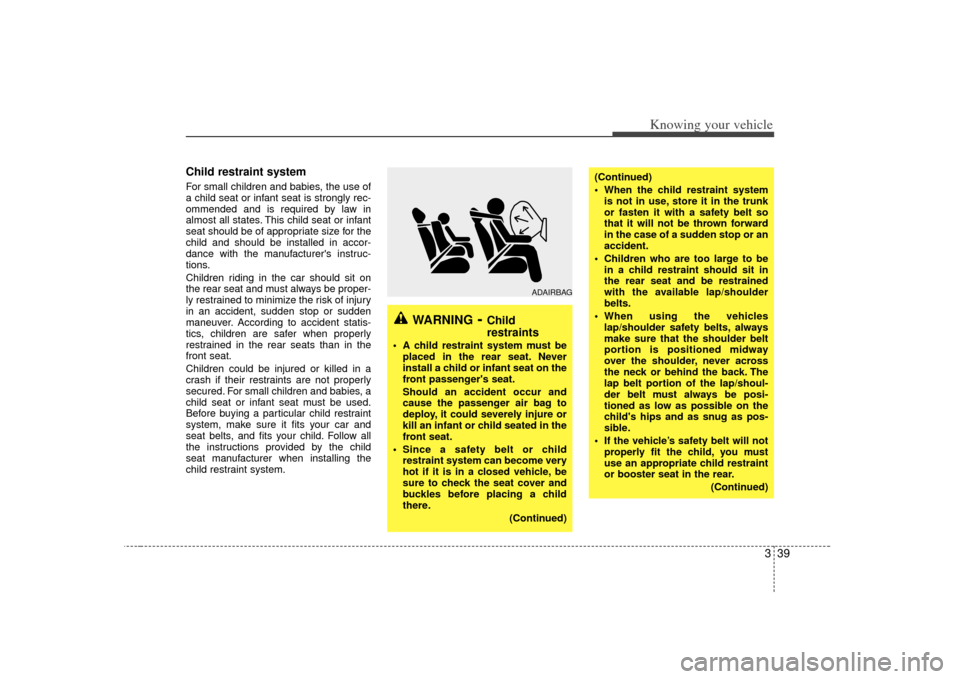
A child restraint system must beplaced in the rear seat. Never
install a child or infant seat on the
front passenger's seat.
Should an accident occur and
cause the passenger air bag to
deploy, it could severely injure or
kill an infant or child seated in the
front seat.
Since a safety belt or child restraint system can become very
hot if it is in a closed vehicle, be
sure to check the seat cover and
buckles before placing a child
there.
(Continued)
(Continued)
When the child restraint systemis not in use, store it in the trunk
or fasten it with a safety belt so
that it will not be thrown forward
in the case of a sudden stop or an
accident.
Children who are too large to be in a child restraint should sit in
the rear seat and be restrained
with the available lap/shoulder
belts.
When using the vehicles lap/shoulder safety belts, always
make sure that the shoulder belt
portion is positioned midway
over the shoulder, never across
the neck or behind the back. The
lap belt portion of the lap/shoul-
der belt must always be posi-
tioned as low as possible on the
child's hips and as snug as pos-
sible.
If the vehicle’s safety belt will not properly fit the child, you must
use an appropriate child restraint
or booster seat in the rear.
(Continued)
ADAIRBAG
Page 49 of 325

Knowing your vehicle40
3
Installing a child restraint system For safety reasons, we recommend that
the child restraint system be used in the
rear seats.
Never place a rear-facing child
restraint in the front passenger seat,
because of the danger that an inflat-
ing passenger side air bag could
impact the rear-facing child restraint
and kill the child.
Since all passenger safety belts move
freely under normal conditions and only
lock under extreme or emergency condi-
tions (emergency lock mode), you must
manually change these safety belts to
the auto lock mode to secure a child
restraint.
(Continued)
Never allow a child to stand up or
kneel while the vehicle is moving.
Never use an infant carrier or child seat that "hooks" over a
seatback. It will not provide ade-
quate protection in an accident.
Never allow a child to be held while they are in a moving vehi-
cle, as this could result in serious
injury to the child in the event of
an accident or a sudden stop.
Holding a child in a moving vehi-
cle does not provide the child
with any protection during an
accident, even if the person hold-
ing the child is wearing a seat
belt.
WARNING
- Child seat
installation
Before installing the childrestraint system, read the instruc-
tions supplied by the child
restraint system manufacturer.
If the safety belt does not operate as described in this section, have
the system checked immediately
by your authorized Kia dealer.
Failure to observe this manual's instructions regarding child
restraint system and the instruc-
tions provided with the child
restraint system could increase
the chance and/or severity of
injury in an accident.
Page 50 of 325
341
Knowing your vehicle
Placing a passenger safety belt intothe auto lock modeThe use of the auto lock mode will
ensure that the normal movement of the
child in the vehicle does not cause the
safety belt to be pulled out and loosen
the firmness of its hold on the child
restraint system. To secure a child
restraint system, use the following proce-
dure.
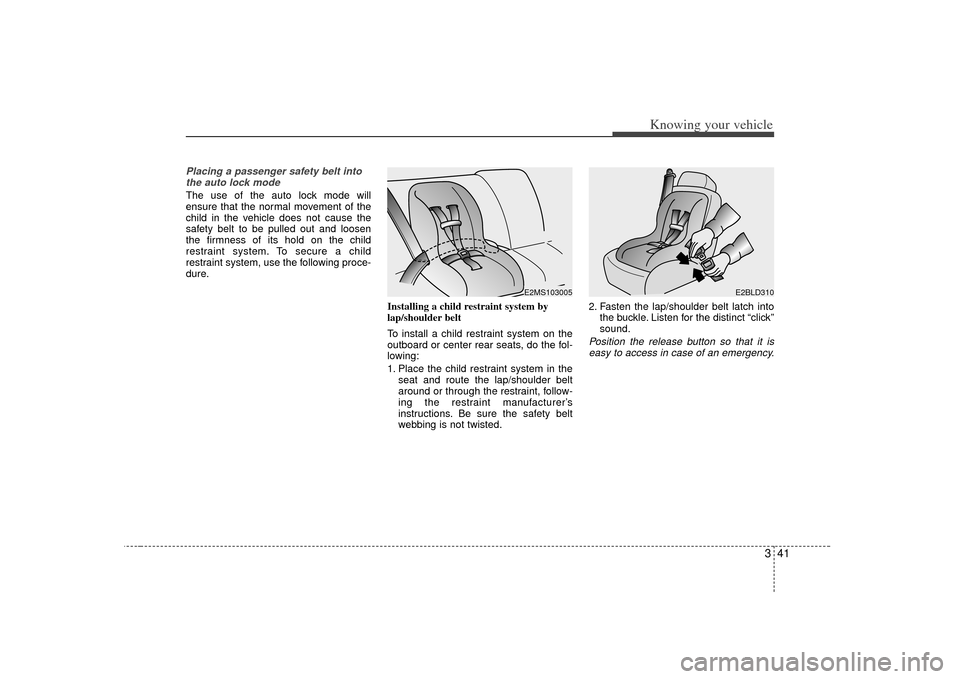
Installing a child restraint system by
lap/shoulder belt
To install a child restraint system on the
outboard or center rear seats, do the fol-
lowing:
1. Place the child restraint system in theseat and route the lap/shoulder belt
around or through the restraint, follow-
ing the restraint manufacturer’s
instructions. Be sure the safety belt
webbing is not twisted. 2. Fasten the lap/shoulder belt latch into
the buckle. Listen for the distinct “click”
sound.
Position the release button so that it iseasy to access in case of an emergency.
E2MS103005
E2BLD310
Page 52 of 325
343
Knowing your vehicle
7. Double check that the retractor is inthe “Auto Lock” mode by attempting to
pull more of the safety belt out of the
retractor. If you cannot, the retractor is
in the “Auto Lock” mode.
To remove the child restraint, press the
release button on the buckle and then
pull the lap/shoulder belt out of the
restraint and allow the safety belt to
retract fully.
When the safety belt is allowed to
retract to its fully stowed position, the
retractor will automatically switch
from the “Auto Lock” mode to the
emergency lock mode for normal
adult usage.
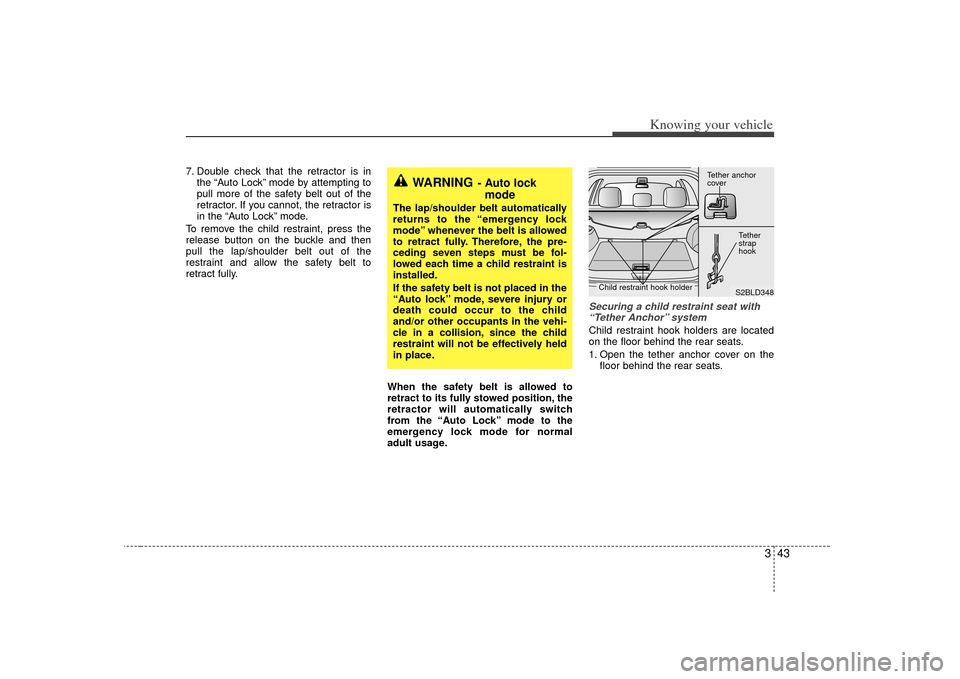
Securing a child restraint seat with“Tether Anchor” system Child restraint hook holders are located
on the floor behind the rear seats.
1. Open the tether anchor cover on the floor behind the rear seats.
WARNING
- Auto lockmode
The lap/shoulder belt automatically
returns to the “emergency lock
mode” whenever the belt is allowed
to retract fully. Therefore, the pre-
ceding seven steps must be fol-
lowed each time a child restraint is
installed.
If the safety belt is not placed in the
“Auto lock” mode, severe injury or
death could occur to the child
and/or other occupants in the vehi-
cle in a collision, since the child
restraint will not be effectively held
in place.
S2BLD348
Tether anchor
coverTether
strap
hook
Child restraint hook holder
Page 53 of 325

Knowing your vehicle44
32. Route the child restraint seat strap
over the seatback.
For vehicles with adjustable headrest,
route the tether strap under the head-
rest and between the headrest posts,
otherwise route the tether strap over
the top of the seatback.
3. Connect the tether strap hook to the appropriate child restraint hook holder
and tighten to secure the seat.
WARNING
- Tether strap
If the tether strap is secured incor-
rectly, the child restraint seat may
not be restrained properly in the
event of a collision. Do not mount
more than one child restraint seat
to a tether anchorage, since the
anchorage can then fail in a colli-
sion.
WARNING
- Child restraintcheck
Check that the child restraint sys-
tem is secure by pushing and
pulling it in different directions.
Incorrectly fitted child restraints
may swing, twist, tip or come away
causing death or injury.
WARNING - Child restraint anchorage
Child restraint anchorages are
designed to withstand only those
loads imposed by correctly fitted
child restraints. Under no circum-
stances are they to be used for
adult seat belts or harnesses or
for attaching other items or
equipment to the vehicle.
The tether strap may not work properly if attached somewhere
other than the correct tether
anchor.
E2BLD349N
Page 55 of 325
Knowing your vehicle46
3
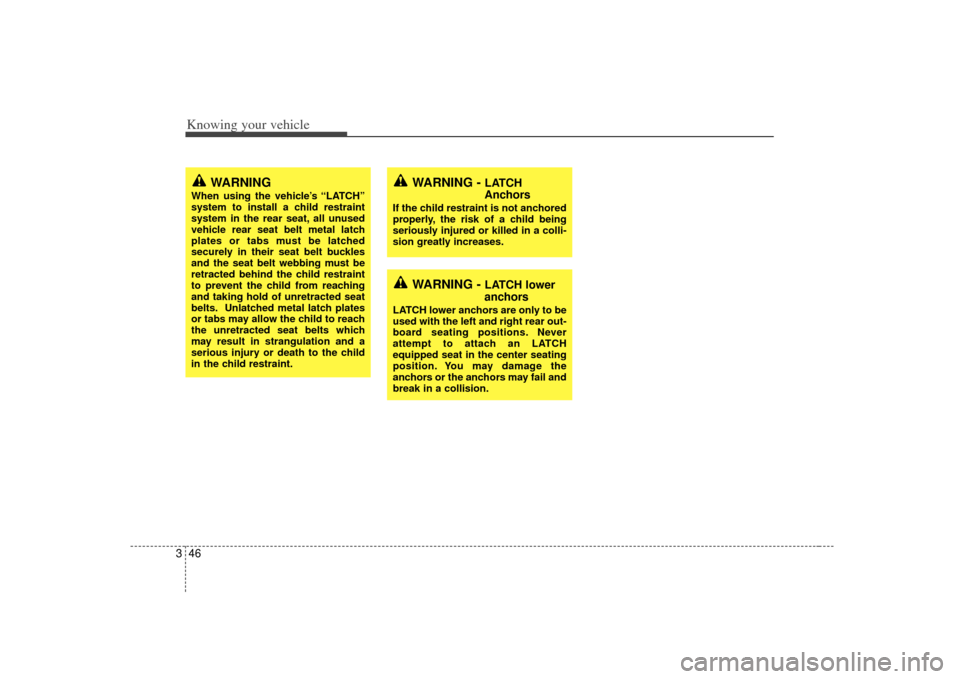
WARNING -
LATCH
Anchors
If the child restraint is not anchored
properly, the risk of a child being
seriously injured or killed in a colli-
sion greatly increases.
WARNING
When using the vehicle’s “LATCH”
system to install a child restraint
system in the rear seat, all unused
vehicle rear seat belt metal latch
plates or tabs must be latched
securely in their seat belt buckles
and the seat belt webbing must be
retracted behind the child restraint
to prevent the child from reaching
and taking hold of unretracted seat
belts. Unlatched metal latch plates
or tabs may allow the child to reach
the unretracted seat belts which
may result in strangulation and a
serious injury or death to the child
in the child restraint.
WARNING -
LATCH lower
anchors
LATCH lower anchors are only to be
used with the left and right rear out-
board seating positions. Never
attempt to attach an LATCH
equipped seat in the center seating
position. You may damage the
anchors or the anchors may fail and
break in a collision.
Page 67 of 325
Knowing your vehicle58
3 The curtain air bag deployment occurs
only on the side of the vehicle affected
by the impact.
The curtain air bags are not designed to deploy during collisions from the
front or rear of the vehicle or in most
rollover situations.
The curtain air bags are designed to deploy only during certain side-impact
collisions, depending on the crash
severity, angle, speed and impact.
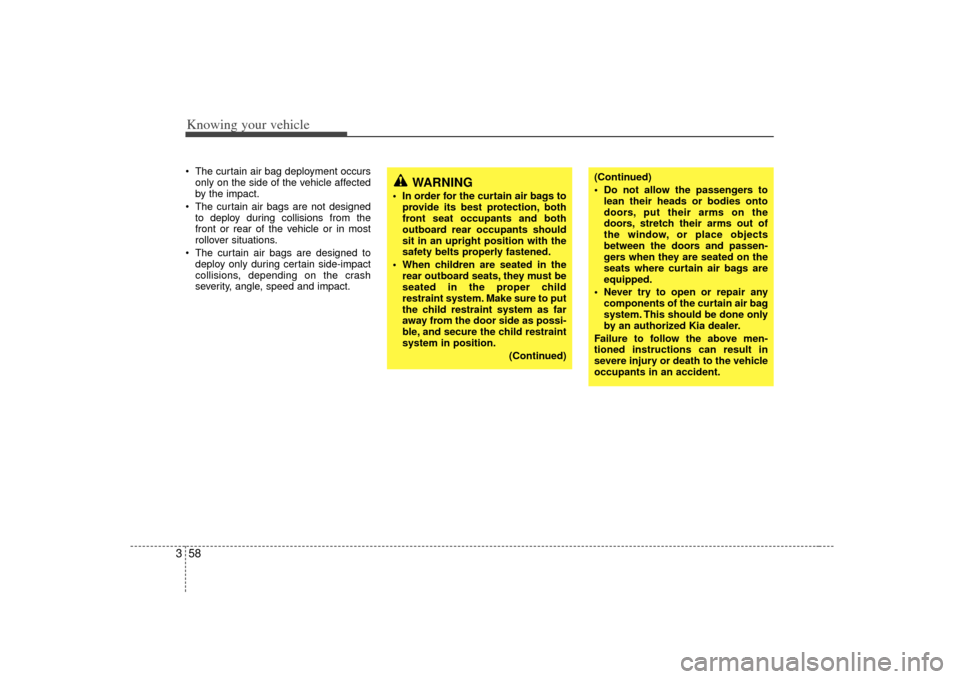
(Continued)
Do not allow the passengers tolean their heads or bodies onto
doors, put their arms on the
doors, stretch their arms out of
the window, or place objects
between the doors and passen-
gers when they are seated on the
seats where curtain air bags are
equipped.
Never try to open or repair any components of the curtain air bag
system. This should be done only
by an authorized Kia dealer.
Failure to follow the above men-
tioned instructions can result in
severe injury or death to the vehicle
occupants in an accident.
WARNING
In order for the curtain air bags to provide its best protection, both
front seat occupants and both
outboard rear occupants should
sit in an upright position with the
safety belts properly fastened.
When children are seated in the rear outboard seats, they must be
seated in the proper child
restraint system. Make sure to put
the child restraint system as far
away from the door side as possi-
ble, and secure the child restraint
system in position.
(Continued)