2007 KIA Sorento ECU
[x] Cancel search: ECUPage 96 of 325
387
Knowing your vehicle
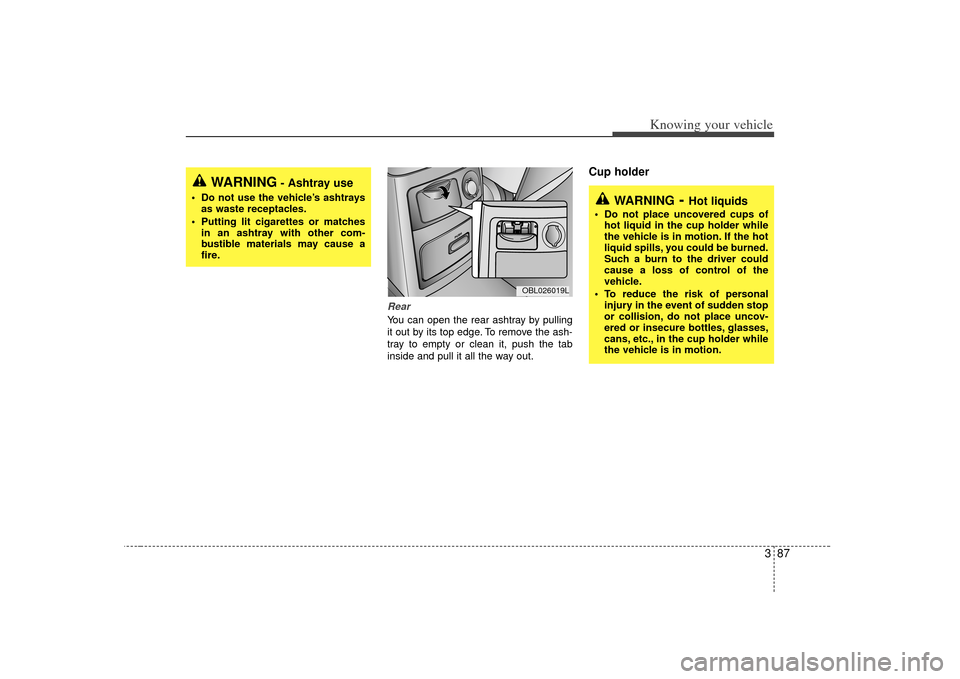
RearYou can open the rear ashtray by pulling
it out by its top edge. To remove the ash-
tray to empty or clean it, push the tab
inside and pull it all the way out.
Cup holder
WARNING
- Ashtray use
Do not use the vehicle’s ashtraysas waste receptacles.
Putting lit cigarettes or matches in an ashtray with other com-
bustible materials may cause a
fire.
WARNING
- Hot liquids
Do not place uncovered cups ofhot liquid in the cup holder while
the vehicle is in motion. If the hot
liquid spills, you could be burned.
Such a burn to the driver could
cause a loss of control of the
vehicle.
To reduce the risk of personal injury in the event of sudden stop
or collision, do not place uncov-
ered or insecure bottles, glasses,
cans, etc., in the cup holder while
the vehicle is in motion.
OBL026019L
Page 97 of 325
Knowing your vehicle88
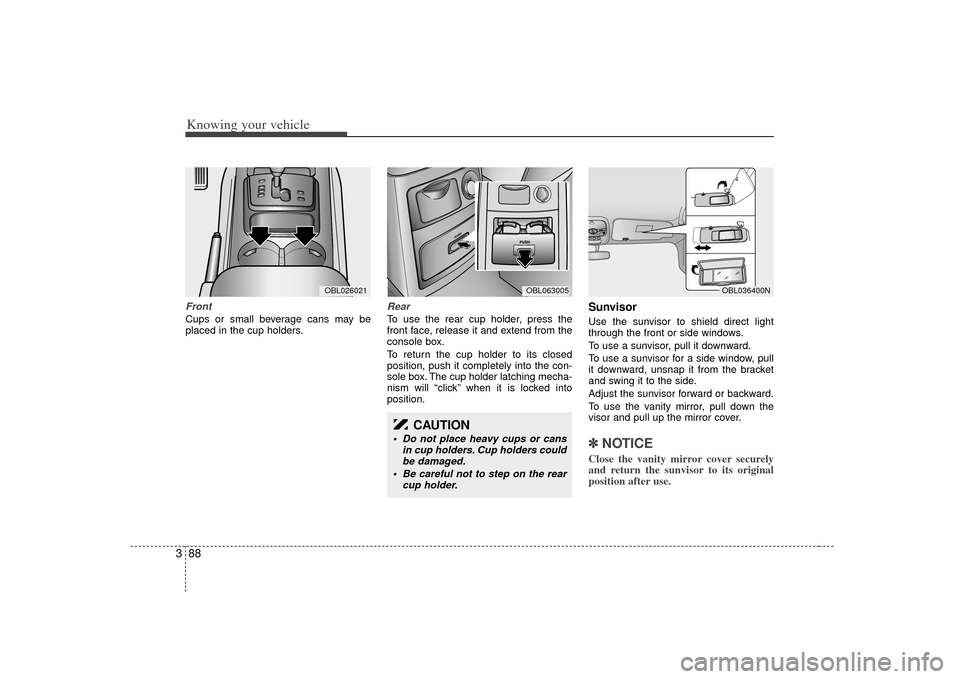
3FrontCups or small beverage cans may be
placed in the cup holders.
RearTo use the rear cup holder, press the
front face, release it and extend from the
console box.
To return the cup holder to its closed
position, push it completely into the con-
sole box. The cup holder latching mecha-
nism will “click” when it is locked into
position.
SunvisorUse the sunvisor to shield direct light
through the front or side windows.
To use a sunvisor, pull it downward.
To use a sunvisor for a side window, pull
it downward, unsnap it from the bracket
and swing it to the side.
Adjust the sunvisor forward or backward.
To use the vanity mirror, pull down the
visor and pull up the mirror cover.✽ ✽
NOTICEClose the vanity mirror cover securely
and return the sunvisor to its original
position after use.
OBL036400N
OBL026021
OBL063005
CAUTION
Do not place heavy cups or cans
in cup holders. Cup holders couldbe damaged.
Be careful not to step on the rear cup holder.
Page 106 of 325

397
Knowing your vehicle
WARNING
The following specification is themaximum weight that can be
loaded onto the roof rack.
Distribute the load as evenly as
possible across the crossbars
and roof rack and secure the load
firmly.
The vehicle center of gravity will be higher when items are loaded
onto the roof rack. Avoid sudden
starts, braking, sharp turns,
abrupt maneuvers or high speeds
that may result in loss of vehicle
control or rollover causing an
accident.
(Continued)
(Continued)
Always drive slowly and turn cor-ners carefully when carrying
items on the roof rack. Severe
wind updrafts, caused by passing
vehicles or natural causes, can
cause sudden upward pressure
on items loaded on the roof rack.
This is especially true when car-
rying large, flat items such as
wood panels or mattresses. This
could cause the items to fall off
the roof rack and cause damage
to your vehicle or those around
you.
To prevent damage or loss of cargo while driving, check fre-
quently before or while driving to
make sure the items on the roof
rack are securely fastened.
CAUTION
If the vehicle has a sunroof, do not position the roof rack loadsso that they could interfere withthe sunroof.
Loading cargo or luggage above specification on the roof rack maydamage your vehicle.
ROOF 45 kg (100 lbs.)
RACK EVENLY DISTRIBUTED
Page 138 of 325

Driving your vehicle84Sports modeWhether the vehicle is stationary or in
motion, sports mode is selected by push-
ing the shift lever from the “D” position
into the manual gate. To return to “D”
range operation, push the shift lever back
into the main gate.
In sports mode, moving the shift lever
backwards and forwards will allow you to
make gearshifts rapidly. The sports mode
allows gearshifts with the accelerator
pedal depressed.Up (+) : Push the lever forward once to
shift up one gear.
Down (-) : Pull the lever backwards once to shift down one gear.
Snow mode
When taking off from a standstill on a
slippery road, push the shift lever forward
into the +(up) position. This causes the
transmission to shift into the 2nd gear
which is better for smooth driving on a
slippery road.
Push the shift lever to the -(down) side to
shift back to the 1st gear.
✽ ✽ NOTICE• Upshifts take place automatically in
sports mode. However, the driver
must execute upshifts in accordance
with road conditions, taking care to
keep the engine speed below the red
zone because upshifts take place at the
higher engine rpm.
• In sports mode, only the four forward gears can be selected. To reverse or
park the vehicle, move the shift lever
to the “R” or “P” position as required.
• In sports mode, downshifts are made automatically when the vehicle slows
down. When the vehicle stops, 1st gear
is automatically selected.
• In sports mode, when the engine rpm approaches the red zone shift points
are varied to upshift automatically.✽ ✽ NOTICEIn the sport mode, if you push the lever
to shift and no shift occurs, the system is
acting to protect your safety and the
vehicle.
E4BLA402C
+ (UP)
- (DOWN)
Automatic
modeSports mode
Page 152 of 325

Driving your vehicle22
4To release the parking brake, pull the
handle up slightly and push the release
button, then lower the handle to the
released position while holding the but-
ton in. Check the brake warning light by turning
the ignition switch ON (do not start the
engine). This light will be illuminated
when the parking brake is applied with
the ignition switch in the START or ON
position.
Before driving, be sure the parking brake
is fully released and the brake warning
light is off.
If the brake warning light remains on
after the parking brake is released, there
may be a malfunction in the brake sys-
tem. Immediate attention is necessary.
If at all possible, cease driving the vehi-
cle immediately. If that is not possible,
use extreme caution while operating the
vehicle and only continue to drive the
vehicle until you can reach a safe loca-
tion or repair shop.
WARNING
- Parking brake
To prevent unintentional move-
ment when stopped, do not use
just the gear shift lever to hold
the vehicle in position. Set the
parking brake AND make sure the
gearshift lever is securely posi-
tioned in 1st (First) gear or R
(Reverse) for manual transmis-
sion equipped vehicles and in P
(Park) for automatic transmission
equipped vehicles.
Never allow a person who is unfa- miliar with the vehicle or children
to touch the parking brake. If the
parking brake is released unin-
tentionally, serious injury may
occur.
E2BLA417
W-75
Page 171 of 325

441
Driving your vehicle
Immobilizer indicator
(if equipped)This light illuminates when the immobiliz-
er key is inserted and turned to the ON
position to start the engine.
At this time, you can start the engine. The
light goes out after the engine is running.
In case this light goes out before you
start the engine, you must turn to the
LOCK position and restart the engine.
If this light blinks when the ignition switch
is in the ON position before starting the
engine, have the system checked by an
authorized Kia Dealer.Parking brake & brake
fluid warning Parking brake warning This light is illuminated when the parking
brake is applied with the ignition switch in
the START or ON position. The warning
light should go off when the parking
brake is released.
Low brake fluid level warningIf the warning light remains on, it may
indicate that the brake fluid level in the
reservoir is low.
If the warning light remains on:
1. Drive carefully to the nearest safelocation and stop your vehicle.
2. With the engine stopped, check the brake fluid level immediately and add
fluid as required. Then check all brake
components for fluid leaks.
3. Do not drive the vehicle if leaks are found, the warning light remains on or
the brakes do not operate properly.
Have it towed to any Authorized Kia
Dealer for a brake system inspection
and necessary repairs.
To check bulb operation, check whether
the parking brake and brake fluid warning
light illuminates when the ignition switch
is in the ON position.
Rear hatch open
warning (if equipped)This warning light comes on when the
rear hatch/window is not closed securely.Low fuel level
warningThis warning light indicates the fuel tank is
nearly empty. The warning light will come
on when the fuel has a little amount.
Refuel as soon as possible.Rear hatch window
defroster indicatorThis light comes on when the rear hatch
defroster switch is depressed to remove
the frost on the rear hatch glass.
Press the switch again to shut off the
defroster when the frost is removed.
The rear hatch window defroster will
automatically turn off after 20 minutes.
It will also turn off whenever you remove
the ignition key.
WARNING
Driving the vehicle with a warning
light on is dangerous. If the brake
warning light remains on, have the
brakes checked and repaired imme-
diately by an Authorized Kia Dealer.
Page 172 of 325

Driving your vehicle42
4Door ajar warningThis warning light illuminates when a
door is not closed securely with the igni-
tion in any position.Headlight high beam
indicator This indicator illuminates when the head-
lights are on and in the high beam posi-
tion or when the turn signal lever is pulled
into the Flash-to-Pass position.
Malfunction indicator
lamp (MIL) (check
engine light)This indicator light is part of the Engine
Control System which monitors various
emission control system components. If
this light illuminates while driving, it indi-
cates that a potential problem has been
detected somewhere in the emission
control system.
Generally, your vehicle will continue to be
drivable, but have the system checked by
an authorized Kia Dealer promptly.✽ ✽
NOTICEA loose fuel filler cap may cause the On
Board Diagnostic System Malfunction
Indicator Light ( ) in the instrument
panel to illuminate unnecessarily.
Always make sure that the fuel filler cap
is tight.
CAUTION
- Check engine
light
Prolonged driving with the
Emission Control SystemMalfunction Indicator Light ( ) illuminated may cause damage to the emission controlsystems which could effect dri-vability and/or fuel economy.
If the
Emission
Control System
Malfunction Indicator Light ( ) begins to flash ON and OFF,potential catalytic converter dam- age is possible which could resultin loss of engine power. Have the Engine Control System inspectedas soon as possible by an author-ized Kia Dealer.
Page 221 of 325

513
Driving tips
Off-road driving with your four-
wheel drive vehicleOff-road driving can be great fun. But it
has definite hazards. The greatest of
these is the terrain itself.
“Off-roading” means you’ve left the paved
road system behind. Traffic lanes are not
marked. Curves are not banked.
There are no carefully engineered road
signs to warn you of dangerous condi-
tions or to advise you of a safe speed.
You have to assess the environment
yourself. Surfaces can be slippery, rough,
uphill or downhill.
Off-road driving involves learning new
skills. That’s why it’s important that you
read and understand this section. You’ll
find useful driving information and sug-
gestions. These will help make your off-
road driving safer and more enjoyable.
Before you go off-roadingThere are some things to do before you
leave the paved roads. Be sure to have
all necessary maintenance and service
work done beforehand. Be sure to read
all the information about your four-wheel
drive vehicle in this manual. Is there
enough fuel? Is the spare tire fully inflat-
ed? Are the fluid levels at the proper lev-
els? What are the local laws that apply to
off-roading where you’ll be driving? If you
don’t know, you should check with law
enforcement people in the area. Will you
be on someone’s private land? If so, be
sure to get the necessary permission.
Loading your vehicle for off-roaddrivingThere are some important items to
remember about how to properly load
your vehicle.
The heaviest things should be in the cargo area and forward of your rear
axle. Place heavier items as far forward
as you can.
Be sure the load is properly secured, so driving over off-road terrain doesn’t
shift your load or throw items toward
the driver or passengers.