2007 KIA Sorento warning
[x] Cancel search: warningPage 215 of 325
57
Driving tips
SPECIAL DRIVING CONDITIONS Hazardous driving conditions When hazardous driving conditions are
encountered such as water, snow, ice,
mud, sand, or similar hazards, follow
these suggestions:
Drive cautiously and allow extra dis-tance for braking.
Avoid sudden movements in braking or steering.
When braking with non-ABS brakes pump the brake pedal with a light up-
and-down motion until the vehicle is
stopped. If stalled in snow, mud, or sand, use
second gear. Accelerate slowly to
avoid spinning the drive wheels.
Use sand, rock salt, tire chains, or other non-slip material under the drive
wheels to provide traction when stalled
in ice, snow, or mud.
Rocking the vehicle If it is necessary to rock the vehicle to
free it from snow, sand, or mud, first turn
the steering wheel right and left to clear
the area around your front wheels. Then,
shift back and forth between 1 (First) and
R (Reverse) in vehicles equipped with a
manual transmission or R (Reverse) and
any forward gear in vehicles equipped
with an automatic transmission. Do not
race the engine, and spin the wheels as
little as possible. If you are still stuck after
a few tries, have the vehicle pulled out by
a tow vehicle to avoid engine overheating
and possible damage to the transmis-
sion.
WARNING
- Downshifting
Downshifting with an automatic
transmission, while driving on slip-
pery surfaces can cause an acci-
dent. The sudden change in tire
speed could cause the tires to skid.
Be careful when downshifting on
slippery surfaces.
WARNING
Do not pump the brake pedal on a
vehicle equipped with ABS.
CAUTION
Prolonged rocking may causeengine over-heating, transmission damage or failure, and tire damage.
Page 216 of 325

Driving tips85
Driving at night Because night driving presents more
hazards than driving in the daylight, here
are some important tips to remember:
Slow down and keep more distancebetween you and other vehicles, as it
may be more difficult to see at night,
especially in areas where there may
not be any street lights.
Adjust your mirrors to reduce the glare from other driver's headlights.
Keep your headlights clean and prop- erly aimed on vehicles not equipped
with the automatic headlight aiming
feature. Dirty or improperly aimed
headlights will make it much more diffi-
cult to see at night.
Avoid staring directly at the headlights of oncoming vehicles. You could be
temporarily blinded, and it will take
several seconds for your eyes to read-
just to the darkness.
Driving in the rain Rain and wet roads can make driving
dangerous, especially if you’re not pre-
pared for the slick pavement. Here are a
few things to consider when driving in the
rain:
A heavy rainfall will make it harder tosee and will increase the distance
needed to stop your vehicle, so slow
down.
Keep your windshield wiping equip- ment in good shape. Replace your
windshield wiper blades when they
show signs of streaking or missing
areas on the windshield.
If your tires are not in good condition, making a quick stop on wet pavement
can cause a skid and possibly lead to
an accident. Be sure your tires are in
good shape.
Turn on your headlights to make it eas- ier for others to see you.
Driving too fast through large puddles can affect your brakes. If you must go
through puddles, try to drive through
them slowly.
If you believe you may have gotten your brakes wet, apply them lightly
while driving until normal braking oper-
ation returns.
WARNING
- Spinning tires
Do not spin the wheels, especially
at speeds more than 56 km/h (35
mph). Spinning the wheels at high
speeds when the vehicle is station-
ary could cause a tire to overheat,
explode and injure bystanders.
CAUTION
The ESC system (if equipped)should be turned OFF prior to rock- ing the vehicle.
Page 217 of 325

59
Driving tips
Winter driving We recommend that you carry emer-gency equipment, including tire chains,
a window scraper, windshield deicer, a
bag of sand or salt, flares, a small
shovel and jumper cables.
Make sure you have sufficient ethylene glycol coolant in the radiator.
Check the battery condition and cables. Cold temperatures reduce the
capacity of any battery, so it must be in
excellent condition to provide enough
winter starting power.
Make sure the engine oil viscosity is suitable for cold weather.
Check the ignition system for loose connections and damage.
Use antifreeze formulated windshield washer fluid. (Do not use engine
coolant antifreeze.)
Do not use the parking brake if it might freeze. When parking, shift to 1 (First)
or R (Reverse) with a manual trans-
mission or P (Park) with an automatic
transmission and block the rear
wheels.
Snow tires If you mount snow tires on your Kia,
make sure they are radial tires of the
same size and load range as the original
tires. Mount snow tires on all four wheels
to balance your vehicle’s handling in all
weather conditions. Keep in mind that the
traction provided by snow tires on dry
roads may not be as high as your vehi-
cle's original equipment tires. You should
drive cautiously even when the roads are
clear. Check with the tire dealer for max-
imum speed recommendations.Do not install studded tires without firstchecking local, state and municipal regu-lations for possible restrictions againsttheir use.
Driving in flooded areas Avoid driving through flooded areas
unless you are sure the water is no high-
er than the bottom of the wheel hub.
Drive through any water slowly. Allow
adequate stopping distance because
brake performance may be affected.
After driving through water, dry the
brakes by gently applying them several
times while the vehicle is moving slowly.
WARNING
- Snow tire size
Snow tires should be equivalent in
size and type to the vehicle's stan-
dard tires. Otherwise, the safety and
handling of your vehicle may be
adversely affected.
Page 218 of 325
Driving tips10
5Reducing the risk of a rolloverThis multi-purpose passenger vehicle is
defined as a Sports Utility Vehicle (SUV).
SUV’s have higher ground clearance and
a narrower track to make them capable
of performing in a wide variety of off-road
applications. Specific design characteris-
tics give them a higher center of gravity
than ordinary cars. An advantage of the
higher ground clearance is a better view
of the road, which allows you to antici-
pate problems. They are not designed for
cornering at the same speeds as con-
ventional passenger drive vehicles, any
more than low-slung sports cars are
designed to perform satisfactorily in off-
road conditions. Due to this risk, driver
and passengers are strongly recom-
mended to buckle their seatbelts. In a
rollover crash, an unbelted person is
more likely to die than a person wearing
a seatbelt. There are steps that a driver
can make to reduce the risk of a rollover.
If at all possible, avoid sharp turns or
abrupt maneuvers, do not load your roof
rack with heavy cargo, and never modify
your vehicle in any way.
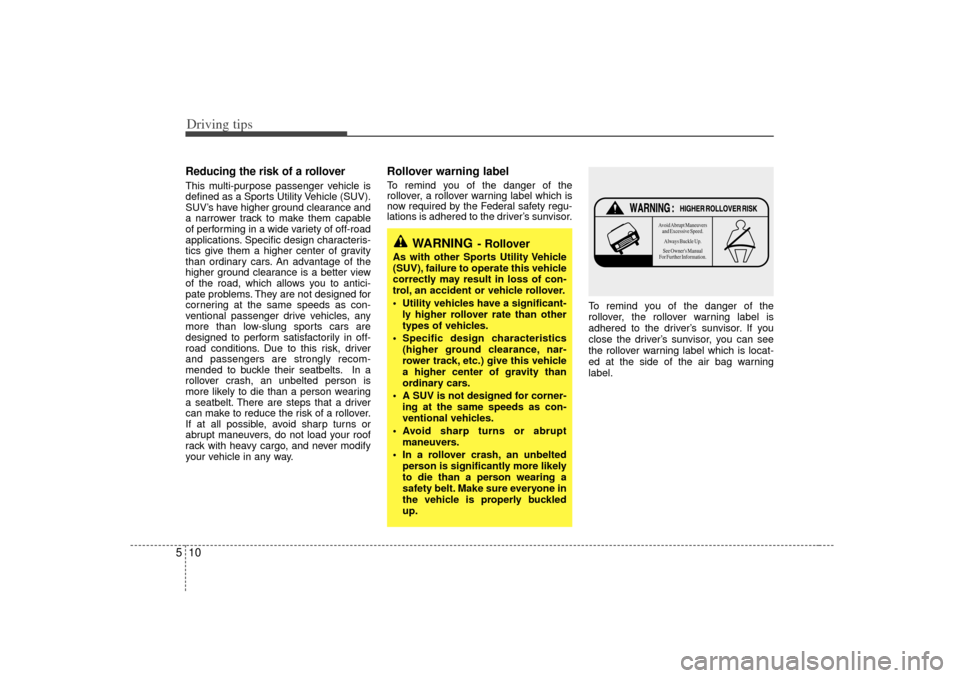
Rollover warning labelTo remind you of the danger of the
rollover, a rollover warning label which is
now required by the Federal safety regu-
lations is adhered to the driver’s sunvisor.
To remind you of the danger of the
rollover, the rollover warning label is
adhered to the driver’s sunvisor. If you
close the driver’s sunvisor, you can see
the rollover warning label which is locat-
ed at the side of the air bag warning
label.
WARNING
- Rollover
As with other Sports Utility Vehicle
(SUV), failure to operate this vehicle
correctly may result in loss of con-
trol, an accident or vehicle rollover.
Utility vehicles have a significant-ly higher rollover rate than other
types of vehicles.
Specific design characteristics (higher ground clearance, nar-
rower track, etc.) give this vehicle
a higher center of gravity than
ordinary cars.
A SUV is not designed for corner- ing at the same speeds as con-
ventional vehicles.
Avoid sharp turns or abrupt maneuvers.
In a rollover crash, an unbelted person is significantly more likely
to die than a person wearing a
safety belt. Make sure everyone in
the vehicle is properly buckled
up.
Avoid Abrupt Maneuversand Excessive Speed.
Always Buckle Up.
See Owner's Manual
For Further Information.
Page 219 of 325

511
Driving tips
USING FOUR-WHEEL DRIVEDriving on snow- or ice-covered
roads ("4HI, 4LO" for part-time
4WD operation or "AUTO" for full-
time 4WD operation) Use snow tires. See “Tires” in this sec-tion for more information.
Keep an adequate distance between yourself and other vehicles.
Avoid sudden braking, acceleration or steering. These actions can cause your
vehicle to lose traction.
Driving in sand or mud ("4HI,
4LO" for part-time 4WD operation
or "AUTO" for full-time 4WD oper-
ation) Avoid sudden braking, acceleration orsteering. These actions can cause your
vehicle to get stuck in the sand or mud.
Drive at low speeds whenever possi- ble.
You may need to get out of your vehi- cle at times to check road conditions.
If you get stuck in the sand or mud, try placing stones, wood or other similar
materials under the tires to get traction,
or move forward and backward repeat-
edly to get unstuck.
WARNING
- Traction
Make sure that no one stands in
front of or behind the tires when
materials are placed under the tires
to get more traction. The tires may
cause loose materials to fly out
from under the vehicle, potentially
causing serious bodily injury or
death.
CAUTION
Prolonged rocking may causeengine damage, overheating, trans-mission differential or transfer case damage or failure and tire damage.
Page 220 of 325

Driving tips12
5Driving on a hill ("4LO" for part-
time 4WD operation or "LOW" for
full-time 4WD operation) Use low gear when going uphill or
downhill and avoid sudden braking.
Do not shift gears or use your clutch when going downhill. Do not coast
downhill in Neutral.
Crossing a ditch ("4LO" for part-
time 4WD operation or "LOW" for
full-time 4WD operation) Avoid driving through ditches if possi-ble, especially if there is water in the
ditch. Your vehicle may stall if the elec-
trical system gets wet. If you must
cross a ditch, select 4LO or LOW
mode.
Avoid driving where the water level is higher than the bottom of the wheel
hub. If the water level rises above this
mark, your vehicle will need to be serv-
iced.
Tap lightly on the brake pedal during and after driving through water. This
will help keep the brakes dry and in
proper working order.
Do not shift gears while crossing a ditch.
Tight corner brake effectThis is called tight corner brake effect.
Tight corner brake effect is a unique
characteristic of four-wheel drive vehicles
caused by the difference in tire rotation at
the four wheels and the zero-degree
alignment of the front wheels and sus-
pension.
Sharp turns at low speeds should be car-
ried out with caution.
WARNING
- 4WD
When turning sharply on a paved
road at low speed while in four-
wheel drive, steering control will be
difficult.
Page 222 of 325

Driving tips14
5
Traveling to remote areasIt makes sense to plan your trip, espe-
cially when going to a remote area. Know
the terrain and plan your route. You are
much less likely to encounter unwanted
surprises. Get accurate maps of trails.
It’s also a good idea to travel with at least
one other vehicle. If something happens
to one of them, the other can quickly
help.
WARNING
- Cargo
Cargo piled close to the height of
(or higher than) the seat backs
can be thrown forward during a
sudden stop or on downhill
slopes. You or your passengers
could be severely injured. Keep
cargo below the top of the seat
backs and, if possible, do not pile
separate items.
Unsecured cargo in the cargo area can be tossed about when
driving on the highways or over
rough terrain. You or your passen-
gers can be struck by flying
objects and severely injured.
Secure the cargo properly.
(Continued)
(Continued)
Cargo should not be carried onthe roof without a proper roof
rack installed. The roof rack will
hold a maximum of 45 kg (100
lbs.). Heavy loads in a roof rack
raise the vehicle’s center of grav-
ity, making it more likely to roll
over. You can be seriously or
fatally injured if the vehicle rolls
over. Do not load cargo on the
roof while driving off-road, if at all
possible. Put heavy loads inside
the cargo area, not on the roof or
in a roof rack. Keep cargo in the
cargo area as far forward and low
as possible.
Page 223 of 325

515
Driving tips
Getting familiar with off-road drivingIt’s necessary for you to practice in an
area that’s safe and close to home before
you begin serious off-road driving. Off-
road driving requires new and different
driving skills.
You need to tune your senses to different
kinds of signals. For example, constantly
sweep the terrain with your eyes looking
for unexpected obstacles. Listen for
unusual tire, gear, or engine sounds. Feel
and respond to the vibrations of the vehi-
cle with your hands, feet, and body while
still carefully controlling your vehicle.
You’ll also need to adjust your expecta-
tions and greatly lower the number of
miles you expect to cover in an hour or a
day.
Controlling your vehicle is the key to suc-
cessful off-road driving. One of the best
ways to control your vehicle is to control
your speed. Here are some things to
keep in mind when traveling at higher
speeds:
You approach things faster and youhave less time to scan the terrain for
obstacles. You have less time to react.
You have much more vehicle bounce
when you drive over obstacles, giving
you less vehicle control.
You’ll need more distance for braking, especially since you’re on an unpaved
surface. Such terrain will always be
more “slippery” than a paved road. Scanning the terrain
Off-road driving can take you over many
different kinds of terrain. You need to be
familiar with the terrain and its many dif-
ferent features. Here are some things to
consider.
Surface conditionsOff-roading can take you over hard-
packed dirt, gravel, rocks, grass, sand,
mud, snow or ice. Each of these surfaces
affects the steering, acceleration, and
braking of your vehicle in different ways.
Depending upon the kind of surface you
are on, you may experience slipping,
sliding, wheel spinning, delayed acceler-
ation, poor traction, and longer braking
distances.
WARNING -
Off road driv-
ing
When you’re driving off-road,
bouncing and quick changes in
direction can easily throw you out
of position in your seat. This could
cause you to lose control of the
vehicle and crash. Whether you are
driving on or off the road, you and
your passengers should always
wear safety belts.