Page 608 of 1575
18.Remove the valve body (A) from the valve body housing (B) with a soft hammer.
19.Using the special tool, remove the oil seal and ballbearing from the valve body housing.
20. Remove the oil seal and O - ring from the rack housing.
Be careful not to damage the pinion valve cylinderinside of the rack housing.
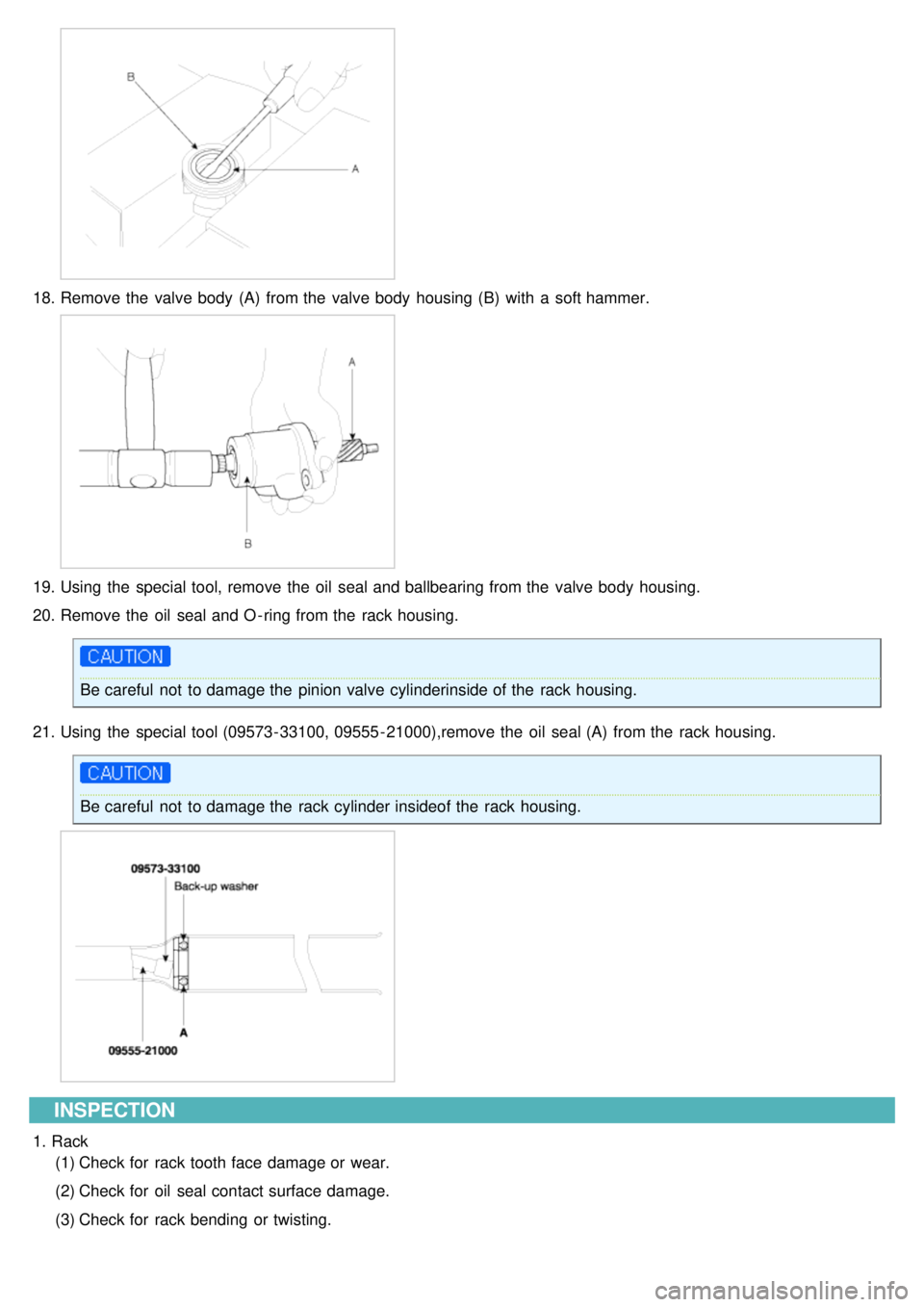
21. Using the special tool (09573- 33100, 09555 - 21000),remove the oil seal (A) from the rack housing.
Be careful not to damage the rack cylinder insideof the rack housing.
INSPECTION
1.Rack
(1) Check for rack tooth face damage or wear.
(2) Check for oil seal contact surface damage.
(3) Check for rack bending or twisting.
Page 609 of 1575
(4)Check for oil seal ring damage or wear.
(5) Check for oil seal damage or wear.
2.Pinion valve
(1) Check for pinion gear tooth face damage or wear.
(2) Check for oil seal contact surface damage.
(3) Check for seal ring damage or wear.
(4) Check for oil seal damage or wear.
3.Bearing
(1) Check for seizure or abnormal noise during abearing rotation.
(2) Check for excessive play.
(3) Check for missing needle bearing rollers.
4. Others
(1) Check for damage of the rack housing cylinder bore.
(2) Check for boot damage, cracking or aging.
REASSEMBLY
1.Apply the specified fluid to the entire surface of the rack oil seal.
Recommended fluid : PSF - 3
2. Install the backup washer and oil seal (A) to the specified position in the rack housing.
Page 625 of 1575
The pressure tube does not twist and come in contact with other components.
2. Add power steering fluid
3. Bleed the power steering system. (Refer to the air bleeding in ST group)
4. Check the oil pump pressure.
DISASSEMBLY
1.Remove two bolts from the oil pump body (A), and then remove the suction pipe (B) and O - ring.
2.Loosen the four bolts and remove the oil pump cover assembly (A) and the gasket.
3.Remove the rotor and vanes.
Page 628 of 1575
12.Remove the O - ring from the connector.
Do not disassemble the flow control valve.
INSPECTION
1.Check that the flow control valve is not bent.
2. Check the shaft for wear and damage.
3. Check the V belt for wear and deterioration.
4. Check the grooves of the rotor and vanes for stratified abrasion.
5. Check the contact surface of the cam ring and vanes for stratified abrasion.
6. Check vanes for damage.
7. Check that there is no striped wear in the side plate or contacting part between the shaft and the pump cover
surface.
REASSEMBLY
1.Install the flow control spring (B), the flow control valve (A) and the connector into the pump body.
2.Install the oil seal in the pump body by using the special tool (09222- 32100).
Page 649 of 1575

2007 > 2.7L V6 GASOLINE >
INSTRUCTIONS
WHEN HANDLING REFRIGERANT
1. R- 134a liquid refrigerant is highly volatile. A drop on the skin of your hand could result in localized frostbite. When
handling the refrigerant, be sure to wear gloves.
2. It is standard practice to wear goggles or glasses to protect your eyes, and gloves to protect your hands. If the
refrigerant splashes into your eyes, wash them with clean water immediately.
3. The R- 134a container is highly pressurized. Never leave it in a hot place, and check that the storage temperature
is below 52°C (126°F)
4. An electronic leak detector should be used to check the system for refrigerant leakage. Bear in mind that the R-
134a, upon coming into contact with flame, produces phosgene, a highly toxic gas.
5. Use only recommended the lubricant for R- 134a systems. If lubricants other than the recommended one used,
system failure may occur.
6. PAG lubricant absorbs moisture from the atmosphere at a rapid rate, therefore the following precautions must be
observed:
a. When removing refrigerant components from a vehicle, cap immediately the components to prevent from the
entry of moisture.
b. When installing refrigerant components to a vehicle, do not remove the cap until just before connecting the
components.
c. Complete the connection of all refrigerant tubes and hoses without delay to prevent the A/C system from taking
on moisture.
d. Use the recommended lubricant from a sealed container only.
7. If an accidental discharge in the system occurs, ventilate the work area before resuming service.
WHEN REPLACING PARTS ON A/C SYSTEM
1.Never open or loosen a connection before discharging the system.
2. Seal the open fittings of components with a cap or plug immediately to prevent intrusion of moisture or dust.
3. Do not remove the sealing caps from a replacement component until it is ready to be installed.
4. Before connecting an open fitting, always install a new sealing ring. Coat the fitting and seal with refrigerant oil
before making the connection.
WHEN INSTALLING CONNECTING PARTS
FLANGE WITH GUIDE PIN
Page 650 of 1575

FLANGE WITH GUIDE PIN
Check the new O - ring for damage (use only the specified) and lubricate it using compressor oil. Tighten the nut to
specified torque.
Size Tightening torque [ N.m (kg.m, lbf.ft) ]
General bolt, nut
4T 7T
M6 5 - 6(0.5 - 0.6, 3.6 - 4.3) 9 - 11(0.9 - 1.1, 6.5 - 7.9)a
M8 12- 14(1.2 - 1.4, 8.7 - 10) 20 - 26 (2.0 - 2.6, 14 - 18)
M10 25 - 28 (2.5 - 2.8, 18 - 20) 45 - 55 (4.5 - 5.5, 32 - 39)
Size Flange bolt, nut
4T 7T
M6 5 - 7(0.5 - 0.7, 3.6 - 5.0) 8 - 12(0.8 - 1.2, 5.8 - 8.6)
M8 10- 15(1.0 - 1.5, 7 - 10) 19 - 28 (1.9 - 2.8, 14 - 20)
M10 21 - 31 (2.1 - 3.1, 15 - 22) 39 - 60 (3.9 - 6.0, 28 - 43)
HANDLING TUBING AND FITTINGS
The internal parts of the refrigeration system will remain in a state of chemical stability as long as pure moisture- free
refrigerant and refrigerant oil are used. Abnormal amounts of dirt, moisture or air can upset the chemical stability and
cause problems or serious damage.
THE FOLLOWING PRECAUTIONS MUST BE OBSERVED
1. When it is necessary to open the refrigeration system, have everything you will need to service the system ready so
the system will not be left open any longer than necessary.
2. Cap or plug all lines and fittings as soon as they are opened to prevent the entrance of dirt and moisture.
3. All lines and components in parts stock should be capped or sealed until they are ready to be used.
4. Never attempt to rebind formed lines to fit. Use the correct line for the installation you are servicing.
5. All tools, including the refrigerant dispensing manifold, the gauge set manifold and test hoses, should be kept clean
and dry.
Page 655 of 1575

Additional health and safety information may be obtained from the refrigerant and lubricant manufacturers.1. When an A/C System has been opened to the atmosphere, such as during installation or repair, it must be
evacuated using an R- 134a refrigerant Recovery/Recycling/Charging System. (If the system has been open for
several days, the receiver/dryer should be replaced, and the system should be evacuated for several hours.)
2. Connect an R- 134a refrigerant Recovery/Recycling/Charging System (A) to the high- pressure service port (B) and
the low- pressure service port (C) as shown, following the equipment manufacturer's instructions.
3.If the low- pressure does not reach more than 93.3 kPa (700 mmHg, 27.6 in.Hg) in 10 minutes, there is probably a
leak in the system. Partially charge the system, and check for leaks (see Leak Test.).
4. Remove the low pressure valve from the low- pressure service port.
SYSTEM CHARGING
Use only service equipment that is U.L - listed and is certified to meet the requirements of SAE J2210 to remove HFC-
134a(R- 134a) from the air conditioning system.
a.Air conditioning refrigerant or lubricant vapor can irritate your eyes, nose, or throat.
b. Be careful when connecting service equipment.
c. Do not breathe refrigerant or vapor.
If accidental system discharge occurs, ventilate work area before resuming service.
Additional health and safety information may be obtained from the refrigerant and lubricant manufacturers. 1. Connect an R- 134a refrigerant Recovery/Recycling/Charging System (A) to the high- pressure service port (B) as
shown, following the equipment manufacturer's instructions.
2.Add the same amount of new refrigerant oil to system that was removed during recovery. Use only specified
refrigerant oil. Charge the system with 28.21 ± 0.88 oz. (800 ± 25g) of R- 134a refrigerant. Do not overcharge the
system the compressor will be damaged.
REFRIGERANT LEAK TEST
Always conduct a leak test with an electronic leak detector whenever leakage or refrigerant is suspected and when
conducting service operations which are accompanied by disassembly or loosening or connection fittings.
Page 656 of 1575
In order to use the leak detector properly, read the manual supplied by the manufacturer.
If a gas leak is detected, proceed as follows: 1. Check the torque on the connection fittings and, if too loose, tighten to the proper torque. Check for gas leakage
with a leak detector (A).
2. If leakage continues even after the fitting has been tightened, discharge the refrigerant from the system, disconnect
the fittings, and check their seating faces for damage. Always replace, even if the damage is slight.
3. Check the compressor oil and add oil if required.
4. Charge the system and recheck for gas leaks. If no leaks are found, evacuate and charge the system again.