Page 927 of 1575
4FR Wheel speed sensor FR WHEELKm/h
5 RL Wheel speed sensor RL WHEELKm/h
6 RR Wheel speed sensor RR WHEELKm/h
7 ABS Warning lamp ABS LAMP-
8 EBD Warning lamp EBD LAMP-
9 Brake Lamp B/LAMP-
10 Pump relay state PUMP RLY-
11 Valve relay state VALVE RLY-
12 Motor MOTOR-
13 Front Left valve(IN) FL INLET-
14 Front Right valve (IN) FR INLET-
15 Rear Left valve (IN) RL INLET-
16 Rear Right valve (IN) RR INLET-
17 Front Left valve (OUT) FL OUTLET-
18 Front Right valve (OUT) FR OUTLET-
19 Rear Left valve(OUT) RL OUTLET-
20 Rear Right valve (OUT) RR OUTLET-
Page 928 of 1575
2007 > 2.7L V6 GASOLINE >
DESCRIPTION
This specification applies to HCU(Hydraulic Control Unit) and ECU(Electronic Control Unit) of the HECU.(Hydraulic and
Electronic Control Unit)
This specification is for the wiring design and installation of ABS/TCS/ESC ECU.
This unit has the functions as follows.
a. Input of signal from Pressure sensor, Steering angle sensor, Yaw & Lateral G sensor, the wheel speed sensors
attached to each wheel.
b. Control of braking force / traction force/ yaw moment.
c. Failsafe function.
d. Self diagnosis function.
e. Interface with the external diagnosis tester.
Installation position : engine compartment a. Brake tube length from Master cylinder port to HECU inlet port should be max. 1m
b. The position should not be close to the engine block and not lower than the wheel.
OPERATION
The ECU shall be put into operation by switching on the operating voltage (IGN).
On completion of the initialization phase, the ECU shall be ready for operation.
In the operating condition, the ECU shall be ready, within the specified limits (voltage and temperature), to process the
signals offered by the various sensors and switches in accordance with the control algorithm defined by the software
and to control the hydraulic and electrical actuators.
Wheel Sensor signal processing
The ECU shall receive wheel speed signal from the four active wheel sensors.
The wheel signals are converted to voltage signal by the signal conditioning circuit after receiving current signal from
active wheel sensors and given as input to the MCU.
Solenoid Valve Control
When one side of the valve coil is connected to the positive voltage that is provided through the valve relay and the
other side is connected to the ground by the semiconductor circuit, the solenoid valve goes into operation.
The electrical function of the coils are always monitored by the valve test pulse under normal operation conditions.
Voltage limits
a.Overvoltage
When overvoltage is detected(above 16.8 V), the ECU switches off the valve relay and shuts down the system.
When voltage is returned to operating range, the system goes back to the normal condition after the initialization
phase.
b. Undervoltage
In the event of undervoltage(below 9.3 V), ABS control shall be inhibited and the warning lamp shall be turned on.
When voltage is returned to operating range, the warning lamp is switched off and ECU returns to normal operating
mode.
Pump Motor Checking
The ECU performs a pump motor test at a speed of 15km/h once after IGN is switched on.
Diagnostic Interface
Failures detected by the ECU are encoded on the ECU, stored in a EEPROM and read out by diagnostic equipment
when the ignition switch is turned on.
The diagnosis interface can also be used for testing the ECU during production of the ECU and for actuating the HCU
(Air - bleeding line or Roll and Brake Test line).
Warning Lamp module
Page 929 of 1575

1.ABS WARNING LAMP MODULE
The active ABS warning lamp module indicates the selftest and failure status of the ABS.The ABS warning lamp
shall be on:
a. During the initialization phase after IGN ON. (continuously 3 seconds).
b. In the event of inhibition of ABS functions by failure.
c. During diagnostic mode.
d. When the ECU Connector is seperated from ECU.
2. PARKING/EBD WARNING LAMP MODULE
The active EBD warning lamp module indicates the selftest and failure status of the EBD.However, in case the
Parking Brake Switch is turned on, the EBD warning lamp is always turned on regardless of EBD functions.The
EBD warning lamp shall be on:
a. During the initialization phase after IGN ON. (continuously 3 seconds).
b. When the Parking Brake Switch is ON or brake fluid level is low.
c. When the EBD function is out of order.
d. During diagnostic mode.
e. When the ECU Connector is seperated from ECU.
ABS CONTROL
1.NORMAL BRAKING without ABS
Inlet valve(EV)Outlet valve(AV)Pump motor
Operation OpenCloseOFF
Page 934 of 1575

2007 > 2.7L V6 GASOLINE >
STANDARD FLOW OF DIAGNOSTIC TROUBLESHOOTING
NOTES WITH REGARD TO DIAGNOSIS
The phenomena listed in the following table are not abnormal.
Phenomenon Explanation
System check sound When starting the engine, a thudding sound can sometimes be heard coming
from inside the engine compartment. This is because the system operation check
is being performed.
ABS operation sound a.Sound of the motor inside the ABS hydraulic unit operation (whine).
b. Sound is generated along with vibration of the brake pedal (scraping).
c. When ABS operates, sound is generated from the vehicle chassis due to
repeated brake application and release
(Thump : suspension; squeak: tires)
ABS operation (Long braking
distance) For road surfaces such as snow- covered and gravel roads, the braking distance
for vehicles with ABS can sometimes be longer than that for other vehicles.
Accordingly, advise the customer to drive safely on such roads by lowering the
vehicle speed.
Diagnosis detection conditions can vary depending on the diagnosis code. When checking the trouble symptom after
the diagnosis code has been erased, ensure that the requirements listed in "Comment" are met.
SCAN TOOL (PRO) CHECK
1. Turn the ignition switch OFF.
2. Connector the Scan tool to the 16P data link connector located the driver's side kick panel.
Page 935 of 1575
3.Turn the ignition switch ON.
4. Check for DTC using the Scan tool
5. After completion trouble of the repair or correction of the problem, erase the stored fault codes using the scan tool.
6. Disconnect the Scan tool from the 16P data link connector.
ABS CHECK SHEET
Page 936 of 1575
PROBLEM SYMPTOMS TABLE
SymptomSuspect Area
ABS does not operate. Only when 1. - 4. are all normal and the problem is still
occurring, replace the HECU.
a. Check the DTC reconfirming that the normal code is
output.
b. Power source circuit.
c. Speed sensor circuit.
d. Check the hydraulic circuit for leakage.
ABS does not operate intermittently. Only when 1. - 4. are all normal and the problem is still
occurring, replace the ABS actuator assembly.
a. Check the DTC reconfirming that the system is
operating to specifications.
b. Wheel speed sensor circuit.
Page 937 of 1575

c.Stop lamp switch circuit.
d. Check the hydraulic circuit for leakage.
Communication with Scan tool is not possible.
(Communication with any system is not possible) a.
Power source circuit
b. Diagnosis line
Communication with Scan tool is not possible.
(Communication with ABS only is not possible) a.
Power source circuit
b. Diagnosis line
c. HECU
When ignition key is turned ON (engine OFF), the ABS
warning lamp does not light up. a.
ABS warning lamp circuit
b. HECU
Even after the engine is started, the ABS warning lamp
remains ON. a.
ABS warning lamp circuit
b. HECU
During ABS operation, the brake pedal may vibrate or may not be able to be depressed. Such phenomena are
due to intermittent changes in hydraulic pressure inside the brake line to prevent the wheels from locking and is
not an abnormality.
DETECTING CONDITION
Trouble Symptoms Possible Cause
Brake operation varies depending on driving conditions and road
surface conditions, so diagnosis can be difficult.However if a normal
DTC is displayed, check the following probable cause. When the
problem is still occurring, replace the ABS control module. a.
Inoperative power source circuit
b. Inoperative wheel speed sensor circuit
c. Inoperative hydraulic circuit for leakage
d. Inoperative HECU
INSPECTION PROCEDURES
DTC INSPECTION
1. Connect the Scan Tool with the data link connector and turn the ignition switch ON.
2. Verify that the system is operating to specifications.
Is the system operating to specifications ?
▶ Check the power source circuit.
▶ Erase the DTC and recheck using Scan Tool.
CHECK THE POWER SOURCE CIRCUIT.
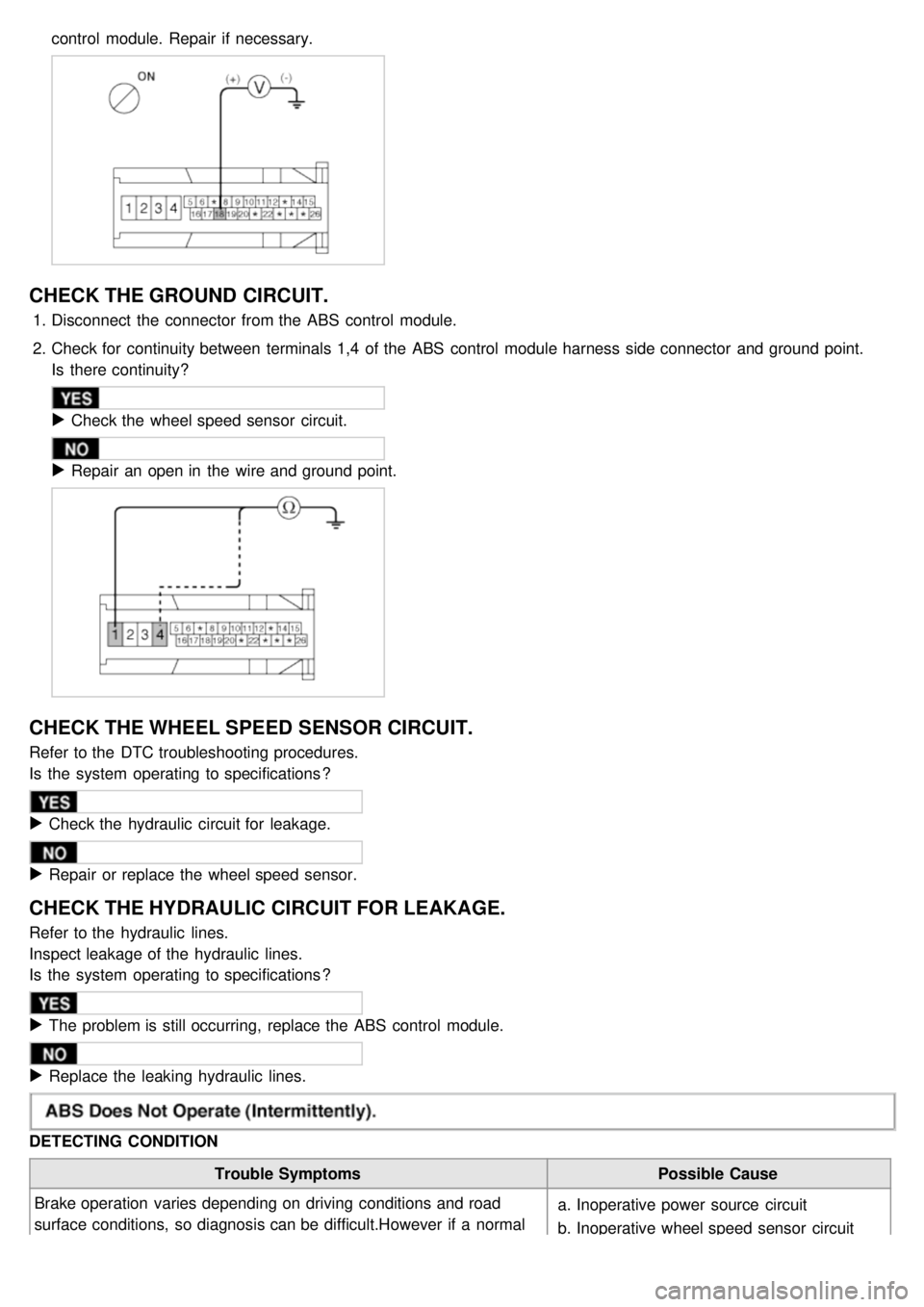
1. Disconnect the connector from the ABS control module.
2. Turn the ignition switch ON, measure the voltage between terminal 18 of the ABS control module harness side
connector and body ground.
Specification: approximately B+
Is the voltage within specification?
▶ Check the ground circuit.
▶ Check the harness or connector between the fuse (10A) in the engine compartment junction block and the ABS
control module. Repair if necessary.
Page 938 of 1575
control module. Repair if necessary.
CHECK THE GROUND CIRCUIT.
1.Disconnect the connector from the ABS control module.
2. Check for continuity between terminals 1,4 of the ABS control module harness side connector and ground point.
Is there continuity?
▶ Check the wheel speed sensor circuit.
▶ Repair an open in the wire and ground point.
CHECK THE WHEEL SPEED SENSOR CIRCUIT.
Refer to the DTC troubleshooting procedures.
Is the system operating to specifications ?
▶ Check the hydraulic circuit for leakage.
▶ Repair or replace the wheel speed sensor.
CHECK THE HYDRAULIC CIRCUIT FOR LEAKAGE.
Refer to the hydraulic lines.
Inspect leakage of the hydraulic lines.
Is the system operating to specifications ?
▶ The problem is still occurring, replace the ABS control module.
▶ Replace the leaking hydraulic lines.
DETECTING CONDITION
Trouble Symptoms Possible Cause
Brake operation varies depending on driving conditions and road
surface conditions, so diagnosis can be difficult.However if a normal
DTC is displayed, check the following probable cause. When the a.
Inoperative power source circuit
b. Inoperative wheel speed sensor circuit


