2007 KIA CARNIVAL wiring
[x] Cancel search: wiringPage 131 of 1575

2007 > 2.7L V6 GASOLINE >
REMOVAL
INTAKE MANIFOLD ASSEMBLY
1. Remove the engine cover.
2. Remove the intake air hose and air cleaner assembly.
(1) Disconnect the MAF connector(A).
(2) Disconnect the breather hose(B) from air cleaner hose.
(3) Remove the intake air hose and air cleaner assembly(C).
3.Disconnect the engine wiring harness connectors.
(1) Disconnect the No.1/No.2 knock sensor connectors(A,B), the oil pressure switch connector(C), the ignition coil
harness(D) and the No.1 VIS(Variable Induction System) connector(E).
(2)Disconnect the bank 1 front/rear O2 sensor connectors(A).
(3)Disconnect the injection connectors(A,B,C), the ground lines(D), the condensor connector(E) and the Ignition
coil connectors(F).
Page 144 of 1575

2.After pressing ENTER key, start the engine.
3.Cranking voltage and starter test results will be displayed on the screen.
Take a relevant action according to the test results by referring to the starter test results as given below.
4.To continue charging system test, press ENTER.
STARTER TEST RESULTS
RESULT ON PRINTER REMEDY
Cranking voltage normal System shows a normal starter draw
Cranking voltage low Cranking voltage is lower than normal level
=> Check starter
Charge battery The state of battery charge is too low to test
=>Charge the battery and
retest
Replace battery => Replace battery
=> If the vehicle is not started though the battery
condition of "Good and fully charged" is displayed.
=> Check wiring for open circuit, battery cable connection,
starter and repair or replace as necessary.
CHARGING SYSTEM TEST PROCEDURE
1.
Press ENTER to begin charging system test.
Page 149 of 1575

2007 > 2.7L V6 GASOLINE >
TROUBLE SHOOTING
IGNITION SYSTEM
Symptom Suspect area Remedy
Engine will not start or
is hard to start
(Cranks OK) Ignition lock switch
Inspect ignition lock switch, or replace as required
Ignition coil Inspect ignition coil, or replace as required
Spark plugs Inspect spark plugs, or replace as required
Ignition wiring disconnected or broken Repair wiring, or replace as required
Rough idle or stalls Ignition wiring Repair wiring, or replace as required
Ignition coil Inspect ignition coil, or replace as required
Engine hesitates/poor
acceleration Spark plugs and spark plug cables
Inspect spark plugs / cable, or replace as required
Ignition wiring Repair wiring, or replace as required
Poor mileage Spark plugs and spark plug cables Inspect spark plugs / cable, or replace as required
CHARGING SYSTEM Symptom Suspect area Remedy
Charging warning
indicator does not
light with ignition
switch "ON" and
engine off. Fuse blown
Check fuses
Light burned out Replace light
Wiring connection loose Tighten loose connection
Electronic voltage regulator Replace voltage regulator
Charging warning
indicator does not go
out with engine
running. (Battery
requires frequent
recharging) Drive belt loose or worn
Adjust belt tension or replace belt
Battery cable loose, corroded or worn Inspect cable connection, repair or replace
cable
Electronic voltage regulator or alternator Replace voltage regulator or alternator
Wiring Repair or replace wiring
Overcharge Electronic voltage regulator Replace voltage regulator
Voltage sensing wire Repair or replace wiring
Discharge Drive belt loose or worn Adjust belt tension or replace belt
Wiring connection loose or short circuit Inspect wiring connection, repair or replace
wiring
Electronic voltage regulator or alternator Replace voltage regulator or alternator
Poor grounding Inspect ground or repair
Worn battery Replace battery
STARTING SYSTEM Symptom Suspect area Remedy
Engine will not crank Battery charge low Charge or replace battery
Battery cables loose, corroded or
worn out Repair or replace cables
Transaxle range switch (Vehicle with
automatic transaxle only) Refer to TR group - automatic transaxle
Page 150 of 1575

Fuse blownReplace fuse
Starter motor faulty Replace
Ignition switch faulty Replace
Engine cranks slowly Battery charge low Charge or replace battery
Battery cables loose, corroded or
worn out Repair or replace cables
Starter motor faulty Replace
Starter keeps running Starter motor Replace
Ignition switch Replace
Starter spins but engine will not
crank Short in wiring
Repair wiring
Pinion gear teeth broken or starter
motor Replace
Ring gear teeth broken Replace fly wheel or torque converter
Page 160 of 1575

2007 > 2.7L V6 GASOLINE >
ON-VEHICLE INPECTION
a.Check that the battery cables are connected to the correct terminals.
b. Disconnect the battery cables when the battery is given a quick charge.
c. Never disconnect the battery while the engine is running.
CHECK BATTERY VOLTAGE
1.If 20 minutes have not passed since the engine was stopped, turn the ignition switch ON and turn on the electrical
system (headlamp, blower motor, rear defogger etc.) for 60 seconds to remove the surface charge.
2. Turn the ignition switch OFF and turn off the electrical systems.
3. Measure the battery voltage between the negative ( - ) and positive (+) terminals of the battery.
Standard voltage : 12.5 ~ 12.9V at 20°C(68°F)
If the voltage is less than specification, charge the battery.
CHECK THE BATTERY TERMINALS AND FUSES
1.Check that the battery terminals are not loose or corroded.
2. Check the fuses for continuity.
INSPECT DRIVE BELT
Visually check the belt for excessive wear, frayed cords etc.
If any defect has been found, replace the drive belt.
Cracks on the rib side of a belt are considered acceptable. If the belt has chunks missing from the ribs, it should
be replaced.
VISUALLY CHECK ALTERNATOR WIRING AND LISTEN FOR ABNORMAL NOISES
1.Check that the wiring is in good condition.
2. Check that there is no abnormal noise from the alternator while the engine is running.
CHECK DISCHARGE WARNING LIGHT CIRCUIT
1.Warm up the engine and then turn it off.
2. Turn off all accessories.
3. Turn the ignition switch "ON". Check that the discharge warning light is lit.
4. Start the engine. Check that the light is lit.
If the light does not go off as specified, troubleshoot the discharge light circuit.
INSPECT CHARGING SYSTEM
VOLTAGE DROP TEST OF ALTERNATOR OUTPUT WIRE
This test determines whether or not the wiring between the alternator "B" terminal and the battery (+) terminal is good
by the voltage drop method.
PREPARATION
Page 161 of 1575

1.Turn the ignition switch to "OFF".
2. Disconnect the output wire from the alternator "B" terminal. Connect the (+) lead wire of ammeter to the "B"
terminal of alternator and the ( - ) lead wire of ammeter to the output wire. Connect the (+) lead wire of voltmeter to
the "B" terminal of alternator and the ( - ) lead wire of voltmeter to the (+) terminal of battery.
TEST
1.Start the engine.
2. Turn on the headlamps and blower motor, and set the engine speed until the ammeter indicates 20A.
And then, read the voltmeter at this time.
RESULT
1.The voltmeter may indicate the standard value.
Standard value: 0.2V max
2. If the value of the voltmeter is higher than expected (above 0.2V max.), poor wiring is suspected. In this case
check the wiring from the alternator "B" terminal to the battery (+) terminal. Check for loose connections, color
change due to an over - heated harness, etc. Correct them before testing again.
3. Upon completion of the test, set the engine speed at idle.
Turn off the headlamps, blower motor and the ignition switch.
OUTPUT CURRENT TEST
This test determines whether or not the alternator gives an output current that is equivalent to the normal output.
PREPARATION
1.Prior to the test, check the following items and correct as necessary.
Check the battery installed in the vehicle to ensure that it is good condition. The battery checking method is
described in the section "Battery".
The battery that is used to test the output current should be one that has been partially discharged. With a fully
charged battery, the test may not be conducted correctly due to an insufficient load.
Check the tension of the alternator drive belt. The belt tension check method is described in the section "Inspect
drive belt".
2. Turn off the ignition switch.
3. Disconnect the battery ground cable.
4. Disconnect the alternator output wire from the alternator "B" terminal.
5. Connect a DC ammeter (0 to 150A) in series between the "B" terminal and the disconnected output wire. Be sure
to connect the ( - ) lead wire of the ammeter to the disconnected output wire.
Tighten each connection securely, as a heavy current will flow. Do not rely on clips.
6. Connect a voltmeter (0 to 20V) between the "B" terminal and ground. Connect the (+) lead wire to the alternator "B"
terminal and ( - ) lead wire to a good ground.
7. Attach an engine tachometer and connect the battery ground cable.
8. Leave the engine hood open.
Page 224 of 1575
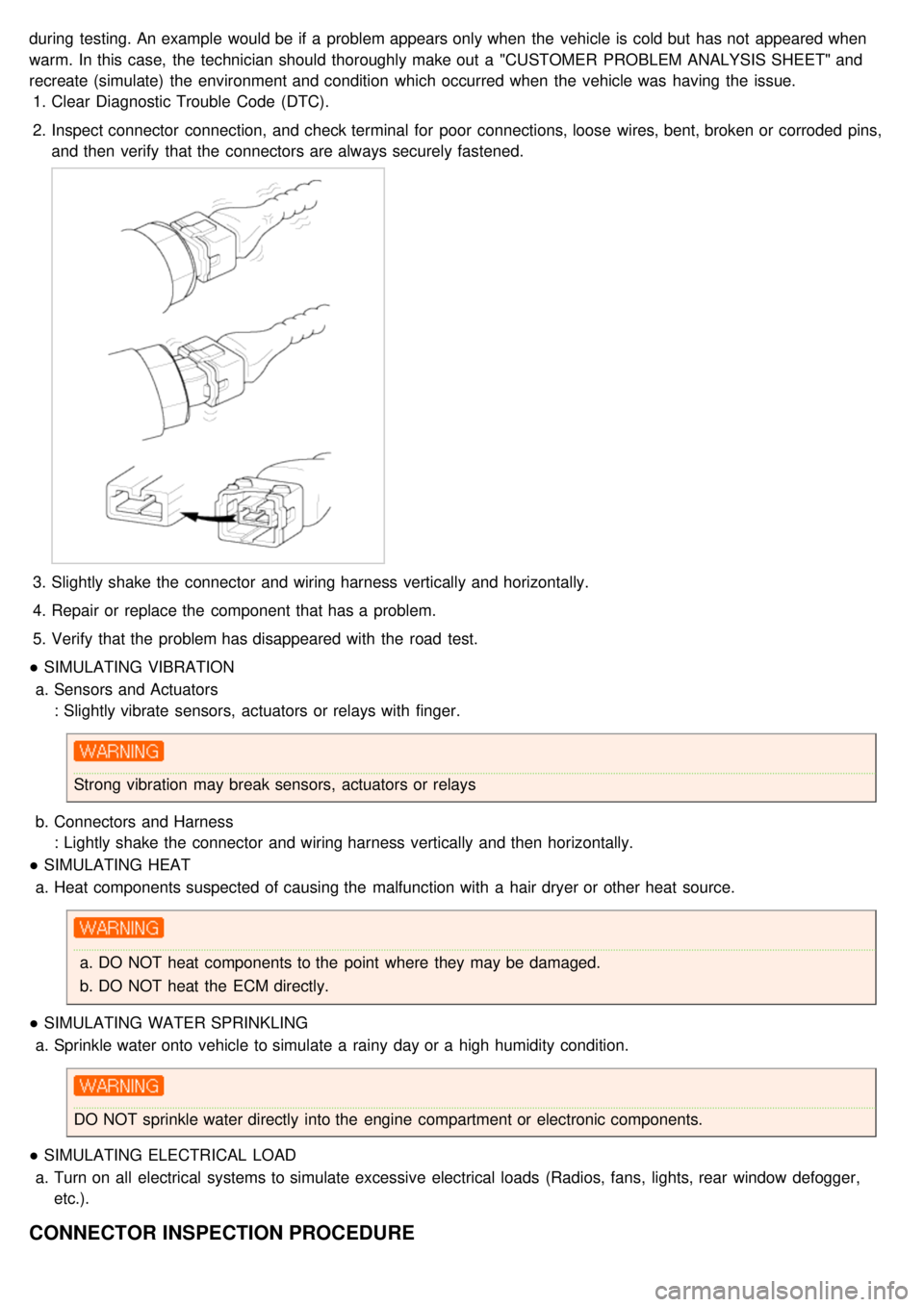
during testing. An example would be if a problem appears only when the vehicle is cold but has not appeared when
warm. In this case, the technician should thoroughly make out a "CUSTOMER PROBLEM ANALYSIS SHEET" and
recreate (simulate) the environment and condition which occurred when the vehicle was having the issue.1. Clear Diagnostic Trouble Code (DTC).
2. Inspect connector connection, and check terminal for poor connections, loose wires, bent, broken or corroded pins,
and then verify that the connectors are always securely fastened.
3.Slightly shake the connector and wiring harness vertically and horizontally.
4. Repair or replace the component that has a problem.
5. Verify that the problem has disappeared with the road test.
● SIMULATING VIBRATION
a. Sensors and Actuators
: Slightly vibrate sensors, actuators or relays with finger.
Strong vibration may break sensors, actuators or relays
b. Connectors and Harness
: Lightly shake the connector and wiring harness vertically and then horizontally.
● SIMULATING HEAT
a. Heat components suspected of causing the malfunction with a hair dryer or other heat source.
a.DO NOT heat components to the point where they may be damaged.
b. DO NOT heat the ECM directly.
● SIMULATING WATER SPRINKLING
a. Sprinkle water onto vehicle to simulate a rainy day or a high humidity condition.
DO NOT sprinkle water directly into the engine compartment or electronic components.
● SIMULATING ELECTRICAL LOAD
a. Turn on all electrical systems to simulate excessive electrical loads (Radios, fans, lights, rear window defogger,
etc.).
CONNECTOR INSPECTION PROCEDURE
Page 225 of 1575

1.Handling of Connector
a. Never pull on the wiring harness when disconnecting connectors.
b.When removing the connector with a lock, press or pull locking lever.
c.Listen for a click when locking connectors. This sound indicates that they are securely locked.
d.When a tester is used to check for continuity, or to measure voltage, always insert tester probe from wire
harness side.