2007 JEEP PATRIOT check engine light
[x] Cancel search: check engine lightPage 178 of 440
25. OFF ROAD Light Ð If Equipped
The symbol illuminates (is armed) when the 4WD lock
switch is activated and the transmission range indicator
is in Low or Reverse position.
26. Malfunction Indicator Light
This light is part of an onboard diagnostic system
called OBD that monitors emissions, engine, and
automatic transmission control systems. The light
will illuminate when the key is in the ON/RUN position
before engine start. If the bulb does not come on when
turning the key from OFF to ON/RUN, have the condi-
tion checked promptly.
Certain conditions such as a loose or missing gas cap,
poor fuel quality, etc. may illuminate the light after
engine start. The vehicle should be serviced if the light
stays on through several of your typical driving cycles. In
most situations the vehicle will drive normally and will
not require towing.If the Malfunction Indicator Light flashes when the
engine is running, serious conditions may exist that
could lead to immediate loss of power or severe catalytic
converter damage. The vehicle should be serviced as
soon as possible if this occurs.
27. Hill Descent Control Light Ð If Equipped
The symbol illuminates (is armed) when the
4WD lock switch is activated and the transmis-
sion range indicator is in Low or Reverse
position (Off Road Mode).
28. Front Fog Light Indicator Ð If Equipped
This light shows when the front fog lights are ON.
UNDERSTANDING YOUR INSTRUMENT PANEL 177
4
Page 179 of 440
29. Electronic Stability Program (ESP) Indicator
Light/Traction Control System (TCS) Indicator Light Ð
If Equipped
If this indicator light flashes during accelera-
tion, apply as little throttle as possible. While
driving, ease up on the accelerator. Adapt your
speed and driving to the prevailing road con-
ditions, and do not switch off the ESP, or TCS Ð if
equipped.
30. Electronic Stability Program (ESP) Indicator Light
The malfunction lamp for the ESP is combined
with BAS. The yellow ªESP/BAS Warning
Lampº comes on when the ignition switch is
turned to the ªONº position. They should go
out with the engine running. If the ªESP/BAS Warning
Lampº comes on continuously with the engine running,
a malfunction has been detected in either the ESP or the
BAS system. If this light remains on after several ignitioncycles, and the vehicle has been driven several miles at
speeds greater than 30 mph (48 km/h), see your autho-
rized dealer as soon as possible.
31.4WD!Malfunction Light
This light monitors the Four -Wheel-Drive
(4WD) system. The light will come on, for a
bulb check, when the ignition key is turned to
the ON position and may stay on for as long as
3 seconds.
When lit solid:There is an 4WD system fault. 4WD
performance will be at a reduced level. Service the 4WD
system soon.
When blinking:The 4WD system is temporarily dis-
abled due to overload condition.
178 UNDERSTANDING YOUR INSTRUMENT PANEL
Page 273 of 440
BRAKE SYSTEM
Your vehicle is equipped with power assisted brakes as
standard equipment. In the event power assist is lost for
any reason (for example, repeated brake applications
with the engine off), the brakes will still function. How-
ever, the effort required to brake the vehicle will be much
greater than that required with the power system oper-
ating.
WARNING!
Riding the brakes can lead to brake failure and
possibly an accident. Driving with your foot resting
or riding on the brake pedal can result in abnormally
high brake temperatures, excessive lining wear, and
possible brake damage. You wouldn't have your full
braking capacity in an emergency.If either of the two hydraulic systems lose normal capa-
bility, the remaining system will still function with some
loss of overall braking effectiveness. This will be evident
by increased pedal travel during application and greater
pedal force required to slow or stop. In addition, if the
malfunction is caused by an internal leak, as the brake
fluid in the master cylinder drops, the brake warning
indicator will light.
WARNING!
Driving a vehicle with the brake light on is danger-
ous. A significant decrease in braking performance or
vehicle stability during braking may occur. It will
take you longer to stop the vehicle or will make your
vehicle harder to control. You could have an accident.
Have the vehicle checked immediately.
272 STARTING AND OPERATING
Page 322 of 440
Towing Tips Ð Automatic Transmission
The automatic transmission fluid and filter should be
changed if you REGULARLY tow a trailer for more than
45 minutes of continuous operation. See Schedule ªBº in
section 8 of this manual for transmission fluid change
intervals.
NOTE:Check the automatic transmission fluid level
before towing.
Towing Tips Ð Electronic Speed Control (If
Equipped)
þ
Don't use in hilly terrain or with heavy loads.
þWhen using the speed control, if you experience speed
drops greater than 10 mph (16 km/h), disengage until
you can get back to cruising speed.
þUse speed control in flat terrain and with light loads to
maximize fuel efficiency.
Towing Tips Ð Cooling System
To reduce potential for engine and transmission over-
heating, take the following actions:
þCity Driving
When stopped for short periods of time, put transmission
in neutral but do not increase engine idle speed.
þHighway Driving
Reduce speed.
þAir Conditioning
Turn off temporarily.
þrefer to Cooling System Operating information in the
Maintenance section of this manual for more informa-
tion.
STARTING AND OPERATING 321
5
Page 345 of 440
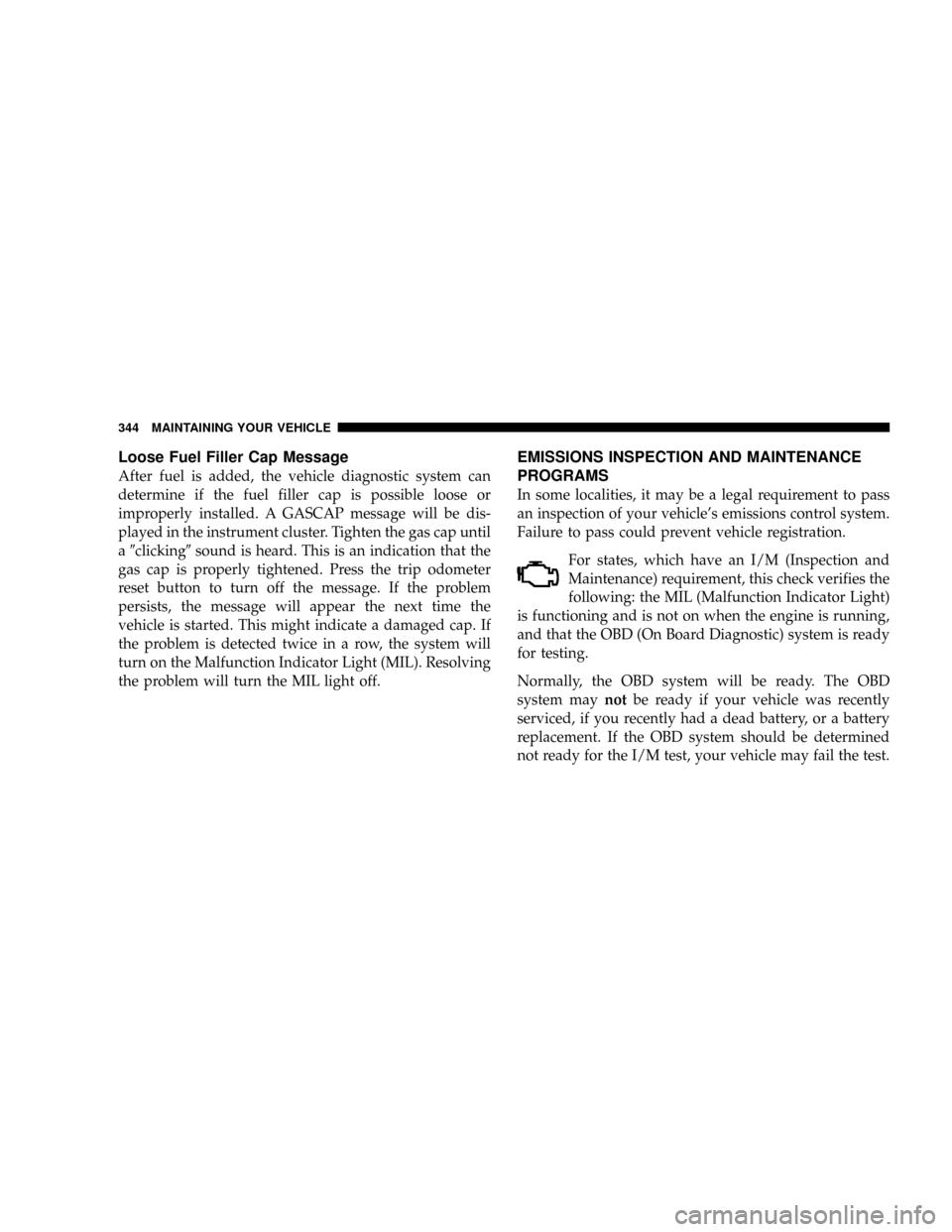
Loose Fuel Filler Cap Message
After fuel is added, the vehicle diagnostic system can
determine if the fuel filler cap is possible loose or
improperly installed. A GASCAP message will be dis-
played in the instrument cluster. Tighten the gas cap until
a9clicking9sound is heard. This is an indication that the
gas cap is properly tightened. Press the trip odometer
reset button to turn off the message. If the problem
persists, the message will appear the next time the
vehicle is started. This might indicate a damaged cap. If
the problem is detected twice in a row, the system will
turn on the Malfunction Indicator Light (MIL). Resolving
the problem will turn the MIL light off.
EMISSIONS INSPECTION AND MAINTENANCE
PROGRAMS
In some localities, it may be a legal requirement to pass
an inspection of your vehicle's emissions control system.
Failure to pass could prevent vehicle registration.
For states, which have an I/M (Inspection and
Maintenance) requirement, this check verifies the
following: the MIL (Malfunction Indicator Light)
is functioning and is not on when the engine is running,
and that the OBD (On Board Diagnostic) system is ready
for testing.
Normally, the OBD system will be ready. The OBD
system maynotbe ready if your vehicle was recently
serviced, if you recently had a dead battery, or a battery
replacement. If the OBD system should be determined
not ready for the I/M test, your vehicle may fail the test.
344 MAINTAINING YOUR VEHICLE
Page 395 of 440
Once a Month
²Check tire pressure and look for unusual wear or
damage.
²Inspect the battery and clean and tighten the terminals
as required.
²Check the fluid levels of coolant reservoir, brake/
clutch master cylinder, and manual transaxle and add
as needed.
²Check all lights and all other electrical items for correct
operation.
At Each Oil Change
²Change the engine oil filter.
²Inspect the exhaust system.
²Inspect the brake hoses.
²Inspect the CV joints (if equipped) and front suspen-
sion components.
²Check the manual transmission fluid level (if
equipped).
²Check the coolant level, hoses, and clamps.
CAUTION!
Do not check the automatic transaxle fluid. It must be
check by a trained service technician every 15,000
miles and if required only the recommended fluid be
added. Refer to the section ªFluids, Lubricants And
Genuine Partsº for the proper fluid.
394 MAINTENANCE SCHEDULES
8
M
A
I
N
T
E
N
A
N
C
E
S
C
H
E
D
U
L
E
S
Page 423 of 440
ABS (Anti-Lock Brake System).............. 273
Adding Engine Coolant (Antifreeze).......... 362
Adding Fuel........................... 307
Adding Washer Fluid..................126,159
Additives, Fuel......................... 305
Air Cleaner, Engine (Engine Air Cleaner Filter) . . . 353
Air Conditioner Maintenance............... 356
Air Conditioning Controls................. 223
Air Conditioning, Operating Tips............ 229
Air Conditioning Refrigerant.............356,357
Air Conditioning System................223,356
Air Pressure, Tires....................... 286
Airbag................................ 49
Airbag Deployment.....................54,56
Airbag Light.....................54,58,70,170
Airbag Maintenance....................... 57
Airbag, Side............................ 55
Airbag, Window (Side Curtain).............50,55
Alarm System (Security Alarm)............30,173Alignment and Balance................... 294
Alterations/Modifications, Vehicle............. 8
Antenna, Satellite Radio................... 220
Antifreeze (Engine Coolant)..............361,388
Capacities........................... 388
Disposal............................ 363
Anti-Lock Brake System (ABS)............136,273
Anti-Theft Security Alarm (Theft Alarm)........ 30
Appearance Care........................ 371
Automatic Door Locks...................20,21
Automatic Transaxle...........12,237,240,326,368
Fluid Level Check...................... 369
Interlock System.....................17,241
Overheating.......................... 326
Selection Of Lubricant................... 368
Shifting............................. 242
Special Additives...................... 369
Ball Joints............................. 357
422 INDEX
Page 425 of 440
CD (Compact Disc) Player Maintenance........ 222
Cellular Phone........................82,223
Center High Mounted Stop Light............ 387
Chains, Tire............................ 301
Changing A Flat Tire..................... 326
Chart, Tire Sizing........................ 278
Check Engine Light (Malfunction Indicator Light) . 344
Child Restraint.......................... 60
Child Restraint Tether Anchors............... 64
Child Restraint with Automatic Belts........... 63
Child Safety Locks........................ 23
Child Seat.............................. 66
Clean Air Gasoline....................... 303
Cleaning
Wheels............................. 373
Climate Control......................... 223
Clock........................190,193,201,213
Clutch............................... 367
Clutch Fluid........................... 367Coin Holder........................... 151
Compact Disc (CD) Maintenance............. 222
Compact Spare Tire...................... 289
Compass.............................. 188
Compass Calibration..................... 188
Compass Variance....................... 186
Console.............................. 151
Contract, Service........................ 414
Coolant (Antifreeze)...................... 388
Cooling System......................... 360
Adding Coolant (Antifreeze).............. 362
Coolant Level......................360,363
Disposal of Used Coolant................ 363
Drain, Flush, and Refill.................. 360
Inspection........................... 363
Points to Remember.................362,364
Pressure Cap......................... 362
Selection of Coolant (Antifreeze)........... 361
Corrosion Protection..................... 371
424 INDEX