2007 ISUZU KB P190 Timing
[x] Cancel search: TimingPage 1072 of 6020
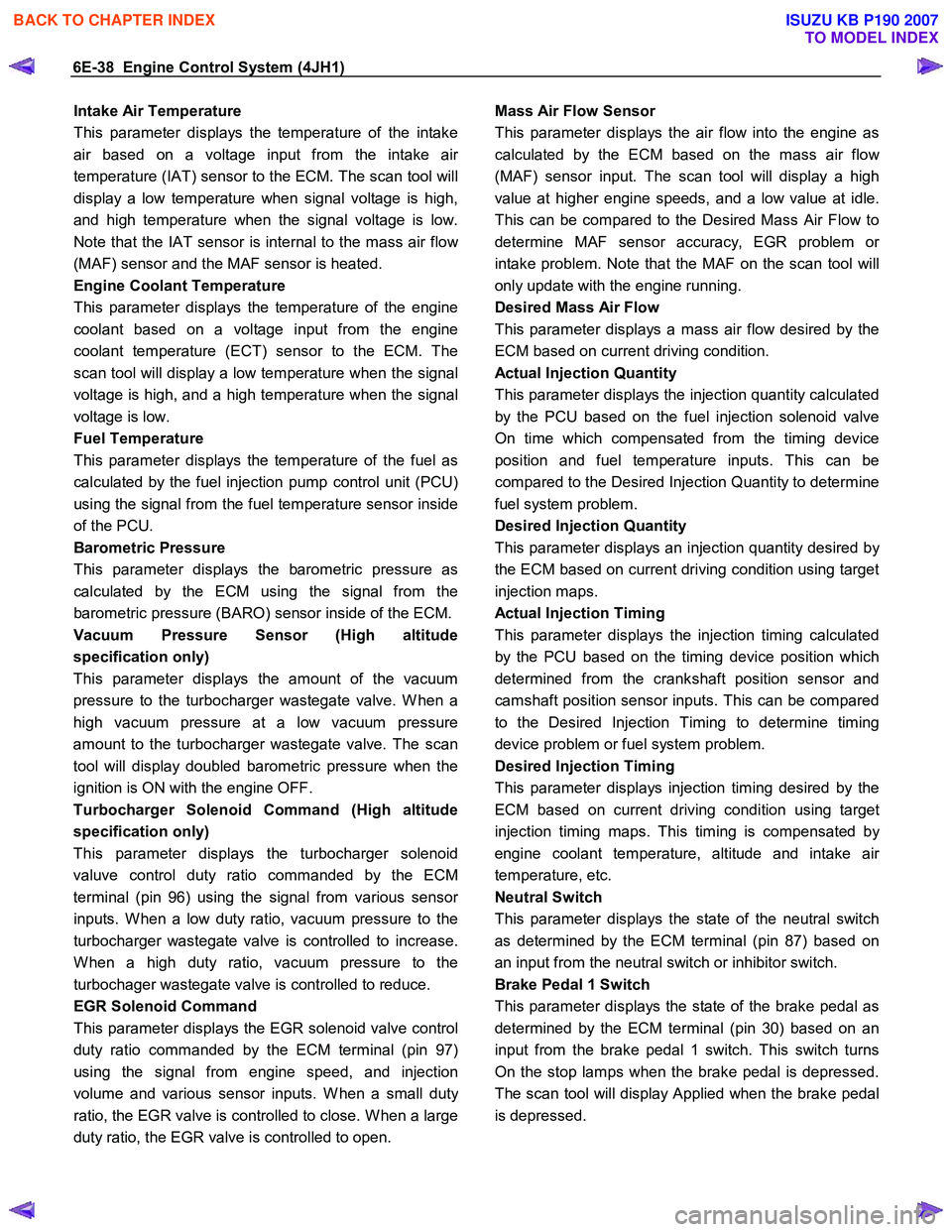
6E-38 Engine Control System (4JH1)
Intake Air Temperature
This parameter displays the temperature of the intake
air based on a voltage input from the intake ai
r
temperature (IAT) sensor to the ECM. The scan tool will
display a low temperature when signal voltage is high,
and high temperature when the signal voltage is low.
Note that the IAT sensor is internal to the mass air flo
w
(MAF) sensor and the MAF sensor is heated.
Engine Coolant Temperature
This parameter displays the temperature of the engine
coolant based on a voltage input from the engine
coolant temperature (ECT) sensor to the ECM. The
scan tool will display a low temperature when the signal
voltage is high, and a high temperature when the signal
voltage is low.
Fuel Temperature
This parameter displays the temperature of the fuel as
calculated by the fuel injection pump control unit (PCU)
using the signal from the fuel temperature sensor inside
of the PCU.
Barometric Pressure
This parameter displays the barometric pressure as
calculated by the ECM using the signal from the
barometric pressure (BARO) sensor inside of the ECM.
Vacuum Pressure Sensor (High altitude
specification only)
This parameter displays the amount of the vacuum
pressure to the turbocharger wastegate valve. W hen a
high vacuum pressure at a low vacuum pressure
amount to the turbocharger wastegate valve. The scan
tool will display doubled barometric pressure when the
ignition is ON with the engine OFF.
Turbocharger Solenoid Command (High altitude
specification only)
This parameter displays the turbocharger solenoid
valuve control duty ratio commanded by the ECM
terminal (pin 96) using the signal from various senso
r
inputs. W hen a low duty ratio, vacuum pressure to the
turbocharger wastegate valve is controlled to increase.
W hen a high duty ratio, vacuum pressure to the
turbochager wastegate valve is controlled to reduce.
EGR Solenoid Command
This parameter displays the EGR solenoid valve control
duty ratio commanded by the ECM terminal (pin 97)
using the signal from engine speed, and injection
volume and various sensor inputs. W hen a small dut
y
ratio, the EGR valve is controlled to close. W hen a large
duty ratio, the EGR valve is controlled to open.
Mass Air Flow Sensor
This parameter displays the air flow into the engine as
calculated by the ECM based on the mass air flo
w
(MAF) sensor input. The scan tool will display a high
value at higher engine speeds, and a low value at idle.
This can be compared to the Desired Mass Air Flow to
determine MAF sensor accuracy, EGR problem o
r
intake problem. Note that the MAF on the scan tool will
only update with the engine running.
Desired Mass Air Flow
This parameter displays a mass air flow desired by the
ECM based on current driving condition.
Actual Injection Quantity
This parameter displays the injection quantity calculated
by the PCU based on the fuel injection solenoid valve
On time which compensated from the timing device
position and fuel temperature inputs. This can be
compared to the Desired Injection Quantity to determine
fuel system problem.
Desired Injection Quantity
This parameter displays an injection quantity desired b
y
the ECM based on current driving condition using target
injection maps.
Actual Injection Timing
This parameter displays the injection timing calculated
by the PCU based on the timing device position which
determined from the crankshaft position sensor and
camshaft position sensor inputs. This can be compared
to the Desired Injection Timing to determine timing
device problem or fuel system problem.
Desired Injection Timing
This parameter displays injection timing desired by the
ECM based on current driving condition using target
injection timing maps. This timing is compensated b
y
engine coolant temperature, altitude and intake ai
r
temperature, etc.
Neutral Switch
This parameter displays the state of the neutral switch
as determined by the ECM terminal (pin 87) based on
an input from the neutral switch or inhibitor switch.
Brake Pedal 1 Switch
This parameter displays the state of the brake pedal as
determined by the ECM terminal (pin 30) based on an
input from the brake pedal 1 switch. This switch turns
On the stop lamps when the brake pedal is depressed.
The scan tool will display Applied when the brake pedal
is depressed.
BACK TO CHAPTER INDEX
TO MODEL INDEX
ISUZU KB P190 2007
Page 1082 of 6020
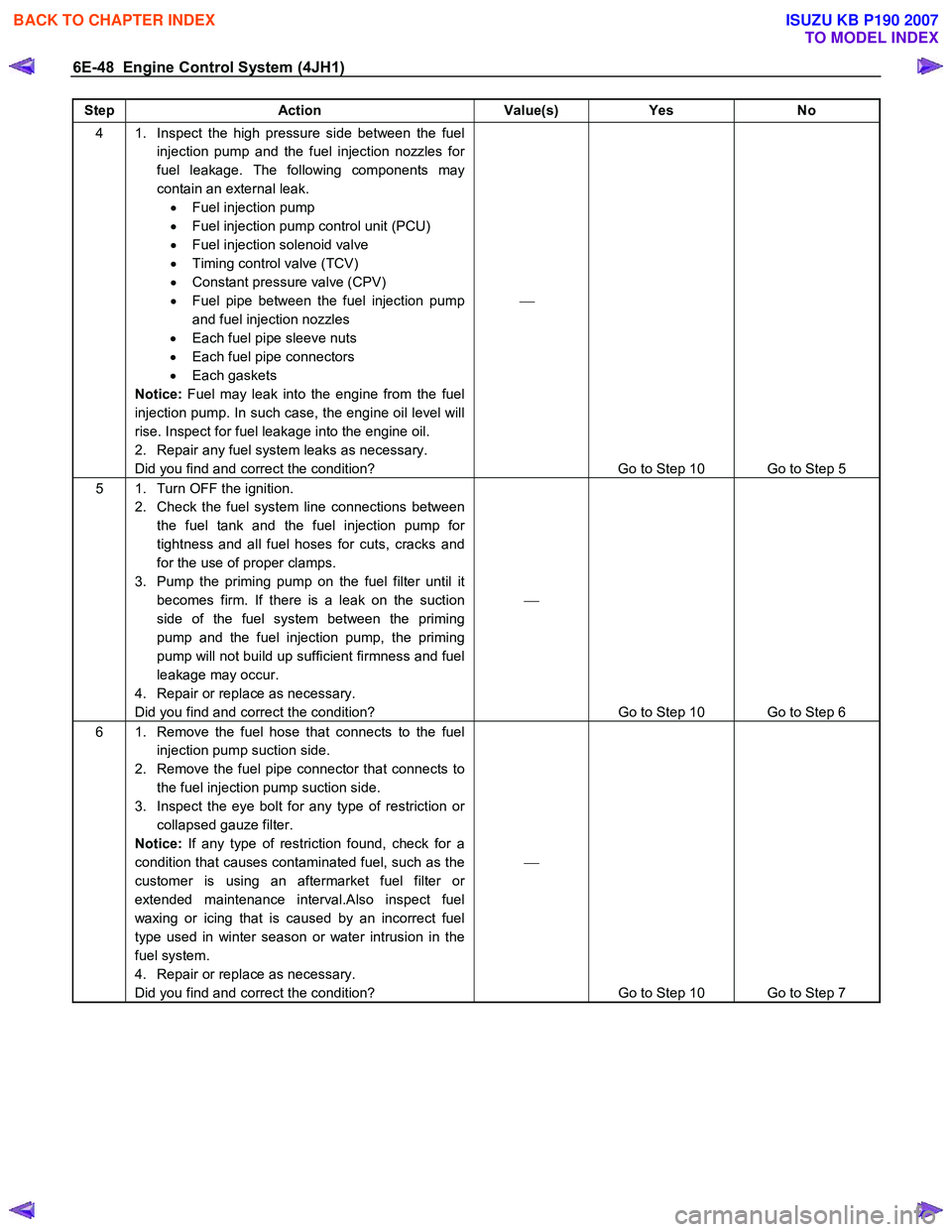
6E-48 Engine Control System (4JH1)
Step Action Value(s) Yes No
4 1. Inspect the high pressure side between the fuel
injection pump and the fuel injection nozzles for
fuel leakage. The following components may
contain an external leak. • Fuel injection pump
• Fuel injection pump control unit (PCU)
• Fuel injection solenoid valve
• Timing control valve (TCV)
• Constant pressure valve (CPV)
• Fuel pipe between the fuel injection pump
and fuel injection nozzles
• Each fuel pipe sleeve nuts
• Each fuel pipe connectors
• Each gaskets
Notice: Fuel may leak into the engine from the fuel
injection pump. In such case, the engine oil level will
rise. Inspect for fuel leakage into the engine oil.
2. Repair any fuel system leaks as necessary.
Did you find and correct the condition?
Go to Step 10 Go to Step 5
5 1. Turn OFF the ignition. 2. Check the fuel system line connections between the fuel tank and the fuel injection pump for
tightness and all fuel hoses for cuts, cracks and
for the use of proper clamps.
3. Pump the priming pump on the fuel filter until it becomes firm. If there is a leak on the suction
side of the fuel system between the priming
pump and the fuel injection pump, the priming
pump will not build up sufficient firmness and fuel
leakage may occur.
4. Repair or replace as necessary.
Did you find and correct the condition?
Go to Step 10 Go to Step 6
6 1. Remove the fuel hose that connects to the fuel injection pump suction side.
2. Remove the fuel pipe connector that connects to the fuel injection pump suction side.
3. Inspect the eye bolt for any type of restriction or collapsed gauze filter.
Notice: If any type of restriction found, check for a
condition that causes contaminated fuel, such as the
customer is using an aftermarket fuel filter or
extended maintenance interval.Also inspect fuel
waxing or icing that is caused by an incorrect fuel
type used in winter season or water intrusion in the
fuel system.
4. Repair or replace as necessary.
Did you find and correct the condition?
Go to Step 10 Go to Step 7
BACK TO CHAPTER INDEX
TO MODEL INDEX
ISUZU KB P190 2007
Page 1083 of 6020
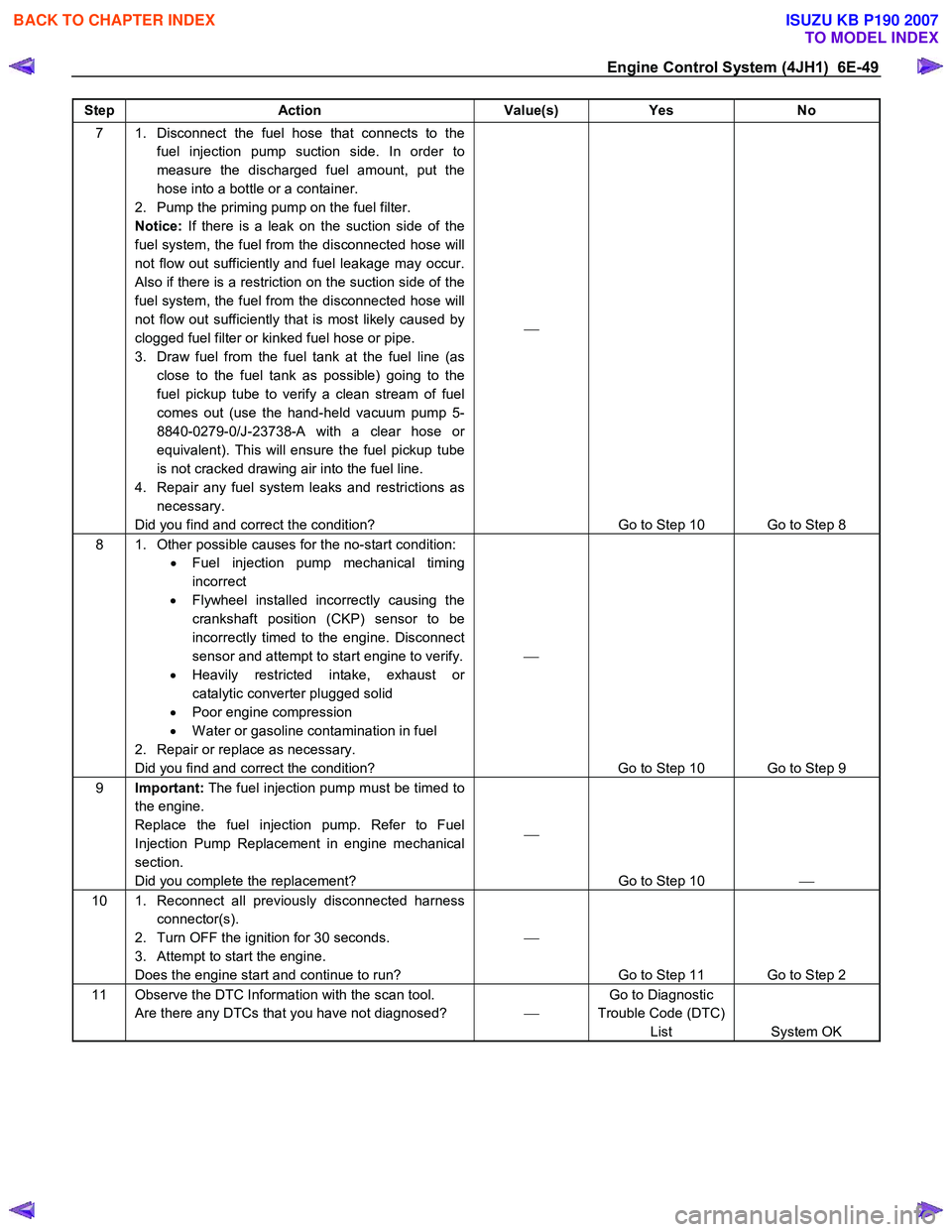
Engine Control System (4JH1) 6E-49
Step Action Value(s) Yes No
7 1. Disconnect the fuel hose that connects to the
fuel injection pump suction side. In order to
measure the discharged fuel amount, put the
hose into a bottle or a container.
2. Pump the priming pump on the fuel filter.
Notice: If there is a leak on the suction side of the
fuel system, the fuel from the disconnected hose will
not flow out sufficiently and fuel leakage may occur.
Also if there is a restriction on the suction side of the
fuel system, the fuel from the disconnected hose will
not flow out sufficiently that is most likely caused by
clogged fuel filter or kinked fuel hose or pipe.
3. Draw fuel from the fuel tank at the fuel line (as close to the fuel tank as possible) going to the
fuel pickup tube to verify a clean stream of fuel
comes out (use the hand-held vacuum pump 5-
8840-0279-0/J-23738-A with a clear hose or
equivalent). This will ensure the fuel pickup tube
is not cracked drawing air into the fuel line.
4. Repair any fuel system leaks and restrictions as necessary.
Did you find and correct the condition?
Go to Step 10 Go to Step 8
8 1. Other possible causes for the no-start condition: • Fuel injection pump mechanical timing
incorrect
• Flywheel installed incorrectly causing the
crankshaft position (CKP) sensor to be
incorrectly timed to the engine. Disconnect
sensor and attempt to start engine to verify.
• Heavily restricted intake, exhaust or
catalytic converter plugged solid
• Poor engine compression
• W ater or gasoline contamination in fuel
2. Repair or replace as necessary.
Did you find and correct the condition?
Go to Step 10 Go to Step 9
9 Important: The fuel injection pump must be timed to
the engine.
Replace the fuel injection pump. Refer to Fuel
Injection Pump Replacement in engine mechanical
section.
Did you complete the replacement?
Go to Step 10
10 1. Reconnect all previously disconnected harness
connector(s).
2. Turn OFF the ignition for 30 seconds.
3. Attempt to start the engine.
Does the engine start and continue to run?
Go to Step 11 Go to Step 2
11 Observe the DTC Information with the scan tool. Are there any DTCs that you have not diagnosed? Go to Diagnostic
Trouble Code (DTC) List System OK
BACK TO CHAPTER INDEX
TO MODEL INDEX
ISUZU KB P190 2007
Page 1086 of 6020
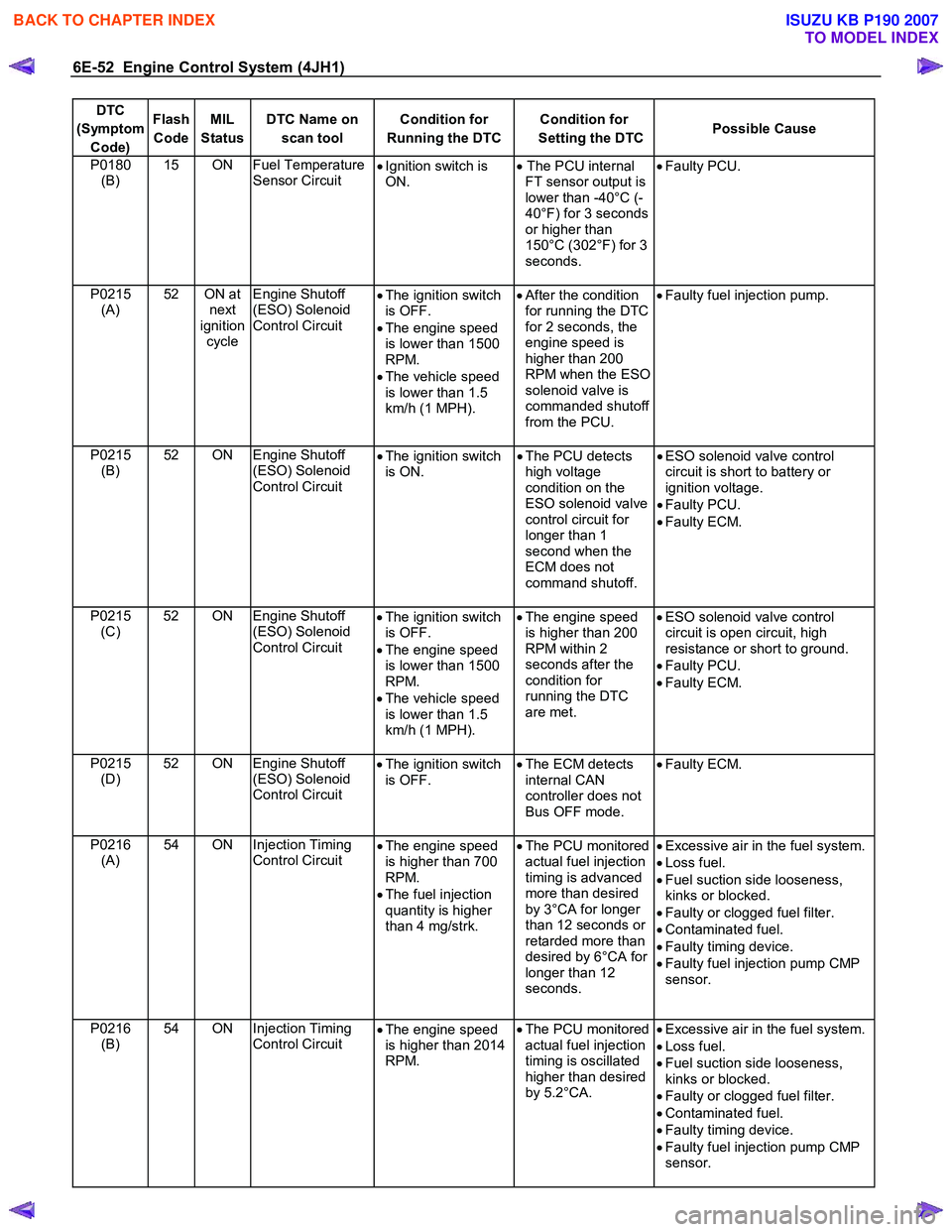
6E-52 Engine Control System (4JH1)
DTC
(Symptom Code) Flash
Code MIL
Status DTC Name on
scan tool Condition for
Running the DTC Condition for
Setting the DTC Possible Cause
P0180
(B) 15 ON Fuel Temperature
Sensor Circuit •
Ignition switch is
ON.
•
The PCU internal
FT sensor output is
lower than -40°C (-
40°F) for 3 seconds
or higher than
150°C (302°F) for 3
seconds.
•
Faulty PCU.
P0215 (A) 52 ON at
next
ignition cycle Engine Shutoff
(ESO) Solenoid
Control Circuit •
The ignition switch
is OFF.
• The engine speed
is lower than 1500
RPM.
• The vehicle speed
is lower than 1.5
km/h (1 MPH).
•
After the condition
for running the DTC
for 2 seconds, the
engine speed is
higher than 200
RPM when the ESO
solenoid valve is
commanded shutoff
from the PCU.
•
Faulty fuel injection pump.
P0215 (B) 52 ON Engine Shutoff
(ESO) Solenoid
Control Circuit •
The ignition switch
is ON. •
The PCU detects
high voltage
condition on the
ESO solenoid valve
control circuit for
longer than 1
second when the
ECM does not
command shutoff.
•
ESO solenoid valve control
circuit is short to battery or
ignition voltage.
• Faulty PCU.
• Faulty ECM.
P0215 (C) 52 ON Engine Shutoff
(ESO) Solenoid
Control Circuit •
The ignition switch
is OFF.
• The engine speed
is lower than 1500
RPM.
• The vehicle speed
is lower than 1.5
km/h (1 MPH).
•
The engine speed
is higher than 200
RPM within 2
seconds after the
condition for
running the DTC
are met.
•
ESO solenoid valve control
circuit is open circuit, high
resistance or short to ground.
• Faulty PCU.
• Faulty ECM.
P0215 (D) 52 ON Engine Shutoff
(ESO) Solenoid
Control Circuit
•
The ignition switch
is OFF. •
The ECM detects
internal CAN
controller does not
Bus OFF mode.
•
Faulty ECM.
P0216 (A) 54 ON Injection Timing
Control Circuit •
The engine speed
is higher than 700
RPM.
• The fuel injection
quantity is higher
than 4 mg/strk.
•
The PCU monitored
actual fuel injection
timing is advanced
more than desired
by 3°CA for longer
than 12 seconds or
retarded more than
desired by 6°CA for
longer than 12
seconds.
•
Excessive air in the fuel system.
• Loss fuel.
• Fuel suction side looseness,
kinks or blocked.
• Faulty or clogged fuel filter.
• Contaminated fuel.
• Faulty timing device.
• Faulty fuel injection pump CMP
sensor.
P0216 (B) 54 ON Injection Timing
Control Circuit •
The engine speed
is higher than 2014
RPM.
•
The PCU monitored
actual fuel injection
timing is oscillated
higher than desired
by 5.2°CA.
•
Excessive air in the fuel system.
• Loss fuel.
• Fuel suction side looseness,
kinks or blocked.
• Faulty or clogged fuel filter.
• Contaminated fuel.
• Faulty timing device.
• Faulty fuel injection pump CMP
sensor.
BACK TO CHAPTER INDEX
TO MODEL INDEX
ISUZU KB P190 2007
Page 1124 of 6020
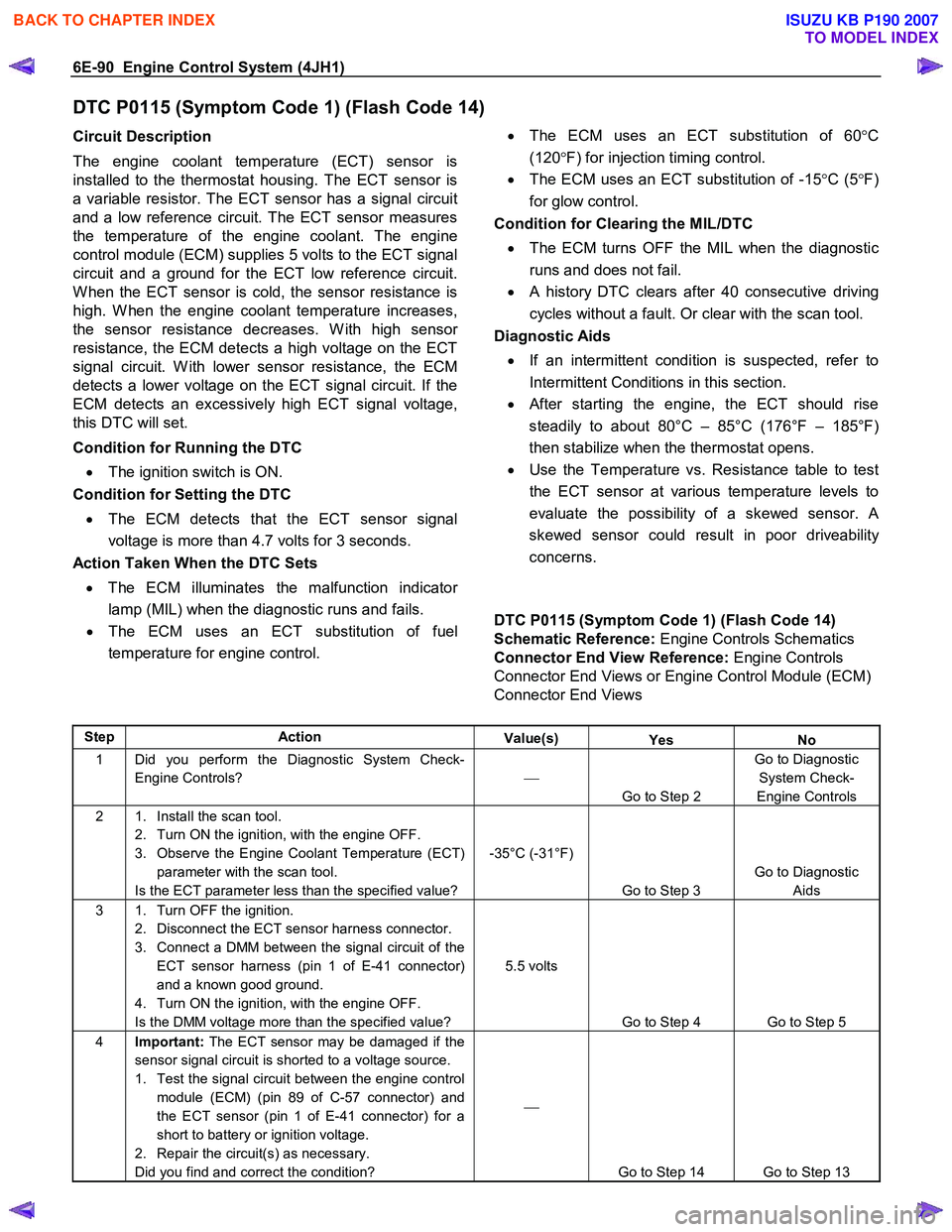
6E-90 Engine Control System (4JH1)
DTC P0115 (Symptom Code 1) (Flash Code 14)
Circuit Description
The engine coolant temperature (ECT) sensor is
installed to the thermostat housing. The ECT sensor is
a variable resistor. The ECT sensor has a signal circuit
and a low reference circuit. The ECT sensor measures
the temperature of the engine coolant. The engine
control module (ECM) supplies 5 volts to the ECT signal
circuit and a ground for the ECT low reference circuit.
W hen the ECT sensor is cold, the sensor resistance is
high. W hen the engine coolant temperature increases,
the sensor resistance decreases. W ith high senso
r
resistance, the ECM detects a high voltage on the ECT
signal circuit. W ith lower sensor resistance, the ECM
detects a lower voltage on the ECT signal circuit. If the
ECM detects an excessively high ECT signal voltage,
this DTC will set.
Condition for Running the DTC
• The ignition switch is ON.
Condition for Setting the DTC
• The ECM detects that the ECT sensor signal
voltage is more than 4.7 volts for 3 seconds.
Action Taken When the DTC Sets
• The ECM illuminates the malfunction indicato
r
lamp (MIL) when the diagnostic runs and fails.
• The ECM uses an ECT substitution of fuel
temperature for engine control.
•
The ECM uses an ECT substitution of 60 °C
(120 °F) for injection timing control.
• The ECM uses an ECT substitution of -15 °C (5 °F)
for glow control.
Condition for Clearing the MIL/DTC
• The ECM turns OFF the MIL when the diagnostic
runs and does not fail.
• A history DTC clears after 40 consecutive driving
cycles without a fault. Or clear with the scan tool.
Diagnostic Aids
• If an intermittent condition is suspected, refer to
Intermittent Conditions in this section.
•
After starting the engine, the ECT should rise
steadily to about 80°C – 85°C (176°F – 185°F)
then stabilize when the thermostat opens.
• Use the Temperature vs. Resistance table to test
the ECT sensor at various temperature levels to
evaluate the possibility of a skewed sensor.
A
skewed sensor could result in poor driveabilit
y
concerns.
DTC P0115 (Symptom Code 1) (Flash Code 14)
Schematic Reference: Engine Controls Schematics
Connector End View Reference: Engine Controls
Connector End Views or Engine Control Module (ECM)
Connector End Views
Step Action Value(s) Yes No
1 Did you perform the Diagnostic System Check-
Engine Controls?
Go to Step 2 Go to Diagnostic
System Check-
Engine Controls
2 1. Install the scan tool. 2. Turn ON the ignition, with the engine OFF.
3. Observe the Engine Coolant Temperature (ECT) parameter with the scan tool.
Is the ECT parameter less than the specified value? -35°C (-31°F)
Go to Step 3 Go to Diagnostic
Aids
3 1. Turn OFF the ignition. 2. Disconnect the ECT sensor harness connector.
3. Connect a DMM between the signal circuit of the ECT sensor harness (pin 1 of E-41 connector)
and a known good ground.
4. Turn ON the ignition, with the engine OFF.
Is the DMM voltage more than the specified value? 5.5 volts
Go to Step 4 Go to Step 5
4 Important: The ECT sensor may be damaged if the
sensor signal circuit is shorted to a voltage source.
1. Test the signal circuit between the engine control module (ECM) (pin 89 of C-57 connector) and
the ECT sensor (pin 1 of E-41 connector) for a
short to battery or ignition voltage.
2. Repair the circuit(s) as necessary.
Did you find and correct the condition?
Go to Step 14 Go to Step 13
BACK TO CHAPTER INDEX
TO MODEL INDEX
ISUZU KB P190 2007
Page 1127 of 6020
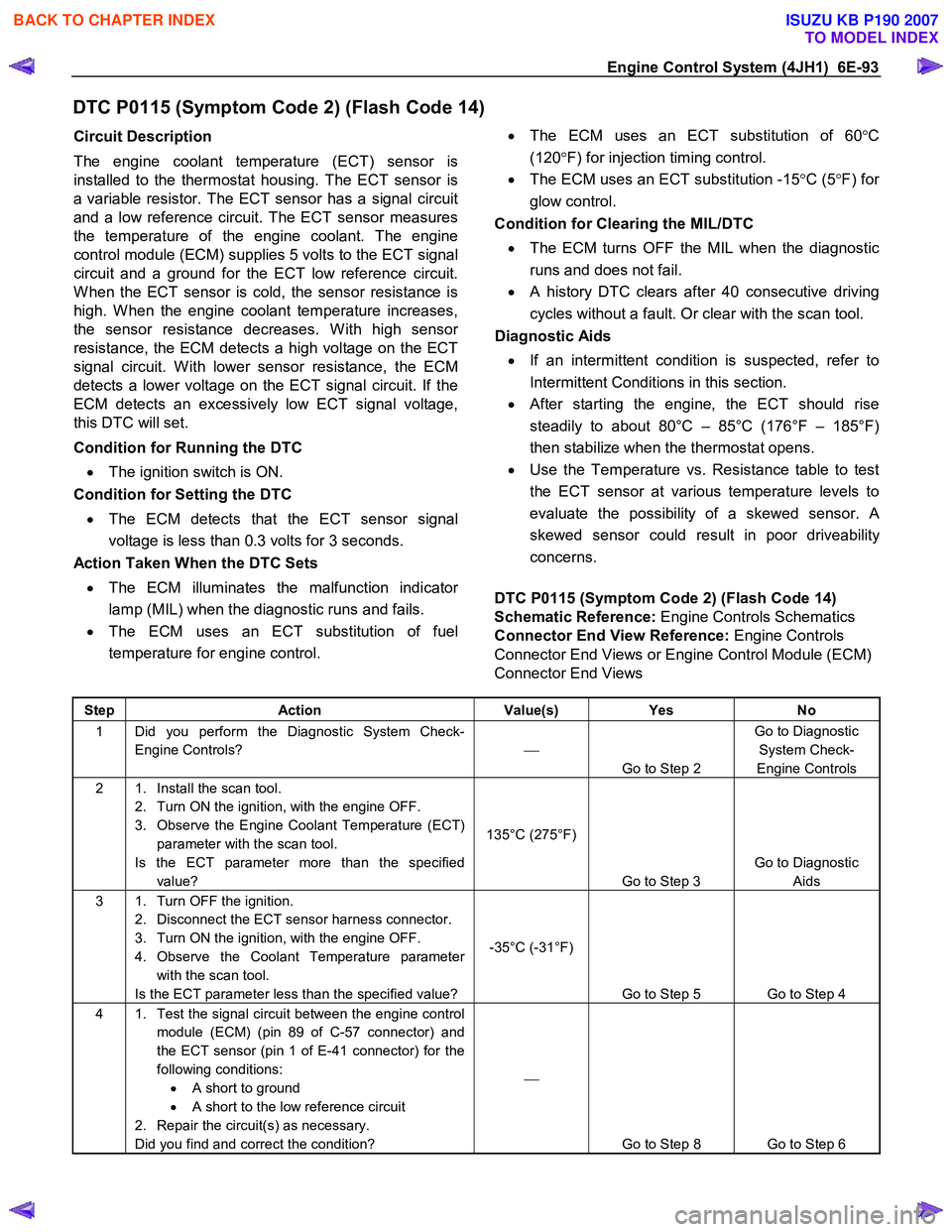
Engine Control System (4JH1) 6E-93
DTC P0115 (Symptom Code 2) (Flash Code 14)
Circuit Description
The engine coolant temperature (ECT) sensor is
installed to the thermostat housing. The ECT sensor is
a variable resistor. The ECT sensor has a signal circuit
and a low reference circuit. The ECT sensor measures
the temperature of the engine coolant. The engine
control module (ECM) supplies 5 volts to the ECT signal
circuit and a ground for the ECT low reference circuit.
W hen the ECT sensor is cold, the sensor resistance is
high. W hen the engine coolant temperature increases,
the sensor resistance decreases. W ith high senso
r
resistance, the ECM detects a high voltage on the ECT
signal circuit. W ith lower sensor resistance, the ECM
detects a lower voltage on the ECT signal circuit. If the
ECM detects an excessively low ECT signal voltage,
this DTC will set.
Condition for Running the DTC
• The ignition switch is ON.
Condition for Setting the DTC
• The ECM detects that the ECT sensor signal
voltage is less than 0.3 volts for 3 seconds.
Action Taken When the DTC Sets
• The ECM illuminates the malfunction indicato
r
lamp (MIL) when the diagnostic runs and fails.
• The ECM uses an ECT substitution of fuel
temperature for engine control.
•
The ECM uses an ECT substitution of 60 °C
(120 °F) for injection timing control.
• The ECM uses an ECT substitution -15 °C (5 °F) fo
r
glow control.
Condition for Clearing the MIL/DTC
• The ECM turns OFF the MIL when the diagnostic
runs and does not fail.
• A history DTC clears after 40 consecutive driving
cycles without a fault. Or clear with the scan tool.
Diagnostic Aids
• If an intermittent condition is suspected, refer to
Intermittent Conditions in this section.
•
After starting the engine, the ECT should rise
steadily to about 80°C – 85°C (176°F – 185°F)
then stabilize when the thermostat opens.
• Use the Temperature vs. Resistance table to test
the ECT sensor at various temperature levels to
evaluate the possibility of a skewed sensor.
A
skewed sensor could result in poor driveabilit
y
concerns.
DTC P0115 (Symptom Code 2) (Flash Code 14)
Schematic Reference: Engine Controls Schematics
Connector End View Reference: Engine Controls
Connector End Views or Engine Control Module (ECM)
Connector End Views
Step Action Value(s) Yes No
1 Did you perform the Diagnostic System Check-
Engine Controls?
Go to Step 2 Go to Diagnostic
System Check-
Engine Controls
2 1. Install the scan tool. 2. Turn ON the ignition, with the engine OFF.
3. Observe the Engine Coolant Temperature (ECT) parameter with the scan tool.
Is the ECT parameter more than the specified value? 135°C (275°F)
Go to Step 3 Go to Diagnostic
Aids
3 1. Turn OFF the ignition. 2. Disconnect the ECT sensor harness connector.
3. Turn ON the ignition, with the engine OFF.
4. Observe the Coolant Temperature parameter with the scan tool.
Is the ECT parameter less than the specified value? -35°C (-31°F)
Go to Step 5 Go to Step 4
4 1. Test the signal circuit between the engine control module (ECM) (pin 89 of C-57 connector) and
the ECT sensor (pin 1 of E-41 connector) for the
following conditions: • A short to ground
• A short to the low reference circuit
2. Repair the circuit(s) as necessary.
Did you find and correct the condition?
Go to Step 8 Go to Step 6
BACK TO CHAPTER INDEX
TO MODEL INDEX
ISUZU KB P190 2007
Page 1130 of 6020
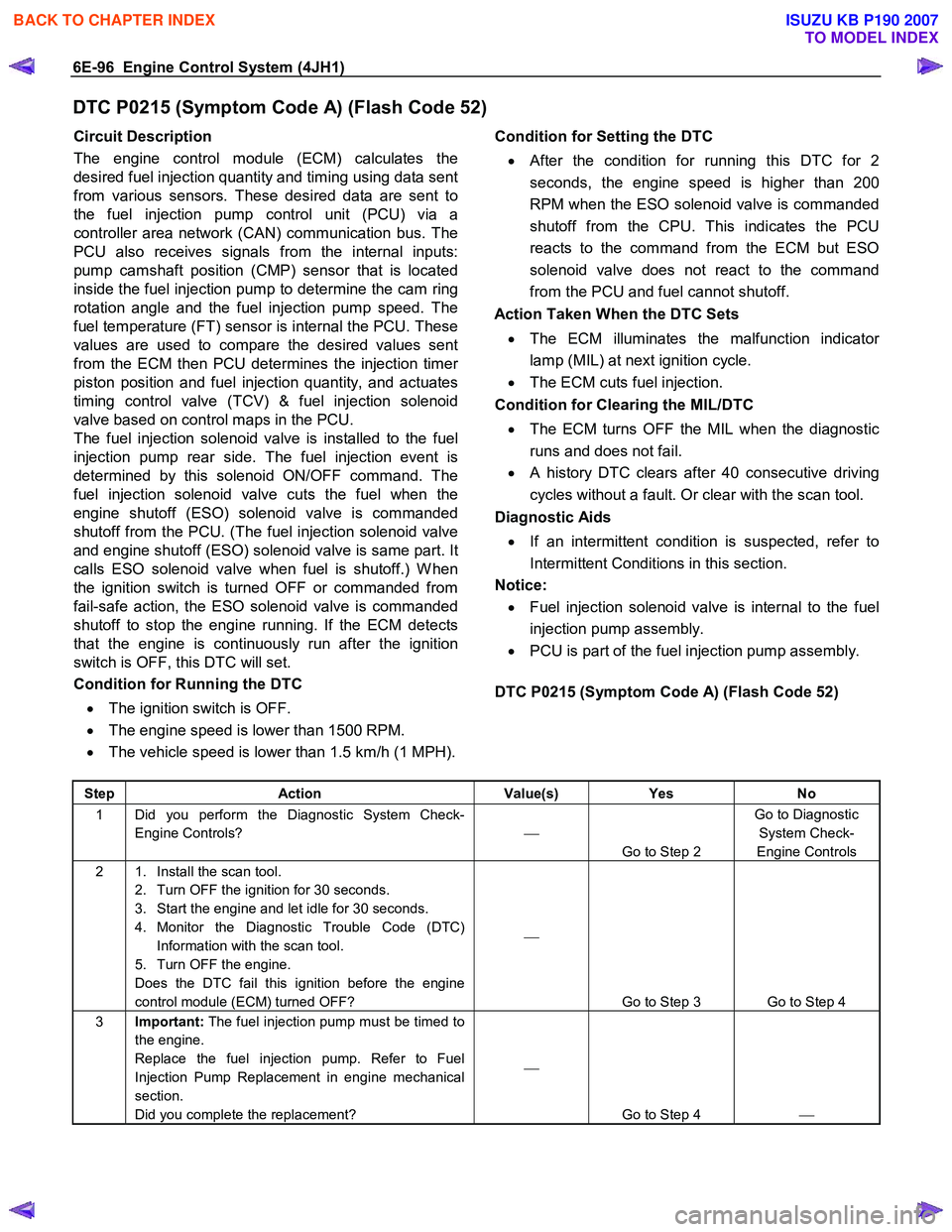
6E-96 Engine Control System (4JH1)
DTC P0215 (Symptom Code A) (Flash Code 52)
Circuit Description
The engine control module (ECM) calculates the
desired fuel injection quantity and timing using data sent
from various sensors. These desired data are sent to
the fuel injection pump control unit (PCU) via a
controller area network (CAN) communication bus. The
PCU also receives signals from the internal inputs:
pump camshaft position (CMP) sensor that is located
inside the fuel injection pump to determine the cam ring
rotation angle and the fuel injection pump speed. The
fuel temperature (FT) sensor is internal the PCU. These
values are used to compare the desired values sent
from the ECM then PCU determines the injection time
r
piston position and fuel injection quantity, and actuates
timing control valve (TCV) & fuel injection solenoid
valve based on control maps in the PCU.
The fuel injection solenoid valve is installed to the fuel
injection pump rear side. The fuel injection event is
determined by this solenoid ON/OFF command. The
fuel injection solenoid valve cuts the fuel when the
engine shutoff (ESO) solenoid valve is commanded
shutoff from the PCU. (The fuel injection solenoid valve
and engine shutoff (ESO) solenoid valve is same part. It
calls ESO solenoid valve when fuel is shutoff.) W hen
the ignition switch is turned OFF or commanded from
fail-safe action, the ESO solenoid valve is commanded
shutoff to stop the engine running. If the ECM detects
that the engine is continuously run after the ignition
switch is OFF, this DTC will set.
Condition for Running the DTC
• The ignition switch is OFF.
• The engine speed is lower than 1500 RPM.
• The vehicle speed is lower than 1.5 km/h (1 MPH).
Condition for Setting the DTC
•
After the condition for running this DTC for 2
seconds, the engine speed is higher than 200
RPM when the ESO solenoid valve is commanded
shutoff from the CPU. This indicates the PCU
reacts to the command from the ECM but ESO
solenoid valve does not react to the command
from the PCU and fuel cannot shutoff.
Action Taken When the DTC Sets
• The ECM illuminates the malfunction indicato
r
lamp (MIL) at next ignition cycle.
• The ECM cuts fuel injection.
Condition for Clearing the MIL/DTC
• The ECM turns OFF the MIL when the diagnostic
runs and does not fail.
• A history DTC clears after 40 consecutive driving
cycles without a fault. Or clear with the scan tool.
Diagnostic Aids
• If an intermittent condition is suspected, refer to
Intermittent Conditions in this section.
Notice:
• Fuel injection solenoid valve is internal to the fuel
injection pump assembly.
• PCU is part of the fuel injection pump assembly.
DTC P0215 (Symptom Code A) (Flash Code 52)
Step Action Value(s) Yes No
1 Did you perform the Diagnostic System Check-
Engine Controls?
Go to Step 2 Go to Diagnostic
System Check-
Engine Controls
2 1. Install the scan tool. 2. Turn OFF the ignition for 30 seconds.
3. Start the engine and let idle for 30 seconds.
4. Monitor the Diagnostic Trouble Code (DTC) Information with the scan tool.
5. Turn OFF the engine.
Does the DTC fail this ignition before the engine
control module (ECM) turned OFF?
Go to Step 3 Go to Step 4
3 Important: The fuel injection pump must be timed to
the engine.
Replace the fuel injection pump. Refer to Fuel
Injection Pump Replacement in engine mechanical
section.
Did you complete the replacement?
Go to Step 4
BACK TO CHAPTER INDEX
TO MODEL INDEX
ISUZU KB P190 2007
Page 1132 of 6020
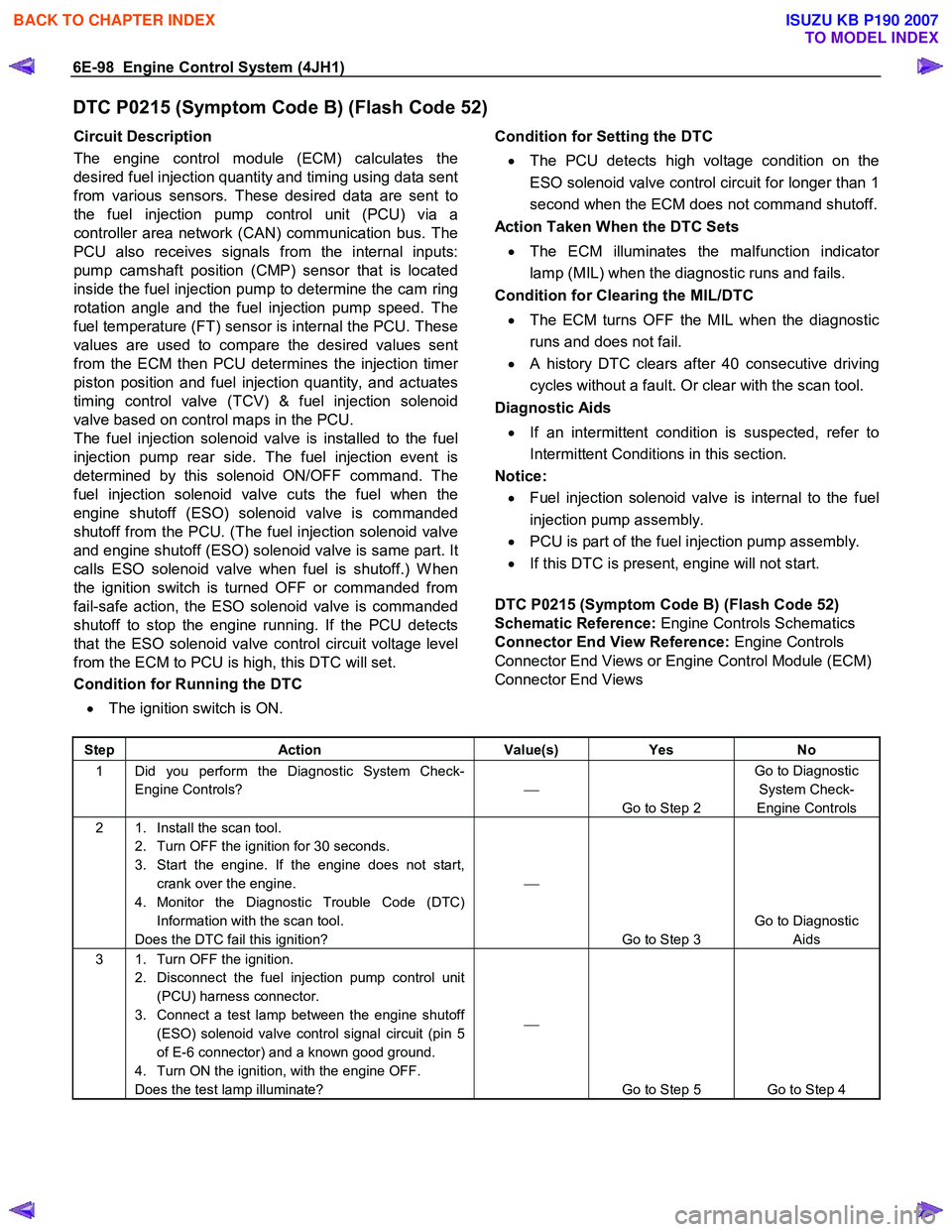
6E-98 Engine Control System (4JH1)
DTC P0215 (Symptom Code B) (Flash Code 52)
Circuit Description
The engine control module (ECM) calculates the
desired fuel injection quantity and timing using data sent
from various sensors. These desired data are sent to
the fuel injection pump control unit (PCU) via a
controller area network (CAN) communication bus. The
PCU also receives signals from the internal inputs:
pump camshaft position (CMP) sensor that is located
inside the fuel injection pump to determine the cam ring
rotation angle and the fuel injection pump speed. The
fuel temperature (FT) sensor is internal the PCU. These
values are used to compare the desired values sent
from the ECM then PCU determines the injection time
r
piston position and fuel injection quantity, and actuates
timing control valve (TCV) & fuel injection solenoid
valve based on control maps in the PCU.
The fuel injection solenoid valve is installed to the fuel
injection pump rear side. The fuel injection event is
determined by this solenoid ON/OFF command. The
fuel injection solenoid valve cuts the fuel when the
engine shutoff (ESO) solenoid valve is commanded
shutoff from the PCU. (The fuel injection solenoid valve
and engine shutoff (ESO) solenoid valve is same part. It
calls ESO solenoid valve when fuel is shutoff.) W hen
the ignition switch is turned OFF or commanded from
fail-safe action, the ESO solenoid valve is commanded
shutoff to stop the engine running. If the PCU detects
that the ESO solenoid valve control circuit voltage level
from the ECM to PCU is high, this DTC will set.
Condition for Running the DTC
• The ignition switch is ON.
Condition for Setting the DTC
• The PCU detects high voltage condition on the
ESO solenoid valve control circuit for longer than 1
second when the ECM does not command shutoff.
Action Taken When the DTC Sets
• The ECM illuminates the malfunction indicato
r
lamp (MIL) when the diagnostic runs and fails.
Condition for Clearing the MIL/DTC
• The ECM turns OFF the MIL when the diagnostic
runs and does not fail.
• A history DTC clears after 40 consecutive driving
cycles without a fault. Or clear with the scan tool.
Diagnostic Aids
• If an intermittent condition is suspected, refer to
Intermittent Conditions in this section.
Notice:
• Fuel injection solenoid valve is internal to the fuel
injection pump assembly.
• PCU is part of the fuel injection pump assembly.
• If this DTC is present, engine will not start.
DTC P0215 (Symptom Code B) (Flash Code 52)
Schematic Reference: Engine Controls Schematics
Connector End View Reference: Engine Controls
Connector End Views or Engine Control Module (ECM)
Connector End Views
Step Action Value(s) Yes No
1 Did you perform the Diagnostic System Check-
Engine Controls?
Go to Step 2 Go to Diagnostic
System Check-
Engine Controls
2 1. Install the scan tool. 2. Turn OFF the ignition for 30 seconds.
3. Start the engine. If the engine does not start, crank over the engine.
4. Monitor the Diagnostic Trouble Code (DTC) Information with the scan tool.
Does the DTC fail this ignition?
Go to Step 3 Go to Diagnostic
Aids
3 1. Turn OFF the ignition. 2. Disconnect the fuel injection pump control unit (PCU) harness connector.
3. Connect a test lamp between the engine shutoff (ESO) solenoid valve control signal circuit (pin 5
of E-6 connector) and a known good ground.
4. Turn ON the ignition, with the engine OFF.
Does the test lamp illuminate?
Go to Step 5 Go to Step 4
BACK TO CHAPTER INDEX
TO MODEL INDEX
ISUZU KB P190 2007