2007 ISUZU KB P190 Timing
[x] Cancel search: TimingPage 3968 of 6020
7A2-2 TRANSMISSION CONTROL SYSTEM (AW30–40LE)
Service Precaution
WARNING: THIS VEHICLE HAS A SUPPLEMENTAL
RESTRAINT SYSTEM (SRS). REFER TO THE SRS
COMPONENT AND WIRING LOCATION VIEW IN
ORDER TO DETERMINE WHETHER YOU ARE
PERFORMING SERVICE ON OR NEAR THE SRS
COMPONENTS OR THE SRS WIRING. WHEN YOU
ARE PERFORMING SERVICE ON OR NEAR THE
SRS COMPONENTS OR THE SRS WIRING, REFER
TO THE SRS SERVICE INFORMATION. FAILURE TO
FOLLOW WARNINGS COULD RESULT IN
POSSIBLE AIR BAG DEPLOYMENT, PERSONAL
INJURY, OR OTHERWISE UNNEEDED SRS SYSTEM
REPAIRS.
CAUTION: Always use the correct fastener in the
proper location. When you replace a fastener, use
ONLY the exact part number for that application.
ISUZU will call out those fasteners that require a
replacement after removal. ISUZU will also call out
the fasteners that require thread lockers or thread
sealant. UNLESS OTHERWISE SPECIFIED, do not
use supplemental coatings (Paints, greases, o
r
other corrosion inhibitors) on threaded fasteners or
fastener joint interfaces. Generally, such coatings
adversely affect the fastener torque and the joint
clamping force, and may damage the fastener.
When you install fasteners, use the correct
tightening sequence and specifications. Following
these instructions can help you avoid damage to
parts and systems.
General Description
The AW 30-40LE is a 4–speed fully electronically
controlled automatic transmission. It uses a
microcomputer as a control unit to judge driving
conditions including throttle opening rate and vehicle
speed, then it sets the shifting point in the optimum
timing so that best driving performance can be
achieved.
In addition, the built–in driving mode select function can
select three driving modes according to the driver's
preference:
• Normal mode –Normal shift pattern.
• 3rd Start mode –Starts in 3rd gear to reduce slippage
on mud, ice or snow.
• Power mode –Delays upshift timing when more
powerful acceleration is required.
Also, the built–in fail–safe function (“emergency mode")
assures driving performance even if the vehicle speed
sensor, throttle signal or any solenoid fails.
Further, the self–diagnostic function conducts diagnosis
in a short time when the control system fails, thus
improving serviceability.
The major features of AW 30-40LE are as follows:
•
A compact structure consisting of 2 sets of planetary
gears and flat torque converter.
• Electronic control selects the optimum driving mode according to the driving conditions.
• Electronic control maintains the optimum hydraulic
pressure for clutch, band brake as well as
transmission so that shift feeling is improved.
• W ide gear ratio and high torque rate of torque
converter provide excellent starting performance.
• Optimum Lock-up control of each driving mode can
have it both ways driving performance and fuel
economy.
• Excellent shift quality can be achieved by the torque
management control through the CAN
communication with the engine.
BACK TO CHAPTER INDEX
TO MODEL INDEX
ISUZU KB P190 2007
Page 4267 of 6020
7A1-28 CONSTRUCTION AND FUNCTION
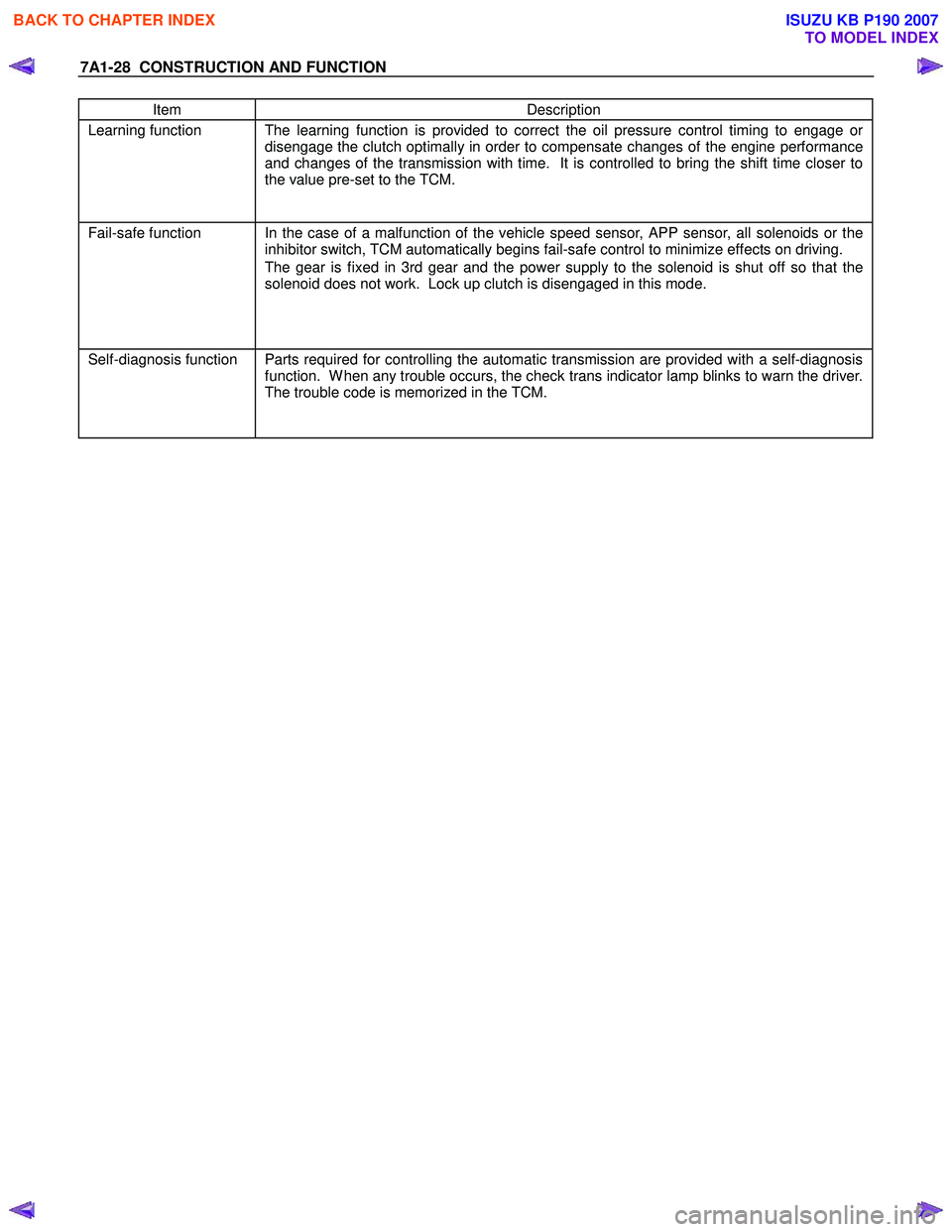
Item Description
Learning function The learning function is provided to correct the oil pressure control timing to engage or
disengage the clutch optimally in order to compensate changes of the engine performance
and changes of the transmission with time. It is controlled to bring the shift time closer to
the value pre-set to the TCM.
Fail-safe function In the case of a malfunction of the vehicle speed sensor, APP sensor, all solenoids or the
inhibitor switch, TCM automatically begins fail-safe control to minimize effects on driving.
The gear is fixed in 3rd gear and the power supply to the solenoid is shut off so that the
solenoid does not work. Lock up clutch is disengaged in this mode.
Self-diagnosis function Parts required for controlling the automatic transmission are provided with a self-diagnosis
function. W hen any trouble occurs, the check trans indicator lamp blinks to warn the driver.
The trouble code is memorized in the TCM.
BACK TO CHAPTER INDEX
TO MODEL INDEX
ISUZU KB P190 2007
Page 4272 of 6020
CONSTRUCTION AND FUNCTION 7A1-33
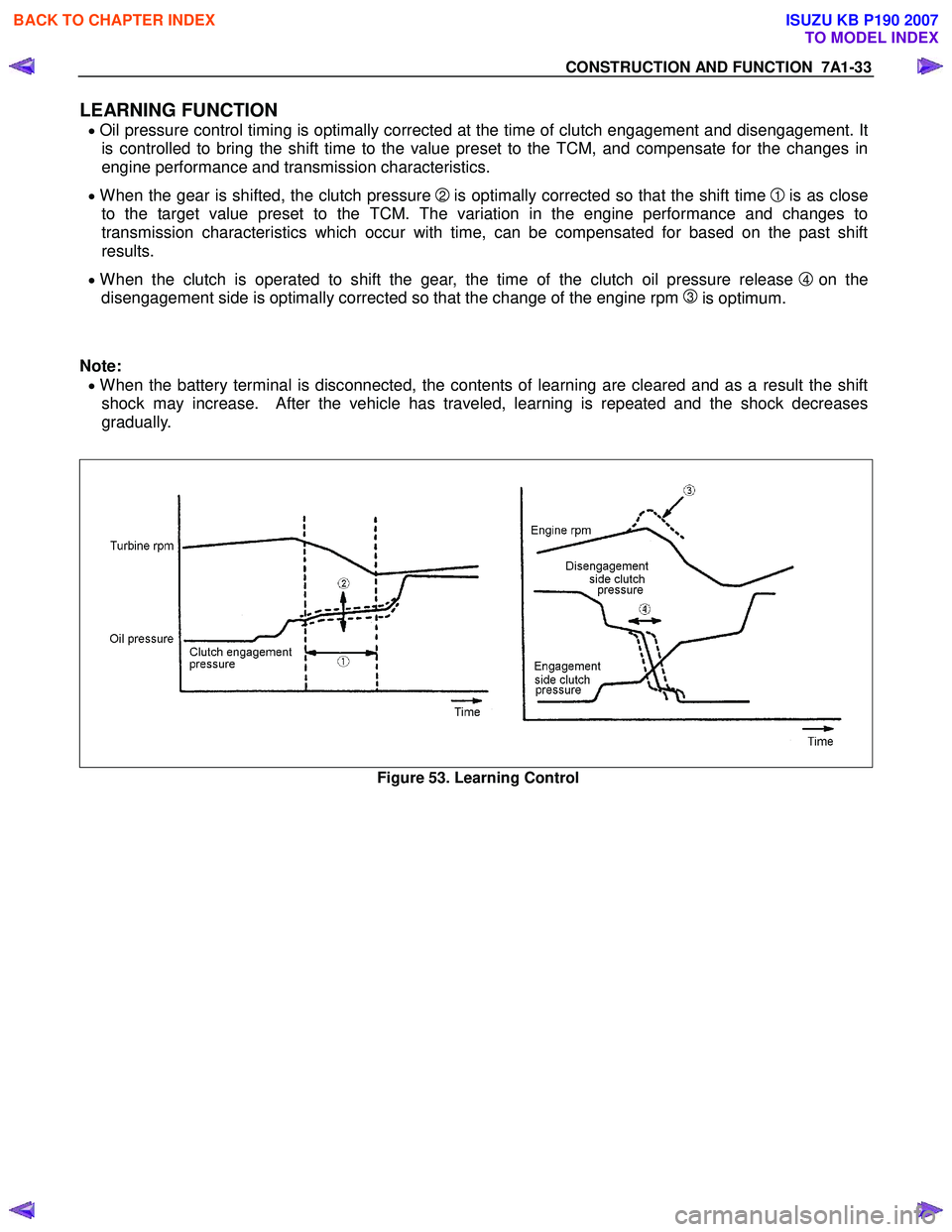
LEARNING FUNCTION
• Oil pressure control timing is optimally corrected at the time of clutch engagement and disengagement. It
is controlled to bring the shift time to the value preset to the TCM, and compensate for the changes in
engine performance and transmission characteristics.
• When the gear is shifted, the clutch pressure 2 is optimally corrected so that the shift time 1 is as close
to the target value preset to the TCM. The variation in the engine performance and changes to
transmission characteristics which occur with time, can be compensated for based on the past shift
results.
• When the clutch is operated to shift the gear, the time of the clutch oil pressure release 4 on the
disengagement side is optimally corrected so that the change of the engine rpm
3 is optimum.
Note:
• When the battery terminal is disconnected, the contents of learning are cleared and as a result the shift
shock may increase. After the vehicle has traveled, learning is repeated and the shock decreases
gradually.
Figure 53. Learning Control
BACK TO CHAPTER INDEX
TO MODEL INDEX
ISUZU KB P190 2007
Page 4444 of 6020
7A2-160 TRANSMISSION CONTROL SYSTEM (JR405E)
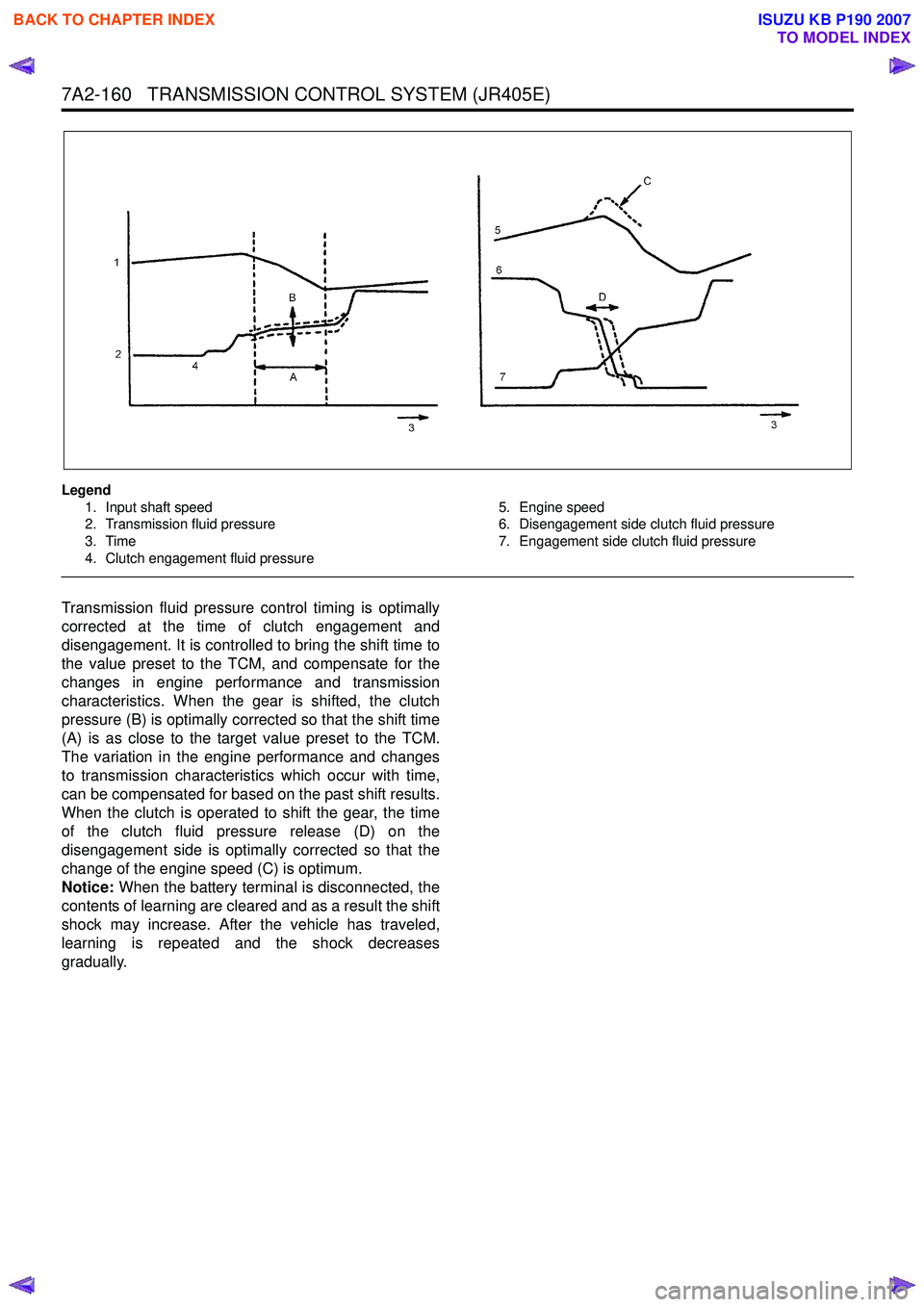
Legend1. Input shaft speed
2. Transmission fluid pressure
3. Time
4. Clutch engagement fluid pressure 5. Engine speed
6. Disengagement side clutch fluid pressure
7. Engagement side clutch fluid pressure
Transmission fluid pressure control timing is optimally
corrected at the time of clutch engagement and
disengagement. It is controlled to bring the shift time to
the value preset to the TCM, and compensate for the
changes in engine performance and transmission
characteristics. When the gear is shifted, the clutch
pressure (B) is optimally corrected so that the shift time
(A) is as close to the target value preset to the TCM.
The variation in the engine performance and changes
to transmission characteristics which occur with time,
can be compensated for based on the past shift results.
When the clutch is operated to shift the gear, the time
of the clutch fluid pressure release (D) on the
disengagement side is optimally corrected so that the
change of the engine speed (C) is optimum.
Notice: When the battery terminal is disconnected, the
contents of learning are cleared and as a result the shift
shock may increase. After the vehicle has traveled,
learning is repeated and the shock decreases
gradually.
BACK TO CHAPTER INDEX
TO MODEL INDEX
ISUZU KB P190 2007
Page 4888 of 6020
7D1-14 TRANSFER CONTROL SYSTEM
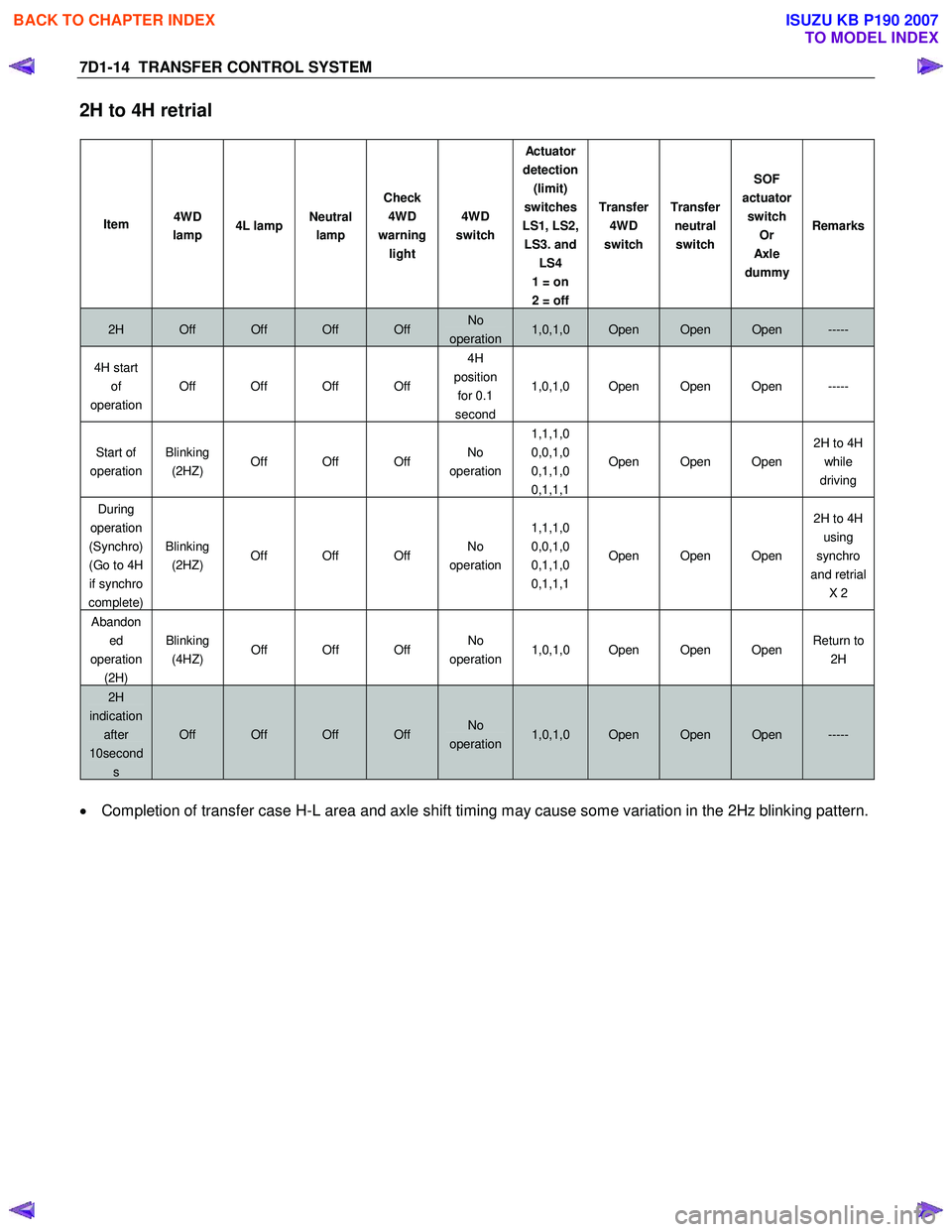
2H to 4H retrial
Item 4WD
lamp 4L lamp Neutral
lamp Check
4WD
warning light 4WD
switch Actu ato r
detection (limit)
switches
LS1, LS2, LS3. and LS4
1 = on
2 = off Transfer
4WD
switch Transfer
neutral switch SOF
actuator switch Or
Axl e
dummy Remarks
2H Off Off Off Off No
operation1,0,1,0 Open Open Open -----
4H start
of
operation Off Off Off Off 4H
position for 0.1
second 1,0,1,0 Open Open Open -----
Start of
operation Blinking
(2HZ) Off Off Off No
operation 1,1,1,0
0,0,1,0
0,1,1,0
0,1,1,1 Open Open Open
2H to 4H
while
driving
During
operation
(Synchro)
(Go to 4H if synchro
complete) Blinking
(2HZ) Off Off Off No
operation 1,1,1,0
0,0,1,0
0,1,1,0
0,1,1,1 Open Open Open 2H to 4H
using
synchro
and retrial X 2
Abandoned
operation (2H) Blinking
(4HZ) Off Off Off No
operation 1,0,1,0 Open Open Open Return to
2H
2H
indication
after
10second
s
Off Off Off Off No
operation1,0,1,0 Open Open Open -----
• Completion of transfer case H-L area and axle shift timing may cause some variation in the 2Hz blinking pattern.
BACK TO CHAPTER INDEX
TO MODEL INDEX
ISUZU KB P190 2007
Page 4891 of 6020
TRANSFER CONTROL SYSTEM 7D1-17
Item 4WD
lamp 4L lamp Neutral
lamp Check
4WD
lamp 4WD
switch Actu ato r
detection (limit)
switches LS1,
LS2,
LS3. and LS4
1 = on
2 = off Transfer
4WD
switch Transfer
neutral switch SOF
actuator switch Or
Axl e
dummy Remarks
2H start
of
operation On On Off Off 2H
position for 0.1
second 1,1,0,1 Closed Open Closed
Switch
operation sensor
During
operation Blinking
(2HZ) Blinking
(2HZ) Off Off No
operation 1,1,0,1 Closed Open Closed 4L to 4H
while
driving
During
operation (Passing through N) On
Blinking
(2HZ) Off Off No
operation 1,1,0,0 Closed Closed Closed 4L to 4H
through neutral
During
operation (Passing through N) Off
Blinking
(2HZ) Off Off No
operation 0,1,0,0 Closed Closed Closed 4L to 4H
through neutral
During
operation (4H
waiting) Off
Blinking
(2HZ) Off Off No
operation 0,0,1,1 Closed Closed Closed 4L to 4H
while
waiting
During
operation (Axle) Off while
waiting for start of H shift Blinking
(2HZ) while
waiting for start of H shift Off Off
No
operation 0,1,1,1
0,1,1,0
0,0,1,0
1,1,1,0 Closed Open Closed
2H to 4H
while
driving
During
operation (Axle) Blinking
(2HZ) at
end of H shift Off at end
of H shift Off Off No
operation 0,1,1,1
0,1,1,0
0,0,1,0
1,1,1,0 Closed Open Closed
Axle
driving
Axle
waiting
Blinking
(2HZ) Off Off Off No
operation1,0,1,0 Open Open Closed -----
2H Off Off Off Off No
operation1,0,1,0 Open Open Open -----
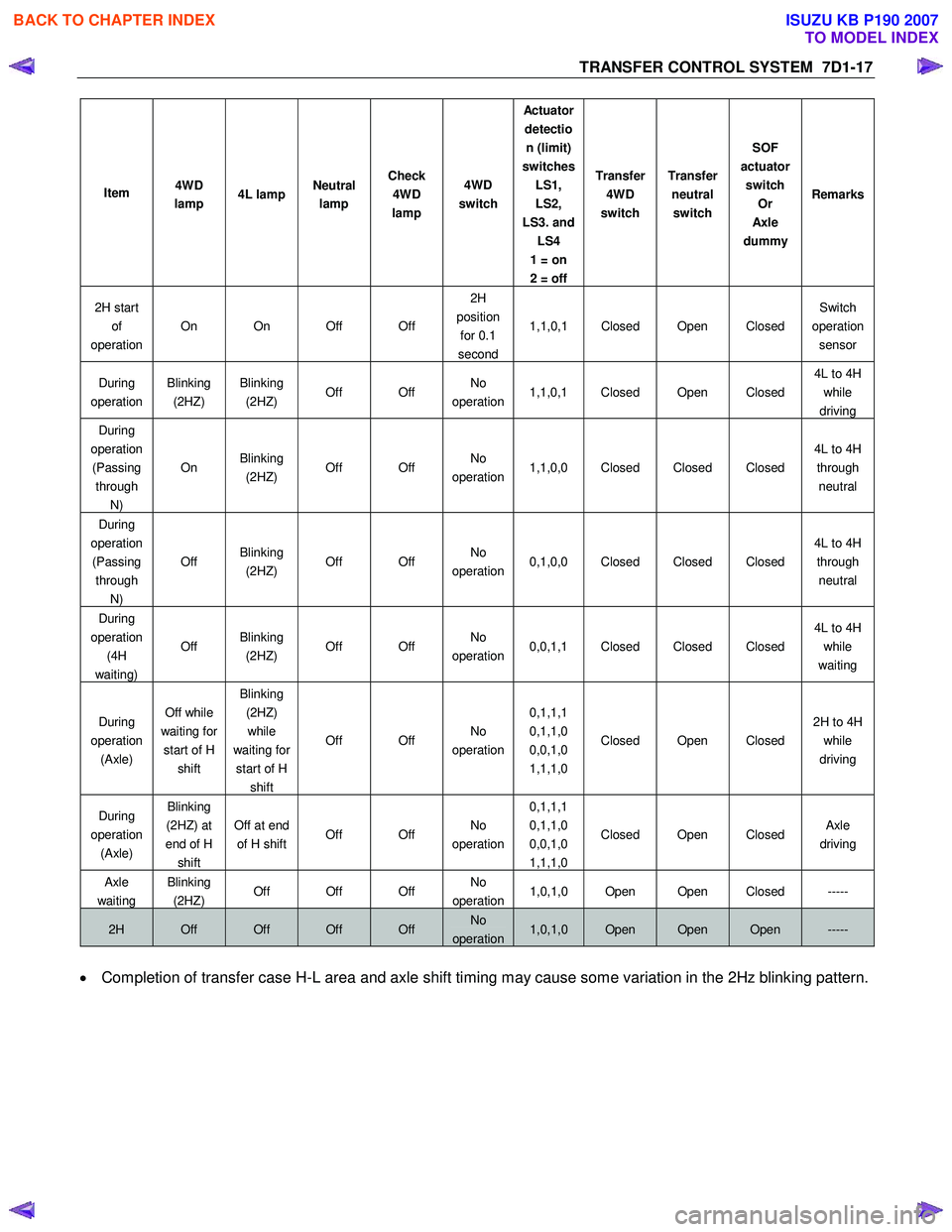
• Completion of transfer case H-L area and axle shift timing may cause some variation in the 2Hz blinking pattern.
BACK TO CHAPTER INDEX
TO MODEL INDEX
ISUZU KB P190 2007
Page 5925 of 6020
IMMOBILIZER SYSTEM (C24SE, 4JA1-T) 11A-27
Diagnostic procedure
• Once the cause of DTC is repaired or gone,
engine can be operated normally, and present
DTC becomes history code.
• History code is canceled by no repeat failure on 25
consequence ignition key on afterward.
• History code cannot be canceled by batter
y
connector disconnected.
Clearing Diagnostic Trouble Codes
IMPORTANT: Do not clear DTCs unless directed to do
so by the service information provided for each
diagnostic procedure. W hen DTCs are cleared, the
Failure Record data which may help diagnose an
intermittent fault will also be erased from memory.
Verifying Vehicle Repair
Verification of vehicle repair will be more
comprehensive for vehicles with immobilizer system
diagnostic. Following a repair, the technician should
perform the following steps:
1. Review and record the Fail Records for the DTC
which has been diagnosed.
2. Clear DTC(s).
3. Operate the vehicle within conditions noted in the
Fail Records.
4. Monitor the DTC status information for the DTC
which has been diagnosed until the diagnostic test
associated with that DTC runs.
Following these steps are very important in verifying
repairs on immobilizer systems. Failure to follow these
steps could result in unnecessary repairs.
Diagnostic Aids
Check the condition for system parts.
• Installation condition, poor connection, damage,
system parts malfunction. Harness, Fuse, Relay,
Immobilizer coil (antenna), Key, Meter, Immobilize
r
control unit (ICU), Engine control module (ECM).
NOTE: Breakage of immobilizer fuse does not operate
immobilizer system. Check engine lamp flashes at this
time.
Check the Electro-Magnetic Interference (EMI)
• Location of vehicle check
Move the vehicle to a new location and perform
the check again.
• Non-OEM Parts.
Switch is "OFF" or remove the Non-OEM parts and
perform the check again.
• Other
Remove the accessory and another key from key.
Check the other items.
• Battery voltage is low.
• Immobilizer programming functions.
Must be programmed immobilizer system.
• Registration for security code, immobilizer control
unit parts number.
• Key switch operation.
Immobilizer system may detect a history DTC b
y
the timing of ON-OFF of a key switch.
• Active the immobilizer system.
• Keyless entry system is malfunction.
• Anti theft system is malfunction.
Check the operation
Check the operation "Lock / unlock" by using transmitte
r
(key) on the vehicle.
BACK TO CHAPTER INDEX TO MODEL INDEX
ISUZU KB P190 2007
Page 5990 of 6020
11B-36 ANTITHEFT SYSTEM
Diagnosis
Diagnostic procedure
• Once the cause of DTC is repaired or gone,
engine can be operated normally, and present
DTC becomes history code.
• History code is canceled by no repeat failure on 25
consequence ignition key on afterward.
• History code cannot be canceled by batter
y
connector disconnected.
Clearing Diagnostic Trouble Codes
IMPORTANT: Do not clear DTCs unless directed to do
so by the service information provided for each
diagnostic procedure. W hen DTCs are cleared, the
Failure Record data which may help diagnose an
intermittent fault will also be erased from memory.
Verifying Vehicle Repair
Verification of vehicle repair will be more
comprehensive for vehicles with immobilizer system
diagnostic. Following a repair, the technician should
perform the following steps:
1. Review and record the Fail Records for the DTC which has been diagnosed.
2. Clear DTC (s).
3. Operate the vehicle within conditions noted in the Fail Records.
4. Monitor the DTC status information for the DTC which has been diagnosed until the diagnostic test
associated with that DTC runs.
Following these steps are very important in verifying
repairs on immobilizer systems. Failure to follow these
steps could result in unnecessary repairs.
Diagnostic Aids
An intermittent may be caused by the following:
• Poor connections.
• Miss routed harness.
• Rubbed through wire insulation.
• Broken wire inside the insulation.
Check for the following conditions:
• Poor connection at ACU-Inspect harness
connectors for backed out terminals, imprope
r
mating, broken locks, improperly formed or
damaged terminals, and poor terminal to wire
connection.
• Damaged harness-Inspect the wiring harness fo
r
damage.
If the harness appears to be OK, observe the data
display on the Tech2 while moving connectors and
wiring harnesses related to the switch or actuator.
A change in the display will indicate the location of
the fault.
If DTC cannot be duplicated, the information included in the Failure Records data can be useful
in determined vehicle mileage since the DTC was
last set.
If it is determined that the DTC occurs intermittently, performing the DTC Diagnostic
Chart may isolate the cause of the fault.
NOTE: Breakage of antitheft fuse does not operate
antitheft system. Check LED lamp flashes at this time.
Check the Electro-Magnetic Interference (EMI)
• Location of vehicle check
Move the vehicle to a new location and perform
the check again.
• Non-OEM Parts.
Switch is “OFF” or remove the Non-OEM parts and
perform the check again.
• Other
Remove the accessory and another key from key.
Check the other items.
• Battery voltage is low.
• Antitheft programming functions.
Must be programmed antitheft system.
• Registration for security code, antitheft control unit
parts number.
• Key switch operation.
Antitheft system may detect a history DTC by the
timing of ON-OFF of a key switch.
• Active the antitheft system.
• Keyless entry system is malfunction.
• Immobilizer system is malfunction.
Check the operation
Check the operation "Lock / unlock" by using transmitter
(key) on the vehicle.
BACK TO CHAPTER INDEX TO MODEL INDEX
ISUZU KB P190 2007