Page 420 of 441

Maintenance66 7G270201AUNCanisterFuel vapors generated inside the fuel
tank are absorbed and stored in the
onboard canister. When the engine is
running, the fuel vapors absorbed in the
canister are drawn into the surge tank
through the purge control solenoid valve.G270202AUNPurge Control Solenoid Valve (PCSV)The purge control solenoid valve is con-
trolled by the Engine Control Module
(ECM); when the engine coolant temper-
ature is low during idling, the PCSV clos-
es so that evaporated fuel is not taken
into the engine. After the engine warms-
up during ordinary driving, the PCSV
opens to introduce evaporated fuel to the
engine.
G270300AUN3. Exhaust emission control
systemThe Exhaust Emission Control System is
a highly effective system which controls
exhaust emissions while maintaining
good vehicle performance.G270301AUNVehicle modifications This vehicle should not be modified.
Modification of your vehicle could affect
its performance, safety or durability and
may even violate governmental safety
and emissions regulations.
In addition, damage or performance
problems resulting from any modification
may not be covered under warranty.G270302AUN-EUEngine exhaust gas precautions (car-
bon monoxide) Carbon monoxide can be present with
other exhaust fumes. Therefore, if you
smell exhaust fumes of any kind inside
your vehicle, have it inspected and
repaired immediately. If you ever sus-
pect exhaust fumes are coming into
your vehicle, drive it only with all the
windows fully open. Have your vehicle
checked and repaired immediately.
WARNING
- Exhaust
Engine exhaust gases contain car-
bon monoxide (CO). Though color-
less and odorless, it is dangerous
and could be lethal if inhaled.
Follow the instructions on this
page to avoid CO poisoning.
PROPOSITION 65
WARNING
Engine exhaust and a wide variety
of automobile components and
parts, including components found
in the interior furnishings in a vehi-
cle, contain or emit chemicals
known to the State of California to
cause cancer and birth defects and
reproductive harm. In addition, cer-
tain fluids contained in vehicles
and certain products of component
wear contain or emit chemicals
known to the State of California to
cause cancer and birth defects or
other reproductive harm.
EN hma 7.qxd 11/28/2006 3:48 PM Page 66
procarmanuals.com
Page 431 of 441
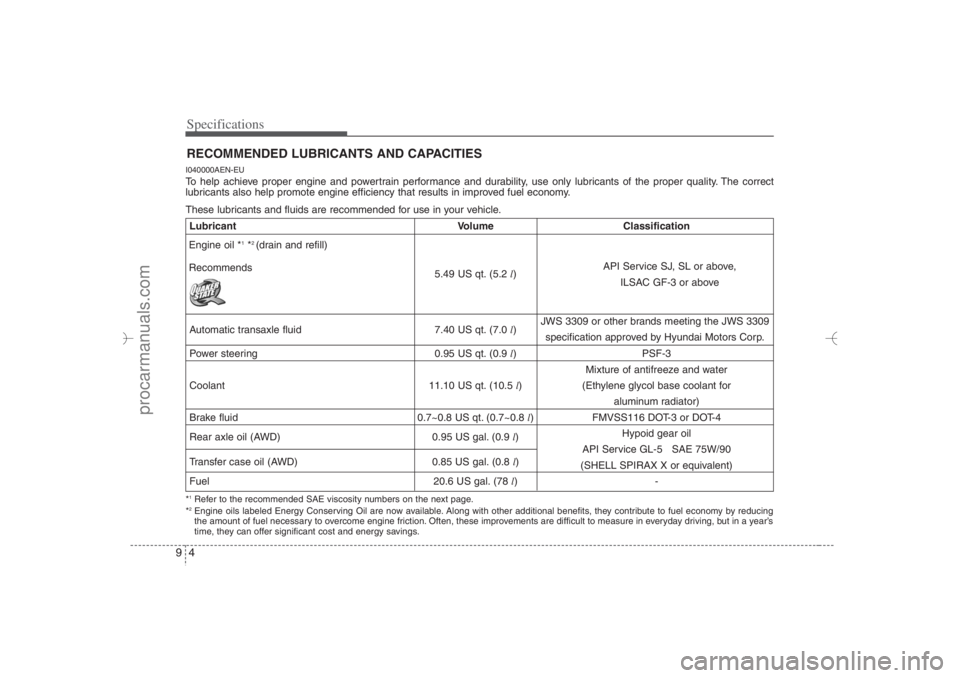
Specifications4 9RECOMMENDED LUBRICANTS AND CAPACITIES I040000AEN-EUTo help achieve proper engine and powertrain performance and durability, use only lubricants of the proper quality. The correct
lubricants also help promote engine efficiency that results in improved fuel economy.These lubricants and fluids are recommended for use in your vehicle.*1Refer to the recommended SAE viscosity numbers on the next page.
*2Engine oils labeled Energy Conserving Oil are now available. Along with other additional benefits, they contribute to fuel economy by reducing
the amount of fuel necessary to overcome engine friction. Often, these improvements are difficult to measure in everyday driving, but in a year’s
time, they can offer significant cost and energy savings.Lubricant Volume Classification
5.49 US qt. (5.2 l)
Automatic transaxle fluid 7.40 US qt. (7.0 l)
Power steering 0.95 US qt. (0.9 l) PSF-3
Mixture of antifreeze and water
Coolant 11.10 US qt. (10.5 l) (Ethylene glycol base coolant for
aluminum radiator)
Brake fluid 0.7~0.8 US qt. (0.7~0.8 l) FMVSS116 DOT-3 or DOT-4
Rear axle oil (AWD) 0.95 US gal. (0.9 l)Hypoid gear oil
API Service GL-5 SAE 75W/90
Transfer case oil (AWD) 0.85 US gal. (0.8 l)
(SHELL SPIRAX X or equivalent)
Fuel 20.6 US gal. (78 l)-Engine oil *
1*2 (drain and refill)
RecommendsAPI Service SJ, SL or above,
ILSAC GF-3 or above
JWS 3309 or other brands meeting the JWS 3309
specification approved by Hyundai Motors Corp.
EN hma 9.qxd 11/27/2006 5:58 PM Page 4
procarmanuals.com
Page 435 of 441

I3
Index
Central door lock switch ·············································4-16
Child-protector rear door lock ·····································4-18
Driver position memory system ····································4-38
Economical operation ····················································5-35
Emergency starting ··························································6-4
Jump starting ·································································6-4
Push starting ··································································6-5
Emission control system ················································7-65
Crankcase emission control system·····························7-65
Evaporative emission control (including ORVR:
Onboard Refueling Vapor Recovery) System ·············7-65
Exhaust emission control system ································7-66
Engine compartment ················································2-4, 7-2
Engine coolant ·······························································7-15
Engine number ·································································8-3
Engine oil ·······································································7-14
Explanation of scheduled maintenance items················7-11
Exterior features···························································4-119
Roof rack ···································································4-119
Fuel filler lid ··································································4-31
Emergency fuel filer lid release ··································4-33
Fuel requirements ····························································1-3
Fuses ··············································································7-43
Fuse/relay panel description ········································7-47Main fuse ·····································································7-46
Memory fuse································································7-45
Hazard warning flasher··················································4-71
Hood···············································································4-30
How to use this manual ···················································1-2
If the engine overheats·····················································6-6
If the engine will not start ···············································6-3
If you have a flat tire ·····················································6-12
Changing tires······························································6-14
Compact spare tire ·······················································6-19
Jack and tools ······························································6-12
Removing and storing the spare tire ···························6-13
In case of an emergency while driving····························6-2
Indicator symbols on the instrument cluster ···················1-7
Instrument cluster ··························································4-52
Engine temperature gauge ···········································4-54
Fuel gauge ···································································4-55
Instrument panel illumination ·····································4-53
Odometer/Tripmeter ····················································4-55
Speedometer ································································4-53
Tachometer ··································································4-53
Trip computer ······························································4-56
Warning and indicators ················································4-59
Instrument panel overview ··············································2-3EF
HI
EN hma Index.qxd 11/28/2006 1:23 PM Page 3
procarmanuals.com
Page:
< prev 1-8 9-16 17-24