Page 263 of 291
6 DO-IT-YOURSELF MAINTENANCE
40
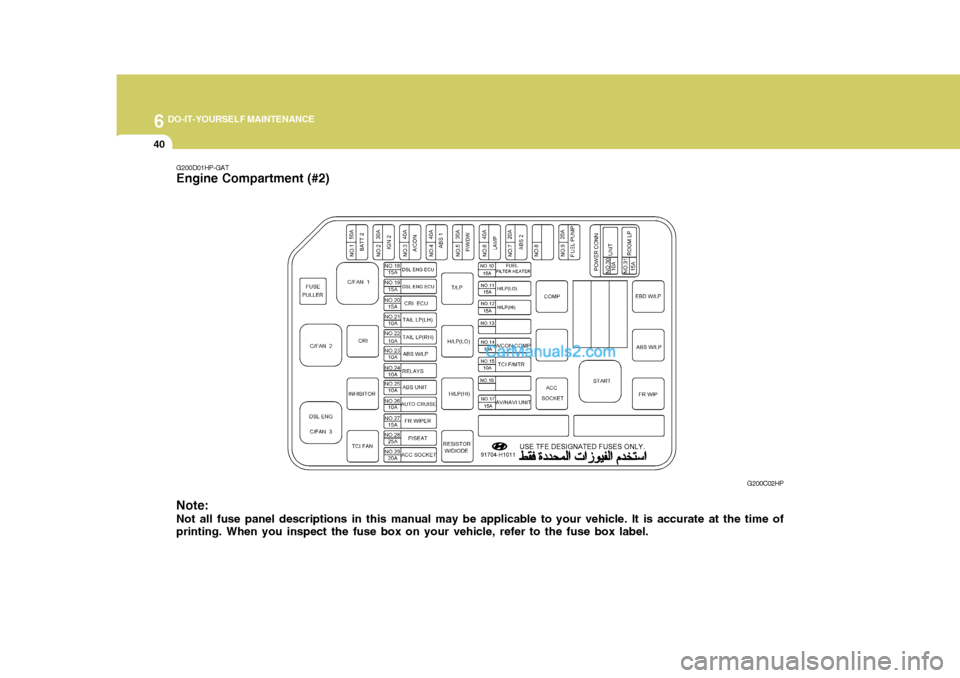
Note: Not all fuse panel descriptions in this manual may be applicable to your vehicle. It is accurate at the time of printing. When you inspect the fuse box on your vehicle, refer to the fuse box label.
G200D01HP-GAT Engine Compartment (#2)
G200C02HP
Page 264 of 291
6
DO-IT-YOURSELF MAINTENANCE
41
AMPERAGES(A) 15A 15A15A-
10A 10A
-
15A 15A15A15A 10A 10A10A 10A 10A 10A15A25A20A
NO. 10
NO. 11
NO. 12
NO. 13
NO. 14
NO. 15
NO. 16
NO. 17
NO. 18
NO. 19
NO. 20
NO. 21
NO. 22
NO. 23
NO. 24
NO. 25
NO. 26
NO. 27
NO. 28
NO. 29
DESCRIPTION
CIRCUIT PROTECTED
Fuel Heater and Sensor(2.9 CRDi)Headlamp(Low beam)Headlamp(High beam) -
A/C Compressor Relay, Triple Switch
TCI Fan Relay(COVEC-F/EGR)--ECM(Diesel Engine)ECM(Diesel Engine)
ECM(2.9 CRDi), Air Heater Relay(2.9 CRDi), EGR Solenoid(2.9 CRDi)
Illuminations, Combination Lamp
License Lamp, Combination Lamp
ABS Control Module, ABS Relay, EBD Relay
ECM(Diesel Engine), Headlamp Relay, Condenser Fan Relay
(Gasoline/COVEC-F), EGR Solenoid(COVEC-F)ABS Control Module
Cruise Control Module
Front Wiper and Washer
Power Seat Switch
Power Outlet Relay
FUSE
Page 265 of 291
6 DO-IT-YOURSELF MAINTENANCE
42
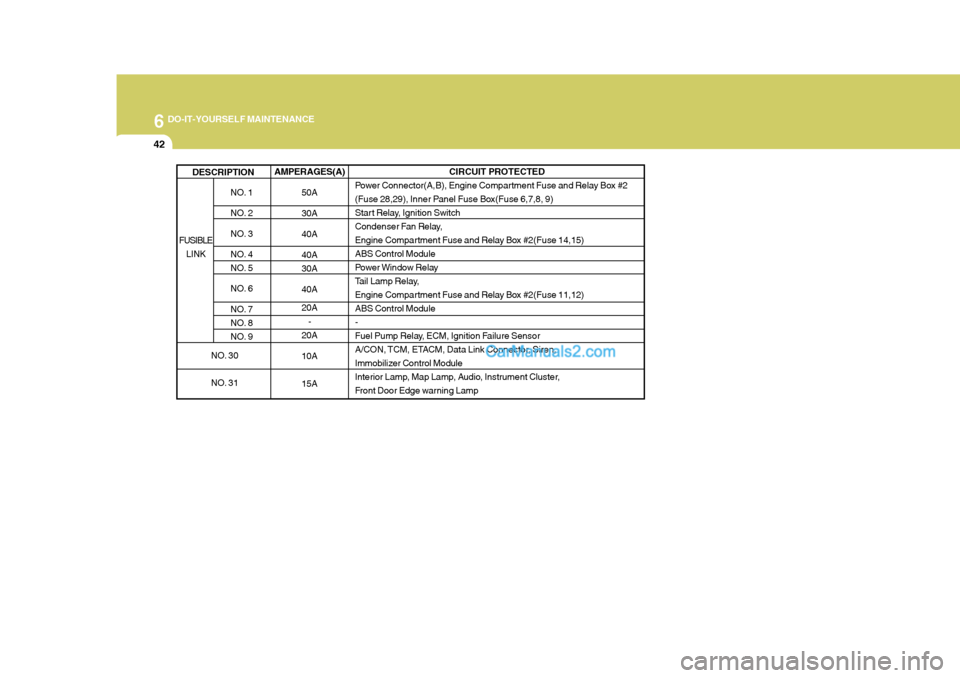
AMPERAGES(A)50A 30A 40A 40A 30A 40A 20A-
20A 10A 15A
NO. 1
NO. 2
NO. 3
NO. 4
NO. 5
NO. 6
NO. 7
NO. 8
NO. 9
DESCRIPTION
CIRCUIT PROTECTED
Power Connector(A,B), Engine Compartment Fuse and Relay Box #2
(Fuse 28,29), Inner Panel Fuse Box(Fuse 6,7,8, 9)
Start Relay, Ignition Switch
Condenser Fan Relay,
Engine Compartment Fuse and Relay Box #2(Fuse 14,15)ABS Control Module
Power Window Relay
Tail Lamp Relay,
Engine Compartment Fuse and Relay Box #2(Fuse 11,12)ABS Control Module-
Fuel Pump Relay, ECM, Ignition Failure Sensor
A/CON, TCM, ETACM, Data Link Connector, Siren,
Immobilizer Control Module
Interior Lamp, Map Lamp, Audio, Instrument Cluster,
Front Door Edge warning Lamp
FUSIBLE LINK
NO. 30
NO. 31
Page 268 of 291
7EMISSION CONTROL SYSTEMS
2EMISSION CONTROL SYSTEMS
H010A01A-GAT
(If Installed)
Your Hyundai is equipped with an
emission control system to meet all requirements of the Emission prohibi- tion rules of your province.
There are three emission control sys-
tems which are as follows.
(1) Crankcase emission control sys- tem (For a Gasoline Engine)
(2) Evaporative emission control sys- tem (For a Gasoline Engine)
(3) Exhaust emission control system
In order to assure the proper function
of the emission control systems, it is recommended that you have your carinspected and maintained by an au- thorized Hyundai dealer in accordance with the maintenance schedule in thismanual. H010B01A-AAT
1. Crankcase Emission Control
System ; For a Gasoline Engine
The positive crankcase ventilation
system is employed to prevent air pollution caused by blow-by gasesbeing emitted from the crankcase. This system supplies fresh filtered air to the crankcase through the air in-take hose. Inside the crankcase, which the fresh air mixes with blow-by gases, which then pass through the PCVvalve into the induction system.
H010C02Y-GAT
2. Evaporative Emission
Control System ; For a Gasoline Engine
The Evaporative Emission Control
System is designed to prevent fuel vapors from escaping into the atmo- sphere. Canister
While the engine is inoperative, fuel
vapors generated inside the fuel tankare absorbed and stored in the canis- ter. When the engine is running, thefuel vapors absorbed in the canister are drawn into the induction system through the purge control solenoidvalve. Purge Control Solenoid Valve
The purge control solenoid valve is
controlled by the ECM; when the en- gine coolant temperature is low, and during idling, it closes, so that evapo- rated fuel is not taken into the surgetank. After engine warm-up, during ordinary driving, it opens so as to introduce evaporated fuel to the surgetank. H010D01A-AAT
3. Exhaust Emission Control
System
The Exhaust Emission Control Sys- tem is a highly effective system whichcontrols exhaust emissions while maintaining good vehicle performance.
Page 269 of 291
7
EMISSION CONTROL SYSTEMS
3
!
CATALYTIC CONVERTER
H020A01A-AAT
; For a Gasoline Engine
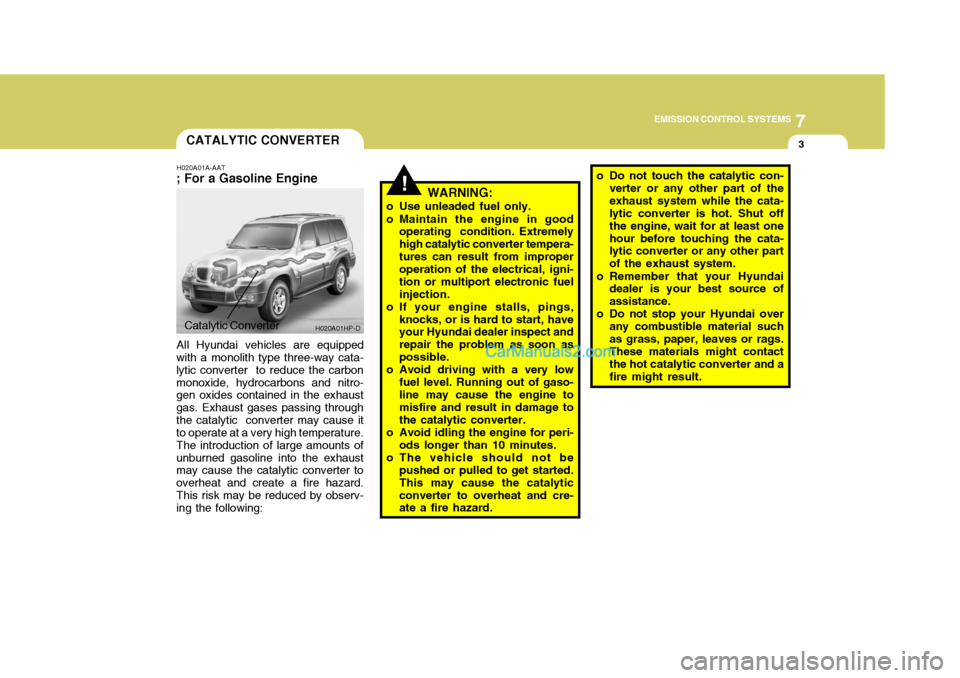
All Hyundai vehicles are equipped
with a monolith type three-way cata- lytic converter to reduce the carbonmonoxide, hydrocarbons and nitro- gen oxides contained in the exhaust gas. Exhaust gases passing throughthe catalytic converter may cause it to operate at a very high temperature. The introduction of large amounts ofunburned gasoline into the exhaust may cause the catalytic converter to overheat and create a fire hazard.This risk may be reduced by observ- ing the following: WARNING:
o Use unleaded fuel only.
o Maintain the engine in good operating condition. Extremely high catalytic converter tempera-tures can result from improper operation of the electrical, igni- tion or multiport electronic fuelinjection.
o If your engine stalls, pings, knocks, or is hard to start, have your Hyundai dealer inspect and repair the problem as soon aspossible.
o Avoid driving with a very low
fuel level. Running out of gaso-line may cause the engine to misfire and result in damage to the catalytic converter.
o Avoid idling the engine for peri-
ods longer than 10 minutes.
o The vehicle should not be pushed or pulled to get started.This may cause the catalyticconverter to overheat and cre- ate a fire hazard.
Catalytic Converter
o Do not touch the catalytic con-
verter or any other part of the exhaust system while the cata- lytic converter is hot. Shut off the engine, wait for at least onehour before touching the cata- lytic converter or any other part of the exhaust system.
o Remember that your Hyundai dealer is your best source ofassistance.
o Do not stop your Hyundai over any combustible material suchas grass, paper, leaves or rags. These materials might contact the hot catalytic converter and afire might result.
H020A01HP-D
Page 270 of 291
7EMISSION CONTROL SYSTEMS
4
!
H020D01HP-GAT ; For a Diesel Engine (If Installed)
WARNING:
o Use diesel only.
o Maintain the engine in good operating condition. Extremely high catalytic converter tempera- tures can result from improperoperation of the electrical, igni- tion or electronic fuel injection.
o If your engine stalls, pings, or is hard to start, have your Hyundaidealer inspect and repair the problem as soon as possible.
o Avoid driving with a very low fuel level. Running out of dieselmay cause the engine to stop and result in damage to the cata- lytic converter.
o Avoid idling the engine for peri- ods longer than 10 minutes.
o The vehicle should not be pushed or pulled to get started.This may cause the catalyticconverter to overheat and cre- ate a fire hazard.
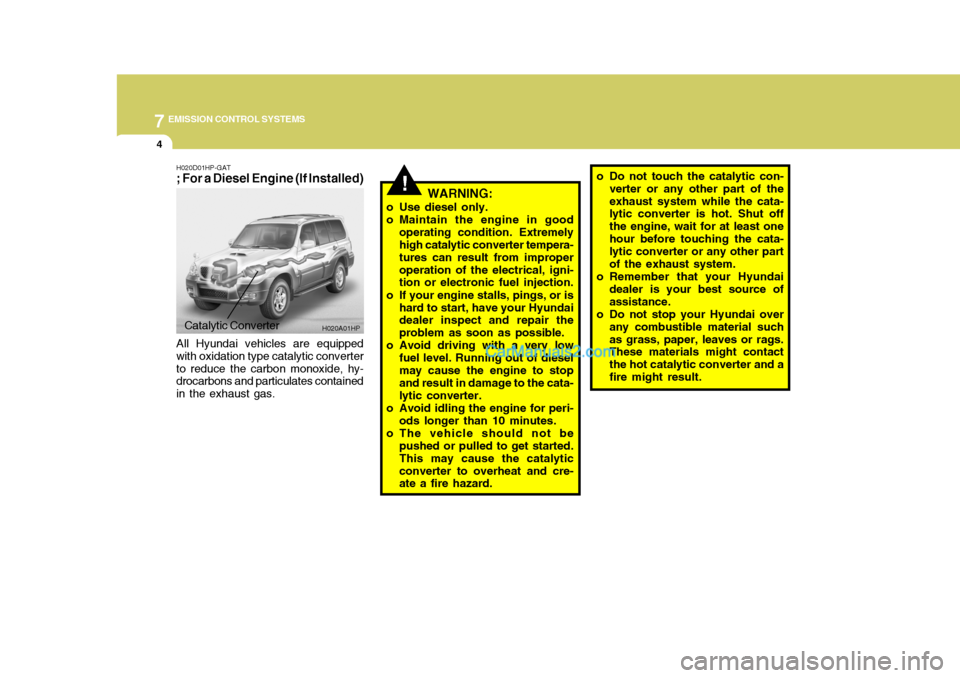
Catalytic Converter H020A01HP
All Hyundai vehicles are equipped with oxidation type catalytic converterto reduce the carbon monoxide, hy- drocarbons and particulates contained in the exhaust gas. o Do not touch the catalytic con-
verter or any other part of theexhaust system while the cata- lytic converter is hot. Shut off the engine, wait for at least onehour before touching the cata- lytic converter or any other part of the exhaust system.
o Remember that your Hyundai
dealer is your best source ofassistance.
o Do not stop your Hyundai over any combustible material suchas grass, paper, leaves or rags. These materials might contact the hot catalytic converter and afire might result.
Page 271 of 291
7
EMISSION CONTROL SYSTEMS
5
H020C01HP-GAT
; For a Diesel Engine (If Installed)
This system helps control oxides of nitrogen by recirculating a part of the exhaust gas into the engine, there by reducing cylinder combustion tem-perature.The EGR system helps reduce Nox(Oxides of Nitrogen) emission gas-ses. EGR SYSTEM
Page 272 of 291
Vehicle Identification Number (VIN) ............................ 8-2
Engine Number ............................................................ 8-2
Recommended Inflation Pressures ............................. 8-3
Snow Tires ................................................................... 8-4
Tire Chains ................................................................... 8-4
Tire Rotation ................................................................ 8-5
Tire Balancing .............................................................. 8-5
Tire Traction ................................................................. 8-5
When to Replace Tires ................................................ 8-6
Spare Tire and Tools ................................................... 8-7
8
CONSUMER INFORMATION
8