Page 240 of 291
6
DO-IT-YOURSELF MAINTENANCE
17
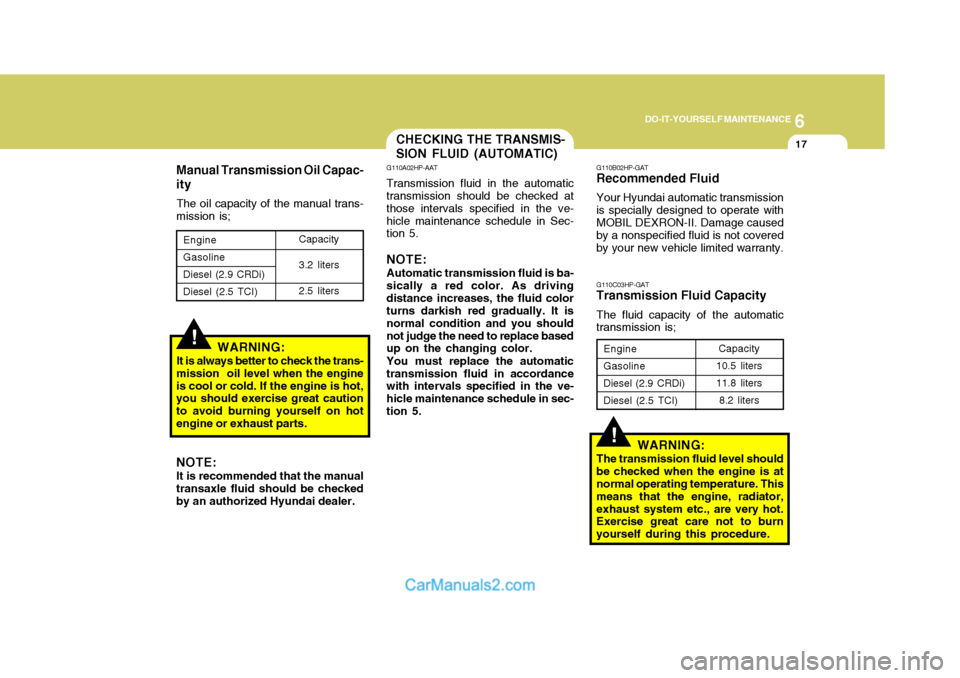
Manual Transmission Oil Capac- ity
The oil capacity of the manual trans-
mission is;
WARNING:
It is always better to check the trans-
mission oil level when the engine is cool or cold. If the engine is hot, you should exercise great caution to avoid burning yourself on hotengine or exhaust parts.
!
Engine GasolineDiesel (2.9 CRDi)Diesel (2.5 TCI) Capacity 3.2 liters 2.5 liters
NOTE: It is recommended that the manual transaxle fluid should be checkedby an authorized Hyundai dealer.
CHECKING THE TRANSMIS- SION FLUID (AUTOMATIC)
!
G110B02HP-GAT
Recommended Fluid
Your Hyundai automatic transmission is specially designed to operate with MOBIL DEXRON-II. Damage caused by a nonspecified fluid is not coveredby your new vehicle limited warranty. G110C03HP-GAT
Transmission Fluid Capacity
The fluid capacity of the automatic transmission is;
WARNING:
The transmission fluid level should be checked when the engine is at normal operating temperature. This means that the engine, radiator,exhaust system etc., are very hot. Exercise great care not to burn yourself during this procedure.
G110A02HP-AAT Transmission fluid in the automatic transmission should be checked at those intervals specified in the ve-hicle maintenance schedule in Sec- tion 5. NOTE: Automatic transmission fluid is ba- sically a red color. As drivingdistance increases, the fluid color turns darkish red gradually. It is normal condition and you shouldnot judge the need to replace based up on the changing color. You must replace the automatic transmission fluid in accordance with intervals specified in the ve- hicle maintenance schedule in sec-tion 5.
Engine GasolineDiesel (2.9 CRDi)Diesel (2.5 TCI)
Capacity
10.5 liters11.8 liters 8.2 liters
Page 241 of 291
6 DO-IT-YOURSELF MAINTENANCE
18
G110D02HP-GAT
To Check the Transmission Fluid Level
Park the car on level ground with the parking brake engaged. When the transmission fluid level is checked, the transmission fluid should be atnormal operating temperature and the engine idling. While the engine is idling, apply the brakes and move the gear selectorlever from "P" to each of its other positions — "R", "N", "D", "2", "L" — and then return to "N" or "P". With theengine still idling: HHP30181. Open the hood, being careful to
keep hands, long hair and clothingclear of any moving parts.
2. Remove the transmission dipstick,wipe it clean, reinsert the dipstickas far as it will go, then remove it again. Now check the fluid level on the dipstick. It should be in the"HOT" range on the dipstick. HHP5009
G110D01HP
G110D02HP
Diesel Engine (2.5 TCI) Gasoline Engine
Diesel Engine (2.9 CRDi)
Page 242 of 291
6
DO-IT-YOURSELF MAINTENANCE
19
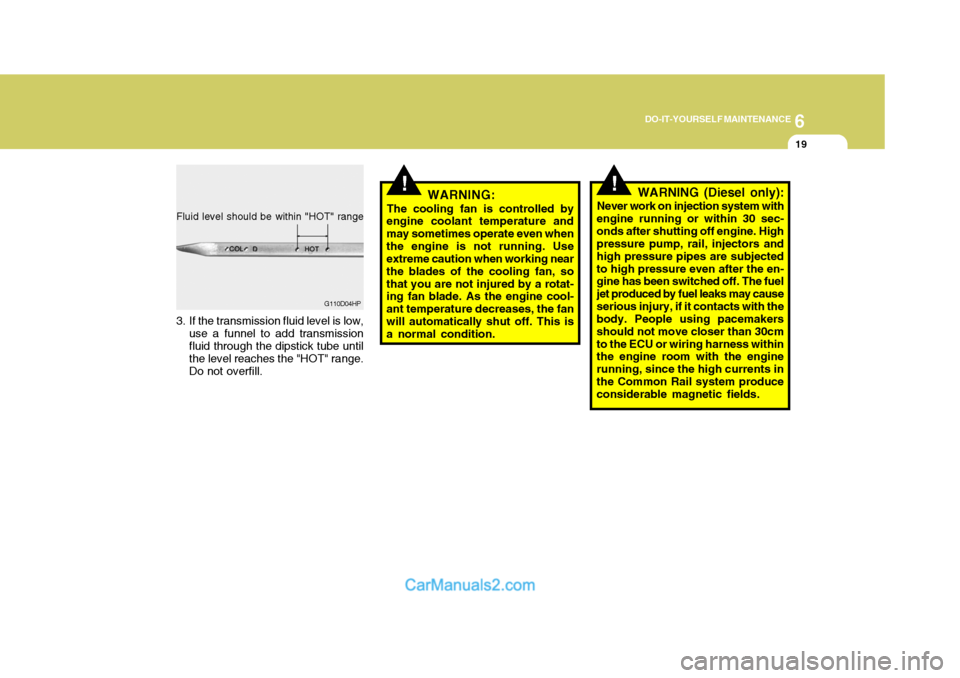
Fluid level should be within "HOT" range
3. If the transmission fluid level is low, use a funnel to add transmission fluid through the dipstick tube until the level reaches the "HOT" range. Do not overfill. G110D04HP
!!WARNING:
The cooling fan is controlled by
engine coolant temperature and may sometimes operate even whenthe engine is not running. Use extreme caution when working near the blades of the cooling fan, sothat you are not injured by a rotat- ing fan blade. As the engine cool- ant temperature decreases, the fanwill automatically shut off. This is a normal condition. WARNING (Diesel only):
Never work on injection system with
engine running or within 30 sec- onds after shutting off engine. High pressure pump, rail, injectors and high pressure pipes are subjectedto high pressure even after the en- gine has been switched off. The fuel jet produced by fuel leaks may causeserious injury, if it contacts with the body. People using pacemakers should not move closer than 30cmto the ECU or wiring harness within the engine room with the engine running, since the high currents inthe Common Rail system produce considerable magnetic fields.
Page 245 of 291
6 DO-IT-YOURSELF MAINTENANCE
22
G140B01A-AAT
Checking the Air Conditioning Operation
1. Start the engine and let it run at
fast idle for several minutes with the air conditioning set at the maxi- mum cold setting.
2. If the air coming out of the in-dash vents is not cold, have the air con-ditioning system inspected by yourHyundai dealer.
CAUTION:
Running the air conditioning sys-
tem for extended periods of timewith a low refrigerant level may damage the compressor.
! G140C01A-AAT
Lubrication
To lubricate the compressor and the
seals in the system, the air condition- ing should be run for at least 10 minutes each week. This is particu-larly important during cool weather when the air conditioning system is not otherwise in use.
AIR CONDITIONING CARE
G140A01A-AAT Keeping the Condenser Clean The air conditioning condenser (and engine radiator) should be checked periodically for accumulation of dirt, dead insects, leaves, etc. These caninterfere with maximum cooling effi- ciency. When removing such accu- mulations, brush or hose them awaycarefully to avoid bending the cooling fans.
Page 247 of 291
6 DO-IT-YOURSELF MAINTENANCE
24CHECKING AND REPLAC- ING FUSES
G200A01A-AAT
Replacing a Fusible Link
G200A01HP
G200A02HP
Bad Good Bad Good
Engine Compartment Fuse and Relay Box #1
Engine Compartment Fuse and Relay Box #2
5. Replace the two filters.
6. Installation is the reverse order of
disassembly. HHP21564. Remove the filter cover by pulling it.
HHP2155
Page 248 of 291

6
DO-IT-YOURSELF MAINTENANCE
25
G200B02HP-GAT
Replacing Accessory Fuses
The fuse box for the lights and other
electrical accessories will be found under the dashboard on the driver’s side. Inside the box you will find a list showing the circuits protected by eachfuse. If any of your car's lights or other
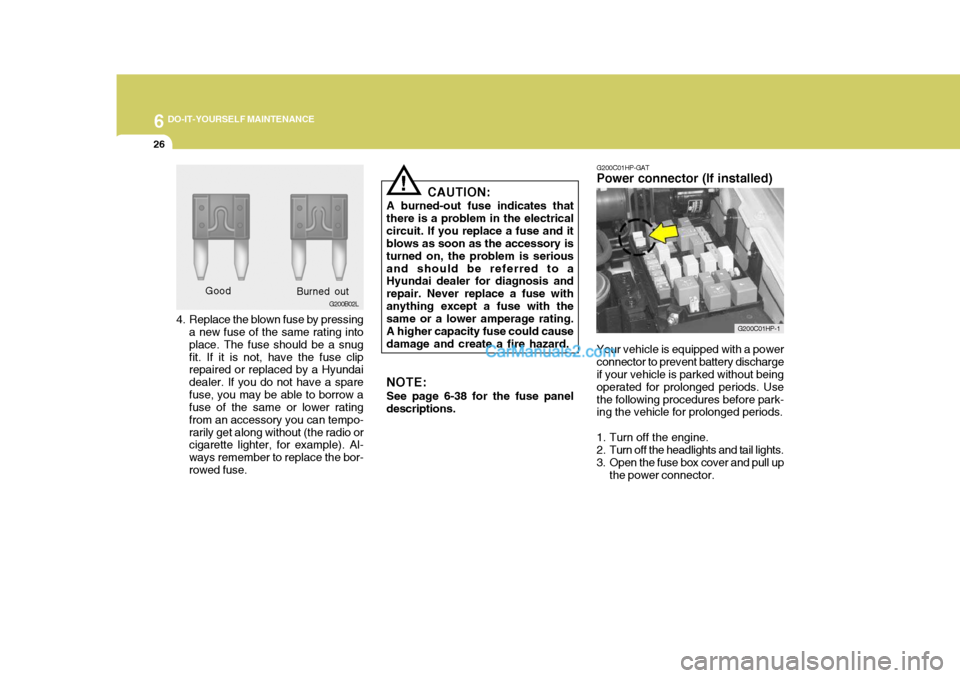
electrical accessories stop working, ablown fuse could be the reason. If the fuse has burned out, you will see that the metal strip inside the fuse hasburned through. If you suspect a blown fuse, follow this procedure: G200B01HP
!
A fusible link will melt if the electrical
circuits from the battery are ever over- loaded, thus preventing damage to the entire wiring harness. (This could be caused by a short in the systemdrawing too much current.) If this ever happens, have a Hyundai dealer determine the cause, repair the sys-tem and replace the fusible link. The fusible links are located in a relay box for easy inspection.
CAUTION:
When replacing a fusible link, never use anything but a new fusible link with the same or lower amper-age rating. Never use a piece of wire or a higher-rated fusible link. This could result in serious dam-age and create a fire hazard. 3. Be sure to check all other fuses,
even if you find one that appears tohave burned out.
1. Turn off the ignition and all other
switches.
2. Open the fuse box and examine each fuse. Remove each fuse bypulling it toward you (a small "fusepuller" tool is contained in the relay and fuse box of the engine room to simplify this operation).
HHP4002
Page 249 of 291
6 DO-IT-YOURSELF MAINTENANCE
26
4. Replace the blown fuse by pressing
a new fuse of the same rating into place. The fuse should be a snugfit. If it is not, have the fuse clip repaired or replaced by a Hyundai dealer. If you do not have a sparefuse, you may be able to borrow a fuse of the same or lower rating from an accessory you can tempo-rarily get along without (the radio or cigarette lighter, for example). Al- ways remember to replace the bor-rowed fuse. Good
G200B02L
Burned out CAUTION:
A burned-out fuse indicates thatthere is a problem in the electricalcircuit. If you replace a fuse and it blows as soon as the accessory is turned on, the problem is seriousand should be referred to a Hyundai dealer for diagnosis and repair. Never replace a fuse withanything except a fuse with the same or a lower amperage rating. A higher capacity fuse could causedamage and create a fire hazard. NOTE: See page 6-38 for the fuse panel descriptions.
! G200C01HP-GAT
Power connector (If installed)
Your vehicle is equipped with a power connector to prevent battery discharge if your vehicle is parked without being operated for prolonged periods. Usethe following procedures before park- ing the vehicle for prolonged periods.
1. Turn off the engine.
2. Turn off the headlights and tail lights.
3. Open the fuse box cover and pull up the power connector.
G200C01HP-1
Page 251 of 291
6 DO-IT-YOURSELF MAINTENANCE
28
!
G210B01Y-GET
Checking the Battery
Keep the battery clean. Any evidence
of corrosion around the battery posts or terminals should be removed using a solution of household baking sodaand warm water. After the battery terminals are dry, cover them with a light coating of grease.
WARNING:Always read the followinginstructions carefullywhen handling a battery.Keep lighted cigarettesand all other flames orsparks away from the bat- tery. Hydrogen, which is a highly combustible gas, is always present in batterycells and may explode if ignited.Keep batteries out of the reach of children because batteries contain highly corrosive SULFURIC ACID.Do not allow battery acid to contact your skin, eyes, clothing or paint finish.If any electrolyte gets intoyour eyes, flush your eyeswith clean water for at least 15 minutes and get imme- diate medical attention. Ifpossible, continue to ap- ply water with a sponge or cloth until medical atten-tion is received.If electrolyte gets on yourskin, thoroughly wash thecontacted area.If you feel a pain or a burn-ing sensation, get medi- cal attention immediately. Wear eye protection when charging or working near a battery. Always provide ventilation when working in an en- closed space.o When lifting a plastic-cased bat- tery, excessive pressure on the case may cause battery acid toleak, resulting in personal in- jury. Lift with a battery carrier or with your hands on oppositecorners.
o Never attempt to charge the bat- tery when the battery cables are connected.
o The electrical ignition system works with high voltage. Never touch these componentswith the engine running or the ignition switched on.