2007 Hyundai Getz Fuel
[x] Cancel search: FuelPage 363 of 463

DRIVING YOUR HYUNDAI 2- 3
!
C020A02O-EAT BEFORE STARTING THE EN- GINE Before you start the engine, you should always:
1. Look around the vehicle to be sure
there are no flat tyres, puddles of oil or water or other indications of pos-sible trouble.
2. After entering the car, check to be
sure the parking brake is engaged.
3. Check that all windows, and lights are clean.
4. Check that the interior and exterior mirrors are clean and in position.
5. Check your seat, seatback and
headrestraint to be sure they are intheir proper positions.
6. Close all the doors.
7. Fasten your seat belt and be sure
that all other occupants have fas- tened theirs.
8. Turn off all lights and accessories that are not needed.
9. When you turn the ignition switch to
"ON" check that all appropriate warn- ing lights are operating and that you have sufficient fuel. 10.Check the operation of warning
lights and all bulbs when key is in the "ON" position.
WARNING: (DIESEL ENGINE)
To ensure that sufficient vacuum exists within the brake system dur-ing cold weather start-up condi- tions, it is necessary to run the engine at idle for several secondsafter starting the engine. SC040A1-F COMBINATION IGNITION SWITCH AND STEERING LOCKTo Start the Engine
o If your Hyundai is equipped with a
manual transaxle, place the shift lever in neutral and depress theclutch pedal fully.
o If your Hyundai has an automatic
transaxle, place the shift lever in "P"(park).
o To start the engine, insert the igni-
tion key and turn it to the "START"position. Release it as soon as the engine starts. Do not hold the key in the "START" position for more than15 seconds.
NOTE: For safety, the engine will not start if the shift lever is not in "P" or "N"Position (automatic transaxle).
!WARNING:
Always wear appropriate shoes when operating your vehicle. Unsuitable shoes (high heels, ski boots, etc.) may interfere with yourability to use the brake and accelera- tor pedal, and the clutch (if installed).
Page 367 of 463

DRIVING YOUR HYUNDAI 2- 7
!
!
C055B01B-GAT STARTING AND STOPPING THE ENGINE FOR TURBO CHARGERINTERCOOLER (DIESEL EN-GINE)
(1) Do not race the engine or sudden
accelerate the engine immediately after start it. If the engine is cold, allow the engine to idle for severalseconds before it is driven to en- sure sufficient lubrication of the turbo charger unit.
(2) After high speed or extended driv- ing, requiring a heavy engine load,the engine should be allowed to idleabout 1 minute before turning it off. This idle time will allow the turbo charger to cool prior to shutting theengine off.
WARNING:
Do not turn the engine off immedi- ately after it has been subjected to a heavy load. Doing so may causesevere damage to the engine or turbo charger unit.
WARNING:
Be sure that the clutch is fully de- pressed when starting a manualtransaxle vehicle. Otherwise there is the potential to cause damage to the vehicle or injury to someoneinside or outside the vehicle as a result of the forward or backward movement of the vehicle that willoccur if the clutch is not depressed when the vehicle is started. SC060B1-E FUEL ECONOMY The following suggestions are made to assist in achieving the greatest degreeof fuel economy.
o Maintaining a constant check on
fuel consumption will enable the most economical use pattern and driving style to be adopted.
o Avoid using the vehicle for very short journeys if possible, particu-larly when a cold start is involved.
o Ensure that tyre pressures are main- tained at the correct level.
o Use only the recommended grade of fuel.
o Avoid carrying unnecessary weight,
and if a roof rack is in use, removeit as soon as possible after use.
o Anticipate the road and conditions
ahead to enable adjustments inspeed to be made smoothly. Avoid heavy acceleration and sharp brak- ing.
o Avoid cruising at unnecessary high speeds.
5. Turn the ignition key to the "Start"
position and release it when theengine starts.
Page 369 of 463
DRIVING YOUR HYUNDAI 2- 9
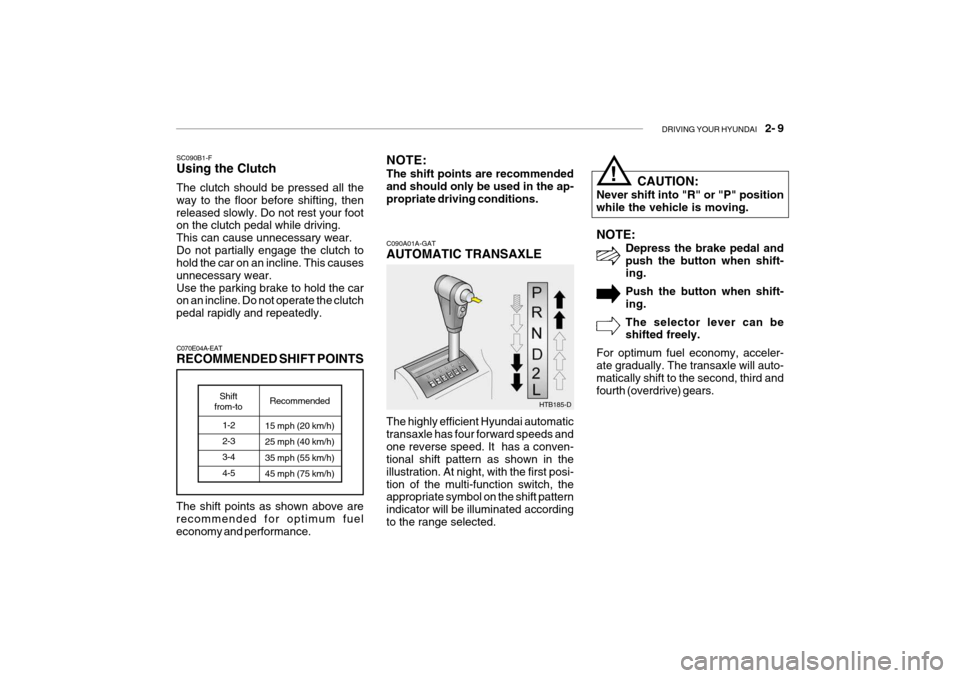
C070E04A-EAT RECOMMENDED SHIFT POINTS
1-2 2-3 3-44-5
Shift
from-to Recommended
15 mph (20 km/h)25 mph (40 km/h)35 mph (55 km/h) 45 mph (75 km/h)
The shift points as shown above are recommended for optimum fuel economy and performance. SC090B1-F Using the Clutch The clutch should be pressed all the way to the floor before shifting, thenreleased slowly. Do not rest your foot on the clutch pedal while driving. This can cause unnecessary wear.Do not partially engage the clutch to hold the car on an incline. This causes unnecessary wear.Use the parking brake to hold the car on an incline. Do not operate the clutch pedal rapidly and repeatedly.
HTB185-D
C090A01A-GAT AUTOMATIC TRANSAXLE The highly efficient Hyundai automatic transaxle has four forward speeds andone reverse speed. It has a conven- tional shift pattern as shown in the illustration. At night, with the first posi-tion of the multi-function switch, the appropriate symbol on the shift pattern indicator will be illuminated accordingto the range selected. CAUTION:
Never shift into "R" or "P" positionwhile the vehicle is moving. NOTE: Depress the brake pedal and push the button when shift- ing. Push the button when shift- ing. The selector lever can be shifted freely.
For optimum fuel economy, acceler-ate gradually. The transaxle will auto- matically shift to the second, third andfourth (overdrive) gears.
!
NOTE: The shift points are recommended and should only be used in the ap- propriate driving conditions.
Page 371 of 463

DRIVING YOUR HYUNDAI 2- 11
C090H01A-EAT NOTE:
o The brake pedal should be de-
pressed when shifting from NEU- TRAL to a forward or reversegear.
o The brake pedal fully depressed
in order to move the shift leverfrom the "P" (Park) position to any of the other positions.
o It is always possible to shift from "R", "N", "D", "2", "L" position.
!
C090I04A-EAT
CAUTION:
o Shift into "R", "D" and "P" only when the vehicle has completely stopped.
o Do not accelerate the engine in
reverse or any of the forward posi- tions with the brakes applied.
o Always apply the footbrake when shifting from "P" or "N", to "R", "D", "2" or "L" position.
o Do not use the "P" (Park) position
in place of the parking brake. Al- ways set the parking brake, shift the transaxle into "P" (Park) and turn off the ignition when you leave the vehicle, even momentarily. Never leave the vehicle unattended whilst the engine is running.
o When accelerating from a stop on
a steep hill, the vehicle may have a tendency to roll backwards. Shift- ing the shift lever into 2nd gear will help prevent the vehicle from rolling backwards.
o Check the automatic transaxle fluid
level regularly, and add fluid as necessary.
o See the maintenance schedule for the proper fluid recommendation. FC120D2-E General Operating Instructions
o The button in the selector handle
must be depressed before the se- lector can be moved.
o The engine may only be started
when the selector is at position "P"or "N".
o Ensure that the footbrake is firmly
applied when shifting from "P" or"N" to "D", "2", "L" or "R" and vice versa.
o Always engage the parking brake when the vehicle is unattended,never use the "P" position in place of the parking brake.
o Under normal circumstances, the selector should be placed in the "D"position and the transaxle allowedto select the most ideal ratio for the circumstances. In this position maxi- mum fuel economy will be achieved.
o When descending steep gradients where engine braking is required,the selector should be placed at the"2" or "L" position depending upon the vehicle speed.
Page 372 of 463
2- 12 DRIVING YOUR HYUNDAI
o When climbing steep gradients us-
ing large throttle openings, the transaxle may re-peatedly changebetween two adjacent ratios. This is a normal characteristic and may be prevented by cancelling the over-drive facility if the shifting occurs between third and fourth ratios, se- lecting position "2" if the shiftingoccurs between third and second ratios or selecting position "1" if the shifting occurs between first andsecond ratios.
o Never move the selector to or from
the "P" or "N" position with the ac-celerator depressed.
o Ensure that the overdrive switch is
at the "ON" position for maximumeconomy.
o If rapid acceleration is required, fully
depress the accelerator pedal. Inthis condition, the kickdown mecha- nism will be operated and the transaxle will automatically down-shift according to the vehicle speed. o The automatic transaxle may be used
to great effect if the vehicle becomesstuck in snow or mud by allowing thevehicle to be rocked to and fro. The engine speed should be held at ap- proximately 1,000rpm by means ofthe accelerator pedal and the selec- tor lever moved between the "D" and "R" positions to induce a rockingmotion.
o Do not depress the accelerator pedal
with the brakes applied and the se-lector at the "R", "D", "2" or "L" position.
o Turn the overdrive switch on for
good fuel economy and smooth driv-ing. But if engine braking is needed in the "D" range or if repeated up-shifting and downshifting between the 3rd and 4th gear is needed when climbing a gentle slope, it is recom-mended that the overdrive switch be turned off. Turn the overdrive switch back on immediately after-ward.
!WARNING:
o Avoid high cornering speeds.
o Do not make quick steering wheel movements, such as sharp lane changes or fast, sharp turns.
o Always wear your seat belts. In a collision crash, an unbeltedperson is significantly more likely to die than a person wearing aseatbelt.
o The risk of rollover is greatly in-
creased if you lose control of yourvehicle at highway speeds.
o Loss of control often occurs if two
or more wheels drop off the road-way and the driver oversteers to reenter the roadway.
o In the event your vehicle leaves the roadway, do not steer sharply.Instead, slow down before pulling back into the travel lanes.
o Never exceed posted speed limits.
o Excessive depressing of the
accelerater pedal under the tire slip condition such as moving out of the mud or fresh snow etc, may cause severe damage to thetransaxle. At this time, take other way such as towing.
Page 373 of 463

DRIVING YOUR HYUNDAI 2- 13
HTB217-D
SC130A1-E OVERDRIVE SWITCH
The overdrive switch prevents the transaxle upshifting higher than third gear when the switch is turned "OFF".The transaxle will start from rest in first gear and upshift to second and third gear depending upon the roadspeedand throttle opening but will not upshift to fourth gear. When the overdrive switch is turned "ON", the transaxlewill start from rest in first gear and will upshift, depending upon roadspeed and throttle opening to second, thirdand fourth gear. Therefore, when the overdrive switch is turned "OFF", the transaxle performs as a three speedunit and the overdrive warning light located in the instrument cluster will be illuminated. When the overdrive switch is turned "ON", the transaxle functionsas a fully automatic four speed unit with the maximum fuel economy po- tential of the vehicle being realized. SC140A1-E EFFECTIVE BRAKING Braking system performance and fric- tion material life are greatly affected by the driving style adopted. The follow- ing suggestions are made to assist inachieving the best results from the braking system.
o Anticipate the road and conditions
ahead in order that heavy braking may be avoided.
o When descending long gradients, use the engine to assist in retardingthe vehicle to minimize the possibil-ity of brake fade occurring.
o When trailer towing, ensure that the
trailer brakes function correctly anduse engine braking to assist the vehicle braking system. o Use only genuine Hyundai replace-
ment brake pads and shoes to en- sure consistent friction characteris-tics and wear rates.
o After driving through deep water
(e.g. fording), the brakes may be-come wet and performance reduced. Always check brake efficiency after emerging from the water and dry thebrakes by lightly depressing the brake pedal several times whilst driving slowly.
o Apply the parking brake only when the vehicle is at rest.
o Since the power assistance pro- vided by the brake servo is derived from the engine, coasting with the engine turned off or towing of thevehicle with the engine turned off will result in greatly increased pedal pressures being required to stop thevehicle.
o Do not hold the vehicle on an incline
with the accelerator pedal. This cancause the transmission to overheat. Always use the brake pedal or park- ing brake.
Page 376 of 463

2- 16 DRIVING YOUR HYUNDAI
o Don't "ride" the brake or clutch pedal.
This can increase fuel consumption and also increase wear on thesecomponents. In addition, driving with your foot resting on the brake pedal may cause the brakes to overheat,which reduces their effectiveness and may lead to more serious con- sequences.
o Take care of your tyres. Keep them inflated to the recommended pres-sure. Incorrect infla-tion, either toomuch or too little, results in unnec- essary tyre wear. Check the tyre pressures at least once a month.
o Be sure that the wheels are aligned correctly. Improper alignment canresult from hitting curbs or drivingtoo fast over irregular surfaces. Poor alignment causes faster tyre wear and may also result in other prob-lems as well as greater fuel con- sumption. o Keep your car in good condition. For
better fuel economy and reduced maintenance costs, maintain yourcar in accordance with the mainte- nance schedule in Section 5. If you drive your car in severe conditions,more frequent maintenance is re- quired (see Section 5 for details).
o Keep your car clean. For maximum
service, your car should be keptclean and free of corrosive materi- als. It is especially important thatmud, dirt, ice, etc. not be allowed to accumulate on the underside of the car. This extra weight can result inincreased fuel consumption and also contribute to corrosion.
o Travel lightly. Don't carry unneces-
sary weight in your car. Weight is anenemy of good fuel economy.
o Don't let the engine idle longer than
necessary. If you are waiting (andnot in traffic), turn off your engine and restart only when you're readyto go.
SC150A1-F DRIVING FOR ECONOMY You can save fuel and get more miles from your car if you follow these sug-gestions:
o Drive smoothly. Accelerate at a
moderate rate. Don't make "jack- rabbit" starts or full-throttle shifts and maintain a steady cruisingspeed. Don't race between stop- lights. Try to adjust your speed to that of the other traffic so you don'thave to change speeds unneces- sarily. Avoid heavy traffic whenever pos-sible. Always maintain a safe dis- tance from other vehicles so you can avoid unnecessary braking. Thisalso reduces brake wear.
o Drive at a moderate speed. The faster
you drive, the more fuel your caruses. Driving at a moderate speed, especially on the highway, is one of the most effective ways to reducefuel consumption.
Page 377 of 463

DRIVING YOUR HYUNDAI 2- 17
ZC170C1-E Anti-freeze/Corrosion inhibitor The cooling system must always con- tain an Ethylene-Glycol based anti-freeze solution. The system is filled during manufacture with solution of the correct strength which should bechecked before the onset of winter and adjusted or changed as required. NOTE: The anti-freeze solution contains a corrosion inhibitor to prevent deg- radation of the aluminum castings contained within the engine. There-fore, never, drain the system and refill with water only. In addition, anti-freeze solution must ALWAYS be used in vehicles fitted with air conditioning, to prevent theheater matrix from freezing and sub- sequently bursting with the refrigera- tion system in use.
SC160A1-F SMOOTH CORNERING Avoid braking or gear changing in cor- ners, especially when roads are wet.Ideally, corners should always be taken under gentle acceleration. If you follow these suggestions, tyre wear will beheld to a minimum.
SC170A1-E WINTER MOTORING The onset of winter conditions subject motor vehicles to greater operating demands. Therefore, the followingsuggestions will assist in maintaining peak performance and reliability dur- ing these periods: ZC170B1-E Electrical System Winter conditions impose severe de- mands upon vehicle electrical systems, particularly the charging circuit. The battery condition and performancealong with the alternator performance and drive belt condition should be checked prior to the onset of winter.
o Remember, your car does not re-
quire extended warm-up. As soonas the engine is running smoothly,you can drive away. In very cold weather, however, give your engine a slightly longer warm-up period.
o Don't "lug" or "over-rev" the engine. Lugging is driving too slowly in toohigh a gear resulting in the enginebucking. If this happens to you, shift to a lower gear. Over-revving is racing the enginebeyond its safe limit. This can be avoided by shifting at the recom- mended speeds.
o Use your air conditioning sparingly. The air conditioning system is oper-ated by the engine power so yourfuel economy is reduced when you use it.