Page 309 of 463
FEATURES OF YOUR HYUNDAI 1- 43
1. Tail Gate Open Warning Light
2. Immobiliser Warning Indicator Light
3. Tachometer
4. Turn Signal Indicator Light
5. Automatic Transaxle Position Indicator Light
(Not all models)
6. Fuel Gauge
7. Odometer/Trip Odometer
8. Speedometer
9. Malfunction Indicator Light (MIL)
10. Diesel Pre-heat Indicator Light (Diesel only)
11. High Beam Indicator Light
12. Engine Coolant Temperature Indicator Light
13. Parking Brake/Brake Fluid Level Warning Light 14. Door Open (Ajar) Warning Light
15. Passenger' s Front Airbag OFF Indicator Light
(Not all models)
16. SRS (Airbag) Warning Light (Not all models)
17. Low Fuel Warning Light
18. Electronic Stability Program (ESP) Indicator Light (Not all models)
19. ABS Warning Light
20. Fuel Filter Warning Light (Diesel only)
21. Seat Belt Warning Light
22. Oil Pressure Warning Light
23. Charging System Warning Light
24. Overdrive off Indicator Light (Auto T/A only)
Page 311 of 463
FEATURES OF YOUR HYUNDAI 1- 45
1. Hatch back door Open Warning Light
2. Immobiliser Warning Indicator Light
3. Tachometer
4. Turn Signal Indicator Light
5. Automatic Transaxle Position Indicator Light
(Not all models)
6. Odometer/Trip Odometer
7. Fuel Gauge
8. Trip Computer (Not all models)
9. Speedometer
10. Malfunction Indicator Light (MIL)
11. Diesel Pre-heat Indicator Light (Diesel only)
12. High Beam Indicator Light
13. Engine Coolant Temperature Indicator Light 14. Parking Brake/Brake Fluid Level Warning Light
15. Door Open (Ajar) Warning Light
16. Passenger' s Front Airbag OFF Indicator Light
(Not all models)
17. SRS (Airbag) Warning Light (Not all models)
18. Low Fuel Warning Light
19. Electronic Stability Program (ESP) Indicator Light (Not all models)
20. ABS Warning Light
21. Fuel Filter Warning Light (Diesel only)
22. Seat Belt Warning Light
23. Oil Pressure Warning Light
24. Charging System Warning Light
25. Overdrive Off Indcator Light (Auto T/A only)
Page 316 of 463

1- 50 FEATURES OF YOUR HYUNDAI
*1) When the ignition key is turned from
"OFF" position to "ON" within 1 minute.
*2) If the vehicle speed exceeds 9km/ h, the seat belt chime also soundsfor approimately 1~2 minutes. If the vehicle speed is below 9km/h,1 minute later the seat belt chime also sounds for about 1~2 minutes.
NOTE: If the driver's seat belt is operated in this order "unbuckled
buckled
unbuckled
buckled
unbuck-
led" within 9 seconds after the seatbelt is buckled, the seat belt warning light and chime will not activate.
The seat belt warning light and chime will activate to the following table.
B265E01TB-EAT
SEAT BELT WARNING LIGHT AND CHIME
User (Driver) Condition
Seat Belt WarningLight
Seat Belt Ignition Switch
Unbuckled ON Stay on until buckled up
Buckled O N Come on for 6 seconds
Unbuckled ON * 1
Blink until buckled up
ON Blink until buckled up* 2
Buckled
Unbuckled
SB210P1-E
LOW FUEL LEVEL WARNING LIGHT
The low fuel warning light serves to warn the driver that the remaining fuel quantity is approximately 9 litres and that the vehicle should be refuelled. Ifthe vehicle is driven for an extended period with the low fuel warning light illuminated there exists a possibilitythat misfiring due to fuel shortage may occur. This situation must be avoided to prevent damage to the catalyst oc-curring.
B260N02FC-EAT MALFUNCTION INDICA- TOR LIGHT
This light illuminates when there is a malfunction of an exhaust gas related component, and the system is not func-tioning properly so that the exhaust gas regulation values are not satisfied. This light will illuminate when the ignition keyis tuned to the "ON" position, and will go out after the engine start. If it illumi- nates while driving, or does not illumi-nate when the ignition key is turned to the "ON" position, take your car to your nearest Hyundai authorised repairer andhave the system checked.
Page 318 of 463

1- 52 FEATURES OF YOUR HYUNDAI
If the red indicator illuminates, pull over and stop as soon as possible and turn off the engine. Then open the bonnetand check the coolant level (See "If the engine overheats" on the page 3-4.) and the water pump drive belt. If you sus-pect cooling system trouble, have your cooling system checked by a Hyundai dealer as soon as possible. NOTE: If the red engine temperature indica- tor illuminates, it indicates overheat-ing that may damage the engine.
B265A01FC-EAT
FUEL FILTER WARNING LIGHT-RED(Diesel Engine)
This light illuminates when the engine has started and go off after a approimately seconds. If it lights upwhile the engine is running, it indicates that water has accumulated inside the fuel filter. If this happens, remove thewater from the fuel filter. (Refer to "6-24 page")B290A01TB-EAT ENGINE COOLANT TEM-
PERATURE INDICATOR
WARNING:
Never remove the radiator cap when the engine is hot. The engine coolantis under pressure and could erupt and cause severe burns. Wait until the engine is cool before removingthe radiator cap.
!
These indicators show the temperature of the engine coolant when the ignition switch is ON. Red indicator illuminatesif the temperature of the engine coolant is above 120±3°C (248±37.4°F). Blue indicator Illuminates if the tem-perature of the engine coolant is below 60±3°C (140±37.4°F).
Page 319 of 463

FEATURES OF YOUR HYUNDAI 1- 53
B300A01A-EAT SPEEDOMETER
B300A01TB-E
Your Hyundai's speedometer is cali- brated in miles per hour or kilometers per hour.
A Type B Type
SB210S1-E BRAKE PAD WEAR INDICATOR The front brake disc pads are fitted with an audible wear indicator which will cause a high pitched noise to be emit- ted when the remaining amount of fric-tion lining is below the specified value. When the wear indicator is heard, the brake pads should be replaced withoutdelay to avoid damage occurring to the brake discs and a severe reduction in braking efficiency.
B900A01A-EAT ACOUSTIC WARNING SOUND (Not all models) The acoustic warning chime sounds when the tail lights are on and the door in driver side is open. This prevents thebattery from discharging when the car is left with the tail lights on. The chime sounds until the tail lights are turned off.
The needle on the gauge indicates the approximate fuel level in the fuel tank.The fuel capacity is given in Section 9.
B280A01A-AAT FUEL GAUGE
HTB2019
Page 322 of 463
1- 56 FEATURES OF YOUR HYUNDAI
B400B05TB-E
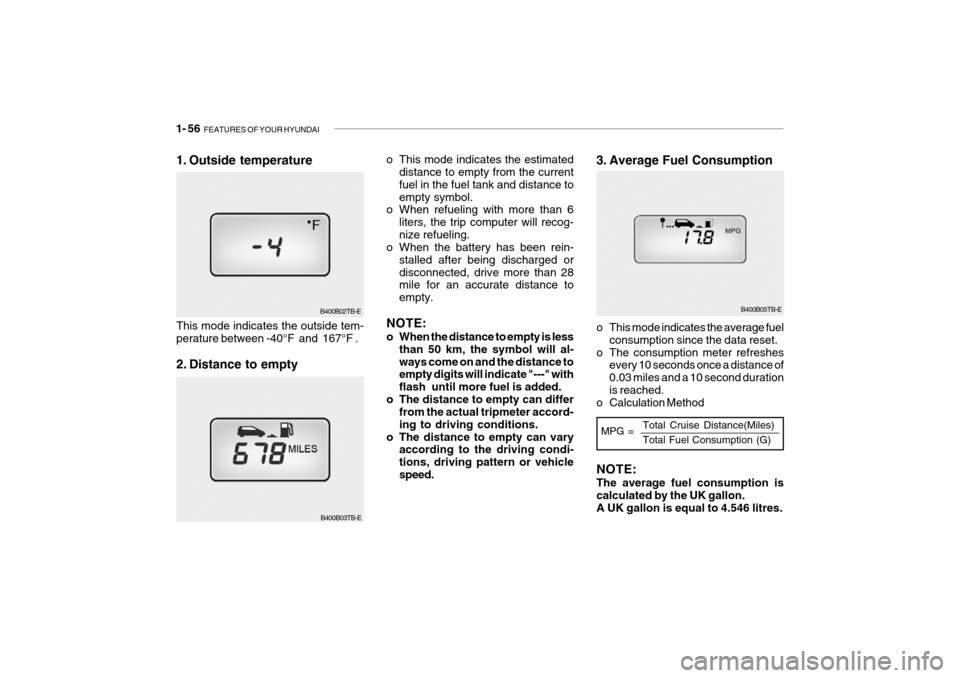
3. Average Fuel Consumption
o This mode indicates the estimated
distance to empty from the current fuel in the fuel tank and distance toempty symbol.
o When refueling with more than 6
liters, the trip computer will recog-nize refueling.
o When the battery has been rein-
stalled after being discharged ordisconnected, drive more than 28 mile for an accurate distance to empty.
NOTE:
o When the distance to empty is less than 50 km, the symbol will al- ways come on and the distance to empty digits will indicate "---" with flash until more fuel is added.
o The distance to empty can differ from the actual tripmeter accord-ing to driving conditions.
o The distance to empty can vary according to the driving condi-tions, driving pattern or vehiclespeed. o This mode indicates the average fuel
consumption since the data reset.
o The consumption meter refreshes every 10 seconds once a distance of0.03 miles and a 10 second durationis reached.
o Calculation Method
B400B03TB-E
1. Outside temperature This mode indicates the outside tem- perature between -40°F and 167°F .
2. Distance to empty
B400B02TB-E
MPG =Total Cruise Distance(Miles) Total Fuel Consumption (G)
NOTE: The average fuel consumption is calculated by the UK gallon. A UK gallon is equal to 4.546 litres.
Page 341 of 463
FEATURES OF YOUR HYUNDAI 1- 75
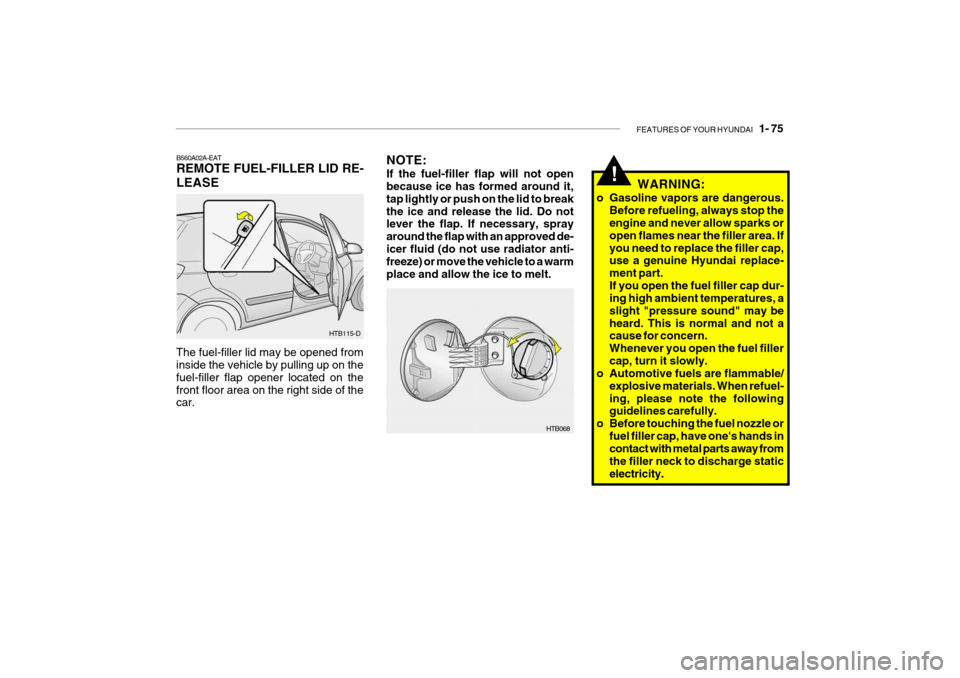
NOTE: If the fuel-filler flap will not open because ice has formed around it, tap lightly or push on the lid to breakthe ice and release the lid. Do not lever the flap. If necessary, spray around the flap with an approved de-icer fluid (do not use radiator anti- freeze) or move the vehicle to a warm place and allow the ice to melt.
HTB068
!WARNING:
o Gasoline vapors are dangerous. Before refueling, always stop the engine and never allow sparks or open flames near the filler area. Ifyou need to replace the filler cap, use a genuine Hyundai replace- ment part.If you open the fuel filler cap dur- ing high ambient temperatures, a slight "pressure sound" may beheard. This is normal and not a cause for concern. Whenever you open the fuel fillercap, turn it slowly.
o Automotive fuels are flammable/
explosive materials. When refuel-ing, please note the following guidelines carefully.
o Before touching the fuel nozzle or
fuel filler cap, have one's hands incontact with metal parts away from the filler neck to discharge staticelectricity.
B560A02A-EAT REMOTE FUEL-FILLER LID RE- LEASE
The fuel-filler lid may be opened from inside the vehicle by pulling up on the fuel-filler flap opener located on thefront floor area on the right side of the car. HTB115-D
Page 342 of 463

1- 76 FEATURES OF YOUR HYUNDAI
B540A01FC-EAT HATCHBACK DOOR
HTB067
WARNING:
The hatchback door should always be kept completely closed while the vehicle is in motion. If it is left openor ajar, poisonous exhaust gases may enter the car resulting in seri- ous illness or death to the occu-pants. See additional warnings con- cerning exhaust gases on page 2-2.
!
o The hatchback door can be locked or unlocked with a key.
o The hatchback door is opened by pulling the outside handle up, raising the hatchback door manually.
o To close, lower the hatchback door, then press down on it until it isclosed. To be sure the hatchback door is fully closed, always try to pullit up again without using the outside handle.o Do not get back in the vehicle
while refueling. Do not operate anything that can produce static electricity. Static electricity dis-charge can ignite fuel vapors re- sulting in explosion.
o When using a portable fuel con-
tainer be sure to place the con-tainer on the ground while refuel- ing. Static electricity dischargefrom the container can ignite fuel vapors causing a fire. While start- ing refueling contact should bemaintained until the filling is com- plete.
o Do not use cellular phones around a gas station. The electric current or electronic interference fromcellular phones can ignite fuel vapors causing a fire.
o When refueling always shut the
engine off. Sparks by electricalequipment of the engine can ig- nite fuel vapors causing a fire.After refueling, check to make sure the fuel filler cap is securely closed, and then start the engine.
o Do not smoke or try to light ciga- rettes around a gas station. Auto-motive fuels are flammable.

