2007 Hyundai Accent shift
[x] Cancel search: shiftPage 168 of 282
2
DRIVING YOUR HYUNDAI
5
2
DRIVING YOUR HYUNDAI
5
!WARNING:
Never run the engine in a closed or poorly ventilated area any longer than is needed to move your car in or out of the area. The carbon mon-oxide gas emitted is odorless and can cause serious injury or death.
C050A01E C051A01O-GAT STARTING FOR THE DIESEL ENGINE ENGINE COLD
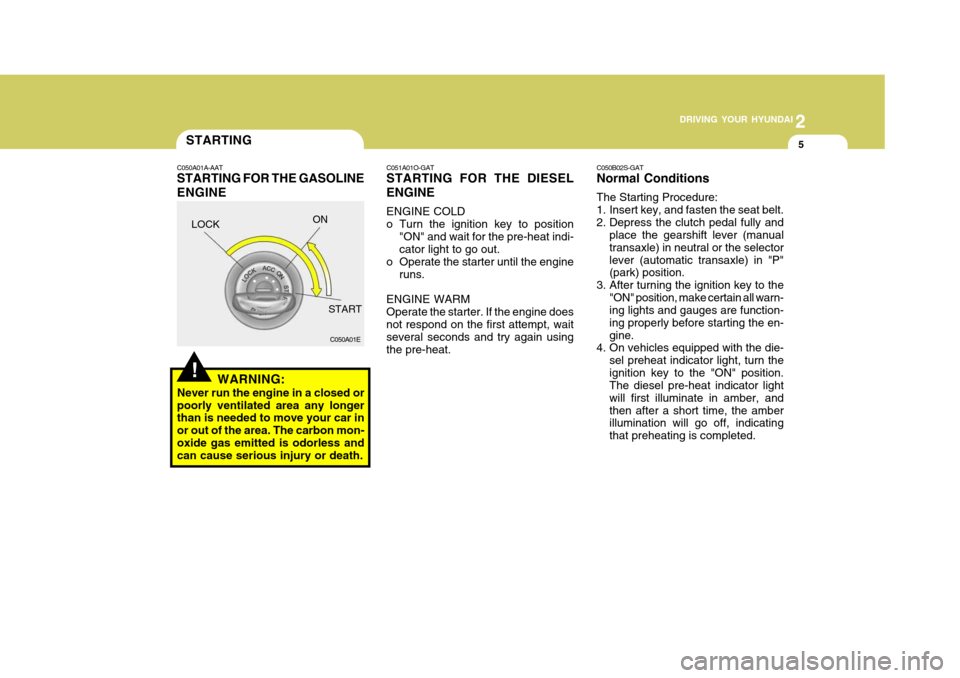
o Turn the ignition key to position
"ON" and wait for the pre-heat indi- cator light to go out.
o Operate the starter until the engine
runs.
ENGINE WARM Operate the starter. If the engine does not respond on the first attempt, wait several seconds and try again usingthe pre-heat.
STARTING
C050A01A-AAT STARTING FOR THE GASOLINE ENGINE C050B02S-GAT Normal Conditions The Starting Procedure:
1. Insert key, and fasten the seat belt.
2. Depress the clutch pedal fully and
place the gearshift lever (manualtransaxle) in neutral or the selectorlever (automatic transaxle) in "P" (park) position.
3. After turning the ignition key to the "ON" position, make certain all warn-ing lights and gauges are function- ing properly before starting the en-gine.
4. On vehicles equipped with the die-
sel preheat indicator light, turn theignition key to the "ON" position. The diesel pre-heat indicator light will first illuminate in amber, andthen after a short time, the amber illumination will go off, indicating that preheating is completed.
LOCK
ON
START
Page 170 of 282
2
DRIVING YOUR HYUNDAI
7
2
DRIVING YOUR HYUNDAI
7OPERATING THE MANUAL TRANSAXLE
OMC035013 NOTE:
o To shift into reverse, rest the lever
in neutral for at least 3 seconds after your car is completelystopped. Then move the lever into the reverse position.
o During cold weather, shifting may be difficult until the transaxle lu-bricant has warmed up. This is normal and not harmful to thetransaxle.
o If you've come to a complete stop
and it's hard to shift into 1 st
or
R(Reverse), put the shift lever in N(Neutral) position and release the clutch. Press the clutch pedalback down, and then shift into 1 st
or R(Reverse) gear position.
o Do not use the shift lever as a handrest during driving, as this can result in premature wear of the transaxle shift forks.
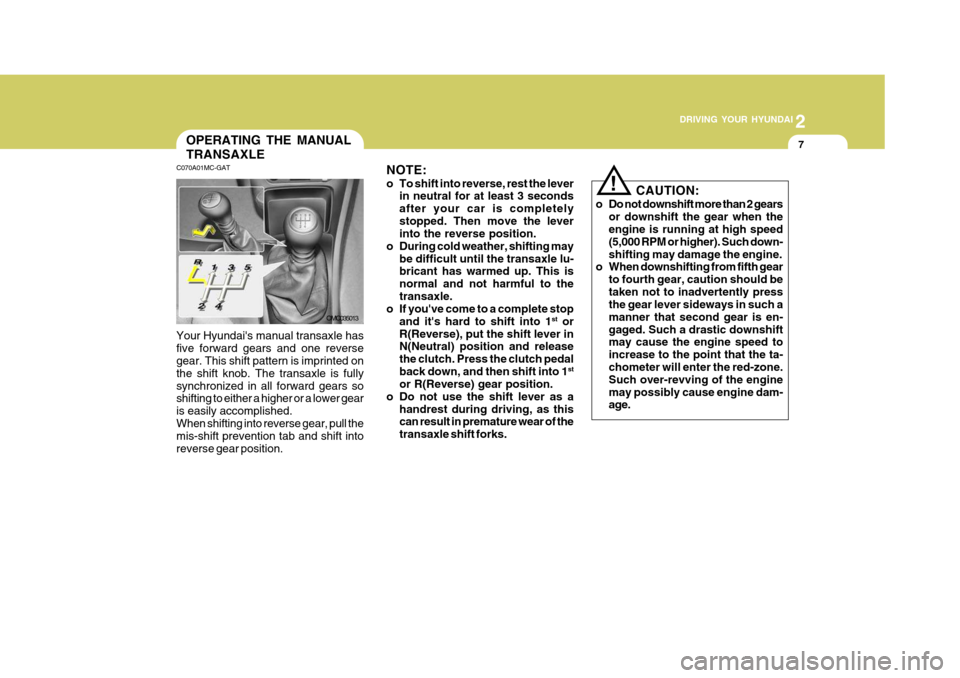
C070A01MC-GAT Your Hyundai's manual transaxle has five forward gears and one reverse gear. This shift pattern is imprinted on the shift knob. The transaxle is fullysynchronized in all forward gears so shifting to either a higher or a lower gear is easily accomplished.When shifting into reverse gear, pull the mis-shift prevention tab and shift into reverse gear position.
CAUTION:
o Do not downshift more than 2 gears or downshift the gear when the engine is running at high speed (5,000 RPM or higher). Such down-shifting may damage the engine.
o When downshifting from fifth gear
to fourth gear, caution should betaken not to inadvertently press the gear lever sideways in such a manner that second gear is en-gaged. Such a drastic downshift may cause the engine speed to increase to the point that the ta- chometer will enter the red-zone. Such over-revving of the enginemay possibly cause engine dam- age.
!
Page 171 of 282

2 DRIVING YOUR HYUNDAI
8
C070D02O-AAT Good Driving Practices
o Never take the car out of gear andcoast down a hill. This is extremely hazardous. Always leave the car in gear.
o Don't "ride" the brakes. This can cause them to overheat and mal-function. Instead, when you are driv- ing down a long hill, slow down andshift to a lower gear. When you do this, engine braking will help slow the car.
o Slow down before shifting to a lower gear. This will help avoid over-rev-ving the engine, which can causedamage.
o Slow down when you encounter cross
winds. This gives you much bettercontrol of your car.
o Be sure the car is completely stopped
before you attempt to shift into re-verse. The transaxle can be dam- aged if you do not. To shift into reverse, depress the clutch, movethe shift lever to neutral, wait three seconds, then shift to the reverse position.
o Exercise extreme caution when driv- ing on a slippery surface. Be espe-
C070E03A-GAT RECOMMENDED SHIFT POINTS
Shift
from-to Recommended
The shift points as shown above are recommended for optimum fuel economy and performance. 20 km/h (15 mph) 40 km/h (25 mph)55 km/h (35 mph) 75 km/h (45 mph)
1-2 2-33-4 4-5
C070B01A-AAT Using the Clutch The clutch should be pressed all the way to the floor before shifting, thenreleased slowly. The clutch pedal should always be used after fully re- turning to the original position. Do notrest your foot on the clutch pedal while driving. This can cause unnecessary wear. Do not partially engage the clutchto hold the car on an incline. This causes unnecessary wear. Use the parking brake to hold the car on anincline. Do not operate the clutch pedal rapidly and repeatedly.
Page 172 of 282
2
DRIVING YOUR HYUNDAI
9
2
DRIVING YOUR HYUNDAI
9
!
cially careful when braking, acceler- ating or shifting gears. On a slipperysurface, an abrupt change in ve- hicle speed can cause the drive wheels to lose traction and the ve-hicle to go out of control.
WARNING:
o Avoid high cornering speeds.
o Do not make quick steering wheel movements, such as sharp lanechanges or fast, sharp turns.
o Always wear your seat belts. In a collis ion crash, an unbelted person
is significantly more likely to diethan a person wearing a seatbelt.
o The risk of rollover is greatly in-
creased if you lose control ofyour vehicle at highway speeds.
o Loss of control often occurs if
two or more wheels drop off theroadway and the driver oversteers to reenter the roadway.
o In the event your vehicle leaves the roadway, do not steer sharply.Instead, slow down before pull- ing back into the travel lanes.
o Never exceed posted speed lim- its.
AUTOMATIC TRANSAXLE
OMC035014
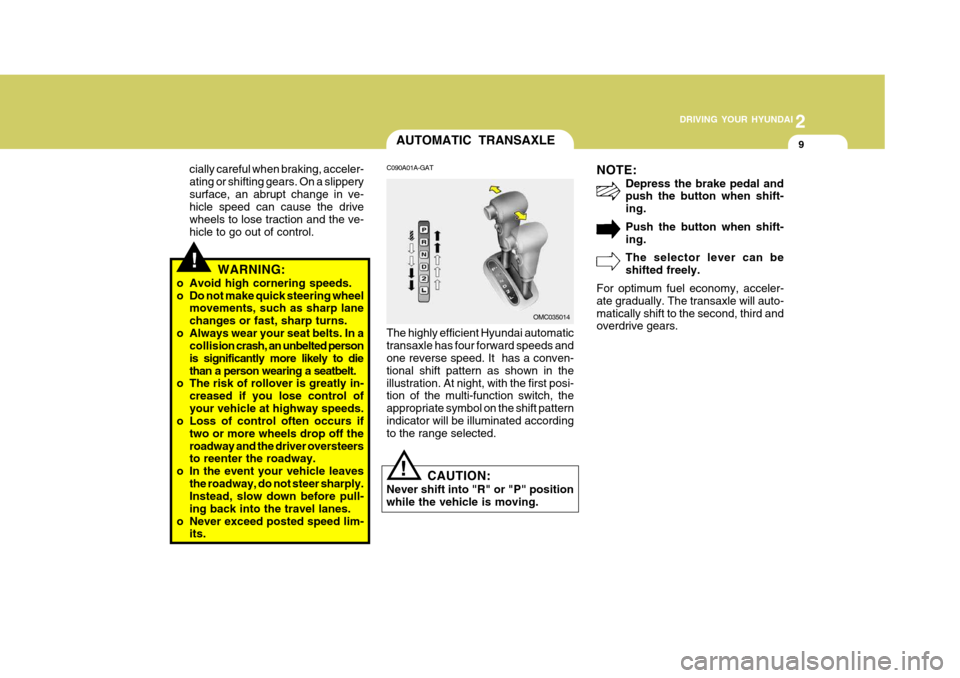
C090A01A-GAT The highly efficient Hyundai automatic transaxle has four forward speeds and one reverse speed. It has a conven- tional shift pattern as shown in theillustration. At night, with the first posi- tion of the multi-function switch, the appropriate symbol on the shift patternindicator will be illuminated according to the range selected.
CAUTION:
Never shift into "R" or "P" position while the vehicle is moving. NOTE:
Depress the brake pedal and push the button when shift- ing. Push the button when shift- ing. The selector lever can be shifted freely.
For optimum fuel economy, acceler-ate gradually. The transaxle will auto-matically shift to the second, third and overdrive gears.
!
Page 173 of 282

2 DRIVING YOUR HYUNDAI
10
C090F01A-AAT o 2 (Second gear): Use for driving on a slippery road, hill climbing or engine braking downhill."2" automatically shifts between first and second gears. This means that no shift-up to 3rd gearis performed. However, the shift-up to third gear is done when the car speed exceeds a certain value to prevent the
engine from over-revving. Manually move the selector to "D" returning to normal driving condition.
C090E01A-GAT o D (Drive): Use for normal driving. The transaxle will automatically shift through a four-gear sequence. Never downshift manu- ally to "2" position or "L" position when vehicle speed is more than 95 km/h(60 mph).
C090C01A-AAT o R (Reverse): Use for backing up the vehicle. Bring the car to a complete stop before shift-ing the selector lever to "R" position.
C090G01A-GAT o L (Low gear): Use for driving up a very steep grade or for engine braking when descending steep hills. When downshifting to "L", the transaxle will temporarily remain insecond gear until the vehicle has slowed enough for low gear to engage. Do not exceed 50 km/h (30 mph) in lowgear.
C090D02A-AAT o N (Neutral): In the "N" position, the transaxle is in neutral, which means that no gears are engaged. The engine can be started with the shift lever in "N" position,although this is not recommended ex- cept if the engine stalls while the car is moving.
C090B02A-AAT The Function of Each Position Is As Follows: o P (Park): Use to hold the vehicle in place when parking or while starting the engine. Whenever parking the car, apply the parking brake and shift the selectorlever to the "P" (Park) position.
!
CAUTION:
Never place the selector lever in the "P" (Park) position unless the ve- hicle is fully stopped. Failure toobserve this caution will cause se- vere damage to the transaxle.
Page 174 of 282
2
DRIVING YOUR HYUNDAI
11
2
DRIVING YOUR HYUNDAI
11
C090H01A-GAT NOTE:
o For smooth and safe operation, depress the brake pedal when shifting from "Neutral" positionor "Park" position to a forward or reverse gear.
o The brake pedal fully depressed in order to move the shift leverfrom the "P" (Park) position to any of the other positions.
o It is always possible to shift from "R", "N", "D", "2", "L" position to"P" position. The vehicle mustbe fully stopped to avoid transaxle damage.
C090I01MC-AAT
CAUTION:
o Shift into "R" and "P" position only when the vehicle has com- pletely stopped.
o Do not accelerate the engine in reverse or any of the forwardpositions with the brakes applied.
o Always apply the footbrake when shifting from "P" or "N", to "R",
"D", "2" or "L" position.
! OMC035016
C090P01A-GAT Overdrive Switch
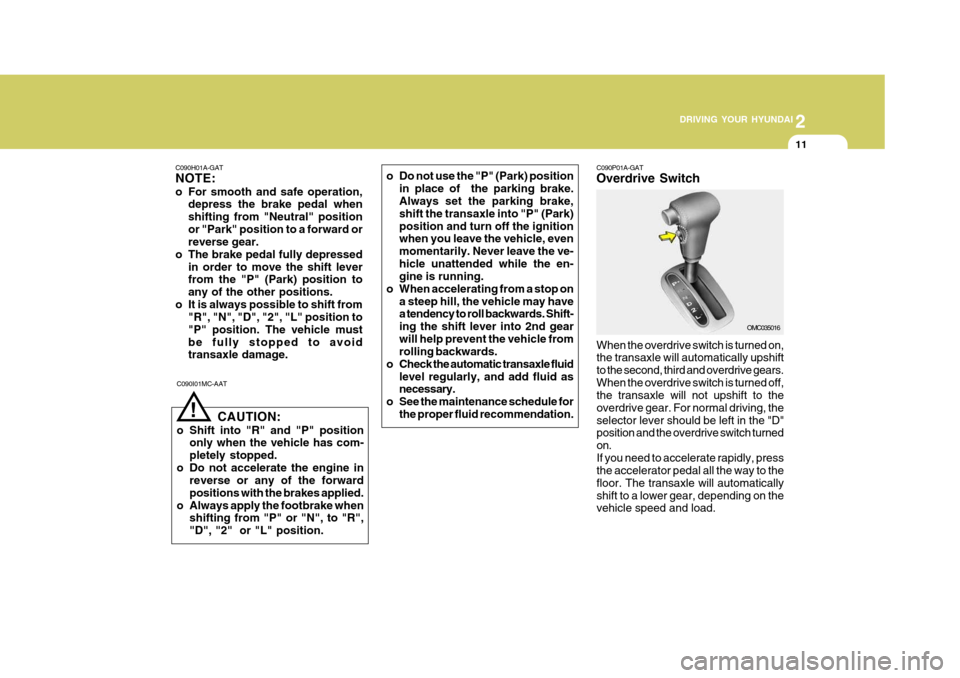
When the overdrive switch is turned on, the transaxle will automatically upshift to the second, third and overdrive gears.When the overdrive switch is turned off, the transaxle will not upshift to the overdrive gear. For normal driving, theselector lever should be left in the "D" position and the overdrive switch turned on.If you need to accelerate rapidly, press the accelerator pedal all the way to the floor. The transaxle will automaticallyshift to a lower gear, depending on the vehicle speed and load.
o Do not use the "P" (Park) position
in place of the parking brake.Always set the parking brake, shift the transaxle into "P" (Park)position and turn off the ignition when you leave the vehicle, even momentarily. Never leave the ve-hicle unattended while the en- gine is running.
o When accelerating from a stop on
a steep hill, the vehicle may havea tendency to roll backwards. Shift- ing the shift lever into 2nd gearwill help prevent the vehicle from rolling backwards.
o Check the automatic transaxle fluid
level regularly, and add fluid asnecessary.
o See the maintenance schedule for
the proper fluid recommendation.
Page 175 of 282
2 DRIVING YOUR HYUNDAI
12
!WARNING:
o Avoid high cornering speeds.
o Do not make quick steering wheel movements, such as sharp lanechanges or fast, sharp turns.
o Exercise extreme caution when driv-
ing on a slippery surface. Be espe-cially careful when braking, acceler- ating or shifting gears. On a slippery surface, an abrupt change in ve-hicle speed can cause the drive wheels to lose traction and the ve- hicle to go out of control.
o Optimum vehicle performance and economy is obtained by smoothlydepressing and releasing the accel-erator pedal.
o Turn the overdrive switch on for good
fuel economy and smooth driving. Ifengine braking is needed in the "D" range or if repeated upshifting and downshifting between 3rd and 4thgear is needed when climbing a gentle slope, it is recommended that the overdrive switch be turned off. Turnthe overdrive switch back on imme- diately afterward.
C090N05A-AAT Good Driving Practices
o Never move the gear selector lever
from "P" or "N" to any other position with the accelerator pedal de- pressed.
o Never move the gear selector lever into "P" when the vehicle is in mo-tion.
o Be sure the car is completely stopped before you attempt to shift into "R".
o Never take the car out of gear and
coast down a hill. This may be ex- tremely hazardous. Always leave the car in gear when moving.
o Do not "ride" the brakes. This can cause them to overheat and mal-function. Instead, when you are driv- ing down a long hill, slow down andshift to a lower gear. When you do this, engine braking will help slow the car.
o Slow down before shifting to a lower gear. Otherwise, the lower gear maynot be engaged.
o Always use the parking brake. Do not depend on placing the transaxlein "P" to keep the car from moving. o Always wear your seat belts.
In a collision crash, an unbeltedperson is significantly more likelyto die than a person wearing a seatbelt.
o The risk of rollover is greatly in- creased if you lose control ofyour vehicle at highway speeds.
o Loss of control often occurs if two or more wheels drop off theroadway and the driver oversteers to reenter the roadway.
o In the event your vehicle leaves the roadway, do not steer sharply.Instead, slow down before pull- ing back into the travel lanes.
o Never exceed posted speed limits.
o If your vehicle becomes stuck in snow, mud, sand, etc., then youmay attempt to rock the vehiclefree by moving it forward and back- ward. Do not attempt this proce- dure if people or objects are any-where near the vehicle. During the rocking operation the vehicle may suddenly move forward of back-ward as it becomes unstuck, caus- ing injury or damage to nearby people or objects.
Page 180 of 282

2
DRIVING YOUR HYUNDAI
17
2
DRIVING YOUR HYUNDAI
17
!
!
GOOD BRAKING PRACTICES
C130A01A-AAT
WARNING:
Nothing should be carried on top of the shelf panel behind the rear seat. If there were an accident or a sud-den stop, such objects could move forward and cause damage to the vehicle or injure the occupants.
o After being parked, check to be sure the parking brake is not engaged and that the parking brake indicator light is out before driving away.
o Driving through water may get the brakes wet. They can also get wet when the car is washed. Wet brakescan be dangerous! Your car will not stop as quickly if the brakes are wet. Wet brakes may cause the car to
pull to one side. To dry the brakes, apply the brakes lightly until the braking action returns to normal,taking care to keep the car under control at all times. If the braking action does not return to normal,stop as soon as it is safe to do so and call your Hyundai dealer for assistance.
CAUTION:
This system can only sense objectswithin the range and location of thesensors; It can not detect objects in other areas where sensors are not installed. Also, small or slim ob-jects, such as poles or objects lo- cated between sensors may not be detected by the sensors.Always visually check behind the vehicle when backing up. Be sure to inform any drivers of thevehicle that may be unfamiliar with the system regarding the systems capabilities and limitations.Your new vehicle warranty does not cover any accidents or damage to the vehicle or its occupants due to aback warning system malfunction. Always drive safely and cautiously.
! WARNING:
Pay close attention when the vehicle is driven close to objects on the road, particularly pedestrians, and especially children. Be aware thatsome objects may not be detected by the sensors, due to the object’s dis- tance, size or material, all of whichcan limit the effectiveness of the sensor. Always perform a visual inspection to make sure the vehicleis clear of all obstructions before moving the vehicle in any direction. NOTE: If you don’t hear an audible warning sound or if the buzzer sounds inter-mittently when shifting the gear to “R” position, this may indicate a malfunction in the back warning sys-tem. If this occurs, have your vehicle checked by an authorized Hyundai dealer as soon as possible.