Page 111 of 228
Even with the cruise control turned
on, you can still use the accelerator
pedal to speed up f or passing. Af ter
completing the pass, take your foot
of f the accelerator pedal. The vehicle
will return to the set cruising speed.
Resting your f oot on the brake or
clutch pedal causes the cruise
control to cancel.You can cancel cruise control in any
of these ways:
Tap the brake or clutch pedal.
Push the CANCEL button on the
steering wheel.
Push the CRUISE button. When you push the CANCEL button,
or tap the brake or clutch pedal, the
system will remember the previously
set cruising speed. To return to that
speed, accelerate to above 25 mph
(40 km/h), then press and release
the RESUME/accel button. The
CRUISE CONTROL indicator comes
on. The vehicle will accelerate to the
same cruising speed as bef ore.
Pressing the CRUISE button turns
the system off and erases the
previous cruising speed.
Canceling Cruise Control
Resuming the Set Speed
Cruise Control
108
Page 119 of 228
Larger or smaller wheels and tires
can interf ere with the operation of
your vehicle’s anti-lock brakes and
other systems.
Removing parts f rom your vehicle,
or replacing components with
non-Honda components could
seriously af f ect your vehicle’s
handling, stability, and reliability.
Lowering the vehicle with a non-
Honda suspension kit that
signif icantly reduces ground
clearance can allow the
undercarriage to hit speed bumps
or other raised objects, which
could cause the airbags to deploy.
Raising your vehicle with a
non-Honda suspension kit can
af f ect the handling and stability. If you plan to modif y your vehicle,
consult your dealer.
Modif ying your steering wheel or
any other part of your vehicle’s
saf ety systems could make the
systems inef f ective.
Non-Honda wheels can cause
excessive stress on suspension
components.
Herearesomeexamples: Modif ying Your Vehicle
A ccessories and Modif ications
116
Page 125 of 228
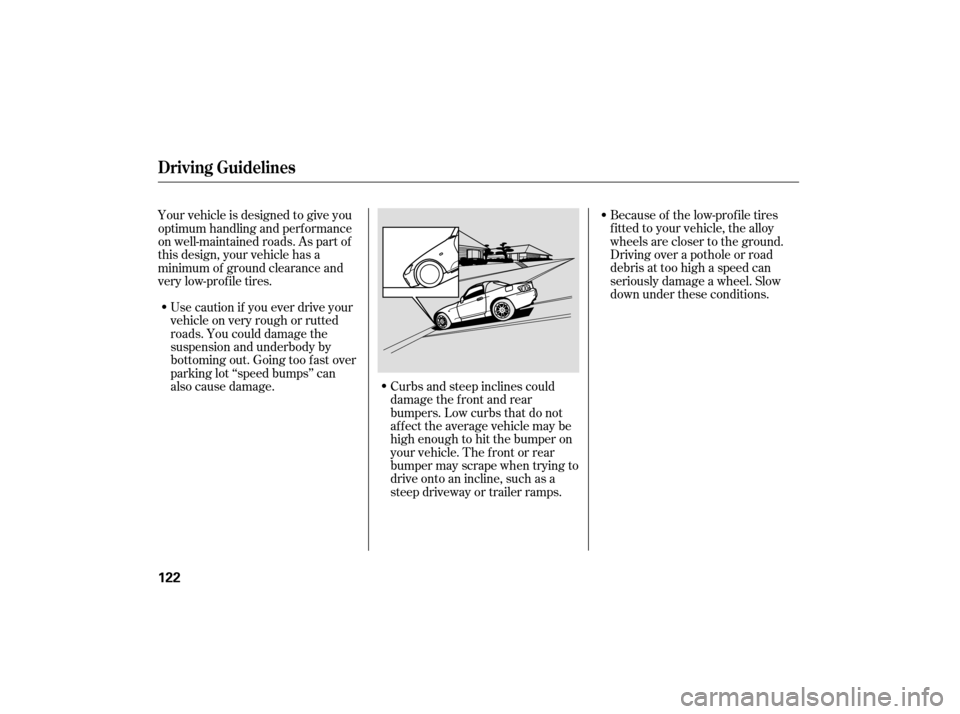
Use caution if you ever drive your
vehicleonveryroughorrutted
roads. You could damage the
suspension and underbody by
bottoming out. Going too f ast over
parking lot ‘‘speed bumps’’ can
also cause damage.Because of the low-prof ile tires
f itted to your vehicle, the alloy
wheels are closer to the ground.
Driving over a pothole or road
debris at too high a speed can
seriously damage a wheel. Slow
down under these conditions.
Your vehicle is designed to give you
optimum handling and perf ormance
on well-maintained roads. As part of
this design, your vehicle has a
minimum of ground clearance and
very low-prof ile tires.
Curbs and steep inclines could
damage the f ront and rear
bumpers. Low curbs that do not
affect the average vehicle may be
high enough to hit the bumper on
your vehicle. The f ront or rear
bumper may scrape when trying to
drive onto an incline, such as a
steep driveway or trailer ramps.
Driving Guidelines
122
Page 130 of 228

Make sure the convertible top and
the windows are closed.
Turn of f the lights.
Place any packages, valuables, etc.,
in the trunk or take them with you.
Lock the doors.
Never park over dry leaves, tall
grass, or other f lammable
materials. The hot three way
catalytic converter could cause
these materials to catch on fire.If the vehicle is f acing uphill, turn
the front wheels away from the
curb, and put the transmission in
f irst gear.
If the vehicle is f acing downhill,
turn the front wheels toward the
curb, and put the transmission in
reverse gear.
Make sure the parking brake is
f ully released bef ore driving away.
Driving with the parking brake
partially set can overheat or
damage the rear brakes.
Resting your f oot on the pedal keeps
the brakes applied lightly, builds up
heat, and reduces their ef f ectiveness.
It also keeps your brake lights on all
the time, conf using drivers behind
you.
Constant application of the brakes
when going down a long hill builds
up heat and reduces their ef f ective-
ness. Use the engine to assist the
brakes by taking your f oot of f the
accelerator and downshif ting to a
lower gear. Your vehicle is equipped with disc
brakes at all f our wheels. A power
assist helps reduce the ef f ort needed
on the brake pedal. The anti-lock
brake system (ABS) helps you retain
steering control when braking very
hard.
Always use the parking brake when
you park your vehicle. Make sure
the parking brake is set f irmly, or
your vehicle may roll if it is parked
on an incline.
CONT INUED
Parking
Parking T ips Braking System
Parking, Braking System
Driving
127
Page 131 of 228

Check the brakes after driving
through deep water. Apply the
brakes moderately to see if they f eel
normal. If not, apply them gently and
f requently until they do. Be extra
cautious in your driving.
The hydraulic system that operates
the brakes has two separate circuits.
Each circuit works diagonally across
the vehicle (the lef t-f ront brake is
connected with the right-rear brake,
etc.). If one circuit should develop a
problem, you will still have braking
at two wheels.If the brake pads need replacing, you
will hear a distinctive, metallic
screeching sound when you apply
the brake pedal. If you do not have
the brake pads replaced, they will
screech all the time. It is normal f or
the brakes to occasionally squeal or
squeak when you apply them.
The anti-lock brake system (ABS)
helps prevent the brakes f rom
locking up, and helps you retain
steering control by pumping the
brakes rapidly, much f aster than a
person can do it.The ABS also balances the f ront-to-
rear braking distribution according
to vehicle loading.
Let the ABS work f or you by always
keeping f irm, steady pressure on the
brake pedal. This is sometimes
ref erred to as ‘‘stomp and steer.’’
You will f eel a pulsation in the brake
pedal when the ABS activates, and
may hear some noise. This is normal:
it is the ABS rapidly pumping the
brakes. On dry pavement, you will
need to press on the brake pedal
very hard before the ABS activates.
However, you may f eel the ABS
activate immediately if you are trying
to stop on snow or ice.
You should never pump the brake pedal.
Braking System Design
Brake Pad Wear Indicators
Anti-lock Brakes (ABS)
Braking System, Anti-lock Brakes (ABS)
128
Page 132 of 228
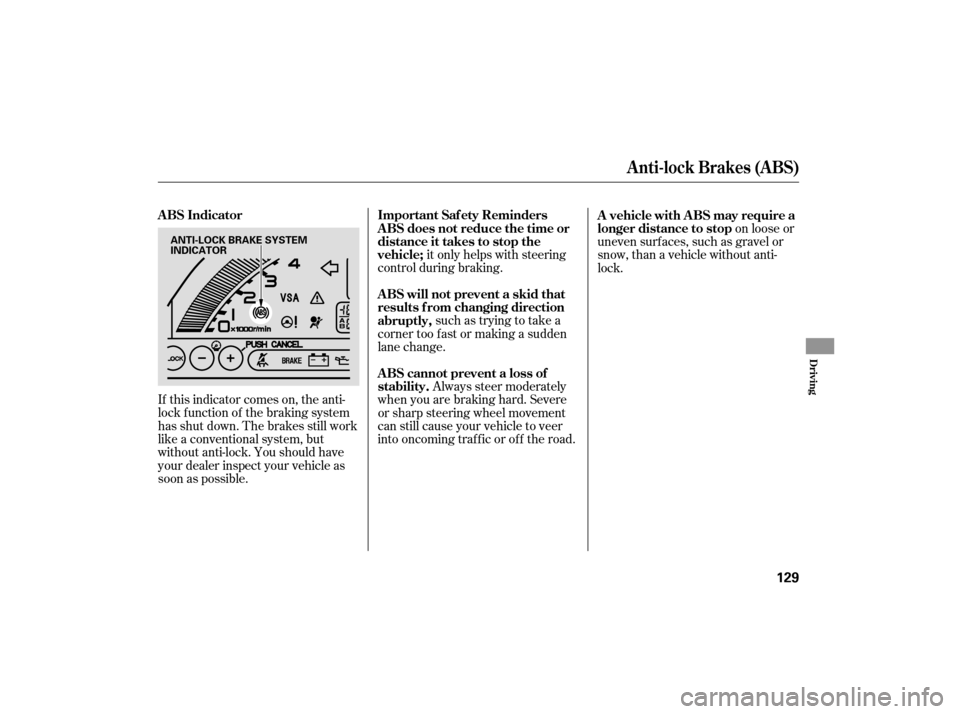
If this indicator comes on, the anti-
lock f unction of the braking system
has shut down. The brakes still work
like a conventional system, but
without anti-lock. You should have
your dealer inspect your vehicle as
soon as possible.it only helps with steering
control during braking.
such as trying to take a
corner too f ast or making a sudden
lane change.
Always steer moderately
when you are braking hard. Severe
or sharp steering wheel movement
can still cause your vehicle to veer
into oncoming traffic or off the road. on loose or
uneven surfaces, such as gravel or
snow, than a vehicle without anti-
lock.
ABS Indicator
A BS does not reduce the time or
distance it takes to stop the
vehicle; Important Saf ety Reminders
A BS will not prevent a skid that
results f rom changing direction
abruptly,
A BS cannot prevent a loss of
stability.A vehicle with A BS may require a
longer distance to stop
Anti-lock Brakes (ABS)
Driving
129
ANTI-LOCK BRAKE SYSTEM
INDICATOR
Page 134 of 228
Your vehicle is not designed to tow a
trailer; Attempting to do so can void
your warranties.
Driving
with varying tire or wheel
sizes may cause the VSA to
malfunction. When replacing tires,
make sure they are of the same size
and type as your original tires (see
page ).
Deactivate the VSA system if you
need to drive with the compact spare
tire installed (see page ).
If you install winter tires, make sure
they are the same size as those that
were originally supplied with your
vehicle. Exercise the same caution
during winter driving as you would if
your vehicle was not equipped with
VSA.
In certain unusual conditions when
your vehicle gets stuck in shallow
mud or f resh snow, it may be easier
to free it with the VSA temporarily
switched of f . When the VSA system
is of f , the traction control system is
alsooff.Youshouldonlyattemptto
f ree your vehicle with the VSA of f if
you are not able to f ree it when the
VSA is on. Immediately af ter f reeing your
vehicle, be sure to switch the VSA on
again. We do not recommend driving
your vehicle with the VSA and
traction control systems switched off.
When VSA is off, the VSA activation
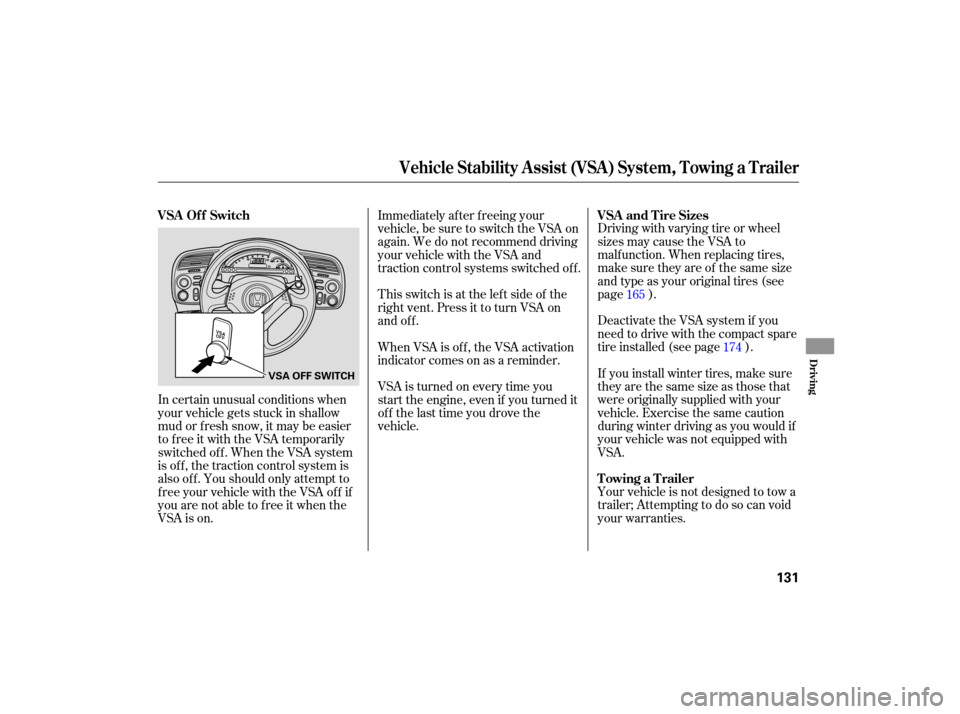
indicator comes on as a reminder. This switch is at the lef t side of the
right vent. Press it to turn VSA on
and off.
VSA is turned on every time you
start the engine, even if you turned it
off the last time you drove the
vehicle.
165
174
VSA Of f Switch
Towing a Trailer VSA and Tire Sizes
Vehicle Stability Assist (VSA) System, Towing a Trailer
Driving
131
VSA OFF SWITCH
Page 136 of 228

This section explains why it is
important to keep your vehicle well
maintained and how to follow basic
maintenance safety precautions.
If you have the skills and tools to
perform more complex maintenance
tasks on your vehicle, you may want
to purchase the service manual. See
page f or inf ormation on how to
obtain a copy, or see your dealer. This section also includes
instructions on how to read the
maintenance minder messages on
the information display, a
maintenance record, and instructions
for simple maintenance tasks you
may want to take care of yourself. ......................
Maintenance Saf ety .134
....................
Maintenance Minder . 135
....................
Maintenance Record .143
..............................
Fluid Locations .145
........................
Adding Engine Oil .146
.........
Changing the Oil and Filter . 147
..............................
Engine Coolant .149
....................
Windshield Washers .151
........
Manual Transmission Fluid . 152
..........................
Dif f erential Fluid .153
................
Brake and Clutch Fluid . 154
.............................................
Lights .155
................
Cleaning the Seat Belts . 160
.....................................
Floor Mats .161
..................
DustandPollenFilter . 161
..............................
Audio Antenna .161
.................................
Wiper Blades .162
...........................................
Wheels .163
...............................................
Tires .163
...................
Checking the Battery . 169
.............................
Vehicle Storage .171
215
Maintenance
Maint enance
133