2007 HONDA S2000 towing
[x] Cancel search: towingPage 1 of 228
 to navigate through\
this reference.
For a printed owners manual, click on authorized manuals or")
2007 Honda S2000 Online Reference Owner's Manual
Use these links (and links throughout this manual) to navigate through\
this reference.
For a printed owner's manual, click on authorized manuals or go to www.h\
elminc.com.
Contents
Owner's Identification Form
Introduction ........................................................................\
.................................................................i
A Few Words About Safe ty
........................................................................\
........................................iii
Your Vehicle at a Glance........................................................................\
.............................................3
Driver and Passenger Safety ........................................................................\
......................................5
Proper use and care of your vehicle's seat belts, and Supplemental Restr\
aint System.
Instruments and Control s........................................................................\
.........................................43
Instrume nt panel indicator and gauge, and how to use dashboard and steering colu\
mn controls.
Comfort and Convenience Features ........................................................................\
...................... 83
How to operate the climate control system, the audio system, and other c\
onvenience features.
Before Driving........................................................................\
..........................................................109
What gasoline to use, how to break -in your new vehicle, and how to load luggage and other cargo.
Driving ........................................................................\
......................................................................121
The proper way to start the engine, shift the transmission, and park, pl\
us towing a trailer.
Maintenance........................................................................\
.............................................................133
The Maintenance Schedule shows you when you need to take you r vehicle to the dealer.
Taking Care of the Unexpecte d........................................................................\
..............................173
This section covers several problems motorists sometimes experience, an d how to handle them.
Technical Informatio n........................................................................\
.............................................199
ID numbers, dimensions, capacities, and technical information.
Warranty and Customer Relations (U.S. and Canad a)................................................................211
A summary of the warranties covering your new Acura, and how to contact \
us.
Authorized Manu als (U.S. only)........................................................................\
..............................215
How to order manuals and other technical literature.
Index........................................................................\
.............................................................................. I
Service Information Summary
A summary of information you need when you pull up to the fuel pump.
Accord Value Package Audio System
Page 124 of 228

This section gives you tips on
starting the engine under various
conditions, and how to operate the
manual transmission. It also includes
important inf ormation on parking
your vehicle and the braking system.........................
Driving Guidelines .122
........................
Preparing to Drive .123
.......................
Starting the Engine .124
...................
Manual Transmission . 125
...........................................
Parking .127
.............................
Braking System .127
...............
Anti-lock Brakes (ABS) . 128
Vehicle Stability Assist (VSA) ........................................
System .130
...........................
Towing a Trailer .131
Driving
Driving
121
Page 134 of 228
Your vehicle is not designed to tow a
trailer; Attempting to do so can void
your warranties.
Driving
with varying tire or wheel
sizes may cause the VSA to
malfunction. When replacing tires,
make sure they are of the same size
and type as your original tires (see
page ).
Deactivate the VSA system if you
need to drive with the compact spare
tire installed (see page ).
If you install winter tires, make sure
they are the same size as those that
were originally supplied with your
vehicle. Exercise the same caution
during winter driving as you would if
your vehicle was not equipped with
VSA.
In certain unusual conditions when
your vehicle gets stuck in shallow
mud or f resh snow, it may be easier
to free it with the VSA temporarily
switched of f . When the VSA system
is of f , the traction control system is
alsooff.Youshouldonlyattemptto
f ree your vehicle with the VSA of f if
you are not able to f ree it when the
VSA is on. Immediately af ter f reeing your
vehicle, be sure to switch the VSA on
again. We do not recommend driving
your vehicle with the VSA and
traction control systems switched off.
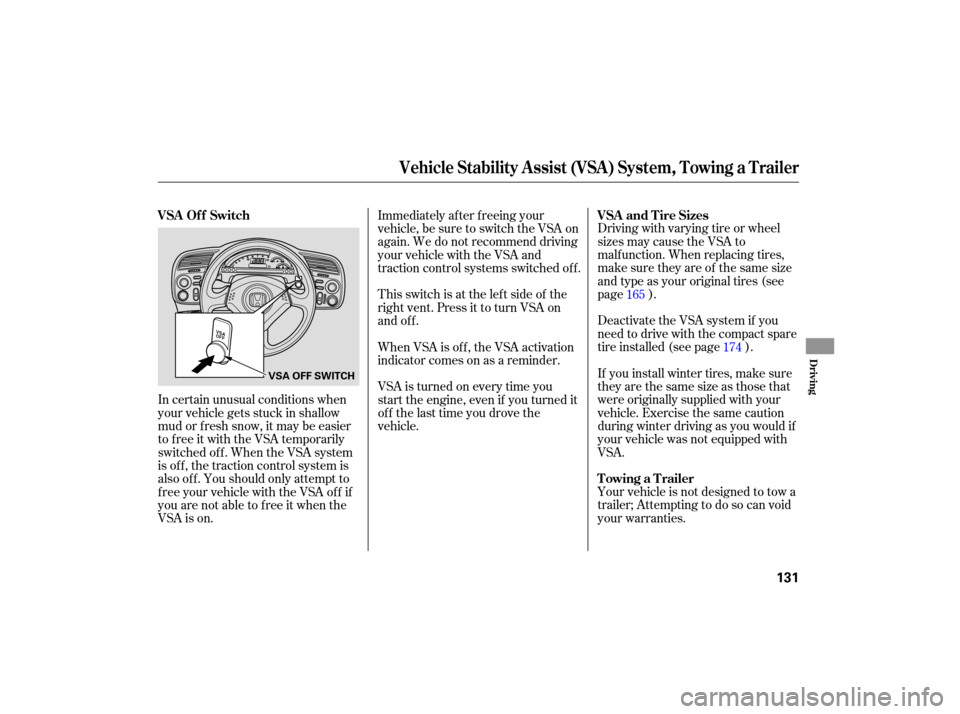
When VSA is off, the VSA activation
indicator comes on as a reminder. This switch is at the lef t side of the
right vent. Press it to turn VSA on
and off.
VSA is turned on every time you
start the engine, even if you turned it
off the last time you drove the
vehicle.
165
174
VSA Of f Switch
Towing a Trailer VSA and Tire Sizes
Vehicle Stability Assist (VSA) System, Towing a Trailer
Driving
131
VSA OFF SWITCH
Page 176 of 228

This section covers the more
common problems that motorists
experience with their vehicles. It
gives you inf ormation about how to
safely evaluate the problem and what
to do to correct it. If the problem has
stranded you on the side of the road,
you may be able to get going again.
If not, you will also f ind instructions
on getting your vehicle towed.......................
Compact Spare Tire .174
....................
Changing a Flat Tire .175
.............
If the Engine Won’t Start . 180
................................
Jump Starting .182
..............
If the Engine Overheats . 183
.........
Low Oil Pressure Indicator . 186
..........
Charging System Indicator . 186
.......
Malf unction Indicator Lamp . 187
...............
Brake System Indicator . 188
.......
Closing the Convertible Top . 189
..............................................
Fuses .190
..........
Checking and Replacing . 191
..............................
Fuse Locations .194
......................
Emergency Towing .196
..........
If Your Vehicle Gets Stuck . 196
Taking Care of the Unexpected
T aking Care of t he Unexpect ed
173
Page 187 of 228

Look for any obvious coolant leaks,
such as a split radiator hose.
Everything is still extremely hot,
so use caution. If you find a leak, it
must be repaired before you
continue driving (see
on page ).
If
the temperatu re gauge stays at
the red mark, turn off the engine.
If you do not see steam or spray,
leave the engine running, and
watch the temperature gauge. If
the high heat is due to overloading,
the engine should start to cool
down almost immediately. If it
does, wait until the temperature
gauge comes down to the midpoint,
th en continue driving.
If
you see steam and/or spray
coming from under the hood, turn
off the engine. Wait until you see
no more signs of steam or spray,
th en open the hood.
Safely
pull to the side of the road.
Put the transmission in neutral,
and set the parking brake. Turn
off the all accessories, and turn on
the hazard warning indicators.
If you don’t find an obvious leak,
check the coolant level in the
radiator reserve tank. Add coolant
if the level is below the MIN mark
(see on
page ).
2. 1.
3. 4.
5.
6.
149 196
Emergency
Towing
A dding Engine Coolant
If theEngineOverheats
184
Steam and spray from an
overheated engine can
seriously scald you.
Do not open the hood if steam
is coming out.
Page 188 of 228

If there was no coolant in the
reserve tank, you may need to add
coolant to the radiator. Let the
engine cool down until the reading
reaches the middle of the
temperature gauge or lower
befo re checking the radiato r. Using
gloves or a large heavy
cloth, turn the radiator cap
counterclockwise, without pushing
down, to the first stop. After the
pressure releases, push down on
the cap, and turn it until it comes
off. Put
the radiator cap back on
tightl y. Run the engine, and check
the temperatu re gauge. If it goes
back to the red mark, the engine
needs repair (see on page ).
If the temperature stays normal,
check the coolant level in the
radiator reserve tank. If it has
gone down, add coolant to the
MAX mark. Put the cap back on
tightly.
Start the engine, and set the
temperature control dial to
maximum heat. Add coolant to the
radiator up to the base of the f iller
neck. If you do not have the
proper coolant mixture available,
you can add plain water.
Remember to have the cooling
system drained and ref illed with
the proper mixture as soon as you
can.
9. 8.
7. 10.
11.196
Emergency
Towing
If theEngineOverheats
T aking Care of t he Unexpect ed
185
Removing the radiator cap
while the engine is hot can
cause the coolant to spray out,
seriously scalding you.
Always let the engine and
radiator cool down before
removing the radiator cap.
Page 191 of 228

If the brake system indicator comes
on while driving, the brake fluid level
is probably low. Press lightly on the
brake pedal to see if it feels normal.
If it does, check the brake fluid level
thenexttimeyoustopataservice
station (see page ).
If the fluid level is low, take your
vehicle to a dealer, and have the
brake system inspected for leaks or
worn brake pads. However,
if the brake pedal does not
feel normal, you should take
immediate action. A problem in one
part of the system’s dual circuit
design will still give you braking at
two wheels. You will feel the brake
pedal go down much farther before
the vehicle begins to slow down, and
you will have to press harder on the
pedal.
Slow down by shifting to a lower
gear, and pull to the side of the road
when it is safe. Because of the long
distance needed to stop, it is
hazardous to drive the vehicle. You
should have it towed and repaired as
soon as possible (see on page ).
If you must drive the vehicle a short
distance in this condition, drive
slowly and caref ully.
The brake system
indicator normally
comes on when
you turn the ignition switch to the
ON (II) position, and as a reminder
to check the parking brake. It will
stay on if you do not f ully release the
parking brake.
154 196Emergency
Towing
Brake System Indicator
188
Canada
U.S.
Page 199 of 228
If your vehicle needs to be towed,
call a prof essional towing service or
organization. Never tow your vehicle
with just a rope or chain. It is very
dangerous.The operator will load
your vehicle on the back of a truck.
Any other method of towing will
damage the drive system. When you
contact the towing agency, inf orm
them a f lat-bed is required. If your vehicle gets stuck in sand,
mud, or snow, call a towing service
to pull it out (see the previous
column).
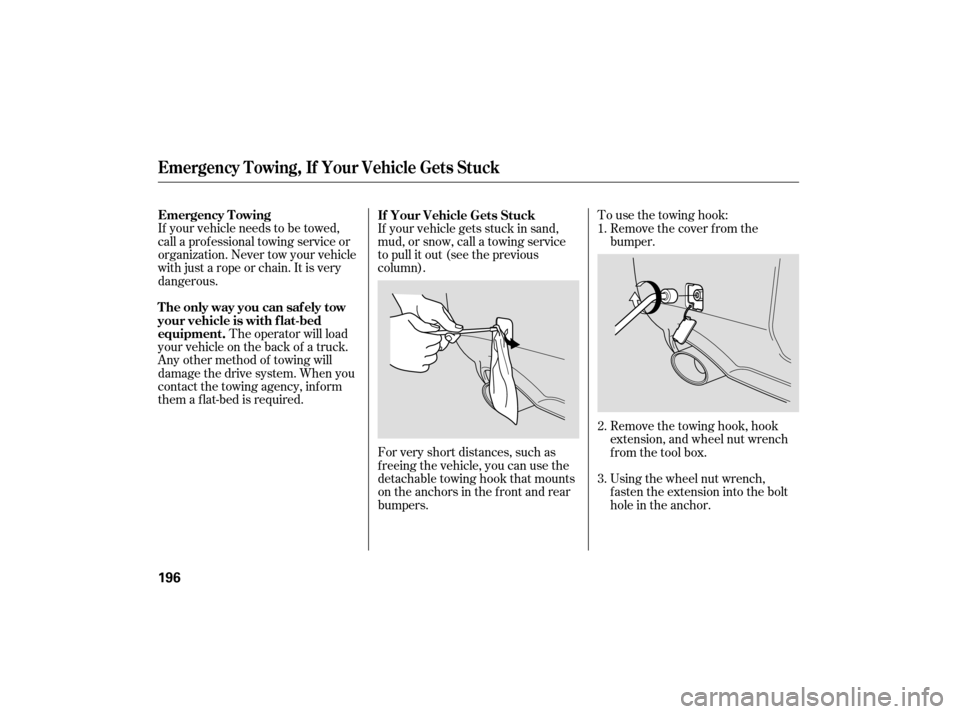
For very short distances, such as
f reeing the vehicle, you can use the
detachable towing hook that mounts
on the anchors in the front and rear
bumpers.To use the towing hook:
Remove the cover f rom the
bumper.
Using the wheel nut wrench,
fasten the extension into the bolt
hole in the anchor. Remove the towing hook, hook
extension, and wheel nut wrench
f rom the tool box.
1.
2.
3.
Emergency T owing
The only way you can saf ely tow
your vehicle is with f lat-bed
equipment.
If Your Vehicle Gets Stuck
Emergency Towing, If Your Vehicle Gets Stuck
196