Page 176 of 228

This section covers the more
common problems that motorists
experience with their vehicles. It
gives you inf ormation about how to
safely evaluate the problem and what
to do to correct it. If the problem has
stranded you on the side of the road,
you may be able to get going again.
If not, you will also f ind instructions
on getting your vehicle towed.......................
Compact Spare Tire .174
....................
Changing a Flat Tire .175
.............
If the Engine Won’t Start . 180
................................
Jump Starting .182
..............
If the Engine Overheats . 183
.........
Low Oil Pressure Indicator . 186
..........
Charging System Indicator . 186
.......
Malf unction Indicator Lamp . 187
...............
Brake System Indicator . 188
.......
Closing the Convertible Top . 189
..............................................
Fuses .190
..........
Checking and Replacing . 191
..............................
Fuse Locations .194
......................
Emergency Towing .196
..........
If Your Vehicle Gets Stuck . 196
Taking Care of the Unexpected
T aking Care of t he Unexpect ed
173
Page 183 of 228

Diagnosing why the engine won’t
start falls into two areas, depending
on what you hear when you press
the ENGINE START button.
You hear nothing, or almost
nothing. The engine’s starter
motor does not operate at all, or
operates very slowly.
You can hear the starter motor
operating normally, or the starter
motor sounds like it is spinning
faster than normal, but the engine
does not start up and run. When
you press the ENGINE
START button, you do not hear the
norm al noise of the engine trying to
start. You may hear a clicking sound
or series of clicks, or nothing at all.
Check these things:
Check the transmission interlock.
The clutch pedal must be pushed
all the way to the floor or the
starter will not operate.
Turn the ignition switch to the ON
(II) position. Turn on the
headlights, and check their
brightness. If the headlights are
very dim or do not come on at all,
the battery is discharged. See
on page . Press
the ENGI NE START button,
then release it. If the headlights do
not dim, check the condition of the
fuses.IfthefusesareOK,thereis
probably something wrong with
the electrical circuit for the
ignition switch or starter motor.
You will need a qualified mechanic
to determine the problem. (See
on page .)
182 196
Nothing Happens or the Starter
Motor Operates Very Slowly
Jump Starting Emergency T owing
If theEngineWon’tStart
180
Page 184 of 228

If the headlights dim noticeably or
go out when you try to start the
engine, either the battery is
discharged or the connections are
co rroded. Check the condition of the
battery and terminal connections
(see page ). You can then try
jump starting the vehicle from a
booster battery (see page ). In
this case, the starter motor’s
speed sounds normal, or even faster
than normal, when you press the
ENGI NE START button, but the
engine does not run. There
may be an electrical
problem, such as no power to the
fuel pump. Check all the fuses
(see page ).
Are you using a properly coded
key? An improperly coded key will
cause the immobilizer system
indicator in the instrument panel
to blink rapidly (see page ).
Are you using the proper starting
procedure? Refer to
on page .
Do you have fuel? Check the fuel
gauge; the low fuel indicator may
not be working. Ifyoufindnothingwrong,youwill
need
a qualified mechanic to find the
problem. See
on page .
61
169
182
124 190
196
T he Starter Operates Normally
Starting the
Engine Emergency T owing
If theEngineWon’tStart
T aking Care of t he Unexpect ed
181
Page 193 of 228
The vehicle’s f uses are contained in
threefuseboxes.The primary under-hood f use box is
onthepassenger’ssidenexttothe
battery. To open it, push the two tabs
as shown.The auxiliary under-hood f use box is
on the driver’s side, near the brake
f luid reservoir. To open it, push the
taboneachside,andremovethelid.
The interior f use box is underneath
the dashboard on the driver’s side.
To open it, turn the knob.
Fuses
190
INTERIOR UNDER-HOOD
(PRIMARY)
UNDER-HOOD
(AUXILIARY)
KNOB
Page 194 of 228

CONTINUED
If something electrical in your
vehicle stops working, check for a
blown fuse first. Determine from the
chart on pages and , or the
diagram on the f use box lid, which
f use or f uses control that device.
Check those f uses f irst, but check all
the f uses bef ore deciding that a
blown f use is the cause. Replace any
blown f uses, and check if the device
works.
Turn the ignition switch to the
LOCK (0) position. Make sure the
headlights and all other
accessories are of f .
Remove the cover f rom the f use
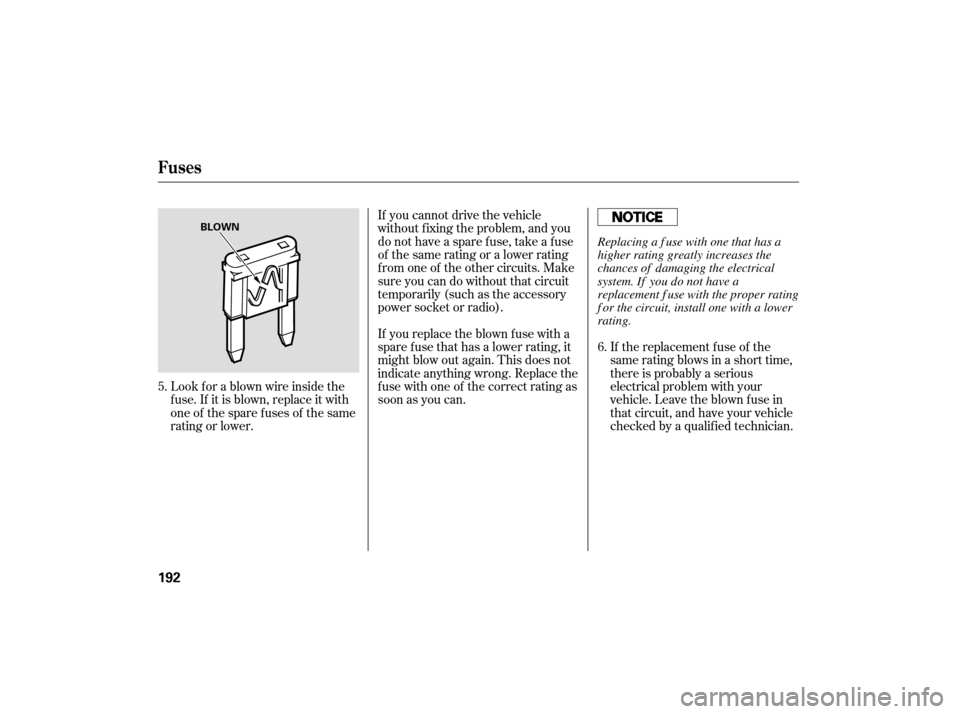
box. Check each of the large f uses in
the primary under-hood f use box
by looking through the top at the
wire inside. Removing these f uses
requires a Phillips-head
screwdriver.
Check the smaller f uses in the
under-hood f use boxes and all the
fuses in the interior fuse box by
pulling out each one with the f use
puller provided in the interior f use
box.
1.
2. 3.
4.
194 195
Fuses
Checking and Replacing Fuses
T aking Care of t he Unexpect ed
191
BLOWN
FUSE PULLER
Page 195 of 228
If you cannot drive the vehicle
without f ixing the problem, and you
do not have a spare fuse, take a fuse
of the same rating or a lower rating
f rom one of the other circuits. Make
sureyoucandowithoutthatcircuit
temporarily (such as the accessory
power socket or radio).
If you replace the blown f use with a
spare f use that has a lower rating, it
might blow out again. This does not
indicate anything wrong. Replace the
f use with one of the correct rating as
soon as you can.If the replacement fuse of the
same rating blows in a short time,
there is probably a serious
electrical problem with your
vehicle. Leave the blown fuse in
that circuit, and have your vehicle
checked by a qualif ied technician.
Look f or a blown wire inside the
f use. If it is blown, replace it with
oneof thesparefusesof thesame
rating or lower. 6.
5.
Fuses
192
BLOWN
Replacing a f use with one that has a
higher rating greatly increases the
chances of damaging the electrical
system. If you do not have a
replacement f use with the proper rating
f or the circuit, install one with a lower
rating.
Page 196 of 228
If the radio fuse is removed, the
audio system will disable itsel f. The
nexttimeyouturnontheradioyou
will see ‘‘CODE’’ (U.S. model) or
‘‘Code’’ (Canadian model) in the
frequency display. Use the preset
buttons to enter the five-digit code
(see page ).
If the instrument panel fuse is
removed, the clock setting in the
instrument panel will be cancel ed. To
reset the time, see page .
105
54
Fuses
T aking Care of t he Unexpect ed
193
Page 206 of 228

�µ
�µ
�µ�µ
�µ�µ �µ
�Î �µ
�µ
�µ
�µ
�µ
�µ
�µ
�µ
�µ
�µ
�Î
�Î
�Î
�Î
�Î
Specifications
Technical Inf ormat ion
203
Battery
Fuses
Alignment
Tires
Lights
Air
conditioning 55
W
12 V 12 V 36 AH/5 HR
0.00 in (0.0 mm)
0.15 in (3.7 mm)
0°30’
6°
215/45R17 87W
245/40R17 91W
32 psi (220 kPa , 2.2 kgf/cm
)
32 psi (220 kPa , 2.2 kgf/cm)
60 psi (420 kPa , 4.2 kgf/cm)
T125/70D16
96M
1°30’
35
W
12 V Capacity
Under-hood
Interior
Toe
Camber
Caster
Size
Pr
essure
SP-10
Headlights
Front
turn signal lights
Rear turn signal lights
Front side marker/
parking lights
Back-up lights
License plate light
Interior light
Trunk light
Side turn signal lights
Refrigerant type
Charge quantity
Lubricant type HFC-134a
(R-134a)
21.2 22.9 oz (600 650 g)
12
V
12 V
12 V
12 V
12 V 21
W
5W
5W
5W
5W
24.7 26.5 oz (700 750 g)
12
V
12 V
12 V 21
W
21 W
5W See page 194 or the fuse label
attached to the inside of the fuse
box door under the dashboard. See page 195or the fuse box
cover.
Front
Rear
Front
Rear
Front in
Front
Rear
Spare Tire
Front
Rear
Spare Tire
: High voltage discharge type High
Low
(H1)
1 : U. S. model
2 : Canadian model (AMBER)
1
2

