Page 179 of 228
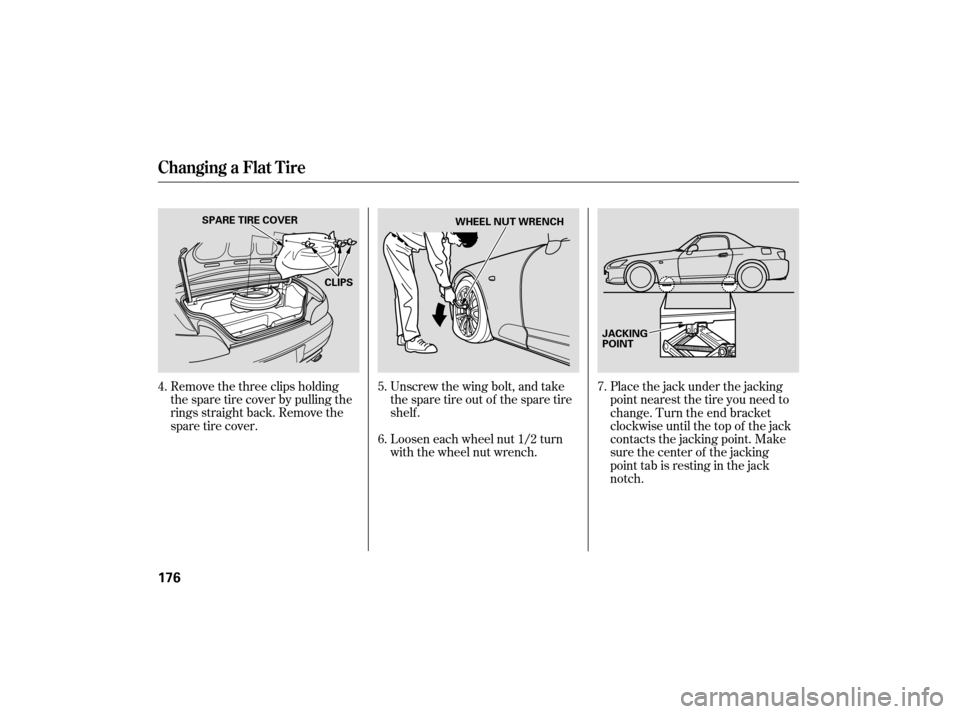
Unscrew the wing bolt, and take
the spare tire out of the spare tire
shelf .
Remove the three clips holding
the spare tire cover by pulling the
rings straight back. Remove the
sparetirecover.
Loosen each wheel nut 1/2 turn
with the wheel nut wrench.Place the jack under the jacking
point nearest the tire you need to
change. Turn the end bracket
clockwise until the top of the jack
contacts the jacking point. Make
sure the center of the jacking
point tab is resting in the jack
notch.
4.
5.
6. 7.
Changing a Flat Tire
176
SPARETIRECOVER
WHEEL NUT WRENCH
JACKING
POINT
CLIPS
Page 180 of 228
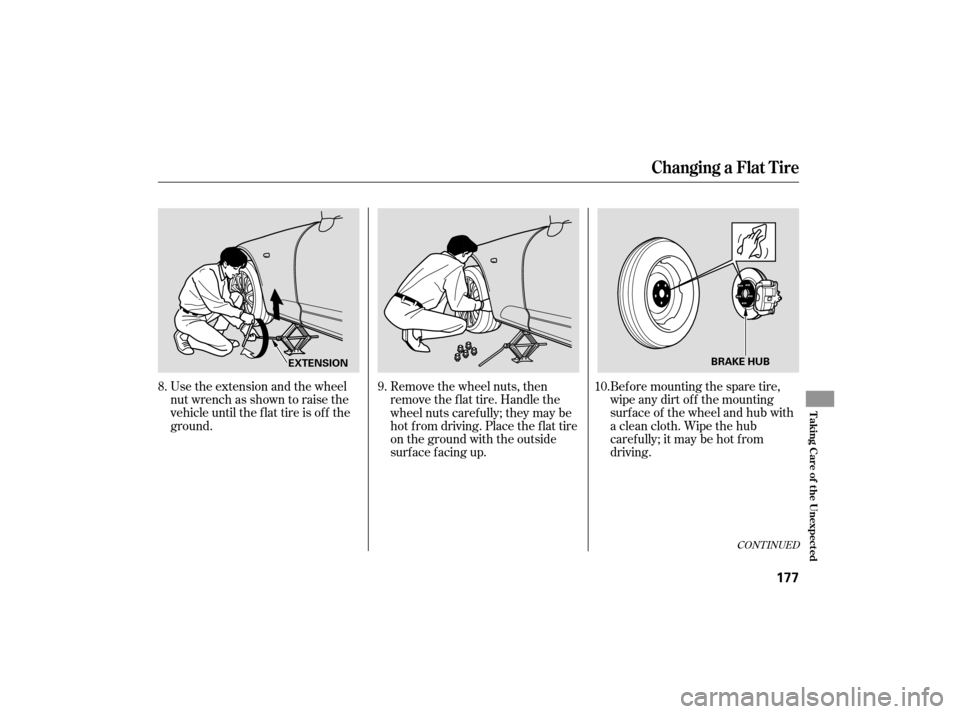
Use the extension and the wheel
nut wrench as shown to raise the
vehicle until the f lat tire is of f the
ground.Bef ore mounting the spare tire,
wipeanydirtoff themounting
surface of the wheel and hub with
a clean cloth. Wipe the hub
carefully;itmaybehotfrom
driving.
Remove the wheel nuts, then
removetheflattire.Handlethe
wheel nuts caref ully; they may be
hot from driving. Place the flat tire
on the ground with the outside
surface facing up.
8.
9.10.
CONT INUED
Changing a Flat Tire
T aking Care of t he Unexpect ed
177
BRAKE HUB
EXTENSION
Page 181 of 228
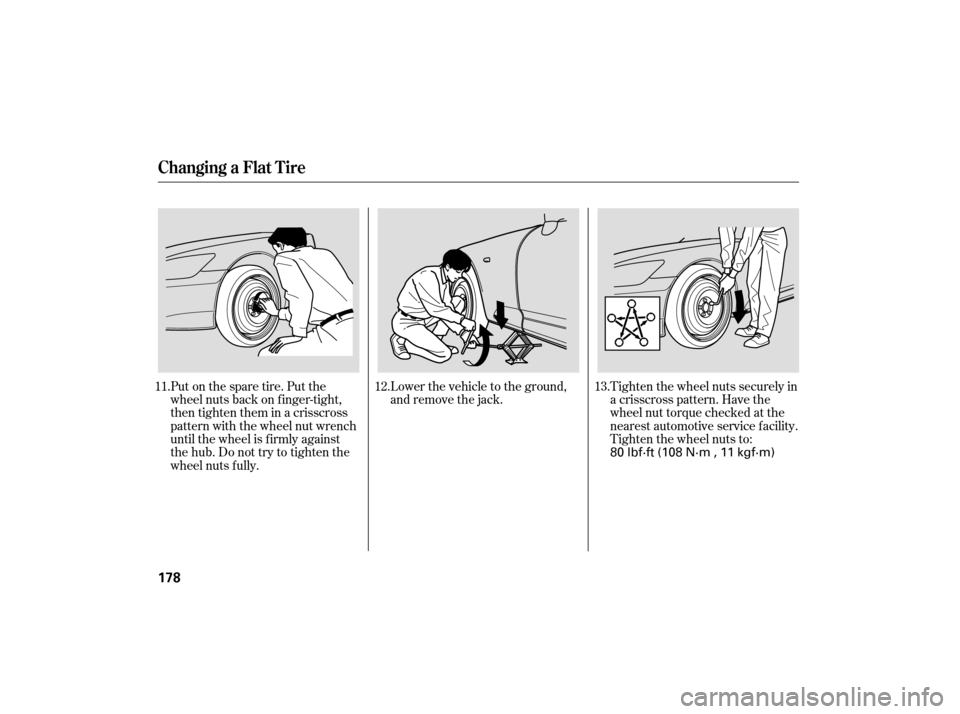
Put on the spare tire. Put the
wheel nuts back on f inger-tight,
then tighten them in a crisscross
pattern with the wheel nut wrench
until the wheel is f irmly against
the hub. Do not try to tighten the
wheel nuts f ully.Lower the vehicle to the ground,
and remove the jack.
Tighten the wheel nuts securely in
a crisscross pattern. Have the
wheel nut torque checked at the
nearest automotive service f acility.
Tighten the wheel nuts to:
13.
11. 12.
Changing a Flat Tire
178
80 lbf·ft (108 N·m , 11 kgf·m)
Page 182 of 228
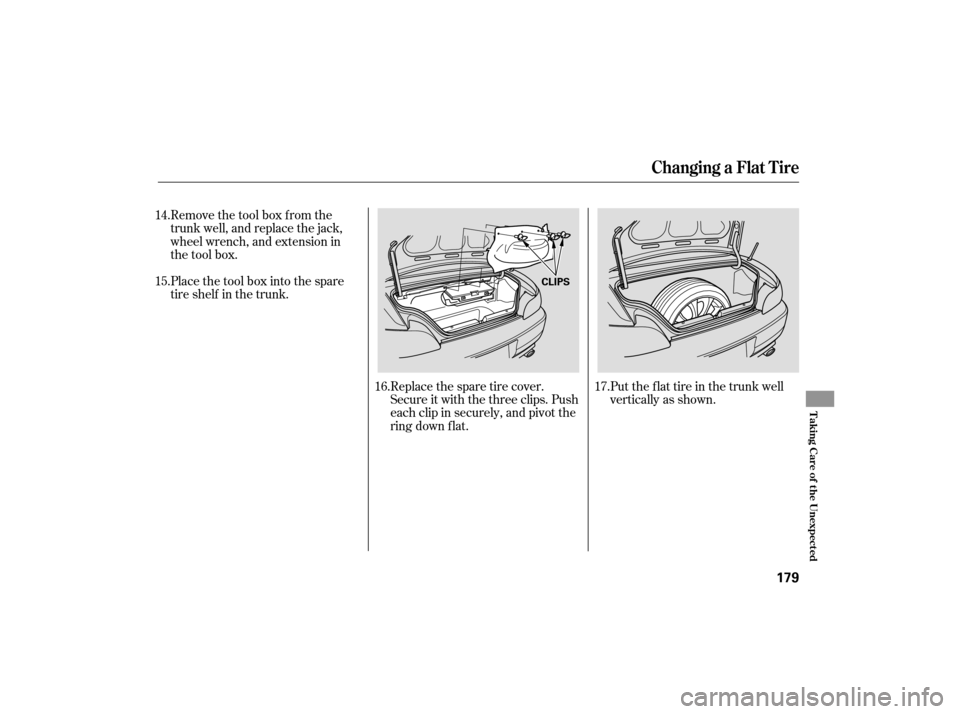
Put the flat tire in the trunk well
vertically as shown.
Remove the tool box f rom the
trunk well, and replace the jack,
wheel wrench, and extension in
the tool box.
Place the tool box into the spare
tire shelf in the trunk.
Replacethesparetirecover.
Secure it with the three clips. Push
each clip in securely, and pivot the
ring down f lat.
16.
17.
14.
15.
Changing a Flat Tire
T aking Care of t he Unexpect ed
179
CLIPS
Page 191 of 228

If the brake system indicator comes
on while driving, the brake fluid level
is probably low. Press lightly on the
brake pedal to see if it feels normal.
If it does, check the brake fluid level
thenexttimeyoustopataservice
station (see page ).
If the fluid level is low, take your
vehicle to a dealer, and have the
brake system inspected for leaks or
worn brake pads. However,
if the brake pedal does not
feel normal, you should take
immediate action. A problem in one
part of the system’s dual circuit
design will still give you braking at
two wheels. You will feel the brake
pedal go down much farther before
the vehicle begins to slow down, and
you will have to press harder on the
pedal.
Slow down by shifting to a lower
gear, and pull to the side of the road
when it is safe. Because of the long
distance needed to stop, it is
hazardous to drive the vehicle. You
should have it towed and repaired as
soon as possible (see on page ).
If you must drive the vehicle a short
distance in this condition, drive
slowly and caref ully.
The brake system
indicator normally
comes on when
you turn the ignition switch to the
ON (II) position, and as a reminder
to check the parking brake. It will
stay on if you do not f ully release the
parking brake.
154 196Emergency
Towing
Brake System Indicator
188
Canada
U.S.
Page 199 of 228
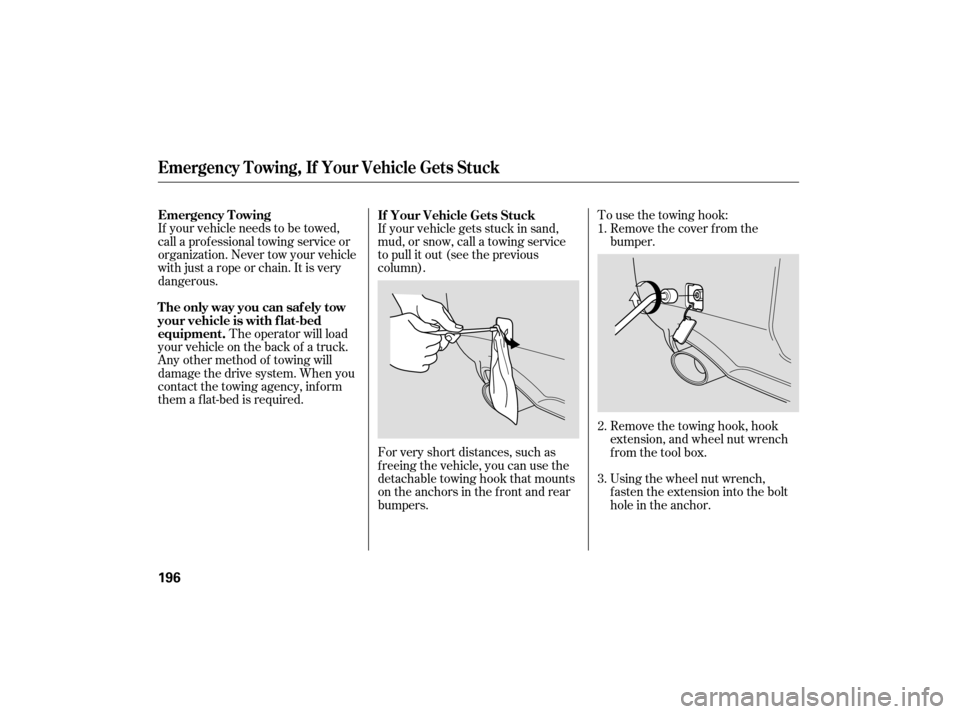
If your vehicle needs to be towed,
call a prof essional towing service or
organization. Never tow your vehicle
with just a rope or chain. It is very
dangerous.The operator will load
your vehicle on the back of a truck.
Any other method of towing will
damage the drive system. When you
contact the towing agency, inf orm
them a f lat-bed is required. If your vehicle gets stuck in sand,
mud, or snow, call a towing service
to pull it out (see the previous
column).
For very short distances, such as
f reeing the vehicle, you can use the
detachable towing hook that mounts
on the anchors in the front and rear
bumpers.To use the towing hook:
Remove the cover f rom the
bumper.
Using the wheel nut wrench,
fasten the extension into the bolt
hole in the anchor. Remove the towing hook, hook
extension, and wheel nut wrench
f rom the tool box.
1.
2.
3.
Emergency T owing
The only way you can saf ely tow
your vehicle is with f lat-bed
equipment.
If Your Vehicle Gets Stuck
Emergency Towing, If Your Vehicle Gets Stuck
196
Page 205 of 228

�Î
�Î
�´
�µ
�Î
�Î
Specif ications
202
Dimensions
Engine WeightsCapacities
162.0 in (4,115 mm)
68.9 in (1,750 mm)
50.6 in (1,285 mm)
94.5 in (2,400 mm)
57.9 in (1,470 mm)
59.4 in (1,510 mm) 13.2 US gal (50)
132 cu-in (2,157 cm
)
11.1 : 1 1.72 US gal (6.5
)
2.01 US gal (7.6)
5.1 US qt (4.8
)
4.8 US qt (4.5)
5.9 US qt (5.6)
1.6 US qt (1.5)
1.7 US qt (1.6)
0.78 US qt (0.74
)
0.81 US qt (0.77)
2.6 US qt (2.5)
6.3 US qt (6.0)
3.43 x 3.57 in (87.0 x 90.7 mm)
Length
Width
Height
Wheelbase
Track
See the certification label attached
to the driver’s doorjamb.Water cooled 4-stroke DOHC
VTEC 4-cylinder gasoline engine
Type
BorexStroke
Displacement
Compression ratio
Spark plugs
Spark Plug Gap
0.04 in (1.1 mm)PK22PR-L11S PFR7G-11S
Including the coolant in the reserve tank and that remaining in the
engine
Reserve tank capacity:
0.16 US gal (0.6
)
Excluding the oil remaining in the engine
Gross vehicle weight rating
(GVWR)
Fuel tank
Engine coolant
Engine oil
Manual
transmission
fluid
Differential
fluid
Windshield
washer
reservoir
Front
Rear
1:
2:
NGK :
DENSO : Change
Total
Change
Total
Change
Total
Change
Total
U.S. Vehicles
Canadian
Vehicles
0mm
0.1 mm
1
2
Including filter
Without filter
Page 208 of 228

�µ
The temperature grades are A (the
highest), B, and C, representing the
tire’s resistance to the generation of
heat and its ability to dissipate heat
when tested under controlled
conditions on a specif ied indoor
laboratory test wheel. Sustained high
temperature can cause the material
of the tire to degenerate and reduce
tire life, and excessive temperature
can lead to sudden tire f ailure. The
grade C corresponds to a level of
perf ormance which all passenger car
tires must meet under the Federal
Motor Vehicle Saf ety Standard No.
109. Grades B and A represent
higher levels of perf ormance on the
laboratory test wheel than the
minimum required by law. Warning: The temperature grade f or
this tire is established f or a tire that
is properly inf lated and not
overloaded. Excessive speed,
underinf lation, or excessive loading,
either separately or in combination,
can cause heat buildup and possible
tire f ailure.
DOT Tire Quality Grading (U.S. Vehicles)
Temperature A,B,C
Technical Inf ormation
205