2007 HONDA PILOT seats
[x] Cancel search: seatsPage 48 of 319
Since LATCH-compatible child seats
are easier to install and reduce the
possibility of improper installation,
we recommend selecting this style.
We also recommend selecting a
LATCH-compatible seat with a rigid,
rather than a flexible, anchor (see
page ). In seating positions and vehicles not
equipped with LATCH, a LATCH-
compatible child seat can be installed
using a seat belt.
If it is necessary to put a f orward-
f acing child seat in the f ront, move
the vehicle seat as far to the rear as
possible, and be sure the child seat is
f irmly secured to the vehicle and the
child is properly strapped in the seat. Whatever type of seat you choose, to
provide proper protection, a child
seat should meet three
requirements:
When buying a child seat, you need
to choose either a conventional child
seat, or one designed f or use with
the lower anchors and tethers for
children (LATCH) system.
Conventional child seats must be
secured to a vehicle with a seat belt,
whereas LATCH-compatible seats
are secured by attaching the seat to
hardware built into the two outer
second row seats.
47
CONT INUED
Protecting Inf ants and Small Children, Selecting a Child Seat
Selecting a Child Seat
Driver and Passenger Saf ety
45
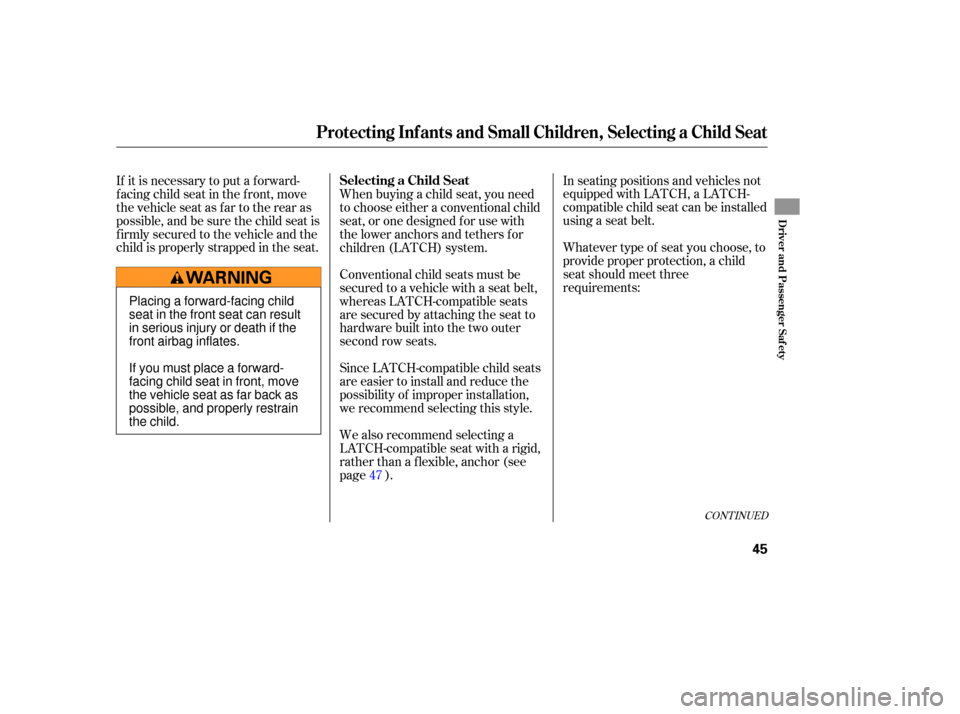
Placing a forward-facing child
seat in the front seat can result
in serious injury or death if the
front airbag inflates.
Ifyoumustplaceaforward-
facing child seat in front, move
the vehicle seat as far back as
possible, and properly restrain
the child.
Page 49 of 319

Af ter selecting a proper child seat
and a good place to install the seat,
there are three main steps in
installing the seat:All child seats must be
secured to the vehicle with the lap
part of a lap/shoulder belt or with
the LATCH (lower anchors and
tethers for children) system. A
child whose seat is not properly
secured to the vehicle can be
endangered in a crash.
Af ter installing a child
seat, push and pull the seat
f orward and f rom side-to-side to
verify that it is secure.
A child seat secured with a seat belt
should be installed as f irmly as
possible. However, it does not need
to be ‘‘rock solid.’’ Some side-to-side movement can be expected and
should not reduce the child seat’s
ef f ectiveness.
If the child seat is not secure, try
installing it in a dif f erent seating
position, or use a dif f erent style of
child seat that can be f irmly secured.
Make sure the child is properly
strappedinthechildseat
according to the child seat maker’s
instructions. A child who is not
properly secured in a child seat
can be seriously injured in a crash.
Look f or FMVSS
213 or CMVSS 213 on the box.
Rear-facing for infants, forward-
f acing f or small children.
Bef ore purchasing a conventional
child seat, or using a previously
purchased one, we recommend that
you test the seat in the specif ic
vehicle seating position or positions
where the seat will be used. The f ollowing pages provide
guidelines on how to properly install
a child seat. A f orward-f acing child
seat is used in all examples, but the
instructions are the same f or rear-
f acing child seats.
Selecting a Child Seat, Installing a Child Seat
Installing a Child Seat
Properly secure t he child seat t o
the vehicle.
Make sure t he child seat is f irmlysecured. Secure the child in the child seat.
T he child seat should meet U.S. or
Canadian Mot or Vehicle Saf et ySt andard 213.
T he child seat should be of theproper type and size to f it the child.
T he child seat should f it thevehicle seat ing posit ion (orposit ions) where it will be used.
3.
1.
2. 1.
2. 3.
46
Page 50 of 319
Make sure there are no objects
near the anchors that could
prevent a secure connection
between the child seat and the
anchors. Move the seat belt buckle or
tongue away f rom the lower
anchors.
To install a LATCH-compatible child
seat:
Place the child seat on the vehicle
seat, then attach the seat to the
lower anchors according to the
child seat maker’s instructions.
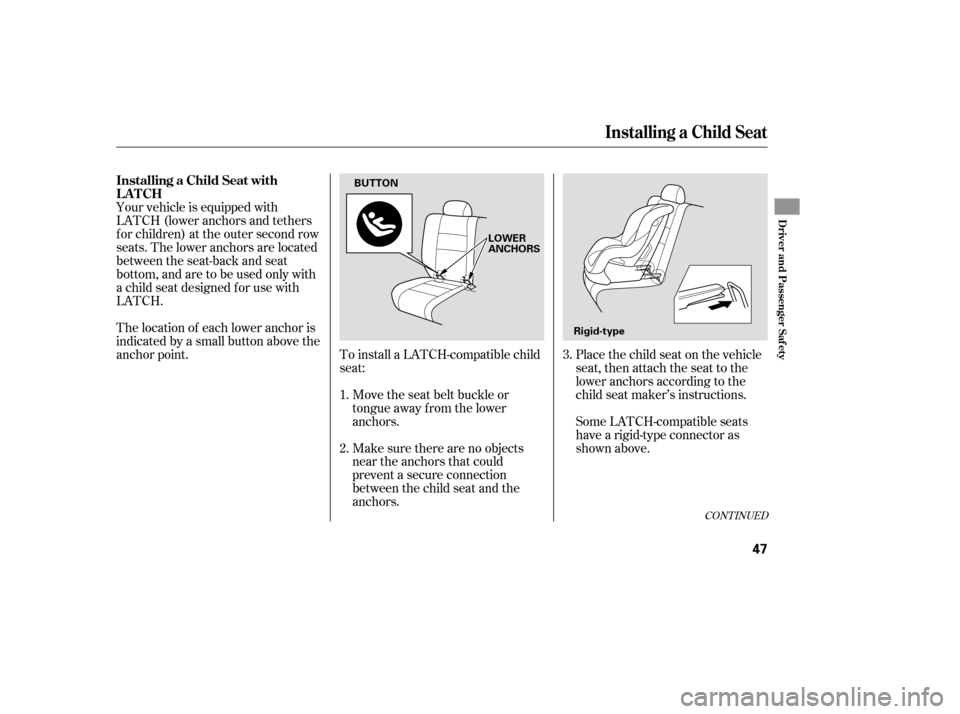
Your vehicle is equipped with
LATCH (lower anchors and tethers
f or children) at the outer second row
seats. The lower anchors are located
between the seat-back and seat
bottom, and are to be used only with
a child seat designed f or use with
LATCH.
The location of each lower anchor is
indicated by a small button above the
anchor point.
Some LATCH-compatible seats
have a rigid-type connector as
shown above.
1.
2. 3.
CONT INUED
Installing a Child Seat
Installing a Child Seat with
LATCH
Driver and Passenger Saf ety
47
LOWER
ANCHORS
BUTTON
Rigid-type
Page 51 of 319
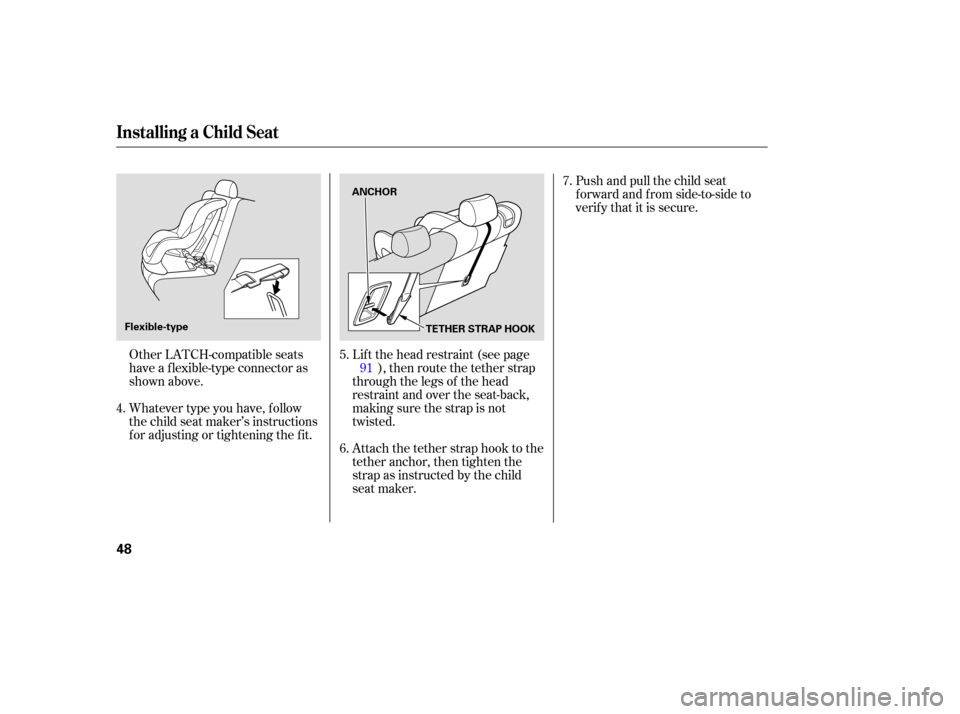
Whatever type you have, follow
the child seat maker’s instructions
for adjusting or tightening the fit. Lift
the head restraint (see page
), then route the tether strap
through the legs of the head
restraint and over the seat-back,
making sure the strap is not
twisted.
Attach the tether strap hook to the
tether anchor, then tighten the
strap as instructed by the child
seat maker.
Other LATCH-compatible seats
have a f lexible-type connector as
shown above. Push and pull the child seat
f orward and f rom side-to-side to
verify that it is secure.
4. 5.
6.7.
91
Installing a Child Seat
48
TETHER STRAP HOOK
ANCHOR
Flexible-type
Page 52 of 319
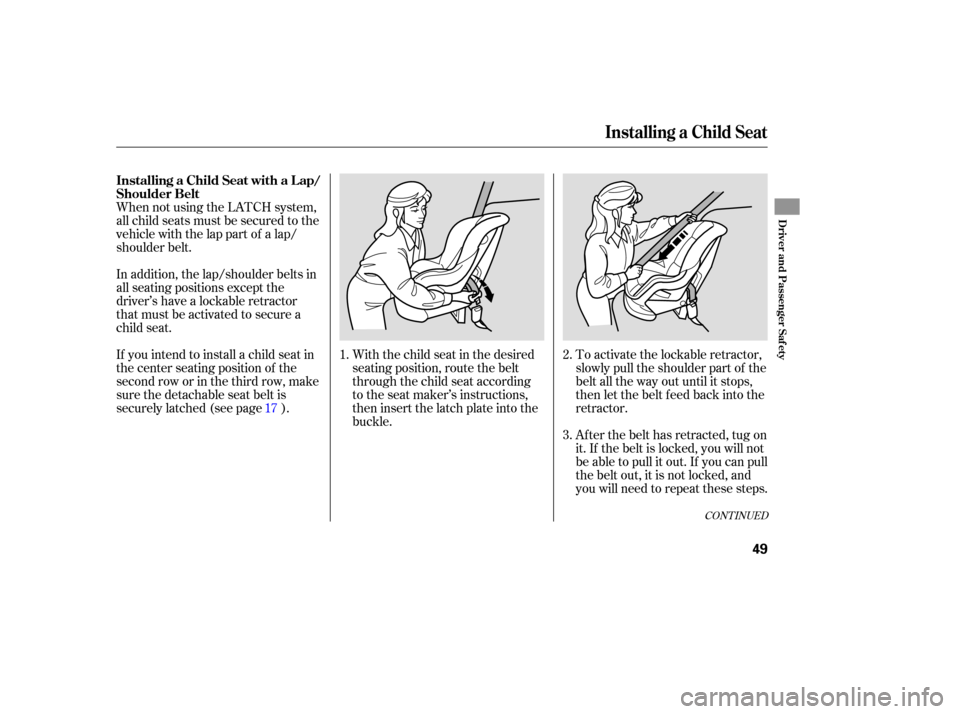
When not using the LATCH system,
all child seats must be secured to the
vehicle with the lap part of a lap/
shoulder belt.
With the child seat in the desired
seating position, route the belt
th rough the child seat according
to the seat maker’s instructions,
then insert the latch plate into the
buckl e. To
activate the lockable retractor,
slowly pull the shoulder part of the
belt all the way out until it stops,
th en let the belt feed back into the
retractor.
After the belt has retracted, tug on
it. If the belt is locked, you will not
be able to pull it out. If you can pull
thebeltout,itisnotlocked,and
you will need to repeat these steps.
In
addition, the lap/shoulder belts in
all seating positions except the
driver’s have a lockable retractor
that must be activated to secure a
child seat.
If you intend to install a child seat in
the center seating position of the
secondroworinthethirdrow,make
sure the detachable seat belt is
securely latched (see page ). 1.
2.
3.
17
CONT INUED
Installing a Child Seat
Installing a Child Seat with a L ap/
Shoulder Belt
Driver and Passenger Saf ety
49
Page 54 of 319
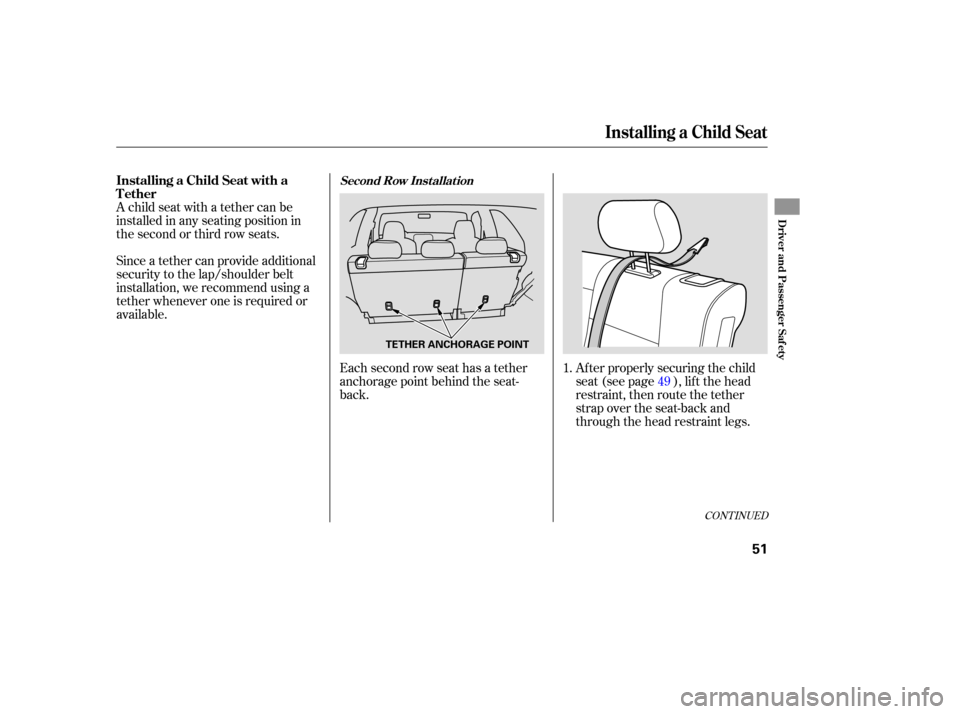
Each second row seat has a tether
anchorage point behind the seat-
back.
A
child seat with a tether can be
installed in any seating position in
the second or third row seats.
Since a teth er can pro vide additional
security to the lap/shoulder belt
installation, we recommend using a
te ther whenever one is required or
available.
Af ter properly securing the child
seat (see page ), lif t the head
restraint, then route the tether
strap over the seat-back and
through the head restraint legs.
1.
49
CONT INUED
Installing a Child Seat
Installing a Child Seat with a
TetherSecond Row Inst allat ion
Driver and Passenger Saf ety
51
TETHER ANCHORAGE POINT
Page 57 of 319
Does the shoulder belt cross
between the child’s neck and arm?
Is the lap part of the belt as low as
possible, touching the child’s
thighs?
Will the child be able to stay
seated like this for the whole trip?
If you answer yes to all these
questions, the child is ready to wear
the lap/shoulder belt correctly. If
you answer no to any question, the
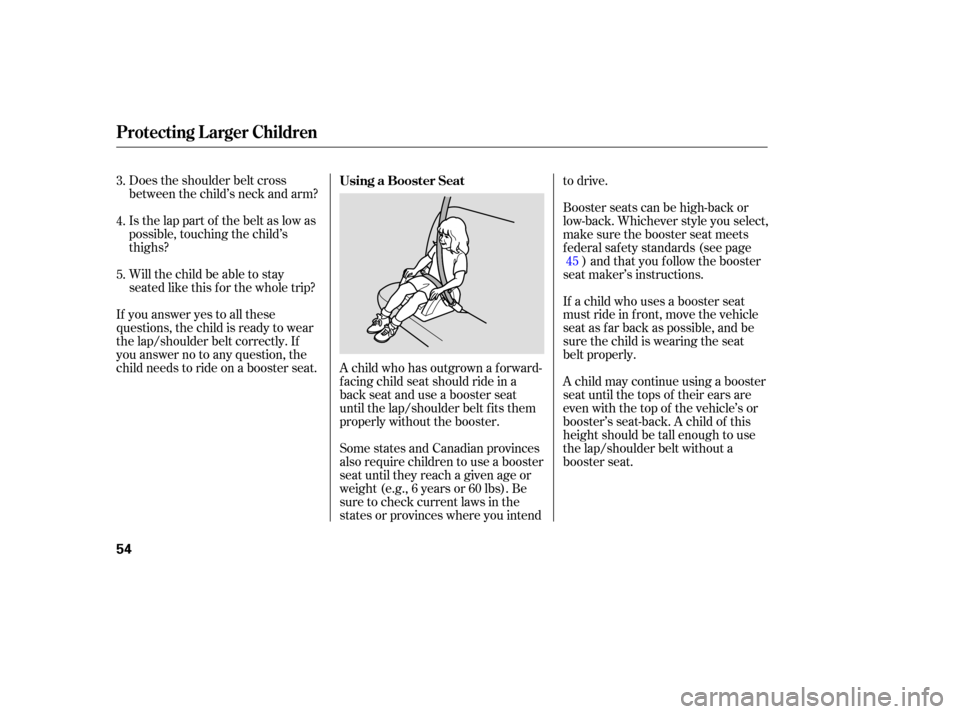
child needs to ride on a booster seat. A child who has outg rown a forward-
facing child seat should ride in a
back seat and use a booster seat
until the lap/shoulder belt fits them
properly without the booster. A
child may continue using a booster
seat until the tops of their ears are
even with the top of the vehicle’s or
booster’s seat-back. A child of this
height should be tall enough to use
the lap/shoulder belt without a
booster seat.
Booster seats can be high-back or
low-back. Whichever style you select,
make sure the booster seat meets
f ederal saf ety standards (see page
) and that you f ollow the booster
seat maker’s instructions.
If a child who uses a booster seat
must ride in f ront, move the vehicle
seat as far back as possible, and be
sure the child is wearing the seat
belt properly.
Some states and Canadian provinces
also require children to use a booster
seat until they reach a given age or
weight (e.g., 6 years or 60 lbs). Be
sure to check current laws in the
states or provinces where you intend to drive.
4.
5. 3.
45
Using a Booster Seat
Protecting L arger Children
54
Page 62 of 319

This section gives inf ormation about
the controls and displays that
contribute to the daily operation of
your vehicle. All the essential
controls are within easy reach............................
Control Locations .60
............................
Instrument Panel .61
..........
Instrument Panel Indicators .62
.............................................
Gauges .70
...................................
Trip Meter .70
.....................................
Odometer .70
..................................
Fuel Gauge .70
...................
Temperature Gauge .71
Outside Temperature
...................................
Indicator .71
..........
Check Fuel Cap Message .72
Controls Near the Steering ...........................................
Wheel .73
.
Windshield Wipers and Washers .74
.................
Turn Signal, Headlights .75
Automatic Lighting Off .....................................
Feature .76
............
Daytime Running Lights .76
........
Instrument Panel Brightness .76
.................
Hazard Warning Button .77
.................
Rear Window Def ogger .77
..........
Steering Wheel Adjustment .78
...............................
Keys and Locks .79
........................
Immobilizer System .79
................................
Ignition Switch .81 ......................................
Door Locks .82
......................
Power Door Locks .82
........................................
Tailgate .82
..................
Childproof Door Locks .83
.......................
Remote Transmitter .83
....................................
Seat Heaters .86
.................................................
Seats .87
..........................
Head Restraints .91
.............................................
Mirrors .92
..............................
Power Windows .94
.........................................
Moonroof .96
.................................
Parking Brake .97
...........
Interior Convenience Items .98
.......................
Beverage Holders .99
...............
Console Compartment .99
....................................
Glove Box .99
....................
Sunglasses Holder .100
................
Conversation Mirror .100
...................................
Sun Visor .101
............................
Vanity Mirror .101
........
Accessory Power Sockets .101
...............................
Interior Lights .102
Instruments and Controls
Inst rument s and Cont rols
59