Page 203 of 319
If the malf unction indicator lamp
comes on along with the ‘‘D’’
indicator, there is a problem with the
automatic transmission control
system. Avoid rapid acceleration, and
have the transmission checked by
your dealer as soon as possible.
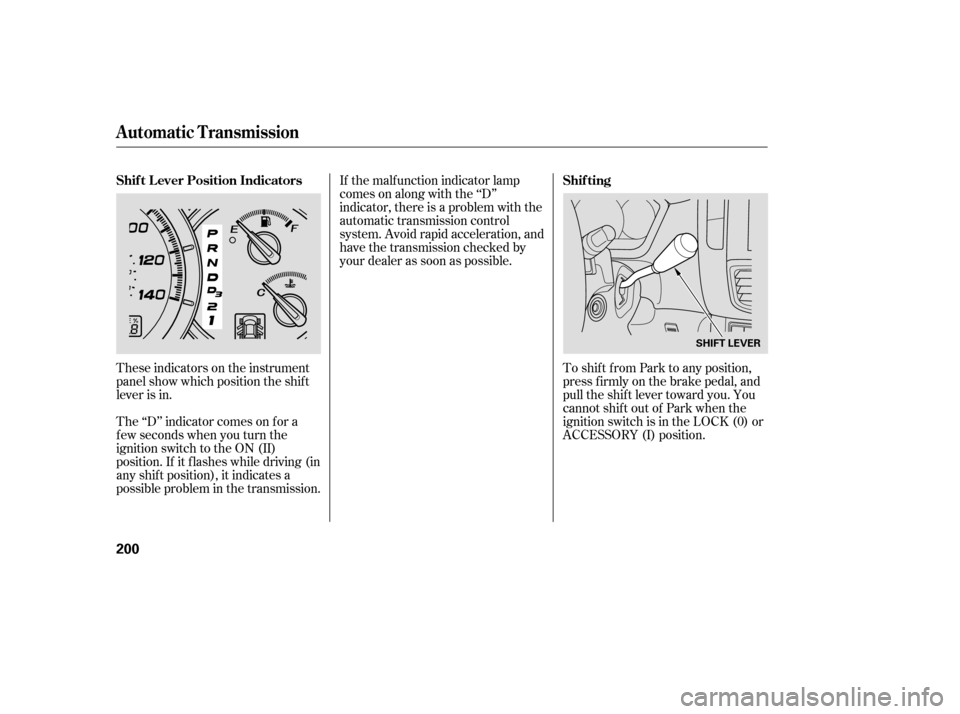
These indicators on the instrument
panel show which position the shif t
lever is in.
The ‘‘D’’ indicator comes on f or a
f ew seconds when you turn the
ignition switch to the ON (II)
position. If it f lashes while driving (in
any shif t position), it indicates a
possible problem in the transmission. To shif t f rom Park to any position,
pressfirmlyonthebrakepedal,and
pull the shif t lever toward you. You
cannot shif t out of Park when the
ignition switch is in the LOCK (0) or
ACCESSORY (I) position.
Automatic Transmission
Shif t L ever Position Indicators
Shif ting
200
SHIFT LEVER
Page 204 of 319

�µ
�µ
�µ
�µTo shift from:
PtoR
RtoP
NtoR
Dto2 2to1
1to2
2toD
DtoD DtoN
DtoD NtoDRtoN Do
this:
Press the brake pedal and
pull the shift lever towards
you.
Pull the shift lever towards
you.
Move the shift lever.
3
3
3
3
Use neutral if you
need to restart a stalled engine, or if
it is necessary to stop briefly with
the engine idling. Shift to the Park
position if you need to leave your
vehicle for any reason. Press on the
brake pedal when you are moving
the shift lever from neutral to
another gear.
Use this position for
your norm al driving. The
transmission automatically selects a
suitable gear for the vehicle speed
and acceleration. You may notice the
transmission shifting up at higher
speeds when the engine is cold. This
helps the engine warm up faster.
This
position mechani-
cally locks the transmission. Use
Park whenever you are turning off or
starting the engine. To shift out of
Park, you must press on the brake
pedal and have your foot off the
accelerator pedal. Pull the shift lever
to wards you, then move it out of
Park.
Press the brake
pedal and pull the shift lever towards
you to shift from Park to reverse. To
shif t f rom reverse to neutral, come
to a complete stop and then shift. If you have done all of the above and
still cannot move the lever out of
Park, see on
page .
To avoid transmission damage, come
to a complete stop bef ore shif ting
into Park. The shif t lever must be in
Park bef ore you can remove the key
from the ignition switch. 203
CONT INUED
Neutral (N)
Drive (D)
Park (P)
Reverse (R)
Shif t L ock Release
Automatic Transmission
Driving
201
Page 206 of 319
Do this if pushing on the brake pedal
and pulling the shif t lever does not
shif t the transmission out of Park:Set the parking brake. Push down on the key while you
pull the shif t lever towards you
and move it out of Park to neutral.
Remove the key from the shift
lock release slot, then install the
cover. Press the brake pedal, and
restart the engine.
Put a cloth on the edge of the shif t
lock release slot cover. Using a
small f lat-tipped screwdriver or a
metal f ingernail f ile, caref ully pry
on the edge of the cover to remove
it.
Insert the key in the shift lock
release slot.
Remove the key from the ignition
switch.
If you need to use the shif t lock
release, it means your vehicle is
developing a problem. Have the
vehicle checked by your dealer.
3.
4. 5.
6.
1.
2. Shif t L ock Release
Automatic Transmission
Driving
203
Page 210 of 319

Set the parking brake bef ore you put
the transmission in Park. This keeps
the vehicle from moving and putting
pressure on the parking mechanism
in the transmission.If the vehicle is f acing downhill,
turn the front wheels toward the
curb and set the parking brake. If the vehicle is f acing uphill, turn
the front wheels away from the
curb and set the parking brake.
Always use the parking brake when
you park your vehicle. Make sure
the parking brake is set f irmly or
your vehicle may roll if it is on an
incline. Make sure the moonroof (if
equipped) and the windows are
closed.
Turn of f the lights.
Place any packages, valuables, etc.
in the cargo area or take them
with you.
Lock the doors.
Check the indicator on the driver’s
door to verify that the security
system is set.
Never park over dry leaves, tall
grass, or other f lammable
materials. The hot three way
catalytic converter could cause
these materials to catch on fire.
On vehicles with security system
Parking Tips
Driving
207
Page 216 of 319
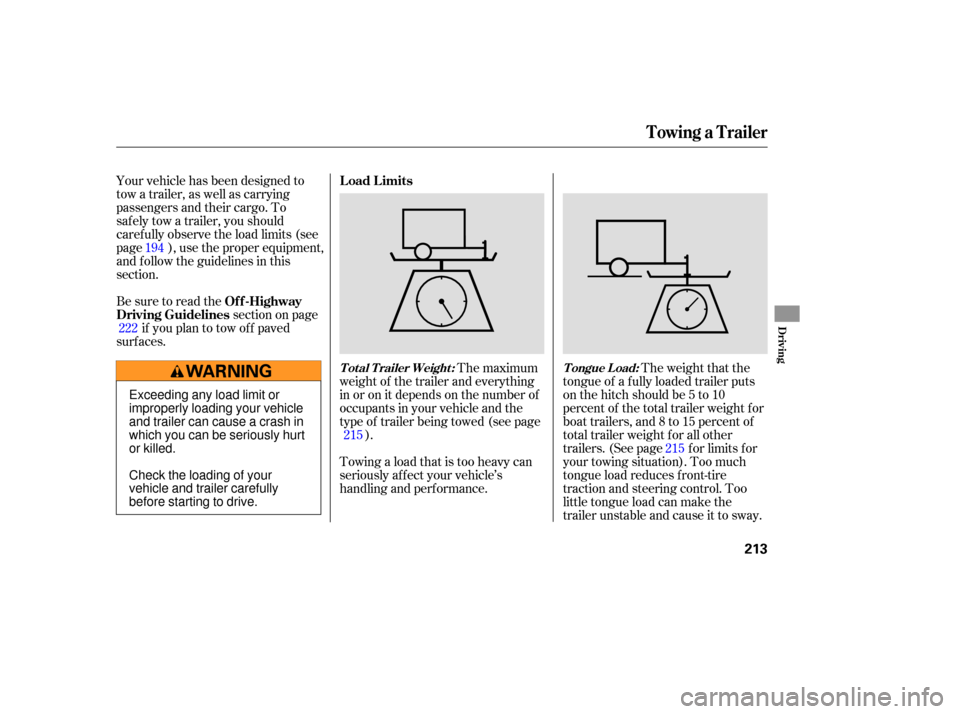
The maximum
weight of the trailer and everything
in or on it depends on the number of
occupants in your vehicle and the
type of trailer being towed (see page
).
To wing a load that is too heavy can
seriously affect your vehicle’s
handling and performance. Theweightthatthe
tongue of a fully loaded trailer puts
on the hitch should be 5 to 10
percent of the total trailer weight for
boat trailers, and 8 to 15 percent of
total trailer weight for all other
trailers. (See page for limits for
your towing situation). Too much
tongue load reduces front-tire
traction and steering control. Too
little tongue load can make the
trailer unstable and cause it to sway.
Your
vehicle has been designed to
tow a trailer, as well as carrying
passengers and their cargo. To
safely tow a trailer, you should
carefully observe the load limits (see
page ), use the proper equipment,
and follow the guidelines in this
section.
Be sure to read the
sectiononpage
if you plan to tow of f paved
surf aces.
215 215
222
194
Load Limits
Off-Highway
Driving Guidelines
Towing a Trailer
T ot al T railer Weight : T ongue L oad:
Driving
213
Exceeding any load limit or
improperly loading your vehicle
and trailer can cause a crash in
which you can be seriously hurt
or killed.
Check the loading of your
vehicle and trailer carefully
beforestartingtodrive.
Page 217 of 319

�µ�µ
�µ Thebestwaytoconfirmthatall
loads
are within limits is to check
them at a public scale.
The
maximum
allowable weight of the vehicle, all
occupants, all cargo and the tongue
load is 5,950 lbs (2,700 kg).
The maximum
allowable weight on the vehicle axles
is 2,865 lbs (1,300 kg) on the front
ax le, and 3,155 lbs (1,430 kg) on the
rear axle.
The maximum
allowable weight of the fully loaded
ve hicle and trailer is 9,700 lbs (4,400
kg) with the proper hitch and fluid
coolers (see page ).
The GCWR must be reduced 2
percent for every 1,000 feet (305
meters) of elevation. Connect
the fully loaded trailer to
the hitch.
Measure again from the ground to
the same spot on the bottom of the
hitch.
Subtract the second measurement
from the first measurement, then
refer to the following table.
Ifthedifferenceismorethan3¾
inch, you have too much load on the
tongue. Redistribute the load or
remove cargo as needed.
1½’’
2¼’’ 3’’
3¾’’ 150
lbs (68 kg)
250 lbs (114 kg)
350 lbs (160 kg)
450 lbs (205 kg)
Measure from the ground to the
bottom of the trailer hitch.
Park
the vehicle on level ground.
For
public scales in your area, check
your local phone book, or contact
your trailer dealer or rental agency
for assistance.
To help ensure a safe drive to a scale,
or if you cannot get to a public scale,
we recommend that you estimate
your total trailer weight and tongue
load as described.
Add the weight of your trailer (as
quoted by the manuf acturer) with
everything in or on the trailer. Then
check the tables on page to
make sure you do not exceed the
limit f or your conditions.
1.
2. 3.
4.
5.
217 215
Estimating Loads
Gross Vehicle Weight Rating
(GVWR)
Gross Axle Weight Ratings
(GA WR)
Gross Combined Weight Rating
(GCWR) If the
difference is: Estimated
tongue load is:
Towing a Trailer
To Estimate the Tongue Load
To Estimate the Total Trailer Weight
214
Page 218 of 319

Number ofOccupants 2
3
4
5
6
7
8
Number of Occupants 2
3
4
5
6
7
8 Equipped with transmission cooler and power steering f luid cooler.
T owing is Not Recommended
Equipped with transmission cooler and power steering f luid cooler.
T owing is Not Recommended
Maximum T otal T railer Weight
Maximum T otal T railer Weight
Maximum T ongue Load
Maximum T ongue Load
Towing a Trailer
Driving
215
Total Trailer Weight and Tongue Load Limits:
BOAT TRAILERS
OTHER TYPES OF TRAILERS
The corresponding weight limits assume occupants fill seats from the front of the vehicle to the back, each occupant weighs 150 lbs (70 kg) and each has 1 5 lbs (7 kg)
of luggage in the cargo area.
4,500 lbs (2,045 kg)
4,500 lbs (2,045 kg)
4,500 lbs (2,045 kg)
4,300 lbs (1,945 kg)
4,100 lbs (1,855 kg) 2,000 lbs (905 kg)
3,500 lbs (1,590 kg)
3,500 lbs (1,590 kg)
3,300 lbs (1,490 kg)
3,100 lbs (1,400 kg)
2,700 lbs (1,220 kg) 1,200 lbs (540 kg) 450 lbs (205 kg)
450 lbs (205 kg)
450 lbs (205 kg)
350 lbs (160 kg)
220 lbs (100 kg)
100 lbs (45 kg)
450 lbs (205 kg)
450 lbs (205 kg)
450 lbs (205 kg)
350 lbs (160 kg)
220 lbs (100 kg) 100 lbs (45 kg)
Page 219 of 319
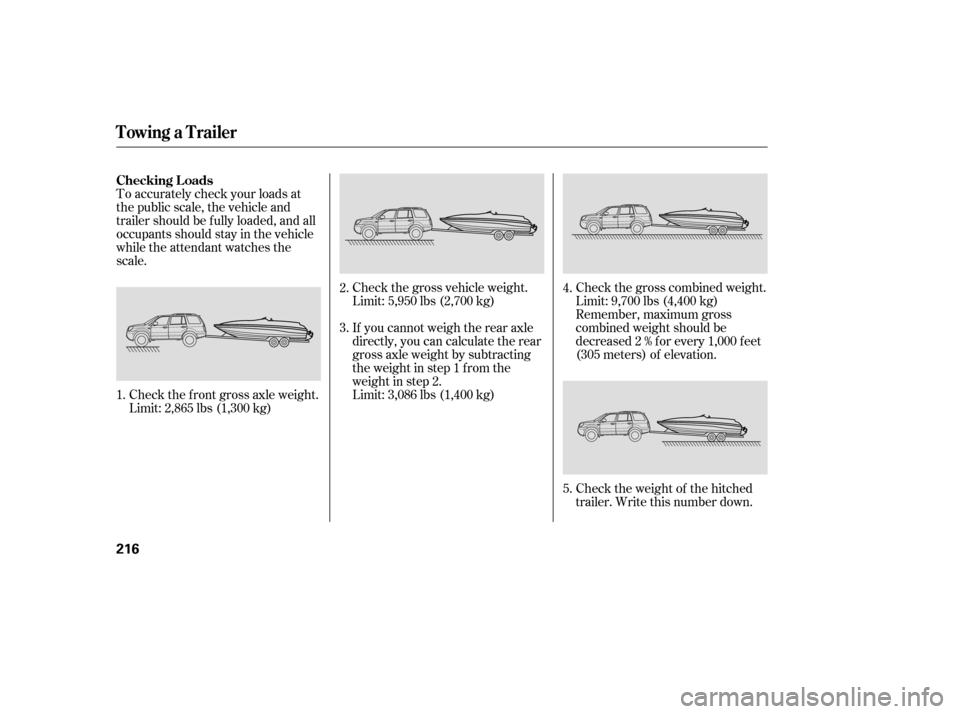
To accurately check your loads at
the public scale, the vehicle and
trailer should be f ully loaded, and all
occupants should stay in the vehicle
while the attendant watches the
scale.Check the f ront gross axle weight.
Limit: 2,865 lbs (1,300 kg) Check the gross vehicle weight.
Limit: 5,950 lbs (2,700 kg)
If you cannot weigh the rear axle
directly, you can calculate the rear
gross axle weight by subtracting
the weight in step 1 from the
weight in step 2.
Limit: 3,086 lbs (1,400 kg)
Check the gross combined weight.
Limit: 9,700 lbs (4,400 kg)
Remember, maximum gross
combined weight should be
decreased 2 % f or every 1,000 f eet
(305 meters) of elevation.
Check the weight of the hitched
trailer. Write this number down.
1. 2.
3.
4.
5.
Towing a Trailer
Checking L oads
216