Page 47 of 311
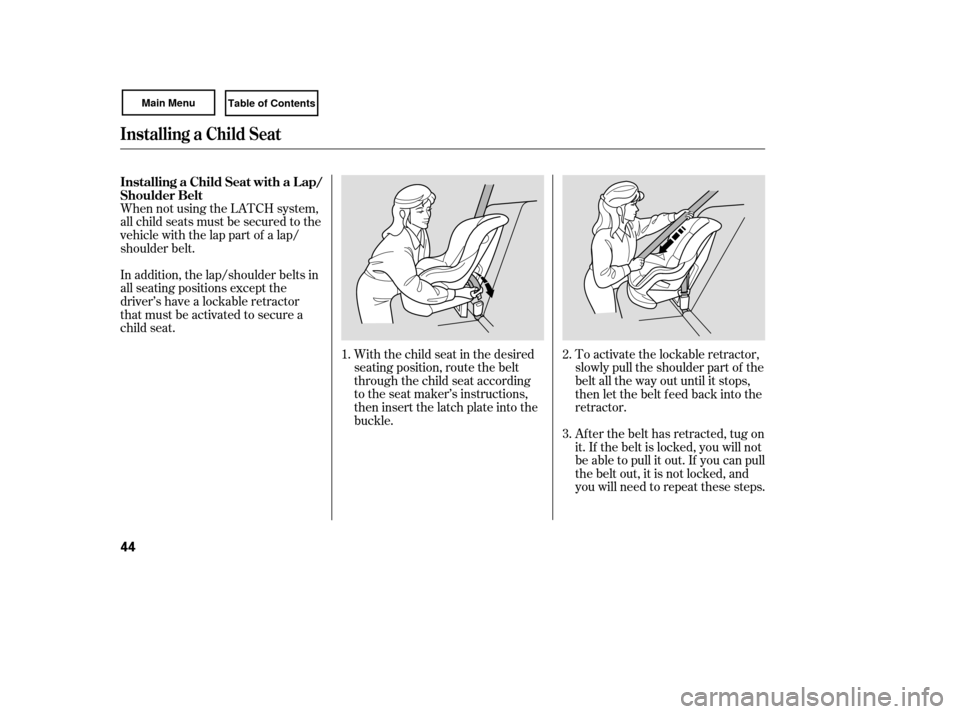
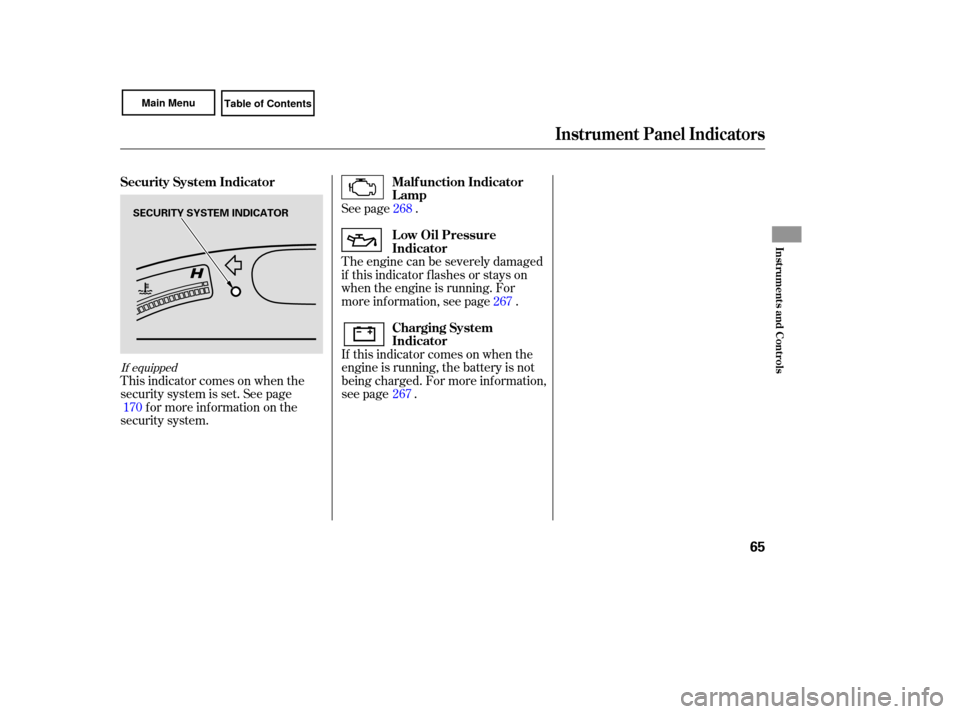
When not using the LATCH system,
all child seats must be secured to the
vehicle with the lap part of a lap/
shoulder belt.With the child seat in the desired
seating position, route the belt
through the child seat according
to the seat maker’s instructions,
then insert the latch plate into the
buckle.To activate the lockable retractor,
slowly pull the shoulder part of the
belt all the way out until it stops,
then let the belt f eed back into the
retractor.
Af ter the belt has retracted, tug on
it. If the belt is locked, you will not
be able to pull it out. If you can pull
thebeltout,itisnotlocked,and
you will need to repeat these steps.
In addition, the lap/shoulder belts in
all seating positions except the
driver’s have a lockable retractor
that must be activated to secure a
child seat.
1. 2.
3.
Installing a Child Seat with a L ap/
Shoulder Belt
Installing a Child Seat
44
Page 48 of 311
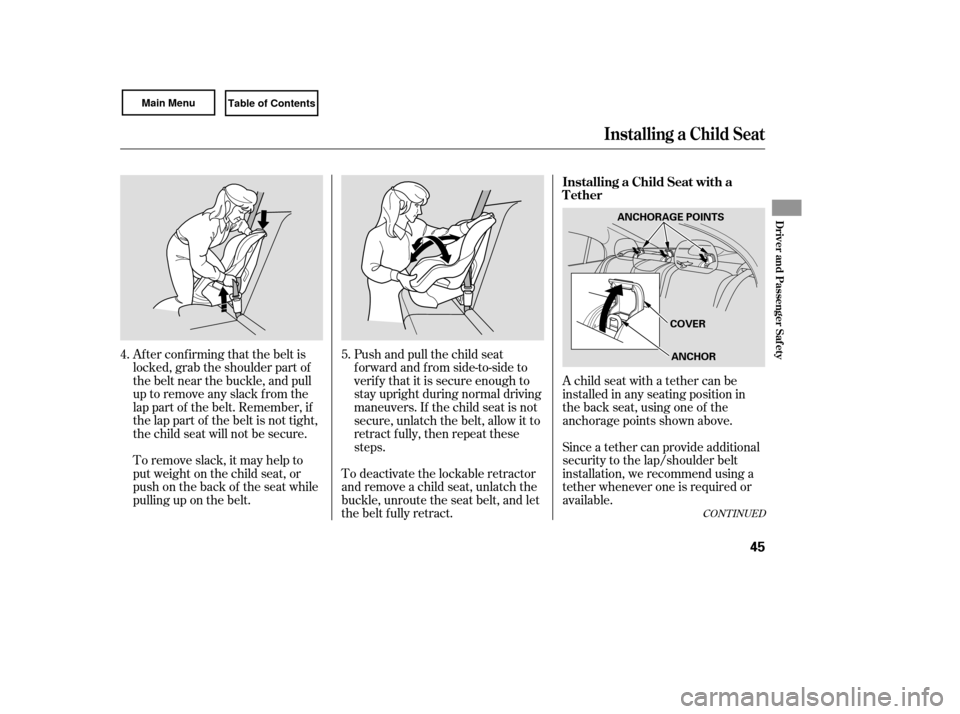
Af ter conf irming that the belt is
locked, grab the shoulder part of
the belt near the buckle, and pull
up to remove any slack from the
lap part of the belt. Remember, if
the lap part of the belt is not tight,
the child seat will not be secure.Push and pull the child seat
f orward and f rom side-to-side to
verify that it is secure enough to
stay upright during normal driving
maneuvers. If the child seat is not
secure, unlatch the belt, allow it to
retract f ully, then repeat these
steps.
To remove slack, it may help to
putweightonthechildseat,or
push on the back of the seat while
pulling up on the belt. To deactivate the lockable retractor
and remove a child seat, unlatch the
buckle, unroute the seat belt, and let
the belt fully retract. Since a tether can provide additional
security to the lap/shoulder belt
installation, we recommend using a
tether whenever one is required or
available. A child seat with a tether can be
installed in any seating position in
the back seat, using one of the
anchorage points shown above.
4. 5.
CONT INUED
Installing a Child Seat with a
Tether
Installing a Child Seat
Driver and Passenger Saf ety
45
COVER
ANCHORAGE POINTS
ANCHOR
Page 49 of 311
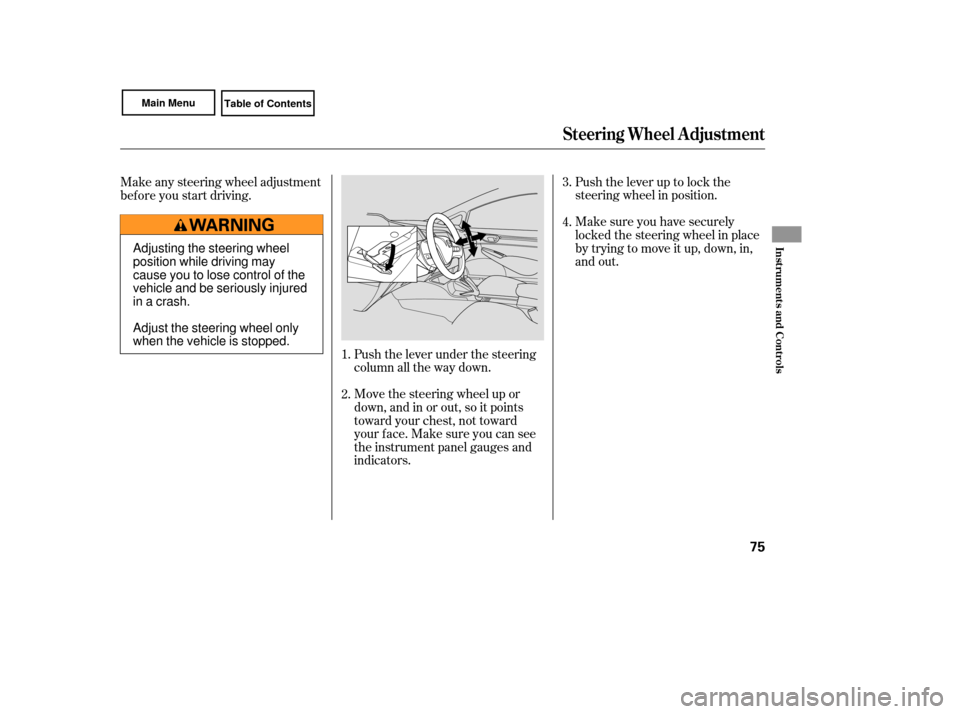
If the tether strap is too long and
cannot be tightened firmly, find a
route where the strap can be
tightened securely.
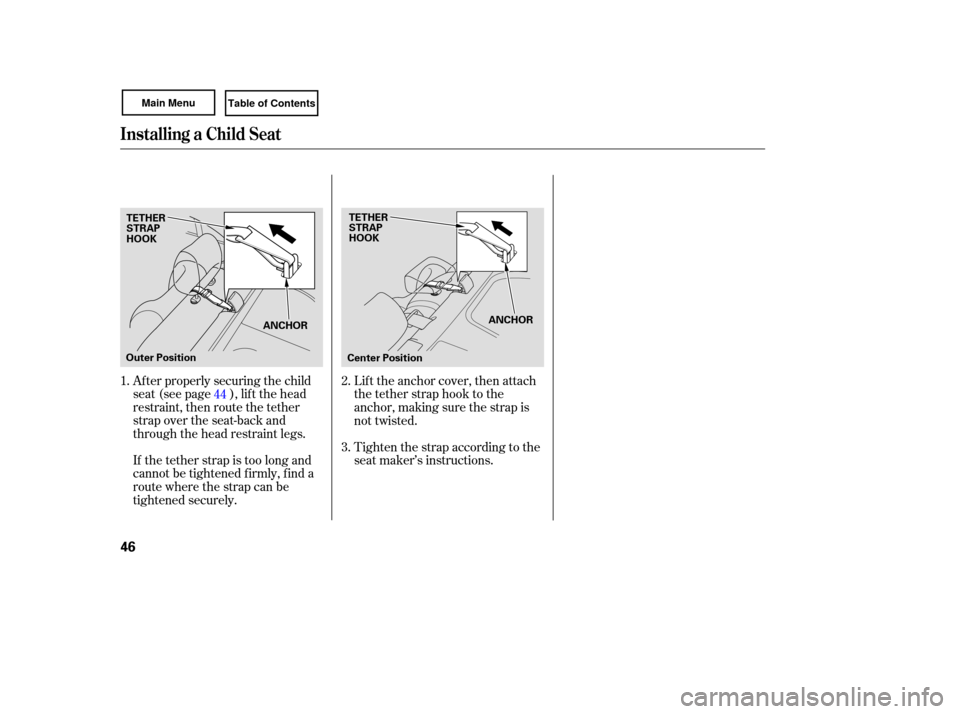
After
properly securing the child
seat (see page ), lif t the head
restraint, then route the tether
strap over the seat-back and
through the head restraint legs. Lift the anchor cover, then attach
the tether strap hook to the
anchor, making sure the strap is
not twisted.
Tighten the strap according to the
seat maker’s instructions.
1.
2.
3.
44
Installing a Child Seat
46
ANCHOR
ANCHOR
Outer Position TETHER
STRAP
HOOK
Center PositionTETHER
STRAP
HOOK
Page 52 of 311
The National Highway Traffic Safety
Administration and Transport
Canada recommend that all children
age 12 and under be properly
restrained in the back seat.
If the passenger’s front airbag
inflates in a moderate to severe
frontal collision, the airbag can cause
serious injuries to a child who is
unrestrained, improperly restrained,
sitting too close to the airbag, or out
of position.
A side airbag also poses risks. If any
part of a larger child’s body is in the
path of a deploying side airbag, the
child could receive possibly serious
injuries. Of
course, children vary widel y. And
while age may be one indicator of
when a child can safely ride in front,
there are other important factors you
should consider. If
you decide that a child can safely
ride up front, be sure to:
Carefully read the owner’s manual,
and make sure you understand all
seat belt instru ctions and all safety
info rmation.
Move the vehicle seat to the rear-
most position.
Have the child sit up straight, back
against the seat, and feet on or
near the floor.
Ch eck that the child’s seat belt is
properly positioned and secu red.
Supervise the child. Even mature
children sometimes need to be
reminded to f asten the seat belts
or sit properly.
Physically, a child must be large
enough f or the lap/shoulder belt to
properly f it (see pages and ). If
the seat belt does not f it properly,
with or without the child sitting on a
booster seat, the child should not sit
in f ront.
To saf ely ride in f ront, a child must
be able to f ollow the rules, including
sitting properly, and wearing the seat
belt properly throughout a ride.
14
47
When Can a L arger Child Sit in
Front
Physical Size
Maturity
Protecting L arger Children
Driver and Passenger Saf ety
49
Page 60 of 311
�Î
�Î
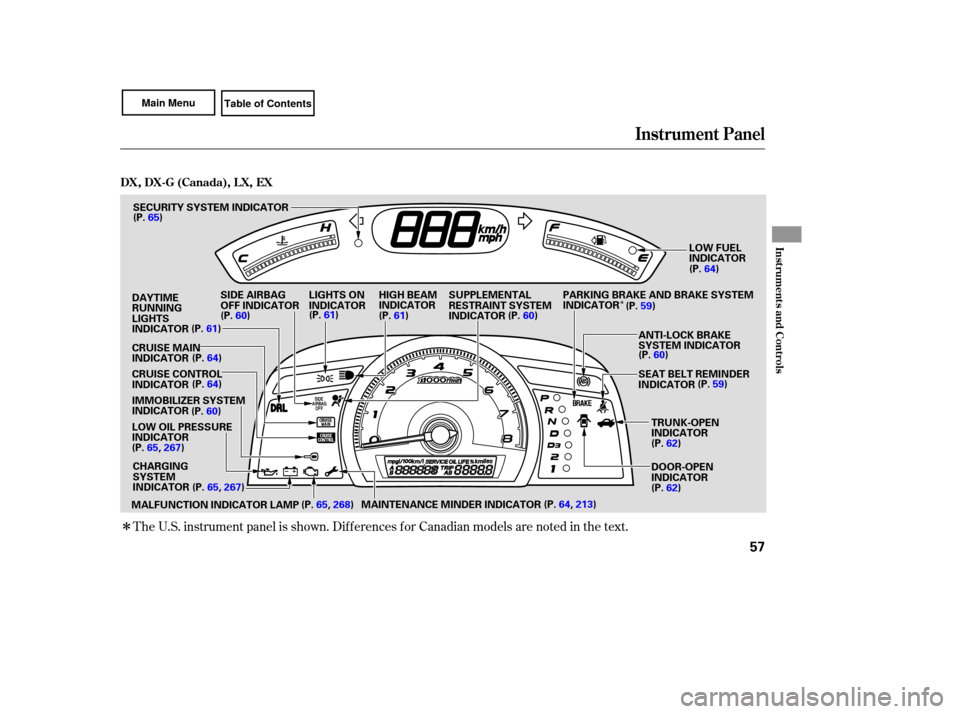
The U.S. instrument panel is shown. Differences for Canadian models are noted in the text.
Instrument Panel
Instrument sand Cont ro ls
DX, DX-G (Canada), LX,EX
57
IMMOBILIZER SYSTEM
INDICATOR
LOW OIL PRESSURE
INDICATOR SEAT
BELT REMINDER
INDICATOR
MAINTENANCE MINDER INDICATOR
SUPPLEMENTAL
RESTRAINT
SYSTEM
INDICATOR
LIGHTS
ON
INDICATOR
CRUISE CONTROL
INDICATOR CRUISE MAIN
INDICATOR SECURITY
SYSTEM INDICATOR
LOW FUEL
INDICATOR
SIDE AIRBAG
OFF INDICATOR
DOOR-OPEN
INDICATOR TRUNK-OPEN
INDICATOR
ANTI-LOCK
BRAKE
SYSTEM INDICATOR
HIGH
BEAM
INDICATOR
(P. 62)
(P. 62)
DAYTIME
RUNNING
LIGHTS
INDICATOR
(P.
65)
(P. 60) (P.
61)
(P. 61) (P. 60) (P.
64)
(P. 60)
(P. 59)
(P.
61)
(P. 64)
(P. 64)
(P. 60)
(P. 65, 267)
(P. 65, 267)
(P. 64, 213)
CHARGING
SYSTEM
INDICATOR
MALFUNCTION INDICATOR LAMP (P.
65, 268) PARKING
BRAKE AND BRAKE SYSTEM
INDICATOR (P. 59)
Page 61 of 311
�Î
�Î�Î
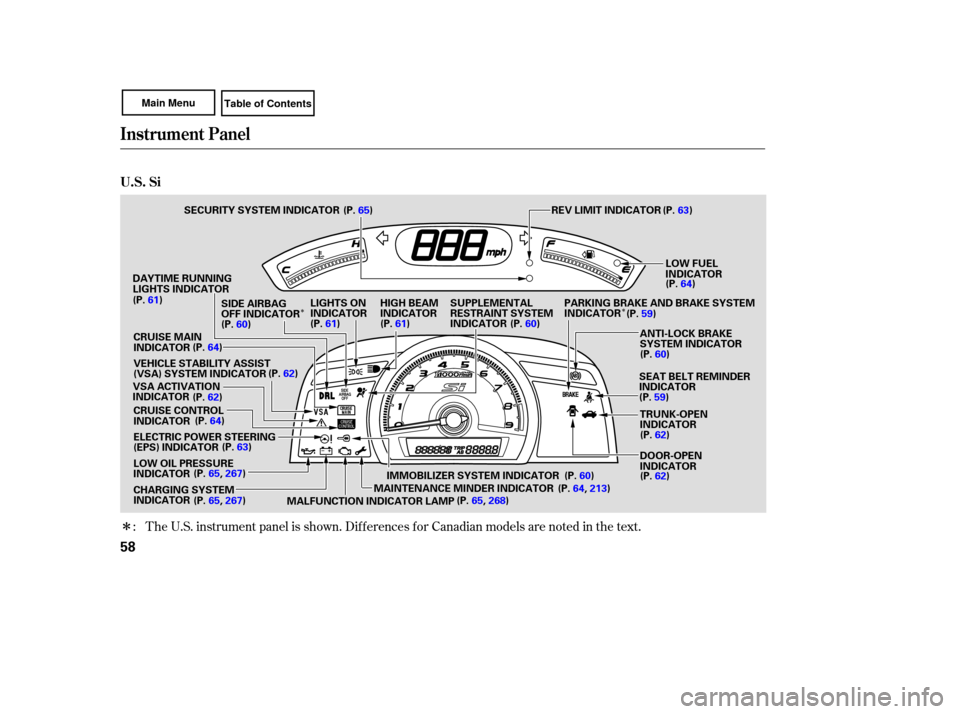
The
U.S. instrument panel is shown. Differences for Canadian models are noted in the text.
:
Instrument Panel
U.S. Si
58
LOW OIL PRESSURE
INDICATOR SECURITY
SYSTEM INDICATOR
LOW FUEL
INDICATOR
SEAT BELT REMINDER
INDICATOR
IMMOBILIZER SYSTEM INDICATOR
LIGHTS
ON
INDICATOR SUPPLEMENTAL
RESTRAINT
SYSTEM
INDICATOR
SIDE
AIRBAG
OFF INDICATOR
CRUISE CONTROL
INDICATOR
ELECTRIC POWER STEERING
(EPS) INDICATOR
CRUISE
MAIN
INDICATOR HIGH
BEAM
INDICATOR
CHARGING SYSTEM
INDICATOR ANTI-LOCK
BRAKE
SYSTEM INDICATOR
DOOR-OPEN
INDICATOR TRUNK-OPEN
INDICATOR
REV
LIMIT INDICATOR
(P. 61)
(P. 61) PARKING
BRAKE AND BRAKE SYSTEM
INDICATOR
MAINTENANCE MINDER INDICATOR
DAYTIME
RUNNING
LIGHTS INDICATOR
VSA ACTIVATION
INDICATOR VEHICLE
STABILITY ASSIST
(VSA) SYSTEM INDICATOR (P.
65)
(P. 60) (P.
61) (P. 60) (P.
59)
(P. 60)(P.
64)
(P.
63)
(P. 62)
(P. 62)
(P. 64)
(P. 63)
(P. 65, 267)
(P. 65, 267) (P.
60)
(P. 64, 213) (P.
62)
(P.
62)
(P.
59)
(P.
64)
MALFUNCTION INDICATOR LAMP (P.
65, 268)
Page 68 of 311
This indicator comes on when the
security system is set. See page
for more information on the
security system. The
engine can be severely damaged
if this indicator flashes or stays on
when the engine is running. For
more information, see page .
If this indicator comes on when the
engine is running, the battery is not
being charged. For more information,
see page .
See
page .
268
267
267
170
If equipped
Security System Indicator Malf unction Indicator
Lamp
L ow Oil Pressure
Indicator
Charging System
Indicator
Instrument Panel Indicators
Inst rument s and Cont rols
65
SECURITY SYSTEM INDICATOR
Page 78 of 311
Make sure you have securely
locked the steering wheel in place
by trying to move it up, down, in,
and out. Push the lever up to lock the
steering wheel in position.
Push the lever under the steering
column all the way down.
Move the steering wheel up or
down, and in or out, so it points
toward your chest, not toward
your f ace. Make sure you can see
the instrument panel gauges and
indicators.
Make any steering wheel adjustment
bef ore you start driving.
1.4.
2. 3.
Steering Wheel A djustment
Inst rument s and Cont rols
75
Adjusting the steering wheel
position while driving may
cause you to lose control of the
vehicle and be seriously injured
inacrash.
Adjust the steering wheel only
when the vehicle is stopped.