2007 GMC CANYON weight
[x] Cancel search: weightPage 287 of 492

The Tire and Loading Information label shows the
number of occupant seating positions (A), and the
maximum vehicle capacity weight (B) in kilograms
and pounds.
The Tire and Loading Information label also shows
the size of the original equipment tires (C) and
the recommended cold tire ination pressures (D).
For more information on tires and ination see
Tires on page 369andInation - Tire Pressure
on page 377.
There is also important information on the
Certication/Tire label. It tells you the Gross Vehicle
Weight Rating (GVWR) and the Gross Axle Weight
Rating (GAWR) for the front and rear axles. See
“Certication/Tire Label” later in this section.
Steps for Determining Correct Load Limit
1. Locate the statement “The combined weight
of occupants and cargo should never exceed
XXX kg or XXX lbs” on your vehicle’s placard.
2. Determine the combined weight of the driver
and passengers that will be riding in your
vehicle.3. Subtract the combined weight of the driver
and passengers from XXX kg or XXX lbs.
4. The resulting gure equals the available
amount of cargo and luggage load capacity.
For example, if the “XXX” amount equals
1400 lbs and there will be ve 150 lb
passengers in your vehicle, the amount of
available cargo and luggage load capacity
is 650 lbs (1400−750 (5 x 150) = 650 lbs).
5. Determine the combined weight of luggage
and cargo being loaded on the vehicle. That
weight may not safely exceed the available
cargo and luggage load capacity calculated
in Step 4.
6. If your vehicle will be towing a trailer, the load
from your trailer will be transferred to your
vehicle. Consult this manual to determine how
this reduces the available cargo and luggage
load capacity of your vehicle.
SeeTowing a Trailer on page 300for important
information on towing a trailer, towing safety,
and trailering tips.
287
Page 288 of 492
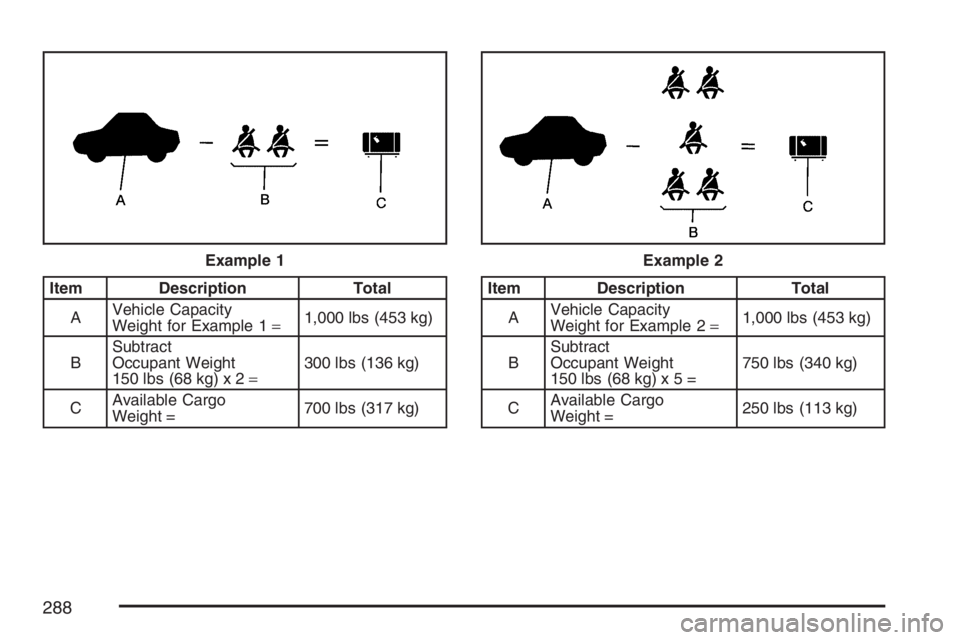
Item Description Total
AVehicle Capacity
Weight for Example 1=1,000 lbs (453 kg)
BSubtract
Occupant Weight
150 lbs (68 kg) x 2=300 lbs (136 kg)
CAvailable Cargo
Weight =700 lbs (317 kg)Item Description Total
AVehicle Capacity
Weight for Example 2=1,000 lbs (453 kg)
BSubtract
Occupant Weight
150 lbs (68 kg) x 5 =750 lbs (340 kg)
CAvailable Cargo
Weight =250 lbs (113 kg) Example 1
Example 2
288
Page 289 of 492

Item Description Total
AVehicle Capacity
Weight for Example 3=1,000 lbs (453 kg)
BSubtract
Occupant Weight
200 lbs (91 kg) x 5 =1,000 lbs (453 kg)
CAvailable Cargo
Weight =0 lbs (0 kg)
Refer to your vehicle’s Tire and Loading Information
label for specic information about your vehicle’s
capacity weight and seating positions. The
combined weight of the driver, passengers, cargo,
and any accessories or equipment added to your
vehicle after it left the factory should never exceed
your vehicle’s capacity weight.
Certication/Tire Label
A vehicle specic Certication/Tire label is attached
to the bottom section of the center pillar, on the
driver’s side of the vehicle. Vehicles without a
center pillar, like extended cab models, will have
the Certication/Tire label attached to the edge of
the driver’s side, extended cab door, below the door
latch post. The label shows the Gross Vehicle
Weight Rating (GVWR). The GVWR includes the
weight of the vehicle, all occupants, fuel, cargo, and
trailer tongue weight, if pulling a trailer.
Example 3
Label Example
289
Page 290 of 492

The Certication/Tire label also tells you the
maximum weights for the front and rear axles,
called Gross Axle Weight Rating (GAWR).
To nd out the actual loads on your front and
rear axles, you need to go to a weigh station and
weigh your vehicle. Your dealer can help you
with this. Be sure to spread out your load equally
on both sides of the centerline.
Never exceed the GVWR for your vehicle, or the
GAWR for either the front or rear axle.
If you do have a heavy load, you should spread
it out.
Similar appearing vehicles may have different
GVWRs and capacity weights. Please note
your vehicle’s Certication/Tire label or consult
your dealer for additional details.
{CAUTION:
Do not load your vehicle any heavier than
the Gross Vehicle Weight Rating (GVWR),
or either the maximum front or rear Gross
Axle Weight Rating (GAWR). If you do,
parts on your vehicle can break, and it
can change the way your vehicle handles.
These could cause you to lose control
and crash. Also, overloading can shorten
the life of your vehicle.
Using heavier suspension components to get
added durability might not change your weight
ratings. Ask your dealer to help you load
your vehicle the right way.
Notice:Overloading your vehicle may cause
damage. Repairs would not be covered by your
warranty. Do not overload your vehicle.
If you put things inside your vehicle — like
suitcases, tools, packages, or anything
else — they will go as fast as the vehicle goes.
If you have to stop or turn quickly, or if there
is a crash, they will keep going.
290
Page 291 of 492

{CAUTION:
Things you put inside your vehicle can
strike and injure people in a sudden stop
or turn, or in a crash.
Put things in the cargo area of your
vehicle. Try to spread the weight
evenly.
Never stack heavier things, like
suitcases, inside the vehicle so that
some of them are above the tops of
the seats.
Do not leave an unsecured child
restraint in your vehicle.
When you carry something inside the
vehicle, secure it whenever you can.
Do not leave a seat folded down
unless you need to.
There is also important loading information for
off-road driving in this manual. See“Loading Your
Vehicle for Off-Road Driving”underOff-Road
Driving on page 256.
Remember not to exceed the Gross Axle Weight
rating (GAWR) of the front or rear axle.
Two-Tiered Loading
By positioning four 2” X 6” wooden planks across
the width of the pickup box, you can create an
upper load platform. The planks must be inserted
in the pickup box depressions. The length of
the planks must allow for at least a 3/4 inch (2 cm)
bearing surface on each end of the plank.
When using this upper load platform, be sure the
load is securely tied down to prevent it from
shifting. The load’s center of gravity should be
positioned in a zone over the rear axle.
Any load that extends beyond the vehicle’s
taillamp area must be properly marked according
to local laws and regulations.
Remember not to exceed the Gross Axle Weight
Rating (GAWR) of the rear axle.
291
Page 292 of 492
Add-On Equipment
When you carry removable items, you may need
to put a limit on how many people you carry
inside your vehicle. Be sure to weigh your vehicle
before you buy and install the new equipment.
Notice:Overloading your vehicle may cause
damage. Repairs would not be covered by your
warranty. Do not overload your vehicle.
Remember not to exceed the Gross Axle Weight
Rating (GAWR) of the rear axle.
A reinforcement kit for mounting a toolbox is
recommended. See your dealer.
Truck-Camper Loading Information
Your vehicle was not designed to carry a
slide-in camper.
Pickup Conversion to Chassis Cab
General Motors is aware that some vehicle
owners may consider having the pickup box
removed and a commercial or recreational
body installed. However, we recommend that
conversions of this type not be done to pickups.
Owners should be aware that, as manufactured,
there are differences between a chassis cab and a
pickup with the box removed which may affect
vehicle safety.
Towing
Towing Your Vehicle
Consult your dealer or a professional towing service
if you need to have your disabled vehicle towed.
SeeRoadside Assistance Program on page 462.
If you want to tow your vehicle behind another
vehicle for recreational purposes (such as behind a
motorhome), see “Recreational Vehicle Towing”
following.
292
Page 300 of 492
7. Turn the ignition to LOCK.
If the tow vehicle will not be started or driven
for six weeks or more, remove the battery
cable from the negative terminal (post) of the
battery to prevent your battery from draining
while towing.
After towing, see “Shifting Out of NEUTRAL”
underFour-Wheel Drive on page 126.
Towing a Trailer
{CAUTION:
If you do not use the correct equipment
and drive properly, you can lose control
when you pull a trailer. For example, if the
trailer is too heavy, the brakes may not
work well — or even at all. You and your
passengers could be seriously injured.
Pull a trailer only if you have followed all
the steps in this section. Ask your dealer
for advice and information about towing
a trailer with your vehicle.Notice:Pulling a trailer improperly can
damage your vehicle and result in costly
repairs that would not be covered by your
warranty. Always follow the instructions in this
section and check with your dealer for more
information about towing a trailer with
your vehicle.
To identify the trailering capacity of your vehicle,
you should read the information in “Weight of
the Trailer” that appears later in this section.
Trailering is different than just driving your vehicle
by itself. Trailering means changes in handling,
acceleration, braking, durability and fuel economy.
Successful, safe trailering takes correct
equipment, and it has to be used properly.
That’s the reason for this part. In it are many
time-tested, important trailering tips and safety
rules. Many of these are important for your safety
and that of your passengers. So please read
this section carefully before you pull a trailer.
300
Page 301 of 492
If You Do Decide To Pull A Trailer
If you do, here are some important points:
There are many different laws, including speed
limit restrictions, having to do with trailering.
Make sure your rig will be legal, not only where
you live but also where you’ll be driving. A good
source for this information can be state or
provincial police.
Consider using a sway control. You can ask a
hitch dealer about sway controls.
Don’t tow a trailer at all during the rst 500 miles
(800 km) your new vehicle is driven. Your
engine, axle or other parts could be damaged.
Then, during the rst 500 miles (800 km) that
you tow a trailer, don’t drive over 50 mph
(80 km/h) and don’t make starts at full throttle.
This helps your engine and other parts of your
vehicle wear in at the heavier loads.
You may want to shift the transmission to
THIRD (3) or, if necessary, a lower gear
selection if the transmission shifts too often
(e.g., under heavy loads and/or hilly
conditions). If you have a manual transmission
and you are towing a trailer, it’s better not to
use the highest gear.Three important considerations have to do with
weight:
the weight of the trailer,
the weight of the trailer tongue
and the weight on your vehicle’s tires.
Weight of the Trailer
How heavy can a trailer safely be?
It depends on how you plan to use your rig.
For example, speed, altitude, road grades, outside
temperature and how much your vehicle is used
to pull a trailer are all important. It can also depend
on any special equipment that you have on your
vehicle, and the amount of tongue weight the
vehicle can carry. See “Weight of the Trailer
Tongue” later in this section for more information.
Maximum trailer weight is calculated assuming
only the driver is in the tow vehicle and it has all
the required trailering equipment. The weight
of additional optional equipment, passengers and
cargo in the tow vehicle must be subtracted
from the maximum trailer weight.
301