Page 199 of 554

The indicator on the inner outlet face will come on
when 115 volt AC power is available. The AC
power is available when the ignition is turned to
ACCESSORY or ON, and electrical equipment
is plugged into the outlet. The AC power is
not available in the outlet when the ignition is
turned to OFF.
The power outlet is not designed for the following
electrical equipment and may not work properly
if these items are plugged into the power outlet:
Equipment with high initial peak wattage
such as: compressor-driven refrigerators
and electric power tools.
Other equipment requiring an extremely
stable power supply such as:
microcomputer-controlled electric blankets,
touch sensor lamps, etc.
SeeHigh Voltage Devices and Wiring on
page 489.
Climate Controls
Climate Control System
With this system you can control the heating,
cooling, defrost, defog, and ventilation of
the vehicle.
Manual Operation
9
(Fan):Turn the left knob clockwise or
counterclockwise to increase or decrease the fan
speed. Turn the knob all the way counterclockwise
to turn the front system off.
199
Page 218 of 554

If the airbag readiness light stays on after you
start the vehicle or comes on when you are driving,
your airbag system may not work properly.
Have your vehicle serviced right away.
{CAUTION:
If the airbag readiness light stays on after
you start your vehicle, it means the airbag
system may not be working properly. The
airbags in your vehicle may not inate in
a crash, or they could even inate without
a crash. To help avoid injury to yourself
or others, have your vehicle serviced right
away if the airbag readiness light stays
on after you start your vehicle.
The airbag readiness light should ash for a
few seconds when you turn the ignition key to ON.
If the light does not come on then, have it xed
so it will be ready to warn you if there is a problem.
Passenger Airbag Status Indicator
Your vehicle has the passenger sensing system.
Your instrument panel has a passenger airbag
status indicator.
When you start the vehicle, the passenger airbag
status indicator will light ON and OFF, or the
symbol for on and off, for several seconds as a
system check. If you use remote start to start your
vehicle from a distance, if your vehicle has this
feature, you may not see the system check. Then,
after several more seconds, the status indicator
will light either ON or OFF, or either the on
or off symbol to let you know the status of the
right front passenger’s frontal and seat-mounted
side impact airbags.
United StatesCanada
218
Page 220 of 554

If, after several seconds, both status indicator
lights remain on, or if there are no lights at
all, there may be a problem with the lights
or the passenger sensing system. See your
dealer/retailer for service.
{CAUTION:
If the airbag readiness light in the
instrument panel cluster ever comes on
and stays on, it means that something may
be wrong with the airbag system. If this
ever happens, have the vehicle serviced
promptly, because an adult-size person
sitting in the right front passenger’s
seat may not have the protection of the
airbag(s). SeeAirbag Readiness Light
on page 217for more on this, including
important safety information.
Charging System Light
The charging system
light will come on briey
when you turn on the
ignition, but the engine is
not running, as a check
to show you it is working.
It should go out once the engine is running. If it
stays on, or comes on while you are driving, you
may have a problem with the charging system.
It could indicate that you have problems with a
generator drive belt, or another electrical problem.
Have it checked right away. Driving while this light
is on could drain your battery.
When this light comes on, the Driver Information
Center (DIC) will also display the SERVICE
BATTERY CHARGING SYSTEM message. See
DIC Warnings and Messages on page 244for more
information.
If you must drive a short distance with the light on,
be certain to turn off all your accessories, such as
the radio and air conditioner.
220
Page 221 of 554

Voltmeter Gage
When the engine is
not running, but the
ignition is turned to ON,
this gage shows the
battery’s state of charge
in DC volts.
When the engine is running, this gage shows the
condition of the charging system. The vehicle’s
charging system regulates voltage based on
the state of charge of the battery. The voltmeter
may uctuate. This is normal. Readings between
the low and high warning zones indicate the
normal operating range.Readings in the low warning zone may occur
when a large number of electrical accessories
are operating in the vehicle and the engine is
left idling for an extended period.
If there is a problem with the battery charging
system, a SERVICE BATTERY CHARGING
SYSTEM message will appear in the Driver
Information Center (DIC) and/or the charging
system light will come on. SeeDIC Warnings and
Messages on page 244andCharging System
Light on page 220for more information.
However, readings in either warning zone may
indicate a possible problem in the electrical
system. Have the vehicle serviced as soon
as possible.
221
Page 222 of 554
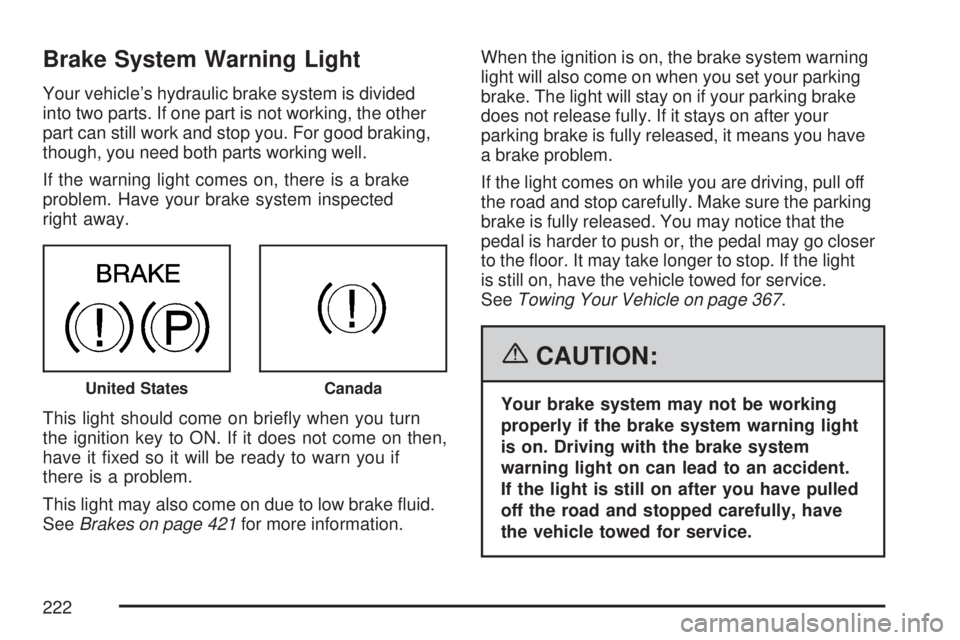
Brake System Warning Light
Your vehicle’s hydraulic brake system is divided
into two parts. If one part is not working, the other
part can still work and stop you. For good braking,
though, you need both parts working well.
If the warning light comes on, there is a brake
problem. Have your brake system inspected
right away.
This light should come on briey when you turn
the ignition key to ON. If it does not come on then,
have it xed so it will be ready to warn you if
there is a problem.
This light may also come on due to low brake uid.
SeeBrakes on page 421for more information.When the ignition is on, the brake system warning
light will also come on when you set your parking
brake. The light will stay on if your parking brake
does not release fully. If it stays on after your
parking brake is fully released, it means you have
a brake problem.
If the light comes on while you are driving, pull off
the road and stop carefully. Make sure the parking
brake is fully released. You may notice that the
pedal is harder to push or, the pedal may go closer
to the oor. It may take longer to stop. If the light
is still on, have the vehicle towed for service.
SeeTowing Your Vehicle on page 367.
{CAUTION:
Your brake system may not be working
properly if the brake system warning light
is on. Driving with the brake system
warning light on can lead to an accident.
If the light is still on after you have pulled
off the road and stopped carefully, have
the vehicle towed for service.United StatesCanada
222
Page 223 of 554

Anti-Lock Brake System
Warning Light
Your vehicle has the Anti-Lock Brake System (ABS).
This light will come on
when your engine is
started and may stay
on for several seconds.
This is normal.
If the light stays on, turn the ignition to off.
If the light comes on and the chime sounds
when you are driving, pull your vehicle over to a
safe location and stop as soon as possible.Turn the ignition off. Then start the engine again
to reset the system. If the light still stays on,
or comes on again while you are driving, your
vehicle needs service. If the regular brake
system warning light is not on, you still have
brakes, but you do not have anti-lock brakes.
If the regular brake system warning light is also
on, you do not have anti-lock brakes and there
is a problem with your regular brakes. SeeBrake
System Warning Light on page 222earlier in
this section.
The ABS warning light will come on briey when
you turn the ignition key to ON. This is normal.
If the light does not come on then, have it xed so
it will be ready to warn you if there is a problem.
223
Page 225 of 554

Engine Coolant Temperature Gage
This gage shows the engine coolant temperature.
Under normal driving conditions the gage will
read 210°F (100 °C) or less. If the gage pointer
is near 260°F (125 °C), the engine is too hot.
It means that your engine coolant has overheated.
If you have been operating your vehicle under
normal driving conditions, you should pull off the
road, stop your vehicle and turn off the engine
as soon as possible.
SeeEngine Overheating on page 410for more
information.
Tire Pressure Light
This light comes on
briey when you turn
the ignition to ON.
It will also come on when one or more of your
tires are signicantly underinated.
A CHECK TIRE PRESSURE Driver Information
Center (DIC) message will accompany the light.
SeeDIC Warnings and Messages on page 244
for more information.
Stop and check your tires as soon as it is safe to do
so. If underinated, inate to the proper pressure.
SeeTires on page 435for more information.
This light will ash for about 70 seconds and then
stay on if a problem is detected with the Tire
Pressure Monitor system.
SeeTire Pressure Monitor System on page 444
for more information.
United StatesCanada
225
Page 226 of 554

Malfunction Indicator Lamp
Check Engine Light
Your vehicle has a
computer which
monitors operation
of the fuel, ignition,
and emission control
systems.
This system is called OBD II (On-Board
Diagnostics-Second Generation) and is intended
to make sure that emissions are at acceptable
levels for the life of the vehicle, helping to produce
a cleaner environment. The check engine light
comes on to indicate that there is a problem and
service is required. Malfunctions often will be
indicated by the system before any problem is
apparent. This can prevent more serious damage
to your vehicle. This system is also designed
to assist your service technician in correctly
diagnosing any malfunction.Notice:If you keep driving your vehicle with
this light on, after awhile, the emission controls
might not work as well, your vehicle’s fuel
economy might not be as good, and the engine
might not run as smoothly. This could lead
to costly repairs that might not be covered
by your warranty.
Notice:Modications made to the engine,
transmission, exhaust, intake, or fuel system
of your vehicle or the replacement of the
original tires with other than those of the same
Tire Performance Criteria (TPC) can affect
your vehicle’s emission controls and can cause
this light to come on. Modications to these
systems could lead to costly repairs not
covered by your warranty. This could also
result in a failure to pass a required Emission
Inspection/Maintenance test. SeeAccessories
and Modifications on page 385.
226