Page 27 of 72
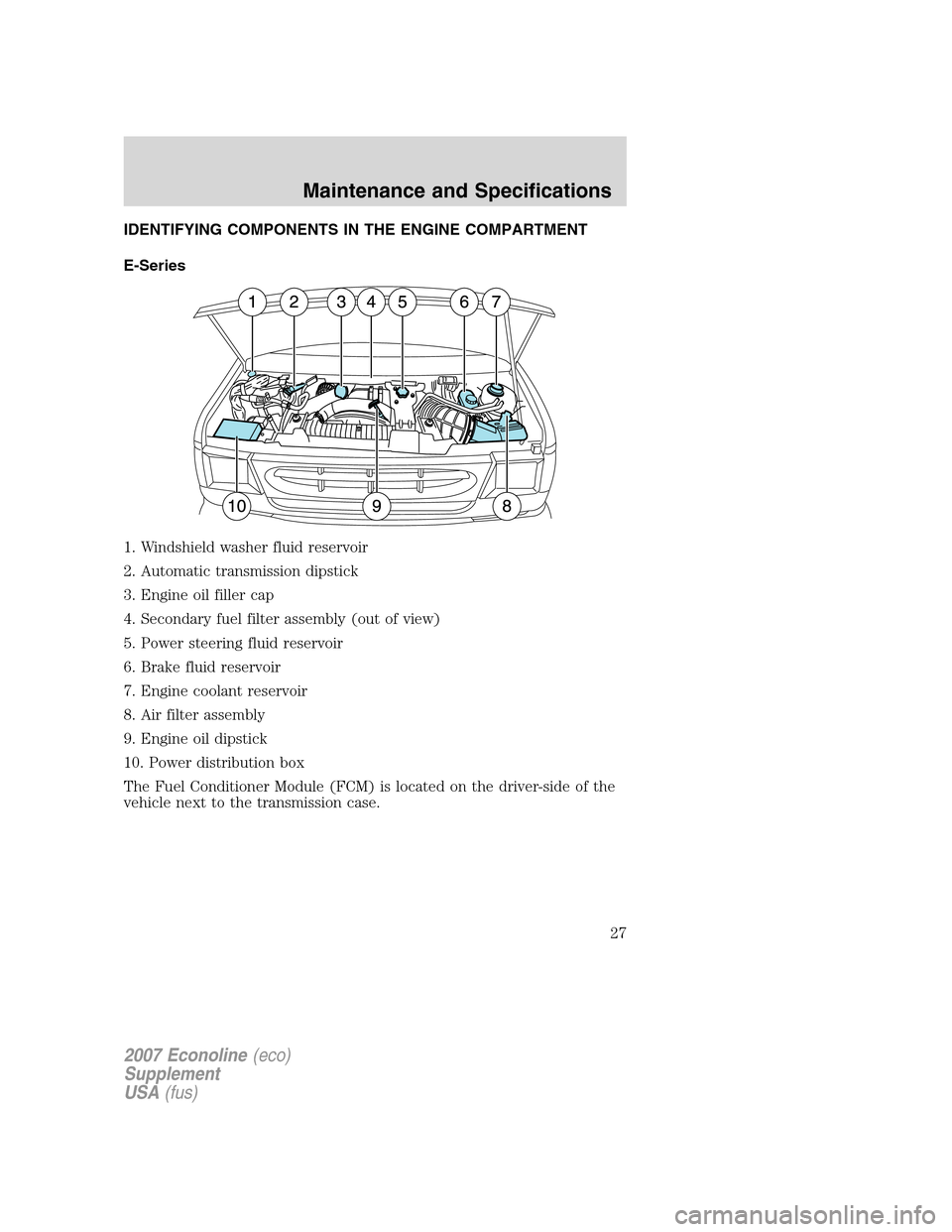
IDENTIFYING COMPONENTS IN THE ENGINE COMPARTMENT
E-Series
1. Windshield washer fluid reservoir
2. Automatic transmission dipstick
3. Engine oil filler cap
4. Secondary fuel filter assembly (out of view)
5. Power steering fluid reservoir
6. Brake fluid reservoir
7. Engine coolant reservoir
8. Air filter assembly
9. Engine oil dipstick
10. Power distribution box
The Fuel Conditioner Module (FCM) is located on the driver-side of the
vehicle next to the transmission case.
2007 Econoline(eco)
Supplement
USA(fus)
Maintenance and Specifications
27
Page 30 of 72
Do not use home heating oil or any diesel fuel not intended for
highway use. Red dye is used to identify fuels intended for
agricultural and non-highway use. Damage to the fuel injection
system, engine and exhaust catalyst can occur if an improper fuel
is used. Do not add gasoline, gasohol or alcohol to diesel fuel.
This practice creates a serious fire hazard and engine
performance problems.
Fuel Filler Cap
When fueling your vehicle:
1. Turn the engine off.
2. Carefully turn the filler cap counterclockwise until it stops.
3. Pull to remove the cap from the fuel filler pipe.
4. To install the cap, align the tabs on the cap with the notches on the
filler pipe.
5. Turn the filler cap clockwise until a few clicks are heard.
If the “Check Fuel Cap” message comes on and stays on after you start
the engine, the fuel filler cap may not be properly installed. Turn off the
engine, remove the fuel filler cap, align the cap properly and reinstall it.
If you must replace the fuel filler cap, replace it with a fuel filler
cap that is designed for your vehicle. The customer warranty may
be void for any damage to the fuel tank or fuel system if the
correct genuine Ford or Motorcraft fuel filler cap is not used.
The fuel system may be under pressure. If the fuel filler cap is
venting vapor or if you hear a hissing sound, wait until it stops
before completely removing the fuel filler cap. Otherwise, fuel may
spray out and injure you or others.
If you do not use the proper fuel filler cap, excessive pressure or
vacuum in the fuel tank may damage the fuel system or cause
the fuel cap to disengage in a collision, which may result in possible
personal injury.
Fuel quality
It should not be necessary to add any aftermarket additives to your fuel
tank if you use a properly formulated diesel fuel that meets the ASTM D
975 industry specification. Aftermarket additives can damage the injector
system or engine. Repairs to correct the effects of using an aftermarket
product in your fuel may not be covered by your warranty.
2007 Econoline (eco)
Supplement
USA (fus)
Maintenance and Specifications
30
Page 34 of 72
3. Remove the drain plug, using a 6mm hex drive, by turning it
counterclockwise. Allow the HFCM to drain for approximately 25 seconds
or until clean fuel is observed. Install the drain plug by turning it
clockwise until it is firmly seated.
4. Verify that the drain plug is closed and sealed, then remove the
container from under the vehicle.
5. Restart the engine and check WATER IN FUEL indicator light; it
should not be illuminated. If it continues to illuminate, have the fuel
system checked and repaired.
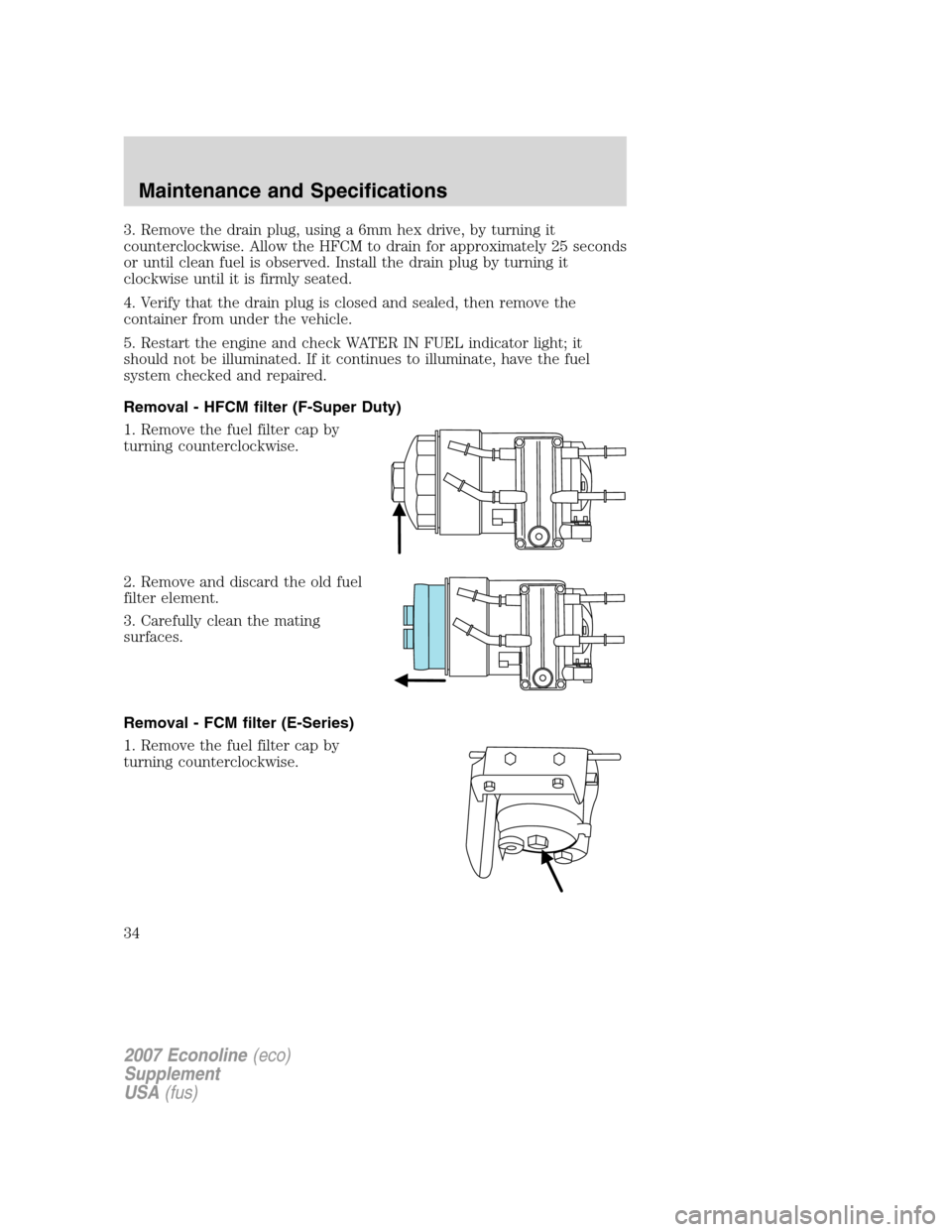
Removal - HFCM filter (F-Super Duty)
1. Remove the fuel filter cap by
turning counterclockwise.
2. Remove and discard the old fuel
filter element.
3. Carefully clean the mating
surfaces.
Removal - FCM filter (E-Series)
1. Remove the fuel filter cap by
turning counterclockwise.
2007 Econoline(eco)
Supplement
USA(fus)
Maintenance and Specifications
34
Page 35 of 72
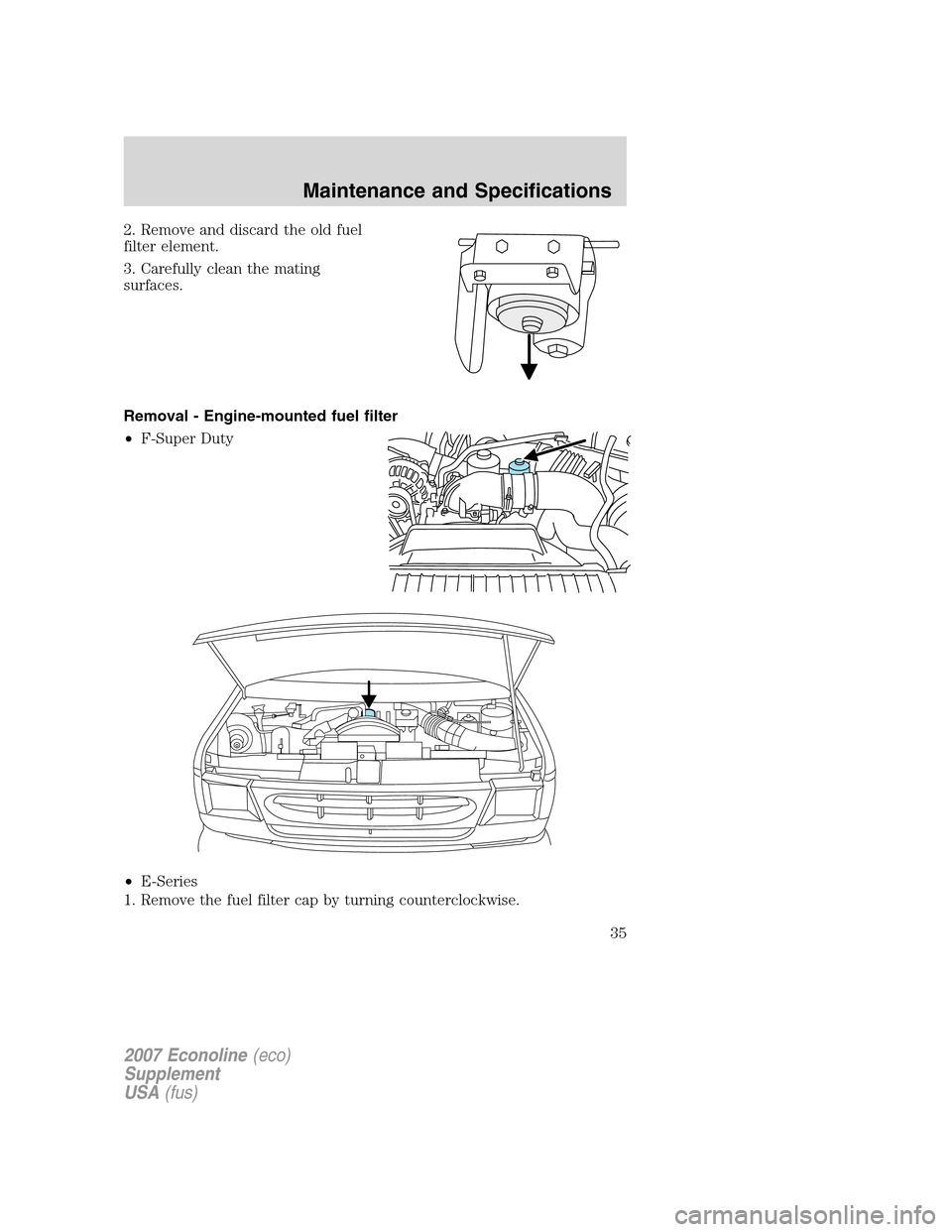
2. Remove and discard the old fuel
filter element.
3. Carefully clean the mating
surfaces.
Removal - Engine-mounted fuel filter
•F-Super Duty
•E-Series
1. Remove the fuel filter cap by turning counterclockwise.
2007 Econoline(eco)
Supplement
USA(fus)
Maintenance and Specifications
35
Page 36 of 72
2. Remove and discard the old fuel filter element.
3. Carefully clean the mating surfaces.
Installation - both
The engine will not run properly if the fuel filter is not installed
in housing.
1. Install the new fuel filter and cap seal (Motorcraft Part No. FD-4604,
F-Series and FD-4606, E-Series) into the fuel filter housing.
2. Tighten cap onto fuel filter housing slowly, allowing fuel to soak into
the fuel filter element. Tighten cap until it contacts the housing.
After replacing the fuel filter, the engine will purge the trapped
air as it runs. The engine may run roughly and smoke until the air
is completely eliminated.
Using a fuel which has more than average impurities may require
the fuel filter to be replaced more frequently than the service
interval specifies.
ENGINE OIL
Checking the engine oil level
Because it is normal to add some oil between oil changes, check your
engine oil level each time you stop for fuel. To check the engine oil level
consistently and accurately, the following procedure is recommended:
1. Have engine at normal operating temperature (at least into the
NORMAL range on the engine coolant temperature gauge).
2. Park the vehicle on a level surface, then turn off the engine and open
the hood.
3. Allow at least20 minutesafter engine shutdown to ensure that the
oil contained in the upper parts of the engine has returned to the oil
pan.
4. Protecting yourself from engine heat, pull out the dipstick, wipe it
clean and reinsert fully.
5. Read oil level on both sides of dipstick and use highest level (reading)
for the actual engine oil level.
6. Maintain the oil level between MIN and MAX or the ADD and
OPERATING RANGE on the dipstick by adding oil as required. The
distance from MIN to MAX or ADD to OPERATING RANGE on the
dipstick represents 2.0 quarts (1.9L). Do not overfill. If the oil level
exceeds MAX or OPERATING RANGE, oil consumption may result.
2007 Econoline(eco)
Supplement
USA(fus)
Maintenance and Specifications
36
Page 38 of 72
Engine oils with improved fuel economy properties (energy conserving)
are currently available. If you use an energy conserving oil, be sure it
meets the recommended Ford Specification,APIservice categories and
SAE viscosity grades listed in theLubricant Specificationschart later
in this chapter. Some energy conserving oilsdo notmeet the
requirements necessary for your diesel engine.
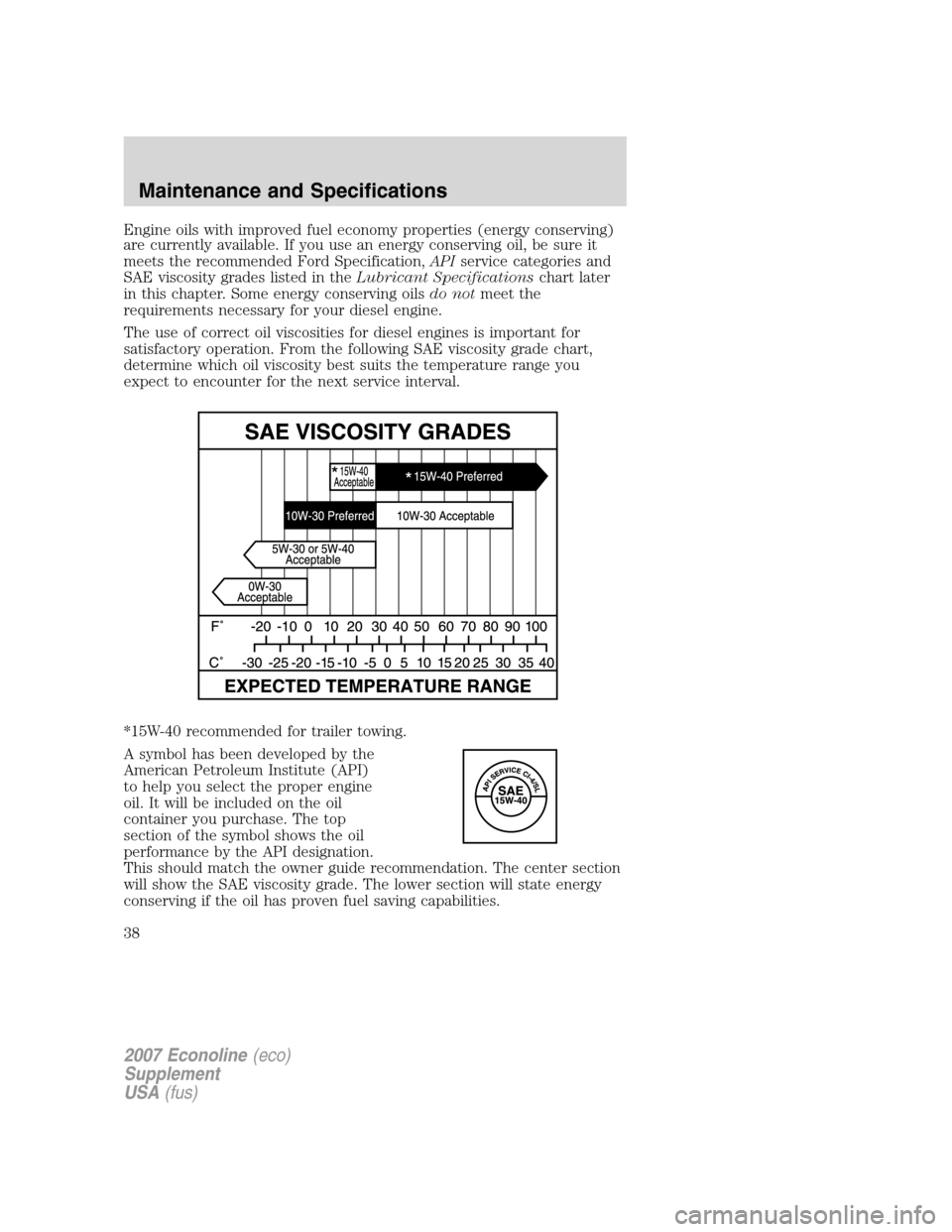
The use of correct oil viscosities for diesel engines is important for
satisfactory operation. From the following SAE viscosity grade chart,
determine which oil viscosity best suits the temperature range you
expect to encounter for the next service interval.
*15W-40 recommended for trailer towing.
A symbol has been developed by the
American Petroleum Institute (API)
to help you select the proper engine
oil. It will be included on the oil
container you purchase. The top
section of the symbol shows the oil
performance by the API designation.
This should match the owner guide recommendation. The center section
will show the SAE viscosity grade. The lower section will state energy
conserving if the oil has proven fuel saving capabilities.
2007 Econoline(eco)
Supplement
USA(fus)
Maintenance and Specifications
38
Page 47 of 72
MOTORCRAFT PART NUMBERS
Item Ford Part Number
Engine oil filter FL-2016
Air Filter – Super Duty
14C3Z-9601-AA
Air Filter – E-series1FA-1804
Fuel filter (2 required) FD-4604
Battery (2 Required) BXT-65-750
1Always use the authorized Motorcraft air filter listed.Failure to use
the correct air filter may result in severe engine damage.
REFILL CAPACITIES
Component Capacity
Cooling system127.5 quarts (26.0L)
Engine oil215.0 quarts (14.2L)
Fuel tankRefer to yourOwner’s
Guide
Radiator cap 16 psi (110 kPa)
Manual transmission
35.8 quarts (5.5L)
Automatic transmissionRefer to yourOwner’s
Guide
1Includes heater and 5.0 quarts (4.7L) in coolant recovery.
2Includes 1 quart (1.0L) in engine oil filter.
3Use Motorcraft MERCON�ATF, Motorcraft part number XT-2–QDX,
meeting Ford specification MERCON�.
2007 Econoline(eco)
Supplement
USA(fus)
Maintenance and Specifications
47