Page 11 of 72

STARTING THE ENGINE
Read all starting instructions carefully before you start your vehicle.
For temperatures below 32°F (0°C), the use of the correct grade engine
oil is essential for proper operation.
If your vehicle is equipped with a manual transmission,make sure
the parking brake is set fully before you turn the key. Depress the clutch
pedal and place the gearshift in the neutral position. The clutch must be
fully depressed in order to operate the starter. Do not press the
accelerator during starting.
If your vehicle is equipped with an automatic transmission,ensure
the gearshift lever is in P (Park) and the parking brake is set before you
turn the key. Do not press the accelerator during starting.
Cold weather starting
The engine block heater must be used for starting when the temperature
is -20°F (-29°C) or colder. Refer toUsing the engine block heater (if
equipped)in theDrivingchapter of theOwner’s Guide.
When operating in cold weather, use a minimum of 45 Cetane Diesel fuel
or use Cetane Index improvers from a reputable manufacturer.
Do not crank the engine for more than 30 seconds as starter damage
may occur. If the engine fails to start, turn the key to 3 (OFF) and wait
30 seconds before trying again.
Do not use starting fluid, such as ether, in the air intake system
(see air cleaner decal). Such fluid could cause immediate
explosive damage to the engine and possible personal injury.
Do not add gasoline, gasohol or alcohol to diesel fuel. This
practice creates a serious fire hazard and causes engine
performance problems.
2007 Econoline(eco)
Supplement
USA(fus)
Driving
11
Page 28 of 72
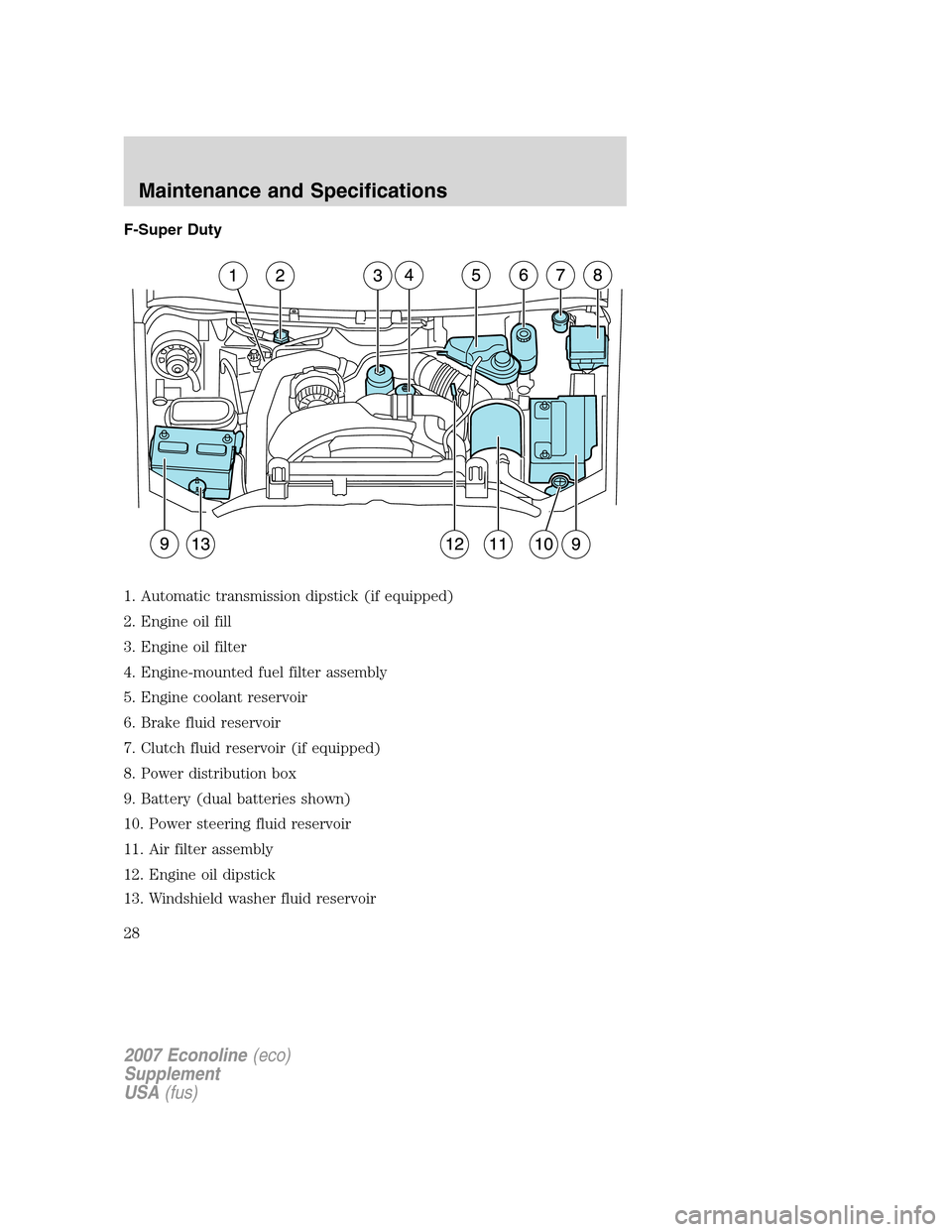
F-Super Duty
1. Automatic transmission dipstick (if equipped)
2. Engine oil fill
3. Engine oil filter
4. Engine-mounted fuel filter assembly
5. Engine coolant reservoir
6. Brake fluid reservoir
7. Clutch fluid reservoir (if equipped)
8. Power distribution box
9. Battery (dual batteries shown)
10. Power steering fluid reservoir
11. Air filter assembly
12. Engine oil dipstick
13. Windshield washer fluid reservoir
2007 Econoline(eco)
Supplement
USA(fus)
Maintenance and Specifications
28
Page 45 of 72
If you fuel your vehicle at a truck stop, you may notice that the fuel
nozzle may shut off every 5–10 seconds. This is due to the flow rates
being designed for larger heavy duty trucks. You may have to fuel at a
slower rate (don’t depress the nozzle trigger fully).
Do not run your diesel vehicle out of fuel as this will allow air to enter
the fuel system which will make restarting difficult. Longer engine
cranking time may be required once air is in the fuel system. If air enters
the fuel system (either through running the fuel tank(s) empty or during
a fuel filter change), the engine will self-purge the trapped air once it
starts running. The engine may run roughly and produce white smoke
while air is in the fuel system; this is normal and should stop after a
short time.
MINOR TROUBLESHOOTING GUIDE
If the engine won’t crank
Turn on the headlights. If the lights are dim, do not go on at all or when
the ignition is turned to 5 (START) the lights become dim or go out, the
battery connections may be loose or corroded, or the battery may be
discharged. If there is a clicking or stuttering sound coming from the
engine compartment when you turn the key to 5 (START), this may also
indicate a loose or corroded battery connection.
Check the battery connections at the battery posts, cable connection to
the engine grounding point and at the starter connection.
If a discharged battery is suspected, have it checked and corrected.
Battery posts, terminals and related accessories contain lead and
lead compounds.Wash hands after handling.
•For vehicles with manual transmissions,the clutch pedalmustbe
fully depressed in order for the starter to operate.
•For vehicles with automatic transmissions,the gearshift lever
must be in P (Park) or N (Neutral) in order for the starter to operate.
•Try operating the starter switch several times. Should the switch be
corroded, this operation may clean the contacts or make the switch
temporarily operable until you can reach the dealer.
•If all electrical connections are tight and you need assistance to start,
refer toJump startingin theRoadside Emergencieschapter of your
Owner’s Guide(F-Super Duty ) or refer to theJump starting
section in theRoadside Emergencieschapter of this supplement
(E-Series).
2007 Econoline(eco)
Supplement
USA(fus)
Maintenance and Specifications
45
Page 53 of 72
Maximum oil change interval
❑Normal schedule: 7,500 miles (12,000 km) or 6 months, whichever occurs first.❑Special Operating Conditions: 5,000 miles (8,000 km), 6 months or 200 hours of engine operation, see appropriate sched-
ule.
Motorcraft Premium Gold Engine Coolant change interval
❑6 years or 105,000 miles (170,000 km) - change Motorcraft Premium Gold Engine Coolant (whichever comes first)❑After initial change - change Motorcraft Premium Gold Engine Coolant every 3 years or 45,000 miles (72,000 km)
Check every month
❑Check function of all interior and exterior lights❑Check tires for wear and adjust air pressure (including spare tire)
❑Check engine oil level
❑Check windshield washer fluid level
❑Check and drain fuel filter/water separator
Check every six months
❑Check lap/shoulder belts and seat latches for wear and function❑Check that externally-mounted spare tire is tight (seeOwner’s Guide)
❑Check power steering fluid level
❑Check washer spray, wiper operation and clean all wiper blades (replace as necessary)
❑Check parking brake for proper operation
❑Check and lubricate all hinges, latches and outside locks
❑Check and lubricate door rubber weatherstrips
❑Check and clean body and door drain holes
❑Check safety warning lamps (brake, ABS, air bag, safety belt) for operation
❑Check cooling system fluid level and coolant strength
❑Check battery connections and clean if necessary
❑Check clutch fluid level, if equipped
Retightening lug nuts
❑On vehicles equipped with single rear wheels, retighten the lug nuts to the specified torque at 500 miles (800 km) after
any wheel disturbance (tire rotation, changing a flat tire, wheel removal, etc.).
❑On vehicles equipped with dual rear wheels, retighten the wheel lug nuts to the specified torque at 100 miles (160 km),
and again at 500 miles (800 km) of new vehicle operation and after any wheel disturbance (tire rotation, changing a flat
tire, wheel removal, etc.).
❑Refer toWheel Lug Nut Torque Specificationin yourOwner’s Guidefor the proper lug nut torque specification.
2007 Econoline(eco)
Supplement
USA(fus)
Scheduled Maintenance Guide
53