2007 FORD FIESTA hose
[x] Cancel search: hosePage 917 of 1226
303-1 2-1 3 Intake Air Distribution and Filtering 303-1 2-1 3
REMOVAL AND INSTALLATION
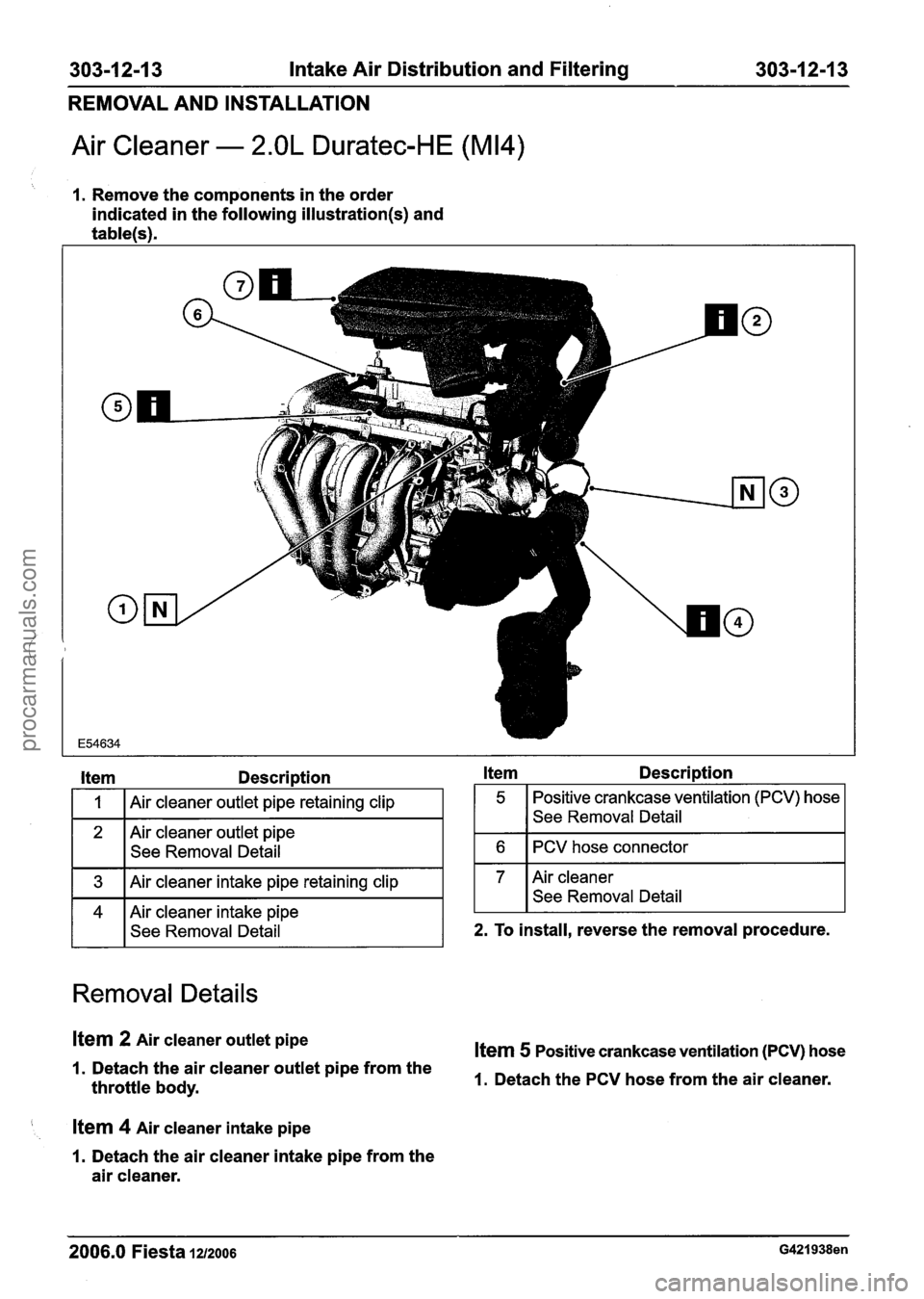
Air Cleaner - 2.OL Duratec-HE (M14)
I. Remove the components in the order
indicated in the following
illustration(s) and
ta
ble(s).
Removal Details
Item Description Item Description
Item 2 Air cleaner outlet pipe Ifem 5 Positive crankcase ventilation (PCV) hose
I
2
3
I. Detach the air cleaner outlet pipe from the
throttle body. 1. Detach the PCV hose from the air cleaner.
5
6
7
Air cleaner outlet pipe retaining clip
Air cleaner outlet pipe See Removal Detail
Air cleaner intake pipe retaining clip
' Item 4 Air cleaner intake pipe
Positive crankcase ventilation (PCV) hose
See Removal Detail
PCV hose connector
Air cleaner See Removal Detail
1. Detach the air cleaner intake pipe from the
air cleaner.
2. To install, reverse the removal procedure.
4
2006.0 Fiesta 1212006 G421938en
Air cleaner intake pipe
See Removal Detail
procarmanuals.com
Page 921 of 1226

303-1 3-3 Evaporative Emissions 303-1 3-3
DIAGNOSIS AND TESTING
Evaporative Emissions
i
Inspection and Verification
1. Verify the customer concern.
2. Visually inspect for obvious signs of mechanical
or electrical damage.
Visual Inspection Chart
I Mechanical I Electrical I
- Vacuum line(s)
- Evaporative emis-
sion (EVAP) system
canister
- EVAP system
hose(s)
- EVAP system
canister purge valve
I - Fuse(s) I I - Wiring harness
- Electrical
connector(s)
3. If an obvious cause for an observed or reported
concern is found, correct the cause (if possible)
before proceeding to the next step.
4. If the cause is not visually evident, verify the
i
' symptom and refer to WDS to diagnose the
' system.
2006.0 Fiesta 12/2006 G28748en
procarmanuals.com
Page 932 of 1226

Electronic Engine Controls
DESCRIPTION AND OPERATION
(Brake Pedal Position) BPP switch
APP sensor
There are two brake pedal switches at the pedal
box: the brake lamp switch and the BPP switch.
The brake lamp switch only serves to switch on
the brake lamps. The BPP switch is used for engine
management purposes.
The BPP switch provides the PCM with the
information that the vehicle will be decelerated.
The BPP switch is closed in the rest state (brake
pedal not depressed) and sends a ground signal
to the PCM.
If when the APP sensor has failed, the BPP is
operated, the engine will be controlled to run at
idle speed by the PCM.
In order that the engine power output can be
matched to that required by the driver, the PCM
needs to know the position of the APP sensor.
The APP sensor is a variable resistor whose
resistance varies with the accelerator position. It
is a sliding contact potentiometer
(2 potentiometers
in total).
If a fault occurs in the APP sensor or the throttle
control unit (TCU) during vehicle operation, then
this will be
briefly indicated by a digital display in
the instrument cluster after the ignition is switched
on, and a trouble code will be stored in the PCM.
2006.0 Fiesta 1212006 G204204en
procarmanuals.com
Page 939 of 1226

303-1 4-1 5 Electronic Engine Controls 303-1 4-1 5
DIAGNOSIS AND TESTING
Monitors
The purpose of the monitors is to continuously
check the operation of the emission related sensors
and actuators. It then establishes if they are
operating within specified tolerances. All monitors
carry out their functions in such a way as to be
unnoticeable by the driver of the vehicle. Each one
is carried out under specific conditions of load,
speed and engine temperature. The Comprehensive Component Monitor, Combustion
Misfire Monitor and
AirIFuel Ratio Monitor operate
continuously. The remaining monitors are only
invoked under certain operating conditions. On
diesel variants, all of the monitors operate under
normal driving conditions: There are no monitors
which intervene and cause special operating
modes to enable the monitors to work. Some diesel
monitors are non-continuous. This means that in
a drive cycle, monitoring is done as and when
suitable driving conditions exist and potential faults
are accumulated and compared with acceptance
criteria. Examples of this type are the turbocharger
boost pressure and exhaust gas recirculation
(EGR) monitors on vehicles with common rail fuel
injection.
( Comprehensive Component Monitor (CCM)
When the CCM detects a component operating out
of tolerance, it sets a Diagnostic Trouble Code
(DTC), which is stored in the EEPROM. If the same
concern is confirmed during the next trip the MIL
will be switched on. The CCM monitors many
components, sub-systems and signals. The
following is a list of those that can effect emissions
depending on application:
Electronic Ignition (El) System.
Crankshaft Position (CKP) Sensor.
Ignition Coil.
Electronic Throttle Control Unit.
Camshaft Position (CMP) Sensor.
Air Conditioning
(AIC) Clutch.
Idle Air Control (IAC) Valve.
Mass Air Flow (MAF) Sensor.
Manifold Absolute Pressure (MAP) Sensor.
Intake Air Temperature (IAT) Sensor.
Engine Coolant Temperature (ECT) Sensor.
Cylinder Head Temperature (CHT) Sensor.
Heated Oxygen Sensor
(H02S).
Catalyst Monitor Sensor.
Charge Air Temperature Sensor.
Knock Sensor (KS).
Throttle Position (TP) Sensor.
Vehicle Speed Sensor (VSS).
Boost Pressure Sensor.
Cam-Crank Phasing Sensor.
EEPROM.
High Pressure Fuel Injection Pump.
Exhaust Gas Recirculation (EGR) Valve Monitor.
Fuel Injectors.
Turbocharger.
Combustion Noise Monitor.
Barometric Pressure (BARO) Sensor.
Combustion Misfire Monitor (All except vehicles
with diesel engine)
The combustion misfire monitor operates independently of the others, and can detect misfires
caused by the ignition system, fuel system or
mechanical engine components. As each cylinder
fires, a characteristic crankshaft acceleration is
produced. The monitor detects irregularities in the
acceleration pattern using the crankshaft position (CKP) sensor, thus detecting the misfire. It can
also detect which cylinder has misfired.
Combustion misfires can be categorized as follows:
Type
A: These can cause catalytic converter
damage due to excessive internal temperatures.
If a certain number of misfires occur over a
pre-determined number of engine revolutions, the
MIL will be switched on to alert the driver of the
concern.
Type B: These can lead to an increase in emissions
to a point above the EOBD threshold. If the misfire
is detected during a second trip, over a,
pre-determined number of engine revolutions, the
MIL will be switched on. If the misfire does not
occur over the next three trips, the MIL will be
extinguished
AirIFuel Ratio (AFR) Monitor (All except vehicles
with diesel engine)
The H02S fitted before the catalytic converter
(upstream) measures the oxygen content of the
exhaust gas and the variations in it. This then
enables the PCM to adjust the opening times of
the fuel injectors to maintain the correct AFR. This
is known as Short Term Fuel Trim (STFT). If the
same variation is registered a pre-determined
number of times, a permanent correction factor is
applied. This is known as Long Term Fuel Trim
(LTFT), which is stored in the EEPROM. When the
correction factors exceed pre-determined limits a
DTC will be set in the EEPROM. If a concern is
2006.0 Fiesta 1212006 G384566en
procarmanuals.com
Page 959 of 1226

303-1 4-35 Electronic Engine Controls 303-1 4-35
REMOVAL AND INSTALLATION
Knock Sensor (KS)
1. Detach the KS electrical connector from the 2, Remove the intake manifold. intake manifold.
For additional information, refer to: Intake
1 Manifold (303-01 Engine - 2.OL Duratec-HE
(M14), Invehicle Repair).
3. Remove the components in the order
indicated in the following
illustration(s) and
table(s).
Item Description Item Description
2 Coolant hose
I I See Removal Detail
1
I I
4. To install, reverse the removal procedure.
KS electrical connector
Removal Details
; I I
See Removal Detail
See Installation Detail
2006.0 Fiesta 1212006 G426587en
procarmanuals.com
Page 960 of 1226

303-1 4-36 Electronic Engine Controls 303-1 4-36
REMOVAL AND INSTALLATION
Ifem 2 Coolant hose kern 3 KS
I. Detach the coolant hose from the coolant N0TE:Make a note of the position of the KS and
hose retaining clip and position it to one
when installed.
make sure
it is positioned in the same position
.
side.
Installation Details
ltem 3 KS
NOTE: Prior to installing the KS, clean the engine
block and KS mating surfaces.
N0TE:Make sure the KS is installed in the same
position as removed.
(I.
2006.0 Fiesta 1212006 G426587en
procarmanuals.com
Page 991 of 1226

Automatic TransmissionlTransaxle -
Vehicles With: 4-Speed Automatic
307-01 -31 Transmission (AW81-40) 307-01 -31
DESCRIPTION AND OPERATION
The transmission control unit determines hill climb
mode or trailer operation from the change in throttle
; valve position supplied by the PCM in relation to
the acceleration of the vehicle.
Depending on the driving resistance, the
transmission control unit chooses between two
gearshift maps which have been specially
programmed for this purpose and in which the shift
timings are again chosen as a function of the
accelerator pedal position and the vehicle speed..
Hill descent mode
The hill descent mode is used to take better
advantage of engine braking during hill descents.
A 'hill descent' situation is recognised by the
transmission control unit if the vehicle is
accelerating without operation of the accelerator
pedal.
If in addition the brake is also depressed then the
transmission control unit automatically shifts back
from 4th into 3rd gear.
( ' Cold start mode
In order to reach operating temperature as quickly
as possible under low ambient temperatures,
gearshifts into 4th gear and engagement of the
torque converter clutch (TCC) are suppressed if
one of the following conditions is met:
Transmission fluid temperature below +20 "C
Coolant temperature below - 40°C
The following are actuated: SSA shift solenoid valve,
SSB shift solenoid valve,
Shift solenoid valve, TCC.
Overheating protection mode
The overheating protection mode serves to protect
the transmission against overheating and the
serious damage that this can cause.
If the transmission fluid temperature reaches a
temperature of around 135
"C, the transmission
control employs a shift pattern designed to prevent
a further increase in the transmission fluid
temperature. When
the transmission fluid temperature drops
back below approx. 125
"C, the transmission
control exits the overheating protection mode.
The MIL warning lamp is actuated by the
transmission control unit if the transmission fluid
temperature reaches approximately 140
"C.
The MIL warning lamp goes out again when the
transmission fluid temperature drops back to below
around 130
"C.
Main line pressure control
In order to ensure the highest possible efficiency
of the automatic transmission and to limit the power
losses from the fluid pump, the main line pressure
is adapted accordingly by the main regulating valve
as a function of the accelerator pedal position
(driver torque demand) and the selector lever
position.
This is influenced by the following variables:
Accelerator pedal position and actuation
Selector lever position
The following are actuated:
Main 'regulating valve
Engagement of the TCC
The TCC is engaged in 3rd and 4th gear depending
on the current driving situation.
Engagement is controlled in accordance with the
shift map stored in the control unit.
This is influenced by the following variables:
Accelerator pedal position and actuation,
Vehicle speed,
Selector lever position,
Transmission fluid temperature,
Coolant temperature.
The following are actuated:
Shift solenoid valve, TCC.
Torque reduction during gearshifts
In order to improve the quality of gearshifts and to
avoid gearshift judder, the engine torque is reduced
by the PCM in response to a request from the
transmission control unit during gearshifts.
The engine torque is also reduced during
engagement and disengagement of the TCC.
2006.0 Fiesta 1212006 G380530en
procarmanuals.com
Page 1023 of 1226
Automatic Transmission/Transaxle -
Vehicles With: 4-Speed Automatic
Transmission (AW81-40)
REMOVAL AND INSTALLATION
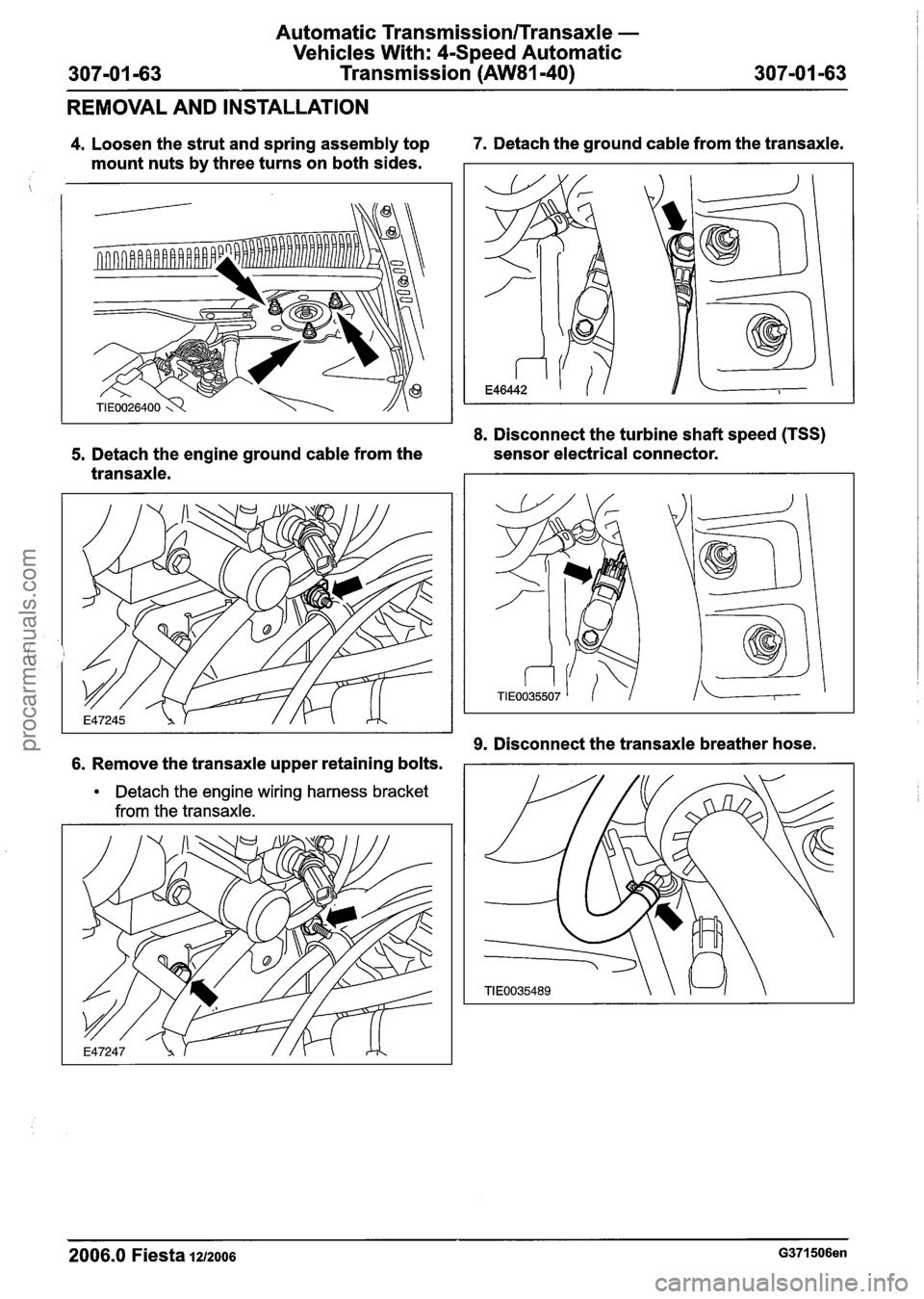
4. Loosen the strut and spring assembly top 7. Detach the ground cable from the transaxle.
mount nuts by three turns on both sides.
8. Disconnect the turbine shaft speed (TSS)
5. Detach the engine ground cable from the sensor
electrical connector.
transaxle.
9. Disconnect the transaxle breather hose.
6. Remove the transaxle upper retaining bolts.
Detach the engine wiring harness bracket
from the transaxle.
2006.0 Fiesta 1212006 G371506en
procarmanuals.com