Page 803 of 1226
Fuel Charging and Controls - 1.25L
Duratec-1 6V (Sigma)llI4L Duratec-1 6V
(Sigma)llI6L Duratec-1 6V (Sigma)
REMOVAL AND INSTALLATION
Fuel Charging Wiring Harness(36 437 0)
Removal
1. Remove the air cleaner. For additional
5. N0TE:lt is necessary to lift the red locking
tab before the electrical connector can be
disconnected.
information, refer to Section
303-12 [Intake the throttle body electrical Air Distribution and Filtering].
connector.
2. Disconnect the spark plug wires from the
ignition coil.
6. Disconnect the fuel charging wiring harness
electrical connector.
3. Disconnect the engine coolant temperature
(ECT) sensor electrical connector.
(
7. Remove the positive crankcase ventilation
(PCV) hose.
4. Disconnect the camshaft position (CMP)
sensor electrical connector.
2006.0 Fiesta 1212006 GI 89082en
procarmanuals.com
Page 805 of 1226
Fuel Charging and Controls - 1.25L
Duratec-1 6V (Sigma)llI4L Duratec-1 6V
303-04A-7 (Sigma)llI6L Duratec-1 6V (Sigma) 303-04A-7
REMOVAL AND INSTALLATION
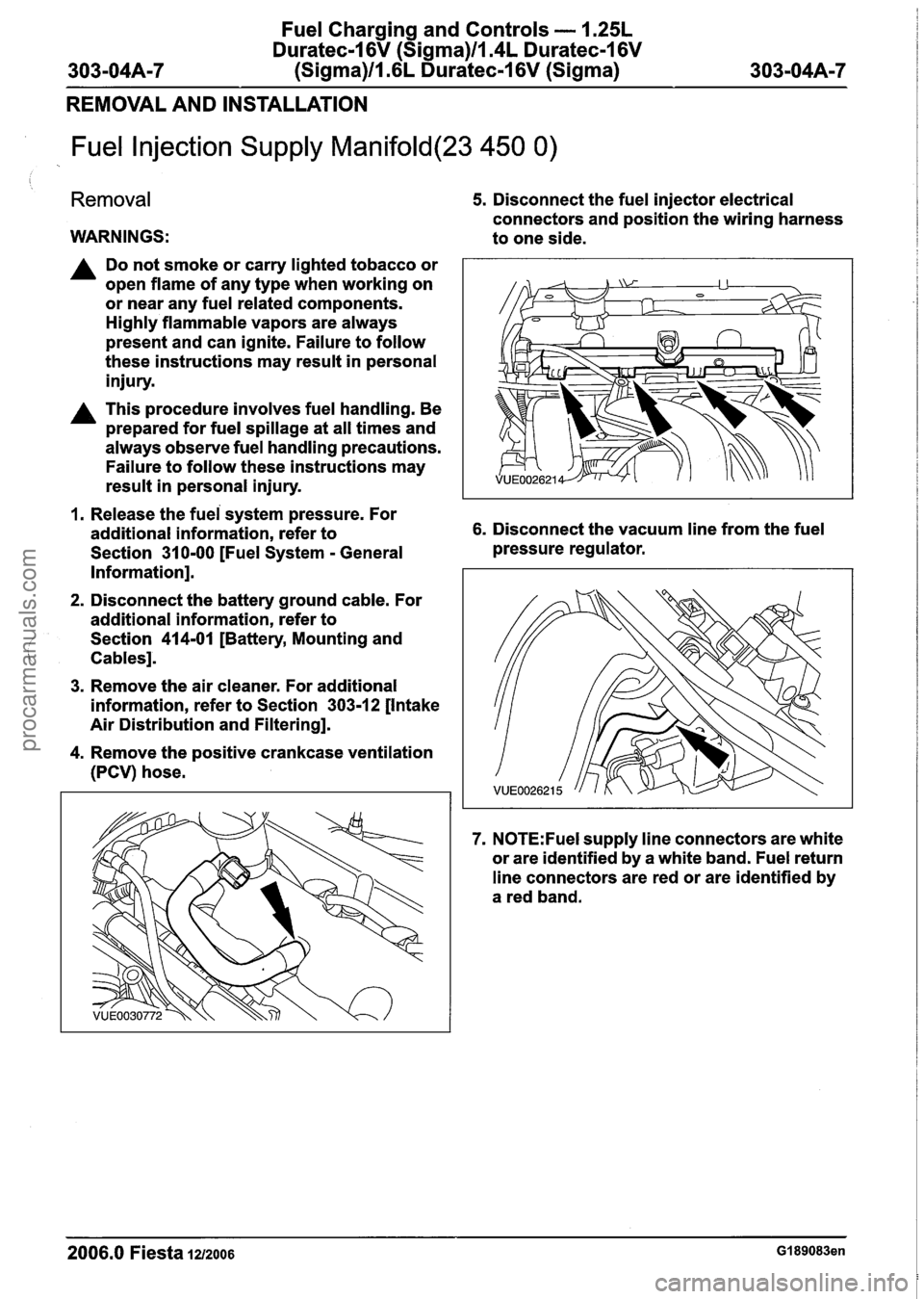
Fuel Injection Supply Manifold(23 450 0)
Removal
WARNINGS:
A Do not smoke or carry lighted tobacco or
open flame of any type when working on
or near any fuel related components.
Highly flammable vapors are always
present and can ignite. Failure to follow
these instructions may result in personal
injury.
A This procedure involves fuel handling. Be
prepared for fuel spillage at all times and
always observe fuel handling precautions.
Failure to follow these instructions may
result in personal injury.
5. Disconnect the fuel injector electrical
connectors and position the wiring harness
to one side.
1. Release the fuei system pressure. For
additional information, refer to 6. Disconnect the vacuum line from the fuel
Section
31 0-00 [Fuel System - General pressure
regulator.
Information].
2. Disconnect the battery ground cable. For
additional information, refer to
Section
414-01 [Battery, Mounting and
Cables].
3. Remove the air cleaner. For additional
information, refer to Section
303-12 [Intake
Air Distribution and Filtering].
4. Remove the positive crankcase ventilation
(PCV) hose.
7. N0TE:Fuel supply line connectors are white
or are identified by a white band. Fuel return
line connectors are red or are identified by
a red band.
2006.0 Fiesta 1212006 GI 89083en
procarmanuals.com
Page 813 of 1226

Fuel Charging and Controls - 2.OL
303-04B-5 Duratec-HE (M14) 303-04B-5
DIAGNOSIS AND TESTING
Fuel Charging and Controls
General Equipment
Wgnostic System (WDS) I
Principles of Operation
Ethanol equipped vehicles
Ethanol, is derived from cellulose waste. A large
proportion of Ethanol is distilled from corn, wheat
and sugar cane crops. The product that is to be
used in this vehicle is called Ethanol E85. E85 is
a mixture of 15% gasoline and 85% Ethanol.
Ethanol is a clear liquid and when fully burnt the
combustion gasses remaining are Carbon Dioxide
and water. This makes the use of Ethanol a good
environmental proposition. One drawback with pure
Ethanol is that it is corrosive to certain rubber and
plastic materials. The
introduction of Ethanol E85 has required some
major internal changes to the fuel supply and
delivery system. Some earlier vehicles used an
Ethanol mixture called Ethanol
El 5. This fuel was
made up of 15% Ethanol and 85% gasoline. At this
mixture ratio, no changes to the fuel charging or
delivery system where required, as no degradation
would occur with the cylinder head valves or
material content of the components, although some
performance loss would be noticeable.
The components used by vehicles running Ethanol
appear to be the same in construction as those
that use unleaded fuel only. The changes are
mainly to do with the materials used and increases
in fuel flow rates.
Ethanol has a much higher octane rating than
standard fuel which means that the ignition and
fuel injection calibrations for a vehicle that is
capable of using Ethanol E85 must be adapted
suitably.
I Item Description
I 1 I Fuel injectors
1ue1 rail I
2006.0 Fiesta 1212006 GI 65371 en
Item Description
3
4
Block heater
Fuel pump module
procarmanuals.com
Page 891 of 1226
Engine Emission Control - 1.3L Duratec-8V
(Rocam)ll.25L Duratec-1 6V (Sigma)ll.4L
303-08A-5 Duratec-1 6V (Sigma)/l.GL Duratec-1 6V (Sigma) 303-08A-5
DESCRIPTION AND OPERATION
PCV
- 1.4Ll1.6L Duratec 16V
Description The crankcase gases are freed of oil in the valve
cover and in the PCV oil separator in order to
prevent the oil from being sucked in and burned.
housing The
PCV valve is located in the PCV oil separator.
The amount of crankcase gases depends on the
engine speed.
The crankcase gases
are sucked
by the PCV valve
into the intake manifold. 3
4
2006.0 Fiesta 1212006 GI 67099en
Hose from PCV oil separator to intake
manifold
intake manifold.
PCV
oil separator with integral PCV valve The
PCV valve is opened by the vacuum in the
procarmanuals.com
Page 892 of 1226

Engine Emission Control - 1.3L Duratec-8V
(Rocam)ll.25L Duratec-1 6V (Sigma)ll.4L
Duratec-1 6V (Sigma)ll .6L Duratec-I 6V (Sigma)
DIAGNOSIS AND TESTING
Engine Emission Control
lnspection and Verification
1. Verify the customer concern.
2. Visually inspect for obvious signs of mechanical
damage.
3. If an obvious cause for an observed or reported
Visual lnspection Chart
I 1 concern is found, correct the cause (if possible)
I Mechanical I before proceeding to the next step.
. -
Symptom Chart
Positive crankcase ventilation (PCV) valve
PCV separator
Symptom Chart
Symptom
Excessive crankcase pressure
4. If the cause is not visually evident, verify the
symptom and refer to the Symptom Chart.
Oil in the air intake system Possible
Sources
Blocked PCV valve.
Blocked PCV separator.
Blocked PCV hose.
Restriction in PCV separator.
PCV valve permanently open. Action
CLEAN
or INSTALL new PCV
components as necessary.
TEST the system for normal
operation. If the concern
persists, REFER to
Section 303-00 [Engine
System
- General Information].
CLEAN or INSTALL a new
PCV separator. TEST the
system for normal operation.
-
INSTALL a new PCV valve.
TEST the system for normal
operation.
2006.0 Fiesta 1212006 Gl48220en
procarmanuals.com
Page 898 of 1226
Engine Emission Control - 2.OL Duratec-HE
303-08B-4
(MI41 303-08B-4
DESCRIPTION AND OPERATION
Item Description two hoses. One PCV hose connects the PCV valve
to the intake manifold, the other PCV hose
2
3
The positive crankcase ventilation (PCV) system
consists of a valve mounted in the crankcase vent
oil separator (attached to the cylinder block) and
connects the valve cover to the air cleaner. 1
4
2006.0 Fiesta 1212006 G37563en
Positive crankcase ventilation (PCV) valve
PCV hose
Crankcase vent oil
se~arator
Under idle and part throttle conditions, the
crankcase vapor flows through the intake manifold
Crankcase vent oil separator retaining
bolt into the combustion chambers where the vapor is
burnt during combustion.
procarmanuals.com
Page 899 of 1226
Engine Emission Control - 2.OL Duratec-HE
303-08B-5
(MI41 303-08B-5
DESCRIPTION AND OPERATION
[ E57308
i, ' Item Description I
I 1 ( PCV hose to valve cover connector I
Under full throttle conditions, the crankcase vapor
flows from the valve cover into the air cleaner
through the PCV hose.
-
2
3
2006.0 Fiesta 1212006 G37563en
PCV hose
PCV hose to air cleaner connector
procarmanuals.com
Page 900 of 1226

Engine Emission Control - 2.OL Duratec-HE
303-08B-6
(MI41 303-08B-6
DIAGNOSIS AND TESTING
Engine Emission Control
lnspection and Verification
General Equipment Visual Inspection Chart L..
I. Verify the customer concern.
2. Visually inspect for obvious signs of mechanical
or electrical damage.
Worldwide Diagnostic System
(WDS)
- Hose(s)/hose joints
- Gasket(s)
- Positive crankcase
ventilation (PCV)
valve
- PCV separator
Mechanical
- Exhaust gas recircu-
lation (EGR) valve
Electrical
- Electrical
con
nector(s)
- Wiring harness
- Fuse(s)
- Relay
- EGRvalve
- Powertain control
module (PCM)
3. If an obvious cause for an observed or reported
concern is found, correct the cause (if possible)
before proceeding to the next step.
4. If the concern is not visually evident, verify the
symptom and refer to the Symptom Chart.
Symptom Chart
Symptom Chart
Symptom Possible Sources Action
I
Poor engine performance EGR valve.
Using WDS, CHECK the EGR
Valve Duty Cycle input signal
I to the EGR vacuum regulator
valve. If the result is 0%,
REMOVE the EGR valve.
REFER to Exhaust Gas Recir-
culation (EGR) Valve
- in this
section.
INSPECT the EGR valve and
valve seat for damage. Make
sure that the EGR valve is in
the closed position. If the EGR
valve is not closed. INSTALL
a
new EGR valve. TEST the
system for normal operation. If
the result is not 0% continue
the engine diagnostic using
WDS.
2006.0 Fiesta 1212006 G334290en
Excessive crankcase pressure Blocked or damaged PCV
hose(s).
Blocked crankcase vent oil
separator. CHECK
the PCV system
components for blockages, CLEAN or INSTALL new
components as necessary.
procarmanuals.com


