2007 FORD FIESTA engine system general information
[x] Cancel search: engine system general informationPage 817 of 1226

Fuel Charging and Controls - 2.OL
303-04B-9 Duratec-HE (M14) 303-04B-9
DIAGNOSIS AND TESTING
Symptom Chart
Symptom Chart
Symptom
Possible Sources Action
Engine does not crank
Engine cranks but does not
start PATS. CHECK
the PATS LED extin-
guishes within 3 seconds when
the ignition is turned on.
REFER to: Anti-Theft
- Passive
(41 9-01
8, Diagnosis and
Testing).
Starting system.
REFER to: Starting System
(303-06, Diagnosis and
Testing).
Ignition switch. REFER to the Wiring
Diagrams.
Powertrain control module
(PCM).
Carry out a full engine
diagnosis using the guided
diagnostic menu in WDS.
Low fuel system pressure.
Inertia fuel shutoff (IFS) switch.
Check the fuel system pres-
sure.
REFER to: Fuel System Pres-
sure Check (31
0-OOA,
General Procedures).
RESET the IFS switch.
Fuel lines damaged or blocked.
INSPECT the fuel lines.
INSTALL new components as
necessary. TEST the system
for normal operation.
I Fuel filter blocked. I INSTALL a new fuel filter. I
Fuel pump module. REFER to: Fuel System - 1.3L
Duratec-8V (Rocam)/l.25L
Duratec-1 6V (Sigma)/2.OL
Duratec-HE (M14)/1.4L
Duratec-1 6V (Sigma)/l .6L
Duratec-1
6V (Sigma) (31 0-00
Fuel System
- General
Information, Diagnosis and
Testing).
Crankshaft position (CKP)
sensor. Carry out a
full engine
diagnosis using the guided
diagnostic menu in WDS.
Camshaft position (CMP)
sensor. Carry out a
full engine
diagnosis using the guided
diagnostic menu in WDS.
PCM. Carry out a full engine
diagnosis using the guided
diagnostic menu in WDS.
2006.0 Fiesta 1212006 GI 65371 en
procarmanuals.com
Page 835 of 1226

Fuel Charging and Controls - 2.OL
303-04B-27 Duratec-HE (M14) 303-04B-27
REMOVAL AND INSTALLATION
Fuel Rail
Materials Name Specification
I Engine Oil - 5W-30 I WSS-~2~91 3-B I
WARNINGS:
A Do not smoke or carry lighted tobacco or
open flame of any type when working on
or near any fuel related components.
Highly flammable vapors are always
present and may ignite. Failure to follow
these instructions may result in personal
injury.
A This procedure involves fuel handling. Be
prepared for fuel spillage at all times and
always observe fuel handling precautions.
Failure to follow these instructions may
result in personal injury.
1. Release the fuel system pressure.
For additional information, refer to: Fuel
System Pressure Release (31 0-00 Fuel
System
- General Information, General
Procedures).
2. Disconnect the battery ground cable.
For additional information, refer to: Battery
Disconnect
(414-01 Battery, Mounting and
Cables, General Procedures).
3. Remove the air cleaner assembly.
For additional information, refer to: Air
Cleaner
- 2.OL Duratec-HE (M14) (303-1 2
intake Air Distribution and Filtering,
Removal and Installation).
4. Remove the components in the order
indicated in the following
illustration(s) and
table(s).
Item Description Item Description
Fuel charging wiring harness retaining clip
See Removal Detail
Fuel charging wiring harness electrical
connector
2006.0 Fiesta 1212006 G421322en
procarmanuals.com
Page 837 of 1226
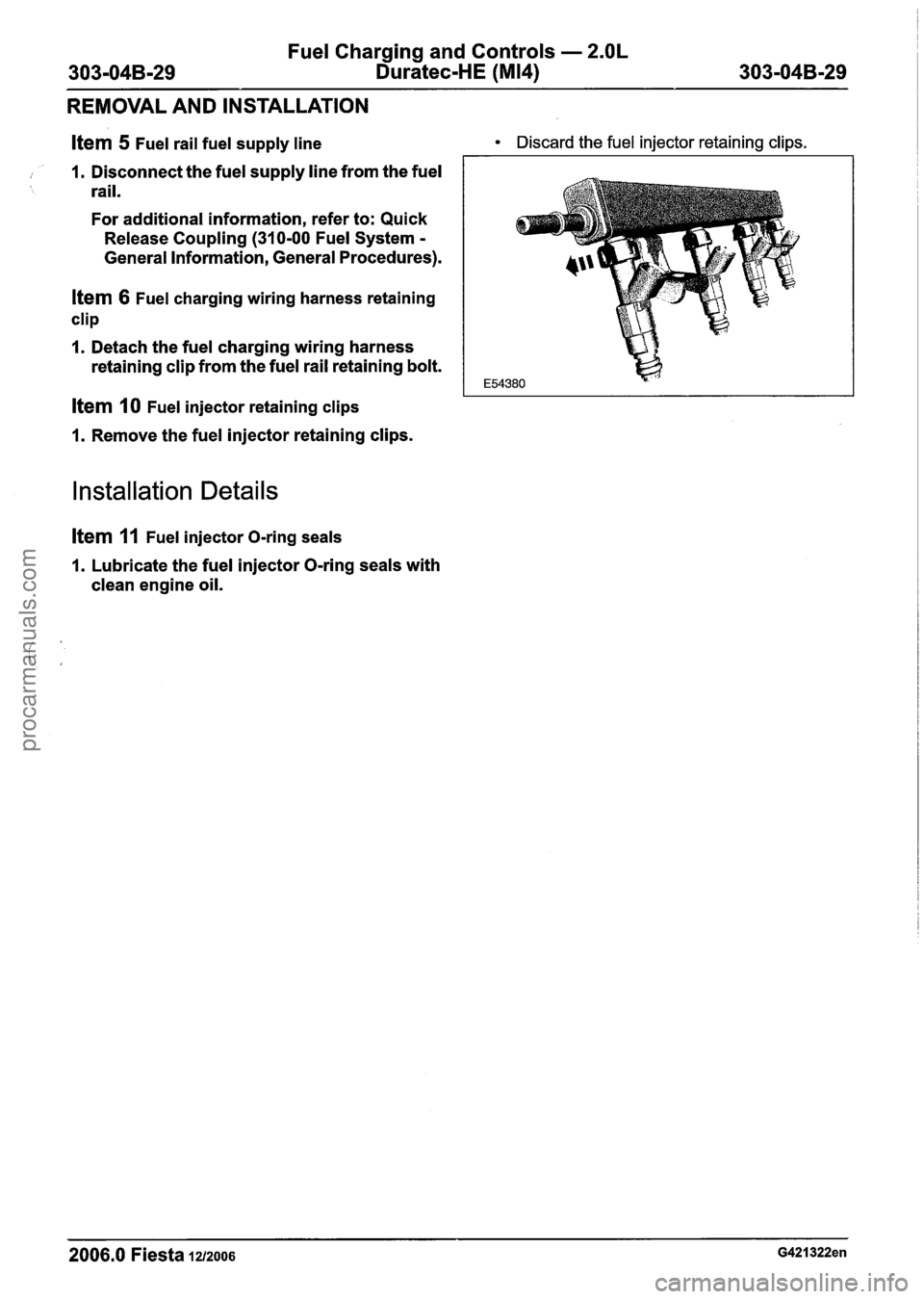
Fuel Charging and Controls - 2.OL
303-04B-29 Duratec-HE (M14) 303-04B-29
REMOVAL AND INSTALLATION
Item 5 Fuel rail fuel supply line
, 1. Disconnect the fuel supply line from the fuel rail.
For additional information, refer to: Quick
Release Coupling (310-00 Fuel System
-
General Information, General Procedures).
Item 6 Fuel charging wiring harness retaining
clip
1. Detach the fuel charging wiring harness
retaining clip from the fuel rail retaining bolt.
Item 10 Fuel injector retaining clips
1. Remove the fuel injector retaining clips.
Installation Details
item 11 Fuel injector O-ring seals
1. Lubricate the fuel injector O-ring seals with
clean engine oil.
Discard the fuel injector retaining clips.
- --
2006.0 Fiesta 1212006 G421322en
procarmanuals.com
Page 868 of 1226

303-06-4 Starting System 303-06-4
DIAGNOSIS AND TESTING
Starting System
Refer to Wiring Diagrams Section 303-06, for
schematic and connector information.
General Eaui~ment
I Worldwide Diagnostic System (WDS) I
Electrical
Electrical connector(s)
Relay
Central junction box (CJB)
Switch(es)
Battery
Starter motor
Powertrain Control Module (PCM)
lnspection and Verification
I. Verify the customer concern.
2. Visually inspect for obvious signs of electrical
damage.
Visual lnspection Chart
Symptom Chart
Electrical
Fuse(s)
Wiring harness
Symptom
The engine does not crank/the
relay does click 3.
If an obvious cause for an observed or reported
concern is found, correct the cause (if possible)
before proceeding to the next step.
4. If the cause is not visually evident, verify the
The engine does not crank/the
relay does not click symptom
and refer to the Symptom Chart.
Possible Sources Action
Battery. REFER to: Charging System
(414-00 Charging System
-
General Information,
Diagnosis and Testing).
1
Starter motor. CARRY OUT the starter motor
I Component Test using WDS.
Relay. CARRY OUT the relay
Component Test. REFER to
the wiring diagrams.
I Circuit(s). I GO to Pinpoint Test A. I
I PCM. I REFER to WDS. I
Battery. REFER to: Charging System
(414-00 Charging System -
General Information,
Diagnosis and Testing).
Fuse. INSTALL a new fuse as
necessary. If the fuse fails
again check for short to ground.
Passive anti-theft system
(PATS). REFER to: Anti-Theft - Passive
(41 9-01 Anti-Theft
- Passive,
Diagnosis and Testing).
I
Starter motor. CARRY OUT the starter motor(
I Component Test using WDS.
I Ignition switch. I GO to Pinpoint Test B. I
2006.0 Fiesta la2006 GI 51 301 en
procarmanuals.com
Page 869 of 1226

303-06-5 Starting System 303-06-5
DIAGNOSIS AND TESTING
Symptom
The engine cranks slowly
Unusual starter noise
The starter spins but the engine
does not crank
Possible Sources Action
Relay.
Battery.
Starter motor.
Starter motor.
Flywheel ring gear.
Starter motor.
Flywheel ring gear.
CARRY OUT the relay
Component Test. REFER to
the wiring diagrams.
GO to Pinpoint Test B.
REFER to: Charging System
(414-00 Charging System
-
General Information,
Diagnosis and Testing).
CARRY OUT the starter motor
Component Test using WDS.
GO to Pinpoint Test C.
REMOVE the starter motor.
REFER to: (303-06 Starting
System)
Starter Motor
- 1.3L Duratec-8V
(Rocam)/l.25L Duratec-I 6V
(Sigma)/l.4L Duratec-1 6V
(Sigma)/l .6L Duratec-1 6V
(Sigma) (Removal and
Installation),
Starter Motor - 1.4L Duratorq-
TDCi (DV)
Diesel (Removal
and Installation).
INSPECT the starter motor
gear for damage. INSTALL a
new starter motor as neces-
sary.
INSPECT the flywheel for
damage.
REMOVE the starter
motor.REFER to: (303-06
Starting System)
Starter Motor
- 1.3L Duratec-8V
(Rocam)/l.25L Duratec-1 6V
(Sigma)/l.4L Duratec-I 6V
(Sigma)ll .6L Duratec-I 6V
(Sigma) (Removal and
Installation),
Starter Motor - 1.4L Duratorq-
TDCi (DV)
Diesel (Removal
and Installation).
INSPECT the starter motor
gear for damage. INSTALL a
new starter motor as neces-
sary.
INSPECT the flywheel for
damage.
2006.0 Fiesta 1212006 Gl51301en
procarmanuals.com
Page 892 of 1226

Engine Emission Control - 1.3L Duratec-8V
(Rocam)ll.25L Duratec-1 6V (Sigma)ll.4L
Duratec-1 6V (Sigma)ll .6L Duratec-I 6V (Sigma)
DIAGNOSIS AND TESTING
Engine Emission Control
lnspection and Verification
1. Verify the customer concern.
2. Visually inspect for obvious signs of mechanical
damage.
3. If an obvious cause for an observed or reported
Visual lnspection Chart
I 1 concern is found, correct the cause (if possible)
I Mechanical I before proceeding to the next step.
. -
Symptom Chart
Positive crankcase ventilation (PCV) valve
PCV separator
Symptom Chart
Symptom
Excessive crankcase pressure
4. If the cause is not visually evident, verify the
symptom and refer to the Symptom Chart.
Oil in the air intake system Possible
Sources
Blocked PCV valve.
Blocked PCV separator.
Blocked PCV hose.
Restriction in PCV separator.
PCV valve permanently open. Action
CLEAN
or INSTALL new PCV
components as necessary.
TEST the system for normal
operation. If the concern
persists, REFER to
Section 303-00 [Engine
System
- General Information].
CLEAN or INSTALL a new
PCV separator. TEST the
system for normal operation.
-
INSTALL a new PCV valve.
TEST the system for normal
operation.
2006.0 Fiesta 1212006 Gl48220en
procarmanuals.com
Page 902 of 1226

Engine Emission Control - 2.OL Duratec-HE
(MI41
REMOVAL AND INSTALLATION
Exhaust Gas Recirculation (EGR) Valve
1. Drain the cooling system.
For additional information, refer to: Cooling
Special
Tool(s) 3.
Remove the air cleaner intake tube.
System Draining, Filling and Bleeding
24003
(303-03 Engine cooling - 2.01 Duratec-HE
(M14), General Procedures).
4. Using the special tool, disconnect the
2. Remove the air cleaner outlet pipe.
radiator upper coolant hose from the coolant
outlet connector.
Removerllnstaller, Coolant
Hose Clamp
303-397
5. Remove the components in the order
indicated in the following
illustration(s) and
table(s).
2006.0 Fiesta 1212006 G421887en
procarmanuals.com
Page 938 of 1226

303-1 4-1 4 Electronic Engine Controls 303-1 4-1 4
DIAGNOSIS AND TESTING
Electronic Engine Controls
General Equipment
I Worldwide Diagnostic system (WDS)
Principles of Operation
For Principles of Operation on the electronic
accelerator control system
REFER to: Acceleration Control (31
0-02A,
Diagnosis and Testing).
European On-Board Diagnostics (EOBD)
EOBD is a diagnostic system integrated into the
powertrain control module (PCM). This system
continuously monitors vehicle emission
components. The system includes a malfunction
indicator lamp (MIL) which indicates when there is
a concern that can affect emissions or the system
malfunctions. Data stored within the module DTC
memory can be accessed using a generic scan
tool or WDS.
EOBD is mandated within European Union
regulations from the year 2000 for passenger
vehicles with petrol engines and from 2003 onwards for passenger vehicles with diesel
engines.
EOBD Functions:
Establishes when and how emissions control
faults must be indicated.
Actuates emission control malfunction indicator
lamp (MIL) and fault memory.
Indicates operating conditions in which the
concern occurred (freeze frame data).
Standardized output of operating data such as
engine speed, engine coolant temperature etc.
Standardized names and abbreviations for
components and systems.
Standardized
DTCs for all manufacturers.
Standardized communication with the diagnostic
equipment.
Standardized 16-pin data link connector (DLC)
in area of the instrument panel.
Concern display must be possible using a
generic scan tool.
EOBD consists of the following elements:
Warm-up Cycle C'
The warm-up cycle is an operation that consists of
key on, engine start and a coolant temperature
increase of
22"C, exceeding 71 OC on completion.
Drive Cycle
A drive cycle commences when the engine is
started (cold or warm) and ends when the engine
is switched off.
Trip
A trip begins when the engine is started and is
complete when all the EOBD monitors have
completed a self-test. This may take place over a
number of drive cycles. On diesel variants, the
information gathered from one drive cycle is not
carried over to a subsequent cycle or cycles.
When a concern has been rectified, particularly
after electronic engine control components have
been changed, the DTC memory, which is part of
the EEPROM must be cleared of all trouble codes.
When the DTC memory has been cleared, the code
.
PI000 (known as the readiness code) is set in the
PCM memory, which indicates that since the
EEPROM has been cleared, not all of the
monitoring systems have completed their tests.
PI000 can only be cleared by carrying out a trip,
which includes driving the vehicle under variable
conditions of speed, load and time so that all of the
monitors are completed. As
PI000 will not
illuminate the MIL it is not necessary to carry out
the trip before returning the vehicle to the customer.
Freeze Frame Data
When a concern is detected, various data is stored
depending on application including:
Diagnostic trouble code.
Vehicle speed.
Engine coolant temperature.
Engine speed.
Engine load.
Mixture formation trim value (trim value for
engine wear) (All except vehicles with diesel
engine).
State of oxygen sensor control (open and closed
loop) (All except vehicles with diesel engine).
Distance covered since the concern was first
registered.
2006.0 Fiesta 1212006 G384566en
procarmanuals.com