2007 FORD F250 jump start
[x] Cancel search: jump startPage 2 of 312
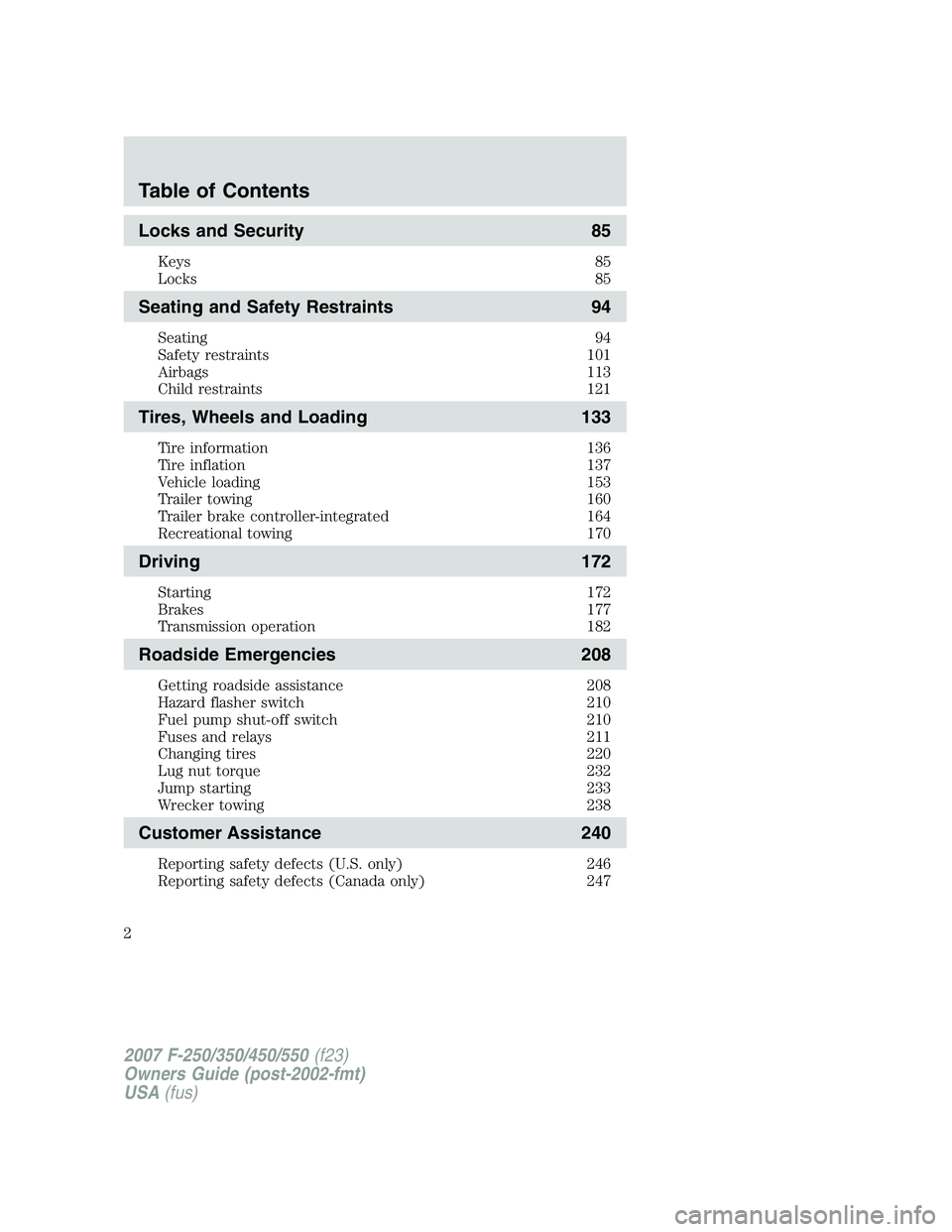
Locks and Security 85
Keys 85
Locks 85
Seating and Safety Restraints 94
Seating 94
Safety restraints 101
Airbags 113
Child restraints 121
Tires, Wheels and Loading 133
Tire information 136
Tire inflation 137
Vehicle loading 153
Trailer towing 160
Trailer brake controller-integrated 164
Recreational towing 170
Driving 172
Starting 172
Brakes 177
Transmission operation 182
Roadside Emergencies 208
Getting roadside assistance 208
Hazard flasher switch 210
Fuel pump shut-off switch 210
Fuses and relays 211
Changing tires 220
Lug nut torque 232
Jump starting 233
Wrecker towing 238
Customer Assistance 240
Reporting safety defects (U.S. only) 246
Reporting safety defects (Canada only) 247
Table of Contents
2
2007 F-250/350/450/550(f23)
Owners Guide (post-2002-fmt)
USA(fus)
Page 208 of 312
ROADSIDE ASSISTANCE
Getting roadside assistance
To fully assist you should you have a vehicle concern, Ford Motor
Company offers a complimentary roadside assistance program. This
program is separate from the New Vehicle Limited Warranty. The service
is available:
•24–hours, seven days a week
•for the New Vehicle Limited Warranty period of five years or
60,000 miles (100,000 km), whichever occurs first on Ford and
Mercury vehicles, and six years or 70,000 miles (110,000 km) on
Lincoln vehicles.
Roadside assistance will cover:
•a flat tire change with a good spare (except Ford GT which has a tire
inflation kit)
•battery jump start
•lock-out assistance (key replacement cost is the customer’s
responsibility)
•fuel delivery – Independent Service Contractors, if not prohibited by
state, local or municipal law shall deliver up to 2.0 gallons (7.5L) of
gasoline or 5 gallons (18.9L) of diesel fuel to a disabled vehicle. Fuel
delivery service is limited to two no-charge occurrences within a
12-month period.
•winch out – available within 100 feet (30.5 meters) of a paved or
county maintained road, no recoveries.
•towing – Ford/Mercury/Lincoln eligible vehicle towed to an authorized
dealer within 35 miles (56.3 km) of the disablement location or to the
nearest authorized dealer. If a member requests to be towed to an
authorized dealer more than 35 miles (56.3 km) from the disablement
location, the member shall be responsible for any mileage costs in
excess of 35 miles (56.3 km).
Trailers shall be covered up to $100 if the disabled eligible vehicle
requires service at the nearest authorized dealer. If the trailer is disabled,
but the towing vehicle is operational, the trailer does not qualify for any
roadside services.
2007 F-250/350/450/550(f23)
Owners Guide (post-2002-fmt)
USA(fus)
Roadside Emergencies
208
Page 233 of 312
JUMP STARTING YOUR VEHICLE
The gases around the battery can explode if exposed to flames,
sparks, or lit cigarettes. An explosion could result in injury or
vehicle damage.
Batteries contain sulfuric acid which can burn skin, eyes and
clothing, if contacted.
Do not attempt to push-start your automatic transmission
vehicle. Automatic transmissions do not have push-start
capability. Attempting to push-start a vehicle with an automatic
transmission may cause transmission damage.
Preparing your vehicle
When the battery is disconnected or a new battery is installed, the
transmission must relearn its shift strategy. As a result, the transmission
may have firm and/or soft shifts. This operation is considered normal and
will not affect function or durability of the transmission. Over time, the
adaptive learning process will fully update transmission operation.
1.Use only a 12–volt supply to start your vehicle.
2. Do not disconnect the battery of the disabled vehicle as this could
damage the vehicle’s electrical system.
3. Park the booster vehicle close to the hood of the disabled vehicle
making sure the two vehiclesdo nottouch. Set the parking brake on
both vehicles and stay clear of the engine cooling fan and other moving
parts.
4. Check all battery terminals and remove any excessive corrosion before
you attach the battery cables. Ensure that vent caps are tight and level.
5. Turn the heater fan on in both vehicles to protect from any electrical
surges. Turn all other accessories off.
2007 F-250/350/450/550(f23)
Owners Guide (post-2002-fmt)
USA(fus)
Roadside Emergencies
233
Page 235 of 312
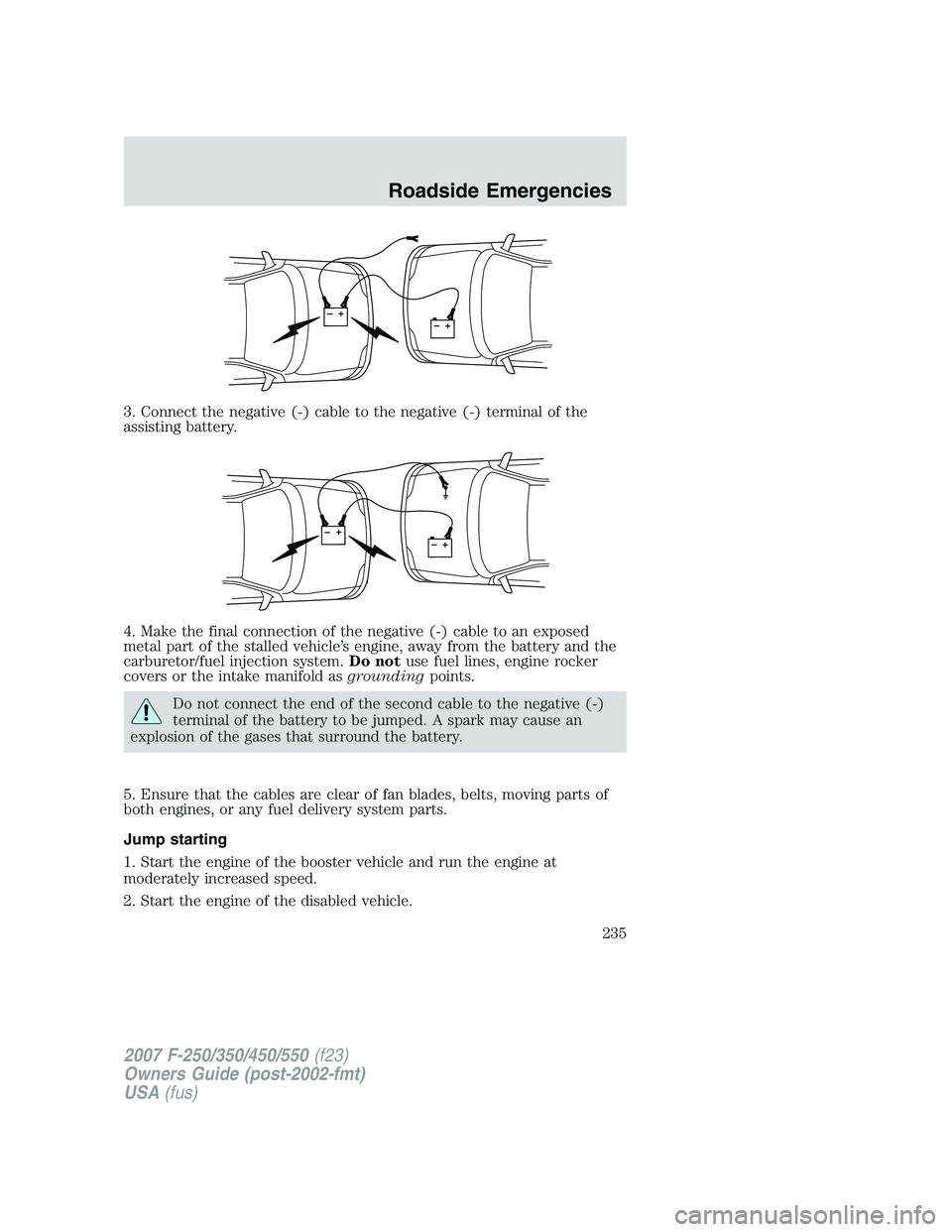
3. Connect the negative (-) cable to the negative (-) terminal of the
assisting battery.
4. Make the final connection of the negative (-) cable to an exposed
metal part of the stalled vehicle’s engine, away from the battery and the
carburetor/fuel injection system.Do notuse fuel lines, engine rocker
covers or the intake manifold asgroundingpoints.
Do not connect the end of the second cable to the negative (-)
terminal of the battery to be jumped. A spark may cause an
explosion of the gases that surround the battery.
5. Ensure that the cables are clear of fan blades, belts, moving parts of
both engines, or any fuel delivery system parts.
Jump starting
1. Start the engine of the booster vehicle and run the engine at
moderately increased speed.
2. Start the engine of the disabled vehicle.
+–+–
+–+–
2007 F-250/350/450/550(f23)
Owners Guide (post-2002-fmt)
USA(fus)
Roadside Emergencies
235
Page 236 of 312
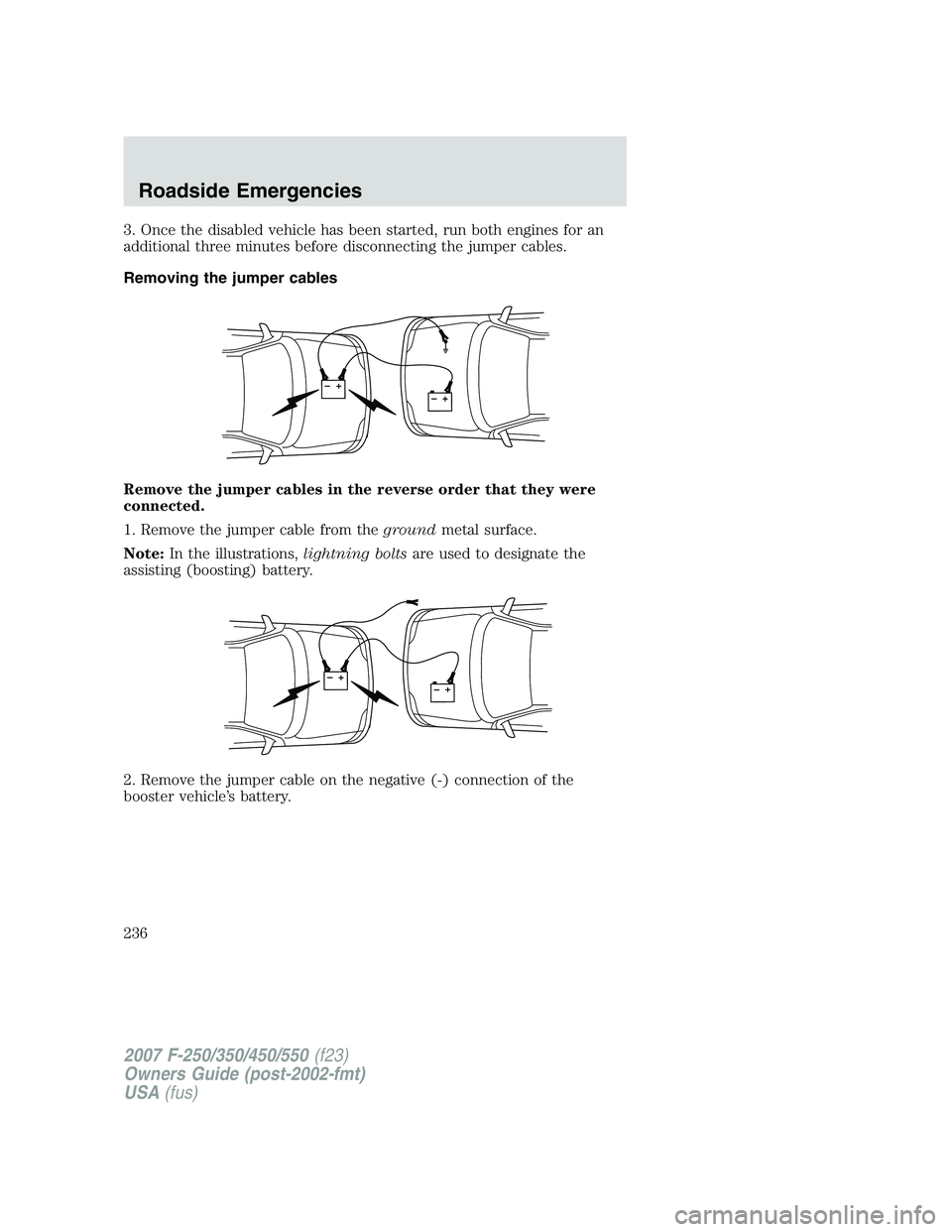
3. Once the disabled vehicle has been started, run both engines for an
additional three minutes before disconnecting the jumper cables.
Removing the jumper cables
Remove the jumper cables in the reverse order that they were
connected.
1. Remove the jumper cable from thegroundmetal surface.
Note:In the illustrations,lightning boltsare used to designate the
assisting (boosting) battery.
2. Remove the jumper cable on the negative (-) connection of the
booster vehicle’s battery.
+–+–
+–+–
2007 F-250/350/450/550(f23)
Owners Guide (post-2002-fmt)
USA(fus)
Roadside Emergencies
236
Page 237 of 312
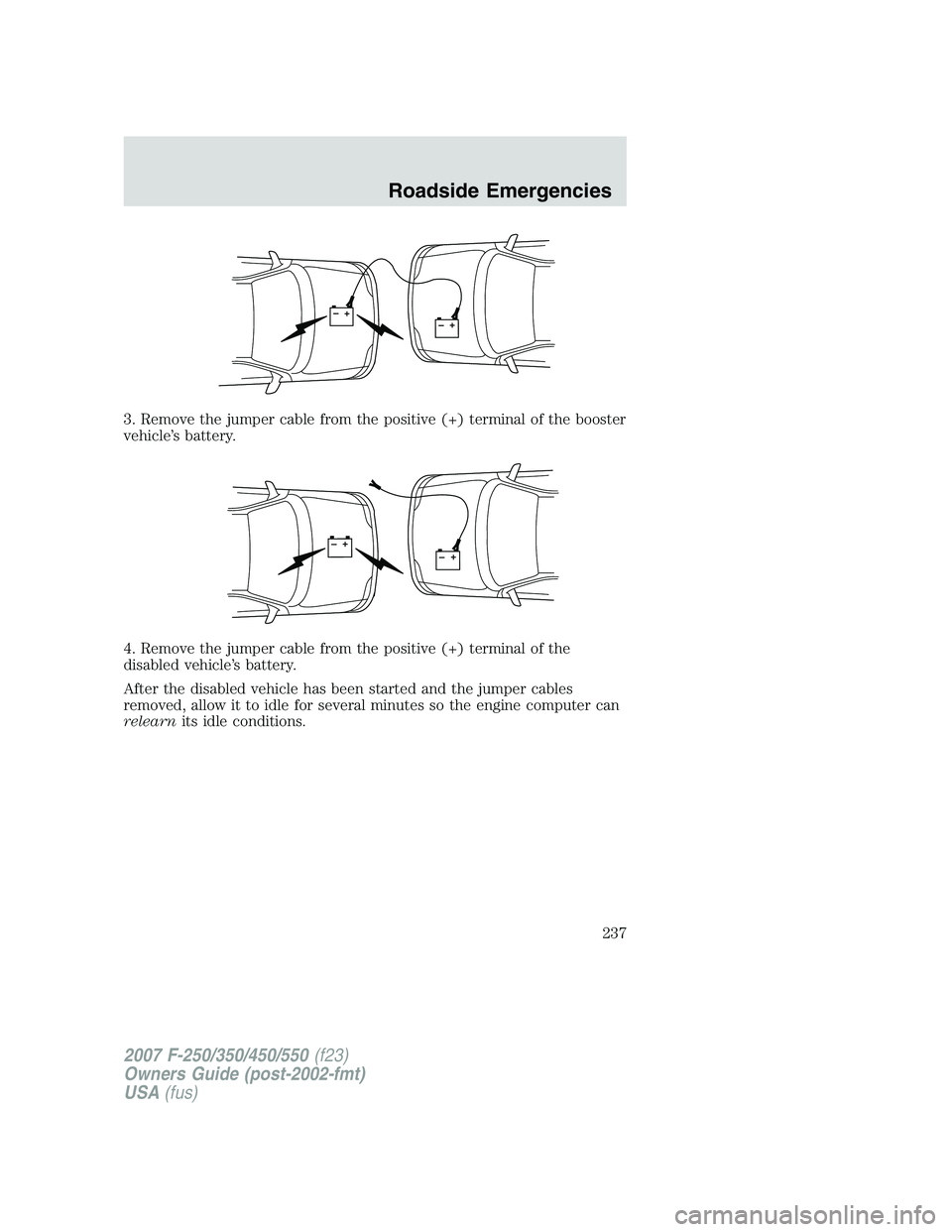
3. Remove the jumper cable from the positive (+) terminal of the booster
vehicle’s battery.
4. Remove the jumper cable from the positive (+) terminal of the
disabled vehicle’s battery.
After the disabled vehicle has been started and the jumper cables
removed, allow it to idle for several minutes so the engine computer can
relearnits idle conditions.
+–+–
+–+–
2007 F-250/350/450/550(f23)
Owners Guide (post-2002-fmt)
USA(fus)
Roadside Emergencies
237
Page 305 of 312
Climate control (see Air
conditioning or Heating) ............41
Clutch
fluid ..........................................285
operation while driving ..........185
recommended shift speeds ....186
Compass, electronic
set zone adjustment .................77
Console ........................................72
overhead ..............................60–61
Controls
power seat .................................97
steering column ........................69
Coolant
checking and adding ..............267
refill capacities ................271, 294
Cruise control
(see Speed control) ....................66
Customer Assistance ................208
Ford accessories for your
vehicle .....................................254
Ford Extended Service
Plan ..........................................244
Getting assistance outside
the U.S. and Canada ..............245
Getting roadside assistance ...208
Getting the service you
need .........................................240
Ordering additional owner’s
literature .................................246
Utilizing the
Mediation/Arbitration
Program ...................................244
D
Daytime running lamps
(see Lamps) ................................45Dipstick
automatic transmission
fluid ..........................................286
engine oil .................................261
Driveline universal joint and
slip yoke ....................................290
Driving under special
conditions ..................185, 198, 201
sand .........................................200
snow and ice ...........................202
through water .................200, 204
E
Electronic message center ...72, 74
Emergencies, roadside
jump-starting ..........................233
Emergency Flashers .................210
Emission control system ..........281
Engine ........................................298
cleaning ...................................249
coolant .....................................267
diesel ...........................................8
fail-safe cooling .......................272
idle speed control ...................265
refill capacities ........................294
service points ..................258–259
starting after a collision .........210
Engine block heater .................177
Engine oil ..................................261
checking and adding ..............261
dipstick ....................................261
filter, specifications ........264, 293
recommendations ...................264
refill capacities ........................294
Exhaust fumes ..........................176
F
Fail safe cooling ........................272
2007 F-250/350/450/550(f23)
Owners Guide (post-2002-fmt)
USA(fus)
Index
305
Page 306 of 312
Fluid capacities .........................294
Foglamps .....................................45
Four-Wheel Drive vehicles .......190
description ..............................194
driving off road .......................196
electronic shift ................190, 194
indicator light .........................191
lever operated shift ................192
manual locking hubs ..............190
preparing to drive your
vehicle .....................................181
Fuel ............................................273
calculating fuel
economy ............................76, 278
cap ...........................................275
capacity ...................................294
choosing the right fuel ...........276
comparisons with EPA fuel
economy estimates .................281
detergent in fuel .....................277
filling your vehicle with
fuel ...........................273, 275, 278
filter, specifications ........273, 293
fuel pump shut-off switch .....210
improving fuel economy ........278
octane rating ...................277, 298
quality ......................................277
running out of fuel .................278
safety information relating to
automotive fuels .....................273
Fuel pump shut-off switch .......210
Fuses ..................................211–212
G
Gas cap (see Fuel cap) ............275
Gas mileage
(see Fuel economy) .................278Gauges .........................................16
transmission fluid
temperature gauge ...................21
H
Hazard flashers .........................210
Head restraints ...........................94
Headlamps ...................................44
aiming ..................................47, 49
autolamp system .......................44
daytime running lights .............45
flash to pass ..............................46
high beam .................................46
replacing bulbs ...................52–55
turning on and off ....................44
Heating
heating and air conditioning
system ...........................38–39, 41
Hood ..........................................257
I
Ignition ...............................172, 298
Infant seats
(see Safety seats) .....................125
Inspection/maintenance (I/M)
testing ........................................283
Instrument panel
cleaning ...................................251
cluster ........................................12
lighting up panel and
interior .......................................46
J
Jump-starting your vehicle ......233
2007 F-250/350/450/550(f23)
Owners Guide (post-2002-fmt)
USA(fus)
Index
306