2007 DODGE SPRINTER lock
[x] Cancel search: lockPage 185 of 393
184 OperationRefueling
4
\3 Refueling
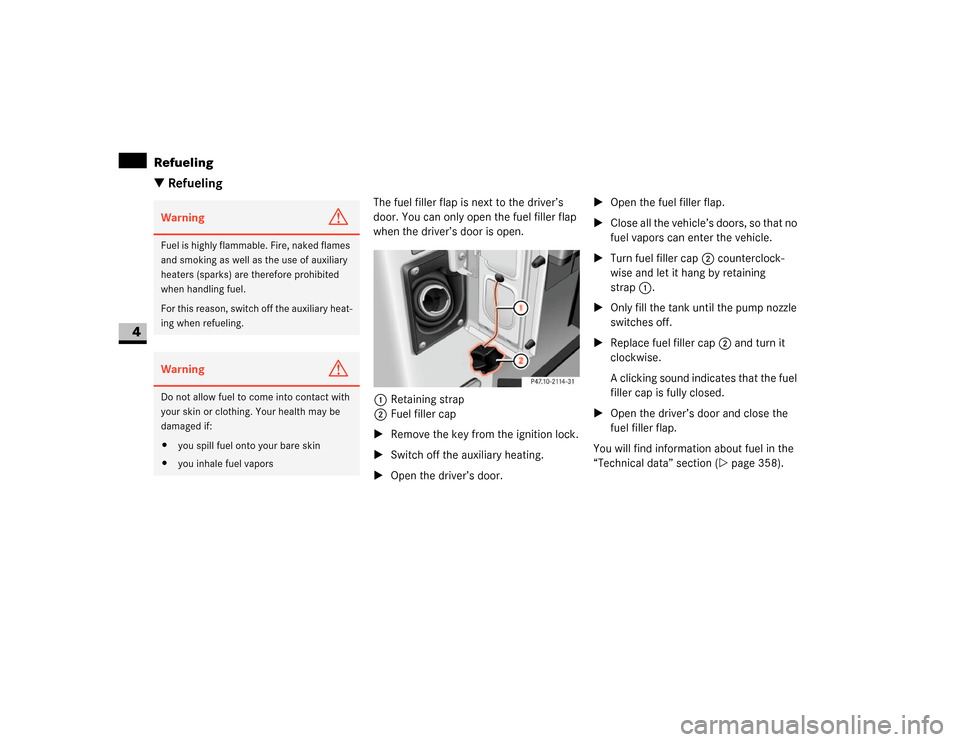
The fuel filler flap is next to the driver’s
door. You can only open the fuel filler flap
when the driver’s door is open.
1Retaining strap
2Fuel filler cap
\1Remove the key from the ignition lock.
\1Switch off the auxiliary heating.
\1Open the driver’s door.\1Open the fuel filler flap.
\1Close all the vehicle’s doors, so that no
fuel vapors can enter the vehicle.
\1Turn fuel filler cap2 counterclock-
wise and let it hang by retaining
strap1.
\1Only fill the tank until the pump nozzle
switches off.
\1Replace fuel filler cap2 and turn it
clockwise.
A clicking sound indicates that the fuel
filler cap is fully closed.
\1Open the driver’s door and close the
fuel filler flap.
You will find information about fuel in the
“Technical data” section (\2page 358).
Warning
G
Fuel is highly flammable. Fire, naked flames
and smoking as well as the use of auxiliary
heaters (sparks) are therefore prohibited
when handling fuel.
For this reason, switch off the auxiliary heat-
ing when refueling.Warning
G
Do not allow fuel to come into contact with
your skin or clothing. Your health may be
damaged if:
\4you spill fuel onto your bare skin
\4you inhale fuel vapors
Page 187 of 393

186 OperationEngine
4
\1Swing the hood upward until support
strut3 engages and the hood is sup-
ported.
Closing\1Lift the hood gently.
\1Push back support strut3
(\2page 185).
\1Let the hood drop from a height of ap-
proximately 05. ft (30 cm).
The hood engages audibly.
\1Check to make sure the hood is fully
closed.Warning
G
If the hood support strut is not engaged, the
hood can fall shut. You could be injured.
After opening the hood, you should there-
fore check whether the support strut is en-
gaged.Warning
G
Engine parts may be hot and can rotate.
There is a risk of injury if the hood is open
and the engine is running.
Only open the hood when the engine has
stopped and cooled down.
Warning
G
The engine has an electronic ignition system
which carries a high voltage. For this reason,
you must never touch the ignition system
components (ignition coil, test socket)
while:
\4the engine is running
\4the engine is being started
\4the key is in position2 in the ignition
lock and the engine is being cranked by
handWarning
G
Make sure that nobody can become trapped
as you close the hood.
Warning
G
Make sure that the hood is securely en-
gaged before driving off. Do no continue
driving if the hood can no longer engage af-
ter an accident, for example.
The hood could otherwise come loose while
the vehicle is in motion and endanger you
and/or others.!
CAUTION
When you press the support strut back,
make sure that you do not press it
against the detent position and cause it
to bend.
Page 192 of 393

191 Operation
Engine
4
The expansion tank is in the engine com-
partment. Only add coolant with the vehi-
cle standing on a level surface and with the
engine switched off. The coolant tempera-
ture must have dropped below 122 °F
(50 °C).1Coolant tank cap
2Brake fluid reservoir cap
3Windshield washer reservoir cap
\1Slowly unscrew cap1 counterclock-
wise to reduce excess pressure.
\1Continue turning the cap and remove
it.
\1Add coolant as far as the MAX mark.
\1Twist cap1 back on.
For coolant specifications, see "Service
products and capacities" (\2page 355).Environmental note
H
When adding oil, take care not to spill any.
No engine oil must be allowed to enter sew-
age systems, surface water, ground water or
soil.
You would otherwise be damaging the envi-
ronment.
Dispose of engine oil in an environmentally
responsible manner. Comply with the manu-
facturer’s instructions.Coolant
Warning
G
When opening the coolant expansion tank
there is a risk of scalding from hot coolant
spraying out. The cooling system and the
coolant expansion tank are pressurized
when the engine is at normal operating tem-
perature.
Wear gloves and eye protection. Only open
the coolant expansion tank when the cool-
ant temperature is less than 122 °F (50 °C).
N20.30-2063-31
Warning
G
Coolant contains glycol and is therefore tox-
ic. Do not swallow coolant. Consult a doctor
immediately if any coolant is swallowed.
Do not allow coolant to come into contact
with your skin, eyes or clothing. In the event
of contact with the eyes, rinse them thor-
oughly with clean water. Clean skin and
clothes immediately with soap and water.
Change out of soiled clothing without delay.
Page 198 of 393

197 Operation
Battery isolating switch*
4
You can disconnect the current to all your
vehicle’s consumers using the battery
isolating switch. This will prevent uncon-
trolled battery discharge caused by quies-
cent current consumption.The battery isolating switch is to the right
of the accelerator pedal in the driver’s foot-
well.
1Connector
2Slide\1Take the key out of the ignition lock
and wait for approx. 20 seconds.
\1Move red slide2 down in the direc-
tion of the arrow and disconnect
connector1 from the ground pin.
\1Clamp connector1 under the acceler-
ator pedal so that it cannot make con-
tact with the ground pin.
The consumers of the vehicle battery
are cut off from the electrical circuit.Warning
G
If the vehicle is equipped with an auxiliary
battery in the engine compartment, it is nec-
essary to disconnect both batteries when
working on the vehicle electrical system.
Only then is the electrical system fully dis-
connected from the power supply.iOnly disconnect the vehicle electrical
system from the power supply using
the battery isolating switch if the vehi-
cle is to be parked up for a long period
or when this is absolutely necessary.
After the power supply is switched on,
you must reset the electric sliding door
(\2page 57).
!
CAUTION
Make sure that the key is in position0
in the ignition lock and wait at least
20 seconds before disconnecting or
connecting the battery isolating
switch. You could otherwise damage
electrical system components.
Switching off the electrical system!
CAUTION
When you clamp the connector under
the accelerator pedal, make sure that
the connector does not become:
\4dirty
\4damaged
It may otherwise not be possible to re-
store the electrical connection when
the parts are reassembled.
Page 199 of 393

198 OperationBattery isolating switch*
4
1Connector
2Ground pin\1Insert the key into the ignition lock.
\1Press connector1 onto ground
pin2 until you feel it engage and the
lock inhibitor is released.
The connector must be in full contact
with ground pin2.
\1Move the red slide up until it engages.
All consumers are reconnected to the
power supply circuit.Switching on the electrical system
Page 203 of 393

202 OperationTires and wheels
4
\4When replacing individual tires, you
should mount new tires on the front
wheels first.
The tire inflation pressure should be
checked regularly, i.e. at least each time
you refuel the vehicle. The preferred inter-
val for checking the tire inflation pressure,
however, is before each trip.
For more information on checking tire in-
flation pressure, refer to "Recommended
tire inflation pressure" (\2page 210).Tire inspection
Every time when checking the tire inflation
pressure, the tires should also be inspect-
ed for the following:
\4excessive treadwear, refer to "Tread
depth". the condition of the tread
depths, i.e. uneven tread wear or ex-
cessive treadwear on one side. Turn
the front wheels to full lock if neces-
sary to enable you to check the inner
edge of the front tires more easily. You
must also always check the inside of
the tire tread on the rear wheels.
\4cord or fabric showing through the
tire’s rubber
\4bumps, bulges, cuts, cracks or splits in
the tread or side of the tire
\4foreign objects between the tires
(on vehicles with twin tires)
Replace the tire if any of the above condi-
tions is found.
Also inspect the spare tire periodically for
condition and inflation. Spare tires will age
and become worn over time even if never
used, and thus should be inspected and re-
placed when necessary.Tire damage
Tire damage can be caused
by:
\4the vehicle’s operating conditions
\4tire aging
\4curbs
\4foreign objects
\4insufficient or excessive tire pressures
\4weather and environmental influences
\4contact with oil, grease, fuel, etc.
Tire care and maintenanceWarning
G
Regularly check the tires for damage. Dam-
aged tires can cause tire inflation pressure
loss. As a result, you could lose control of
your vehicle.
Worn, old tires can cause accidents. If the
tire tread is badly worn, or if the tires have
sustained damage, replace them.
Warning
G
Driving over curbs or sharp-edged objects
can cause damage to the tire substructure
which is not visible from the outside.
Damage to the tire substructure cannot be
detected until later and can cause the tire to
burst.
\2\2
Page 244 of 393

243 Operation
Cleaning and care of the vehicle
4
Steps
Engine cleaningLight-alloy wheels*
Clean light-alloy wheels on a regular basis.
Outside of windshield and wiper blades
\1Turn key to position1 in ignition lock
(\2page 67).
\1Switch on windshield wipers
(\2page 126).
\1When the wiper arms are vertical, turn
key to position0 in the ignition lock or
remove the key.
\1Fold the wiper arms away from the
windshield until you feel them engage
in place.\1You can now clean the windshield and
the wiper blades.
\1Fold the windshield wipers back again
before you switch on the ignition.Warning
G
Dirty or iced-up steps and entrances create
a risk of slipping or falling.
Keep steps, entrances and footwear free
from dirt (e.g. mud, clay, snow and ice).!
CAUTION
Do not allow water to enter the intake
and ventilation openings.
When cleaning with high-pressure wa-
ter or steam cleaners, the spray must
not be aimed directly at electrical com-
ponents or at the end of electrical
lines.
Treat the engine with preservative
agents after cleaning. Protect the belt
drive system from the preservative
when you do so.
!
CAUTION
Do not use any acidic or alkaline clean-
ing agents. They can cause corrosion of
the wheel bolts (wheel nuts) or the bal-
ancing weight retainers.
!
CAUTION
Do not fold the windshield wipers away
from the windshield unless the hood is
closed. You will otherwise damage the
hood.
Warning
G
Switch off the ignition before cleaning the
windshield or the wiper blades. The wind-
shield wipers could otherwise move and in-
jure you.
Page 251 of 393

250 Practical hintsWhat to do if ...
5
Audible warning signalsWarning
G
Always have maintenance work carried out
at an authorized Sprinter Dealer which has
the necessary specialist knowledge and
tools to carry out the work required.
The manufacturer recommends that you use
an authorized Sprinter Dealer for this pur-
pose.
In particular, work relevant to safety or on
safety-related systems must be carried out
at an authorized Sprinter Dealer. There is a
risk of an accident and injury if this work is
carried out incorrectly.
Problem
Possible cause / result
Suggested solutions
The anti-theft alarm system is suddenly
triggered.
You have opened the vehicle using the key
while the anti-theft alarm system was still
primed.
Key:
\1Press theΠbutton.
or
\1Insert the key into the ignition lock.
The anti-theft alarm system is deacti-
vated.
You hear a warning signal.
A message appears in the display.
\1Observe the instructions on
(\2page 281).
You are driving with the handbrake applied.
\1Release the handbrake
(\2page 115).
You opened the driver’s door and forgot to
switch off the lights.
\1Turn the light switch to0.
Warning
G
You are not wearing your seat belt.
\1Fasten your seat belt (\2page 25).