Page 165 of 492

there are any question regarding the operation of your
heater defroster ducts, have the system checked by an
authorized dealer
Seat Belts
Inspect the belt system periodically, checking for cuts,
frays and loose parts. Damaged parts must be replaced
immediately. Do not disassemble or modify the system.
Seat belt assemblies must be replaced after an accident if
they have been damaged (bent retractor, torn webbing,
etc.) or if the front airbags have deployed. If there is any
question regarding belt or retractor condition, replace the
belt.
Airbag Light
The light should come on and remain on for 6 to 8
seconds as a bulb check when the ignition switch is first
turned ON. If the light is not lit during starting, see your
authorized dealer. If the light stays on, flickers or comeson while driving, have the system checked by an autho-
rized dealer. If there is a problem with the airbag light the
seatbelt light will flash.
Safety Checks You Should Make Outside The
Vehicle
Tires
Examine tires for tread wear or uneven wear patterns.
Check for stones, nails, glass or other objects lodged in
the tread.
Inspect for tread cuts or sidewall cracks. Check wheel
nuts for tightness and tires for proper pressure.
Lights
Check the operation of all exterior lights. Check turn
signal and high beam indicator lights on the instrument
panel.
Door Latches
Check for positive closing, latching and locking.
164 UNDERSTANDING THE FEATURES OF YOUR VEHICLE
Page 168 of 492
UNDERSTANDING YOUR INSTRUMENT PANEL
CONTENTS
mInstruments And Controls.................171
mInstrument Cluster......................172
mInstrument Cluster Description.............173
mElectronic Digital Clock..................181
NClock Setting Procedure.................181
mRadio General Information................182
NRadio Broadcast Signals.................182
NTwo Types Of Signals..................182
NElectrical Disturbances..................182NAM Reception.......................182
NFM Reception........................183
mSales Code REF Ð AM/FM/CD (Single Disc)
Radio With Optional Satellite Radio And Hands
Free Phone Capability...................183
NOperating Instructions - Radio Mode.......183
NOperation Instructions - CD Mode.........187
NOperation Instructions - Auxiliary Mode.....189
NOperating Instructions - Hands Free Phone Ð
If Equipped.........................1904
Page 169 of 492

NOperating Instructions - Satellite Radio Ð If
Equipped...........................191
mSales Code RAQ ± AM/FM/CD (6-Disc) Radio
With Optional Satellite Radio, Hands Free Phone,
And Vehicle Entertainment Systems (VES)
Capabilities...........................191
NOperating Instructions - Radio Mode.......191
NOperation Instructions - (CD Mode For CD
Audio Play).........................196
NLoad/Eject Button (CD Mode For CD Audio
Play)..............................198
NNotes On Playing MP3 Files.............200
NOperation Instructions - (CD Mode For MP3
Audio Play).........................202
NLoad/Eject Button (CD Mode For MP3 Play) . . 202mSales Code RAK ± AM/FM/Cassette/CD (6-Disc)
Radio With Optional Satellite Radio, Hands Free
Phone, Video, MP3, And WMA Capabilities....204
NOperating Instructions - Radio Mode.......205
NOperating Instructions Ð Tape Player.......209
NSeek Button.........................209
NFast Forward (FF).....................210
NRewind (RW)........................210
NTape Eject...........................210
NScan Button.........................210
NChanging Tape Direction................210
NMetal Tape Selection...................210
NPinch Roller Release...................210
NNoise Reduction......................211
168 UNDERSTANDING YOUR INSTRUMENT PANEL
Page 170 of 492

NOperation Instructions - (CD Mode For CD
Audio Play).........................211
NLoad/Eject Button (CD Mode For CD Audio
Play)..............................212
NNotes On Playing MP3 Files.............214
NOperation Instructions - (CD Mode For MP3
And WMA Audio Play).................216
NLoad/Eject Button (CD Mode For MP3 And
WMA Play).........................216
mSales Code REC Ð AM/FM/CD (6±Disc) Radio
With Navigation System..................219
NOperating Instructions Ð Satellite Radio (If
Equipped)..........................219
NClock Setting Procedure.................219
mSatellite Radio Ð If Equipped..............220NSystem Activation.....................220
NElectronic Serial Number/Sirius Identification
Number (ESN/SID)....................220
NSelecting Satellite Mode In REF, RAQ, And RAK
Radios.............................221
NSelecting a Channel....................222
NStoring And Selecting Pre-Set Channels......222
NUsing The PTY (Program Type) Button (If
Equipped)..........................222
NPTY Button9Scan9.....................222
NPTY Button9Seek9.....................223
NSatellite Antenna......................223
NReception Quality.....................223
mRemote Sound System Controls Ð If Equipped . . 224
UNDERSTANDING YOUR INSTRUMENT PANEL 169
4
Page 171 of 492
NRadio Operation......................224
NTape Player.........................225
NCD Player..........................225
mCassette Tape And Player Maintenance.......225
mCompact Disc Maintenance................226
mRadio Operation And Cellular Phones........227
mClimate Controls.......................227NHeater Only Ð Fleet Vehicles.............228
NAir Conditioning And Heating Ð If Equipped . 230
NAir Conditioning With Dual Zone Temperature
Control Ð If Equipped.................233
NOperating Tips.......................237
NOperating Tips Chart...................240
170 UNDERSTANDING YOUR INSTRUMENT PANEL
Page 172 of 492
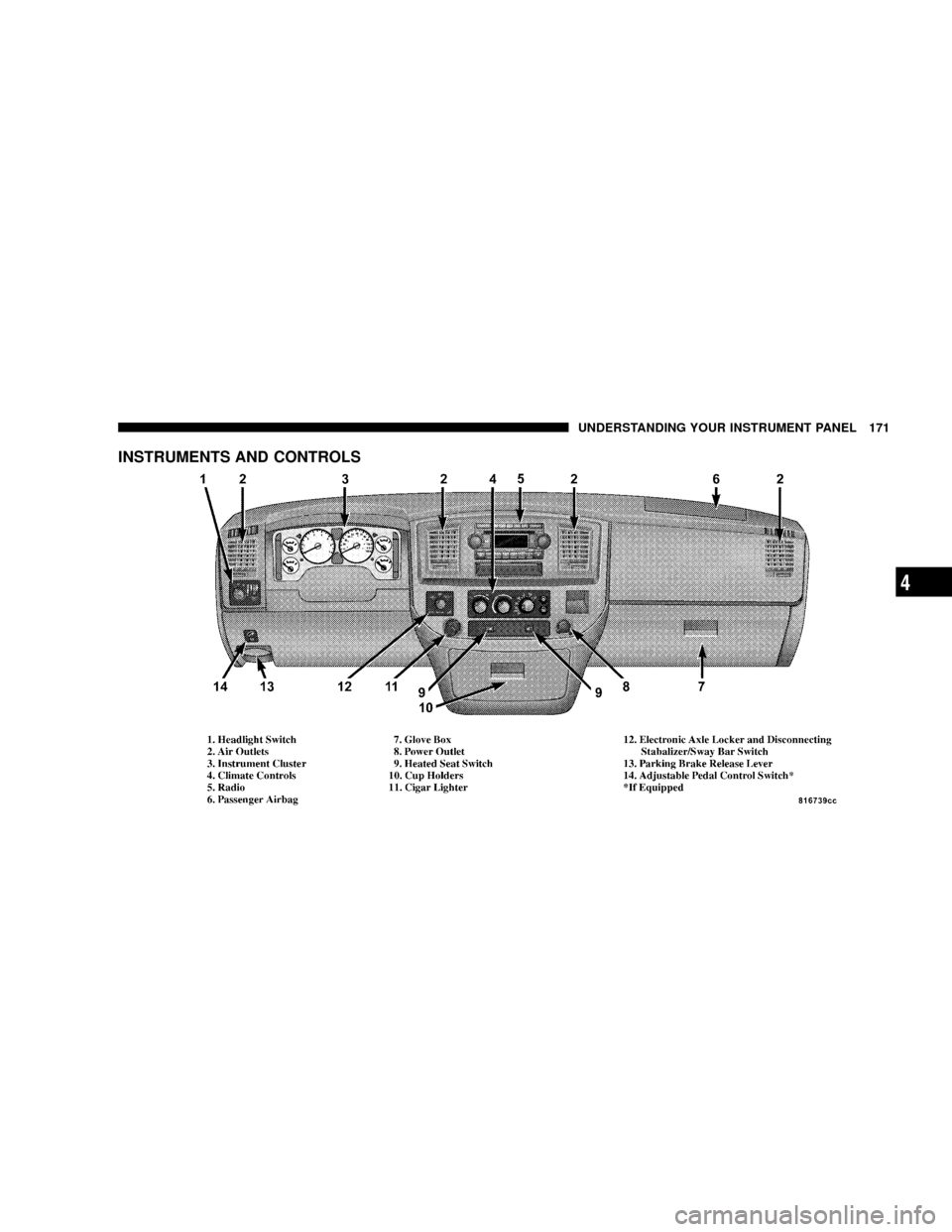
INSTRUMENTS AND CONTROLS
UNDERSTANDING YOUR INSTRUMENT PANEL 171
4
Page 173 of 492
INSTRUMENT CLUSTER
172 UNDERSTANDING YOUR INSTRUMENT PANEL
Page 174 of 492

INSTRUMENT CLUSTER DESCRIPTION
1. Check Gages
This light illuminates when the Voltmeter, Engine
Oil Pressure or Engine Coolant Temperature
gages indicate a reading either too high or too low.
Examine the gages carefully, and follow the instructions
above for each indicated problem.
NOTE:When the ignition switch is turned to OFF, the
Fuel Gage, Voltmeter, Oil Pressure and Engine Coolant
Temperature gages may not show accurate readings.
When the engine is not running, turn the ignition switch
to ON to obtain accurate readings.
2. Voltage Gauge
When the engine is running, the gauge indicates
the electrical system voltage. The pointer should
stay within the normal range if the battery is charged. Ifthe pointer moves to either extreme left or right and
remains there during normal driving, the electrical sys-
tem should be serviced.
NOTE:If the gauge pointer moves to either extreme of
the gauge, the ªCheck Gagesº indicator will illuminate
and a single chime will sound. The ªCheck Gagesº
indicator may also illuminate prior to the voltage gauge
moving out of normal range. In either case, see you local
authorized Dealer for system service.
3. Turn Signal Indicators
Lights in instrument cluster flash when outside turn
signals are operating.
4. Tachometer
The tachometer indicates engine speed in revolutions per
minute.
UNDERSTANDING YOUR INSTRUMENT PANEL 173
4