Page 239 of 492

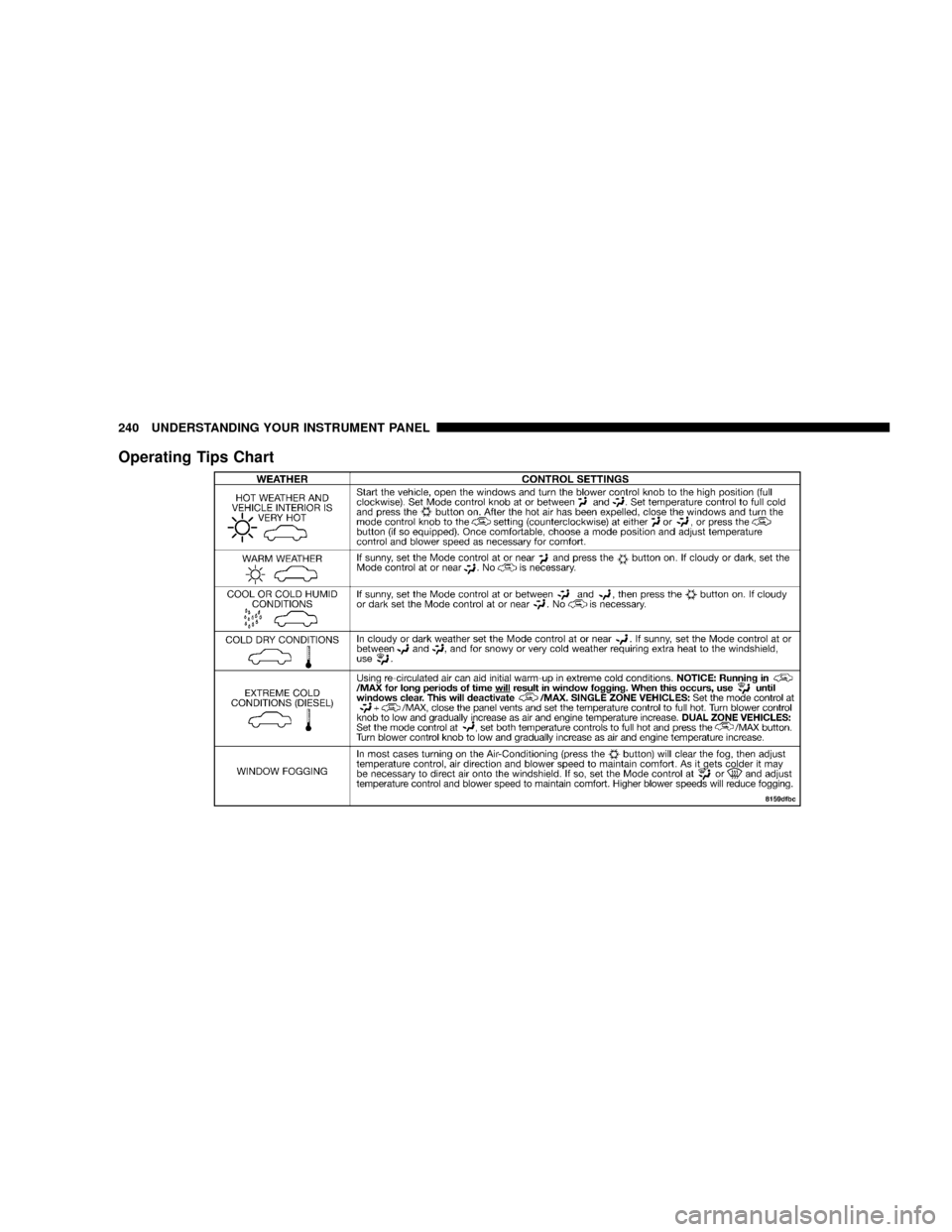
Window Fogging
Windows will fog on the inside when the humidity inside
the vehicle is high. This often occurs in mild or cool
temperatures when it's rainy or humid. In most cases
turning on the Air-conditioning (pressing the snowflake
button) will clear the fog. Adjust the temperature control,
air direction and blower speed to maintain comfort.
As the temperature gets colder it may be necessary to
direct air onto the windshield by using MIX Mode
position on the control. Adjust the temperature control
and blower speed to maintain comfort. Higher blower
speeds will reduce fogging. Interior fogging on the
windshield can be quickly removed by selecting the
defrost mode.
Regular cleaning of the inside of the windows with a
non-filming cleaning solution (vinegar and water works
very well) will help prevent contaminates (cigarettesmoke, perfumes, etc.) from sticking to the windows.
Contaminates increase the rate of window fogging.
Summer Operation
Air conditioned vehicles must be protected with a high
quality antifreeze coolant during summer to provide
proper corrosion protection and to raise the boiling point
of the coolant for protection against overheating. A 50 %
concentration is recommended. Refer to Recommended
Fluids and Genuine Parts for the proper coolant type.
When using the air conditioner in extremely heavy traffic
in hot weather especially when towing a trailer, addi-
tional engine cooling may be required. If this situation is
encountered, operate the transmission in a lower gear to
increase engine RPM, coolant flow and fan speed. When
stopped in heavy traffic, it may be necessary to shift into
NEUTRAL and depress the accelerator slightly for fast
idle operation to increase coolant flow and fan speed.
238 UNDERSTANDING YOUR INSTRUMENT PANEL
Page 240 of 492
NOTE:On models equipped with Diesel engines, the
idle speed will automatically increase to 1000 rpm at
elevated coolant temperatures to improve engine cooling.
Your air conditioning system is also equipped with an
automatic recirculation system. When the system senses
a heavy load or high heat conditions, it may use partial
Recirculation A/C mode to provide additional comfort.Winter Operation
When operating the system during the winter months,
make sure the air intake, located directly in front of the
windshield, is free of ice, slush, snow, or other obstruc-
tions.
UNDERSTANDING YOUR INSTRUMENT PANEL 239
4
Page 241 of 492
Operating Tips Chart
240 UNDERSTANDING YOUR INSTRUMENT PANEL
Page 251 of 492

WARNING!
It is dangerous to shift the selector lever out of ªPº or
ªNº if the engine speed is higher than idle speed. If
your foot is not firmly on the brake pedal, the
vehicle could accelerate quickly forward or in re-
verse. You could lose control of the vehicle and hit
someone or something. Only shift into gear when
the engine is idling normally and when your right
foot is firmly on the brake pedal.
Automatic Transmission with Overdrive
The gear shift selector display, located in the instrument
panel cluster, indicates the transmission gear range (the
selector is illuminated for night driving). The selector
lever is mounted on the right side of the steering column.
You must depress the brake pedal, to pull the selector
lever out of park (P) position (Brake Interlock System). To
drive, move the selector lever from Park or Neutral to thedesired drive position. Pull the selector lever toward you
when shifting into Reverse, Second, First or Park, or
when shifting out of Park.
Gear Ranges
DO NOT race the engine when shifting from Park or
Neutral position into another gear range.
ªPº Park
This gear position supplements the parking brake by
locking the transmission. The engine can be started in
this range. Never use Park while the vehicle is in motion.
Apply the parking brake when leaving the vehicle in this
range. Always apply parking brake first, then place the
selector in Park position. On 4-wheel-drive vehicles be
sure that the transfer case is in a drive position!
250 STARTING AND OPERATING
Page 268 of 492

Stabilizer/Sway Bar System
Power Wagon vehicles are equipped with an electronic
disconnecting stabilizer/sway bar. This system allows
greater front suspension travel in off-road situations.
This system is controlled by the electronic control sway
bar switch located on the instrument panel.The switch has two positions, on-road and off-road. The
system is normally in on-road mode, indicated by a solid
green light. The stabilizer/sway bar should remain in
on-road mode during normal driving conditions.
WARNING!
Do not disconnect the stabilizer bar and drive on
hard surfaced roads or at speeds above 18 MPH, you
may lose control of the vehicle, which could result in
serious injury. The front stabilizer bar enhances
vehicle stability and is necessary for maintaining
control of the vehicle. The system monitors vehicle
speed and will attempt to reconnect the stabilizer bar
at speeds over 18 MPH. This is indicated by a
flashing off road light and solid on road light. Once
vehicle speed is reduced below 14 MPH the system
will once again attempt to return to off road mode.
Electronic Control Sway Bar Switch
STARTING AND OPERATING 267
5
Page 309 of 492

vehicle's frame/tow hook and run the wire rope through
a snatch block. Disengage the clutch and, using the
snatch block, pull out enough wire to reach your anchor
point. Do not attach hook to mounting kit. Secure to the
anchor point with a tree trunk protector or choker chain.
Attach the clevis/shackle. Attach the shackle to the two
ends of the strap/chain, being careful not to over tighten
(tighten and back-off 1/2 turn).
PARKING BRAKE
The foot operated parking brake is positioned below the
lower left corner of the instrument panel. To release the
parking brake, pull the parking brake release handle.
NOTE:The instrument cluster red brake warning light
will come on and flash to indicate that the parking brake
is applied. You must be sure that the parking brake is
fully applied before leaving the vehicle.Be sure the parking brake is firmly set when parked and
the gear shift lever is in the PARK position. When
parking on a hill you should apply the parking brake
before placing the gear shift lever in PARK, otherwise the
load on the transmission locking mechanism may make it
difficult to move the selector out of PARK.
Parking Brake Release
308 STARTING AND OPERATING
Page 481 of 492

Passing............................. 124
Switch.............................. 120
Heated Mirrors.......................86,154
Heated Seats........................... 115
Heater............................... 230
Heater, Engine Block..................... 249
High Beam/Low Beam Select (Dimmer) Switch . . 124
Hitches
Trailer Towing........................ 349
Hoisting.............................. 375
HomeLinkt(Garage Door Opener) Transmitter . . . 139
Hood Release.......................... 117
Hoses................................ 408
Hub Caps............................. 373
Ignition............................... 13
Cables (Spark Plug Wires)................ 393
Key ...............................12,13
Wiring System (Spark Plug Wires).......... 393Ignition Key Removal..................... 13
Illuminated Entry........................ 20
Infant Restraint........................58,59
Inflation Pressure Tires.................... 332
Inside Rearview Mirror.................... 83
Instrument Cluster....................172,173
Instrument Panel and Controls.............. 171
Instrument Panel Lens Cleaning............. 424
Integrated Power Module (Fuses)............ 425
Interior Appearance Care.................. 423
Interior Lights.......................... 119
Intermittent Wipers (Delay Wipers)........... 125
Introduction............................. 4
Jack Location........................... 367
Jack Operation.......................... 369
Jump Starting.......................... 375
Key, Replacement........................ 17
480 INDEX