Page 259 of 400
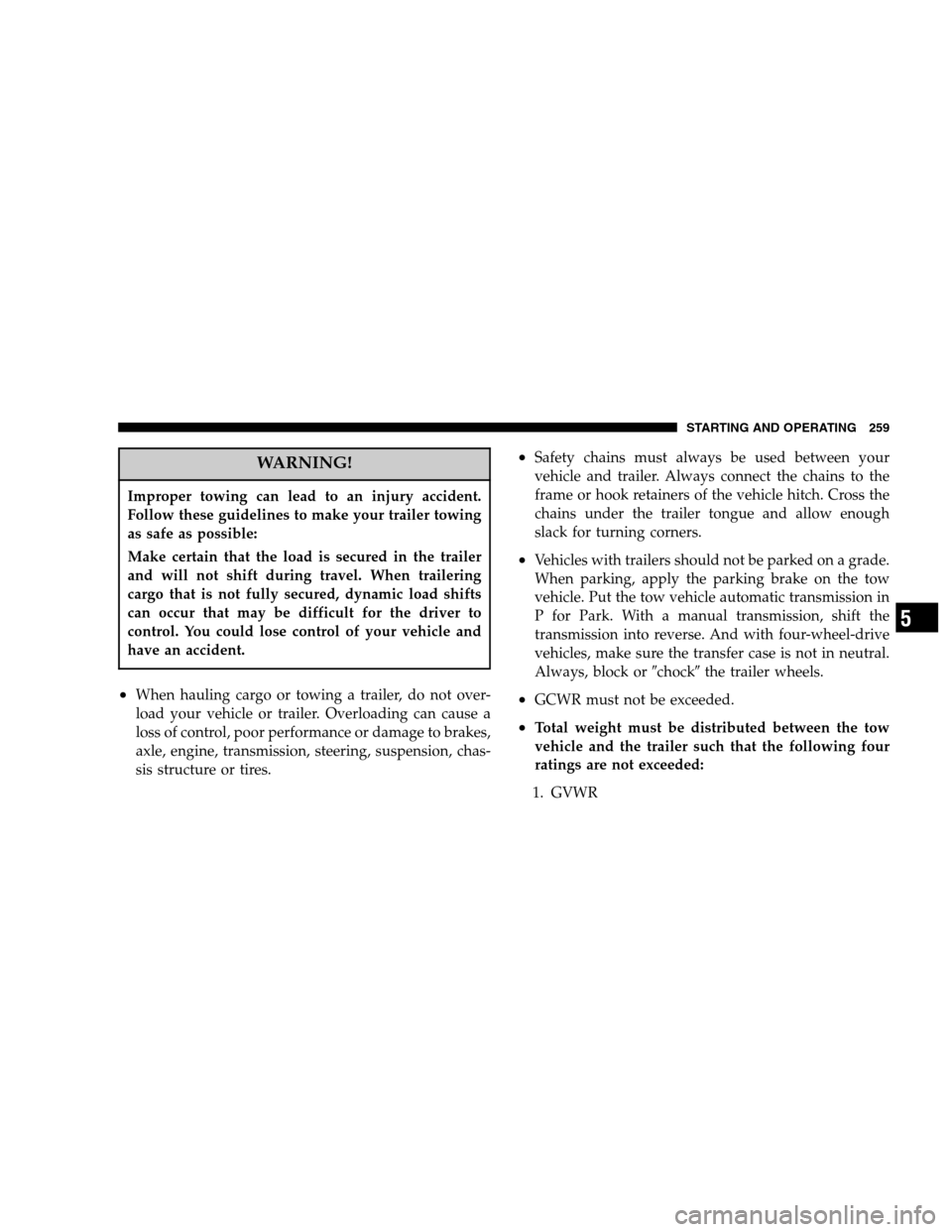
WARNING!
Improper towing can lead to an injury accident.
Follow these guidelines to make your trailer towing
as safe as possible:
Make certain that the load is secured in the trailer
and will not shift during travel. When trailering
cargo that is not fully secured, dynamic load shifts
can occur that may be difficult for the driver to
control. You could lose control of your vehicle and
have an accident.
•When hauling cargo or towing a trailer, do not over-
load your vehicle or trailer. Overloading can cause a
loss of control, poor performance or damage to brakes,
axle, engine, transmission, steering, suspension, chas-
sis structure or tires.
•Safety chains must always be used between your
vehicle and trailer. Always connect the chains to the
frame or hook retainers of the vehicle hitch. Cross the
chains under the trailer tongue and allow enough
slack for turning corners.
•Vehicles with trailers should not be parked on a grade.
When parking, apply the parking brake on the tow
vehicle. Put the tow vehicle automatic transmission in
P for Park. With a manual transmission, shift the
transmission into reverse. And with four-wheel-drive
vehicles, make sure the transfer case is not in neutral.
Always, block or�chock�the trailer wheels.
•GCWR must not be exceeded.
•Total weight must be distributed between the tow
vehicle and the trailer such that the following four
ratings are not exceeded:
1. GVWR
STARTING AND OPERATING 259
5
Page 272 of 400
HAZARD WARNING FLASHER
The flasher switch is on the top of the steering column,
just behind the steering wheel. Press the flasher switch
and all front and rear directional signals will flash
intermittently.
Press the switch a second time to turn off the emergency
flashers.This is an emergency warning system and should not be
used when the vehicle is in motion. Use it when your
vehicle is disabled and is creating a safety hazard for
other motorists.
If it is necessary to leave the vehicle to go for service, the
flasher system will continue to operate with the ignition
key removed and the vehicle locked.
ADDING FUEL
If using a portable fuel container, it should have a flexible
nozzle long enough to reach past the restriction in the
fuel filler tube.
272 WHAT TO DO IN EMERGENCIES
Page 289 of 400
MAINTAINING YOUR VEHICLE
CONTENTS
�3.7L/4.7L Engine Compartment.............292
�Onboard Diagnostic System — OBD II........293
▫Loose Fuel Filler Cap Message............293
�Emissions Inspection And Maintenance
Programs............................294
�Replacement Parts......................295
�Dealer Service.........................296
�Maintenance Procedures..................296
▫Engine Oil..........................297▫Engine Oil Filter......................300
▫Drive Belts — Check Condition And Tension . . 301
▫Spark Plugs.........................301
▫Engine Air Cleaner Filter................302
▫Engine Fuel Filter.....................302
▫Catalytic Converter....................302
▫Maintenance Free Battery................304
▫Air Conditioner Maintenance.............305
▫Power Steering — Fluid Check............306
7
Page 306 of 400
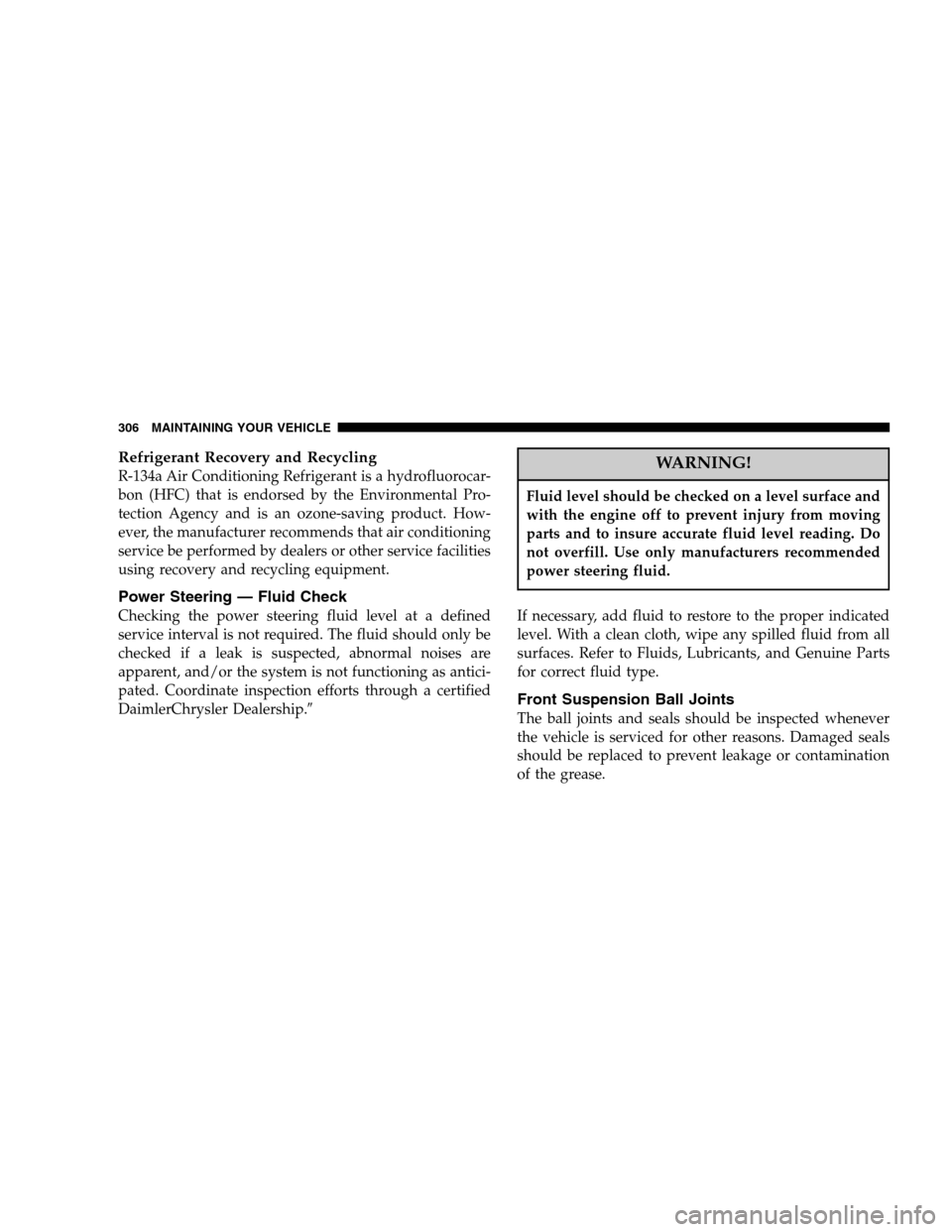
Refrigerant Recovery and Recycling
R-134a Air Conditioning Refrigerant is a hydrofluorocar-
bon (HFC) that is endorsed by the Environmental Pro-
tection Agency and is an ozone-saving product. How-
ever, the manufacturer recommends that air conditioning
service be performed by dealers or other service facilities
using recovery and recycling equipment.
Power Steering — Fluid Check
Checking the power steering fluid level at a defined
service interval is not required. The fluid should only be
checked if a leak is suspected, abnormal noises are
apparent, and/or the system is not functioning as antici-
pated. Coordinate inspection efforts through a certified
DaimlerChrysler Dealership.�
WARNING!
Fluid level should be checked on a level surface and
with the engine off to prevent injury from moving
parts and to insure accurate fluid level reading. Do
not overfill. Use only manufacturers recommended
power steering fluid.
If necessary, add fluid to restore to the proper indicated
level. With a clean cloth, wipe any spilled fluid from all
surfaces. Refer to Fluids, Lubricants, and Genuine Parts
for correct fluid type.
Front Suspension Ball Joints
The ball joints and seals should be inspected whenever
the vehicle is serviced for other reasons. Damaged seals
should be replaced to prevent leakage or contamination
of the grease.
306 MAINTAINING YOUR VEHICLE
Page 347 of 400
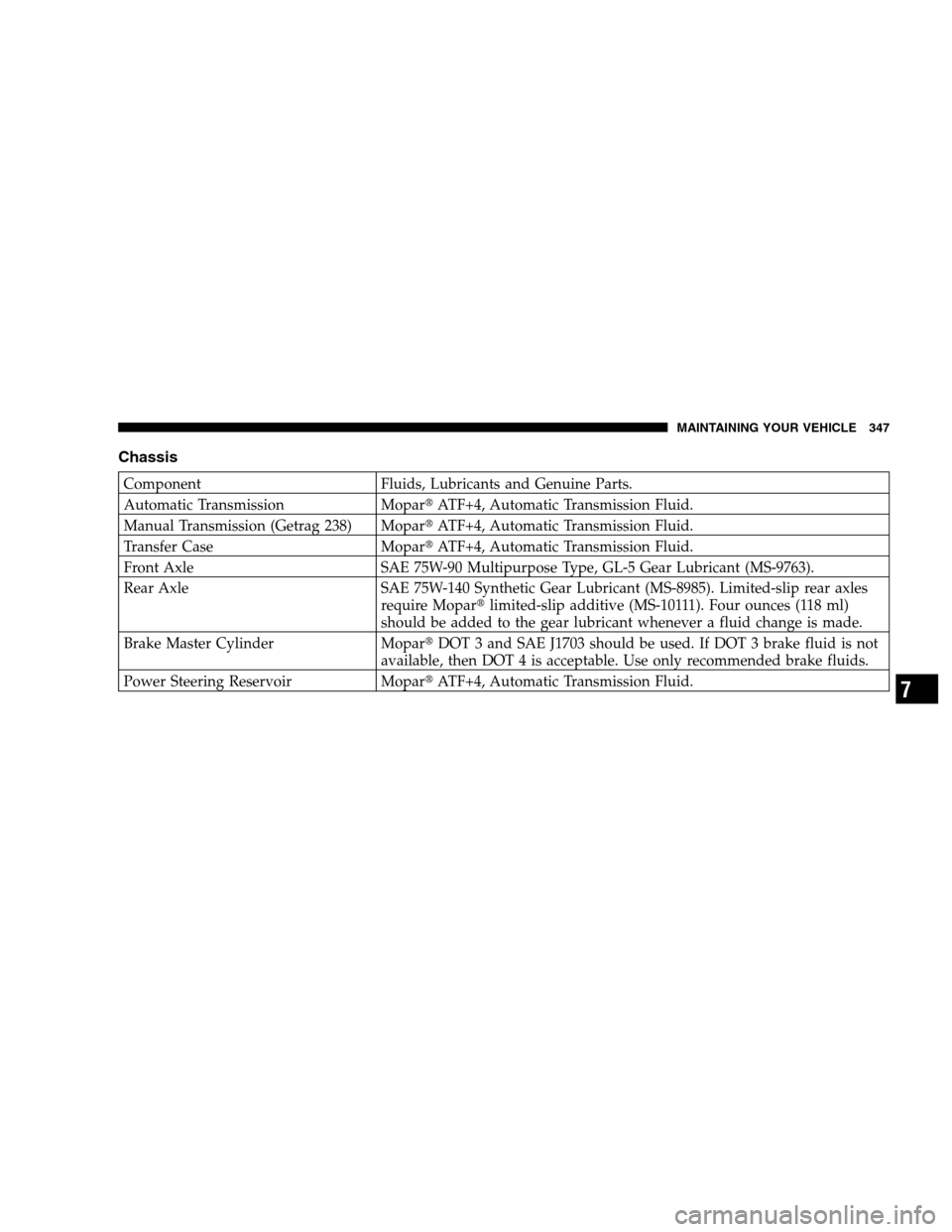
Chassis
Component Fluids, Lubricants and Genuine Parts.
Automatic Transmission Mopar�ATF+4, Automatic Transmission Fluid.
Manual Transmission (Getrag 238) Mopar�ATF+4, Automatic Transmission Fluid.
Transfer Case Mopar�ATF+4, Automatic Transmission Fluid.
Front Axle SAE 75W-90 Multipurpose Type, GL-5 Gear Lubricant (MS-9763).
Rear Axle SAE 75W-140 Synthetic Gear Lubricant (MS-8985). Limited-slip rear axles
require Mopar�limited-slip additive (MS-10111). Four ounces (118 ml)
should be added to the gear lubricant whenever a fluid change is made.
Brake Master Cylinder Mopar�DOT 3 and SAE J1703 should be used. If DOT 3 brake fluid is not
available, then DOT 4 is acceptable. Use only recommended brake fluids.
Power Steering Reservoir Mopar�ATF+4, Automatic Transmission Fluid.
MAINTAINING YOUR VEHICLE 347
7
Page 379 of 400

Axle Lubrication (Axle Fluid)............... 321
BallJoints ............................. 306
Battery............................... 304
Charging............................ 283
Emergency Starting..................... 283
Gas Caution.......................... 283
Keyless Transmitter Replacement (RKE)....... 25
Saving Feature (Protection)................ 91
Belts,Drive ............................ 301
Belts, Seat.............................. 35
Body Mechanism Lubrication............... 307
B-Pillar Location........................ 222
Brake Fluid............................ 347
Brake System........................213,316
Anti-Lock (ABS)....................213,214
Disc Brakes.......................... 316
Fluid Check.......................... 316
Hoses.............................. 317Master Cylinder....................... 316
Parking............................. 212
Warning Light.....................139,141
Brake/Transmission Interlock............... 191
Break-In Recommendations, New Vehicle........ 71
Bulb Replacement....................... 333
Bulbs,Light ............................ 332
Calibration, Compass..................... 107
Camper............................... 128
Capacities, Fluid........................ 345
Caps, Filler
Oil (Engine).......................... 299
Power Steering........................ 306
Radiator (Coolant Pressure)............... 312
Car Washes............................ 323
Carbon Monoxide Warning..............129,242
CargoLight ............................ 94
Cargo (Vehicle Loading)................... 247
INDEX 379
10
Page 381 of 400

Selection of Coolant (Antifreeze)...... 311,345,346
Temperature Gauge..................... 136
Cruise Control (Speed Control)............... 99
CupHolder ............................ 123
Customer Assistance..................... 370
Data Recorder, Event...................... 56
Daytime Running Lights................... 93
Dealer Service.......................... 296
Defroster, Rear Window................... 124
Defroster, Windshield................... 73,177
Delay (Intermittent) Wipers................. 97
Diagnostic System, Onboard................ 293
Differential, Limited-Slip.................. 210
Dimmer Switch, Headlight................. 137
Dipsticks
Automatic Transmission................. 318
Oil (Engine).......................... 297
Power Steering........................ 306Disarming, Theft System................... 18
Disc Brakes............................ 316
Disposal
Antifreeze (Engine Coolant)............... 313
Door Locks............................. 27
Door Opener, Garage..................... 110
DriveBelts ............................ 301
Drive Shaft Universal Joints................ 307
E-85 Fuel............................. 245
Electric Remote Mirrors.................... 81
Electrical Power Outlets................... 119
Electronic Speed Control (Cruise Control)....... 99
Emergency, In Case of
FreeingVehicleWhenStuck ............... 217
Jacking............................. 278
Tow Hooks.......................... 285
Towing ............................. 286
Emission Control System Maintenance......... 350
INDEX 381
10
Page 383 of 400

Maintenance.......................... 247
Replacement Parts..................... 247
Starting............................. 246
Flooded Engine Starting................... 188
Floor Console.......................... 121
Fluid, Brake........................... 347
Fluid Capacities......................... 345
Fluid Level Checks
Automatic Transmission................. 318
Brake............................... 316
Engine Oil........................... 297
Power Steering........................ 306
Transfer Case......................... 321
Fluids, Lubricants and Genuine Parts.......... 346
Fog Lights........................... 93,345
Four Wheel Drive....................... 199
Operation........................... 199
Four-Way Hazard Flasher.................. 272
Freeing A Stuck Vehicle................... 217FrontAxle(Differential) ................... 322
Fuel................................. 238
Adding............................. 243
Filter ............................... 302
Gauge.............................. 136
Octane Rating......................238,346
Requirements......................238,345
Tank Capacity........................ 345
Fuel, Flexible.............See Flexible Fuel Vehicles
Fueling ............................... 243
Fuses................................ 327
Garage Door Opener (HomeLink�) ........... 110
Gas Cap (Fuel Filler Cap)...............244,293
Gas Gauge (Fuel Gauge)................... 136
Gasoline (Fuel)......................... 238
Gasoline, Reformulated................... 239
Gauges
Coolant Temperature.................... 136
INDEX 383
10