Page 314 of 464

Monitoring Lamp to be ON, and a Chime will sound.
This sequence will repeat for every key cycle until the
original Tire Pressure Monitoring System tire has been
properly repaired (or replaced) and put back on the
vehicle in place of the compact spare tire.
Tire Pressure Monitoring Premium System – If
Equipped
The Tire Pressure Monitor System (TPMS) uses wireless
technology with wheel rim mounted electronic sensors to
monitor tire pressure levels. Sensors, mounted to each
wheel as part of the valve stem, transmit tire pressure
readings to the Receiver Module.
NOTE:It is particularly important, for you to check the
tire pressure in all of your tires regularly and to maintain
the proper pressure.
The Tire Pressure Monitor System (TPMS) consists of the
following components:
•Receiver Module
•4 Wheel Sensors
•Wheel Sensor Trigger Modules (mounted in three of
the four wheel wells)
•Various Tire Pressure Monitoring System Messages,
which display in the Electronic Vehicle Information
Center (EVIC)
•Yellow Tire Pressure Monitoring Telltale Light
Tire Pressure Monitoring Low Pressure Warnings
The Tire Pressure Monitoring System Telltale Lamp will
illuminate in the instrument cluster, and an audible
chime will be activated when one or more of the four
active road tire pressures are low. The audible chime will
sound once every ignition cycle for each condition that it
detects. In addition, the Electronic Vehicle Information
Center (EVIC) will show a graphic display of the pressure
value(s) with the low tire(s) flashing.
314 STARTING AND OPERATING
Page 316 of 464

NOTE:Your vehicle is equipped with a compact spare
wheel and tire assembly that does not have a tire pressure
monitoring sensor. Therefore, it will not be monitored by
the Tire Pressure Monitoring System. In the event that a
compact spare tire is used to replace a low pressure road
tire, the next ignition key cycle will still show the Tire
Pressure Monitoring Lamp to be ON, a Chime will
sound, and the Electronic Vehicle Information Center
(EVIC) will still show the low tire pressure value flashing
on the graphic display. This sequence will repeat for
every key cycle until the original Tire Pressure Monitor-
ing System (TPMS) tire has been properly repaired (or
replaced) and put back on the vehicle in place of the
compact spare tire.CAUTION!
The Tire Pressure Monitoring System (TPMS) has
been optimized for the original equipment tires and
wheels. TPMS pressures have been established for
the tire size equipped on your vehicle. Undesirable
system operation or sensor damage may result when
using replacement equipment that is not of the same
size, type, and/or style. After-market wheels can
cause sensor damage. Do not use tire sealant from a
can, or balance beads if your vehicle is equipped
with a TPMS, as damage to the sensors may result.
316 STARTING AND OPERATING
Page 343 of 464
WHAT TO DO IN EMERGENCIES
CONTENTS
�Hazard Warning Flasher..................344
�If Your Engine Overheats.................345
�Jacking And Tire Changing................346
▫Jack Location........................346
▫Spare Tire Stowage....................348
▫Preparations For Jacking................349
▫Jacking Instructions....................350
�Jump-Starting Procedure..................354�Freeing A Stuck Vehicle..................356
�Towing A Disabled Vehicle................357
▫With Ignition Key.....................357
▫Without The Ignition Key...............358
▫Towing This Vehicle Behind Another Vehicle
(Flat Towing With All Four Wheels On The
Ground)............................358
▫Towing This Vehicle Behind Another Vehicle
With A Tow Dolly.....................359
6
Page 349 of 464
CAUTION!
The winch mechanism is designed for use with the
jack handle only. Use of an air wrench or other
power tools is not recommended and can damage the
winch.
When the spare is clear, tilt the retainer at the end of the
cable and pull it through the center of the wheel.
Preparations For Jacking
Park the vehicle on a firm level surface, avoid ice or
slippery areas,set the parking brakeand place the gear
selector in PARK. Turn OFF the ignition.
WARNING!
Do not attempt to change a tire on the side of the
vehicle close to moving traffic. Pull far enough off
the road to avoid the danger of being hit when
operating the jack or changing the wheel.
•Turn on the Hazard Warning Flasher.
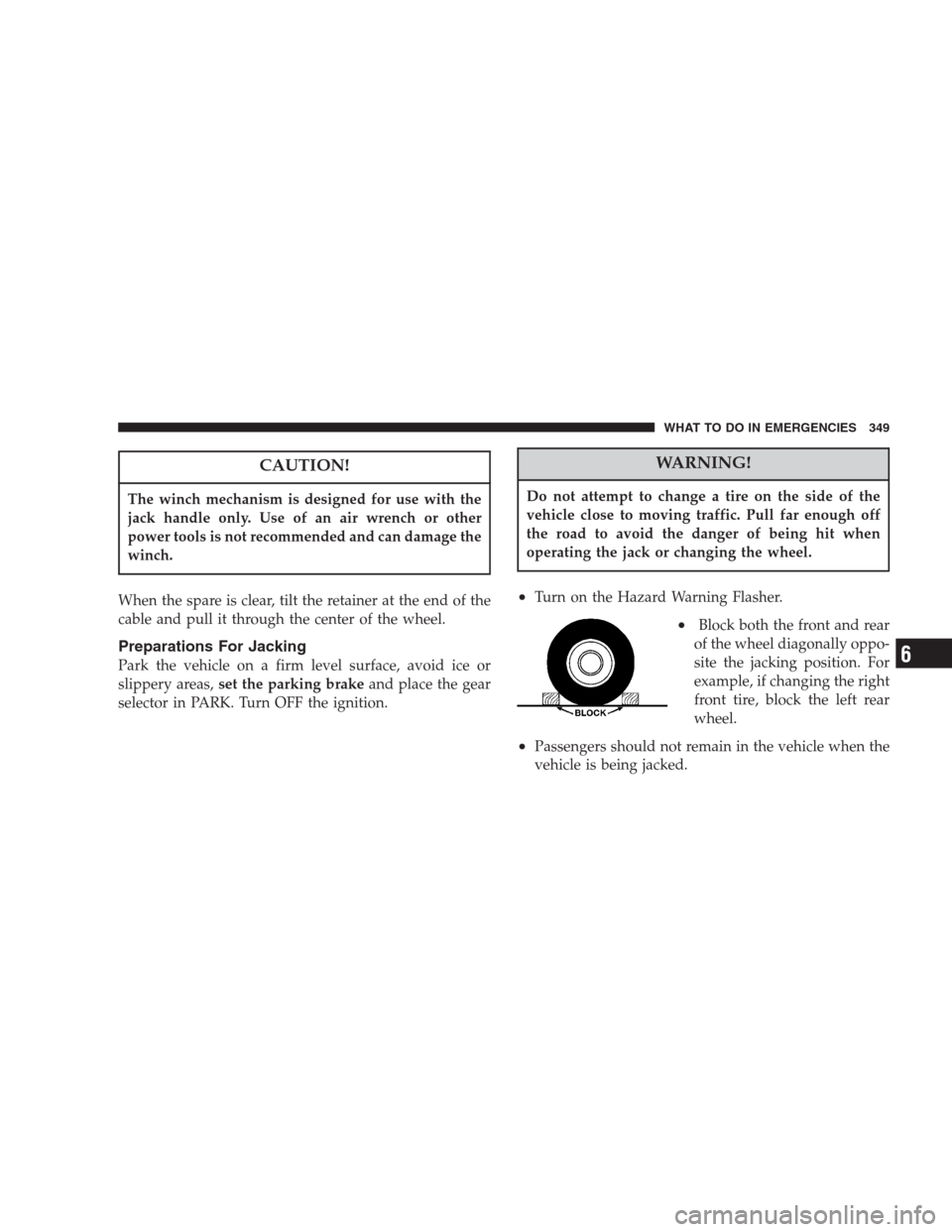
•Block both the front and rear
of the wheel diagonally oppo-
site the jacking position. For
example, if changing the right
front tire, block the left rear
wheel.
•Passengers should not remain in the vehicle when the
vehicle is being jacked.
WHAT TO DO IN EMERGENCIES 349
6
Page 350 of 464
Jacking Instructions
WARNING!
•Getting under a jacked-up vehicle is dangerous.
The vehicle could slip off the jack and fall on you.
You could be crushed. Never get any part of your
body under a vehicle that is on a jack. Never start
or run the engine while the vehicle is on a jack. If
you need to get under a raised vehicle, take it to a
service center where it can be raised on a lift.
•The jack is designed to use as a tool for changing
tires only. The jack should not be used to lift the
vehicle for service purposes. The vehicle should
be jacked on a firm level surface only. Avoid ice or
slippery areas.
WARNING!
Carefully follow these tire changing warnings to help
prevent personal injury or damage to your vehicle:
•Always park on a firm, level surface as far from the edge
of the roadway as possible before raising the vehicle.
•Block the wheel diagonally opposite the wheel to be
raised.
•Apply the parking brake firmly before jacking.
•Never start the engine with the vehicle on a jack.
•Do not let anyone sit in the vehicle when it is on a jack.
•Do not get under the vehicle when it is on a jack.
•Only use the jack in the positions indicated.
•If working on or near a roadway, be extremely careful
of motor traffic.
•To assure that spare tires, flat or inflated are securely
stowed, spares must be stowed with the value stem
facing the ground.
350 WHAT TO DO IN EMERGENCIES
Page 351 of 464
1. Remove the spare wheel, scissors jack and jack-handle
from stowage.
2. Carefully pry off the wheel center cap if equipped,
using the tip of the jack handle.
3. Loosen (but do not remove) the wheel lug nuts by
turning them to the left one turn while the wheel is still
on the ground.
NOTE:Do not oil wheel studs. For chrome wheels, do
not substitute with chrome plated wheel nuts.
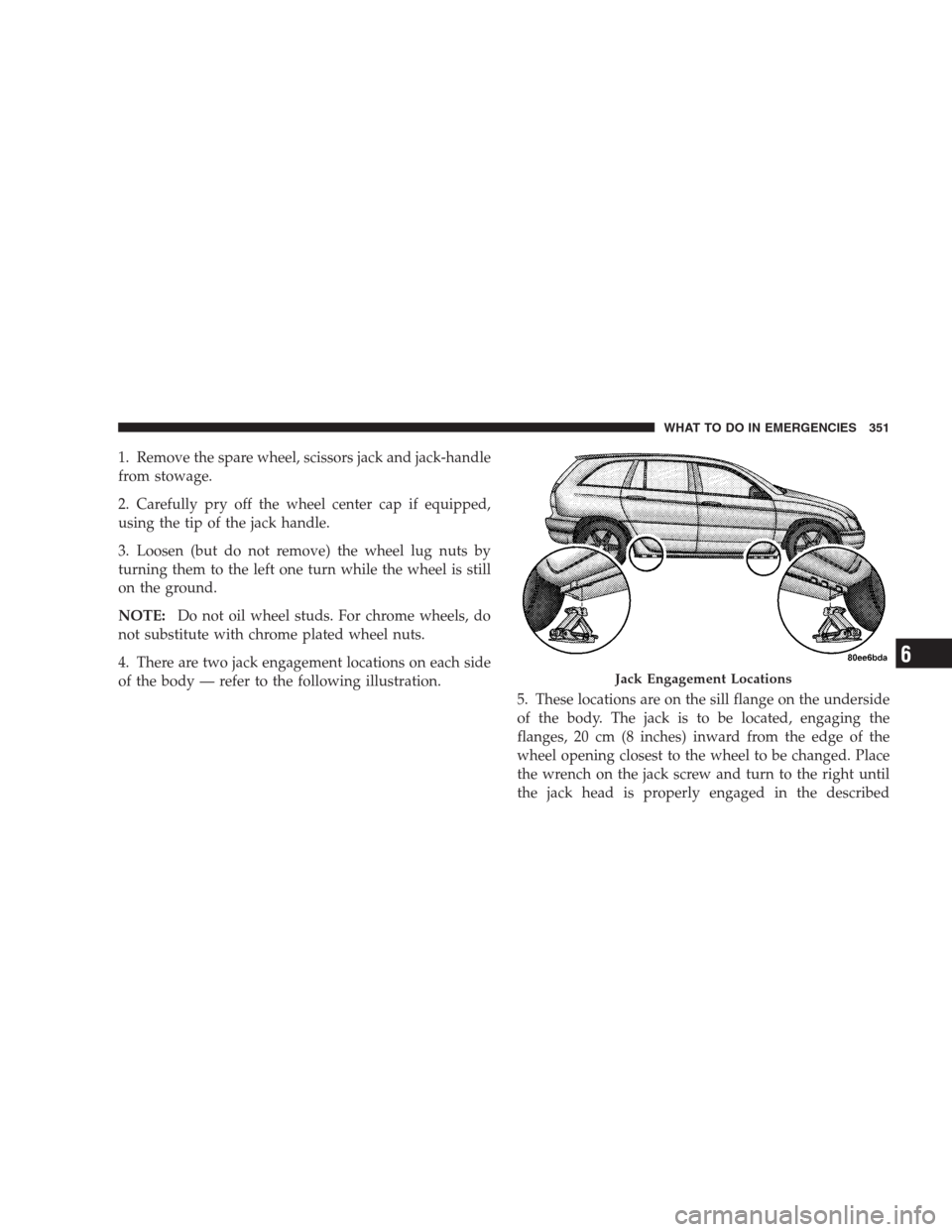
4. There are two jack engagement locations on each side
of the body — refer to the following illustration.
5. These locations are on the sill flange on the underside
of the body. The jack is to be located, engaging the
flanges, 20 cm (8 inches) inward from the edge of the
wheel opening closest to the wheel to be changed. Place
the wrench on the jack screw and turn to the right until
the jack head is properly engaged in the described
Jack Engagement Locations
WHAT TO DO IN EMERGENCIES 351
6
Page 352 of 464
location.Do not raise the vehicle until you are sure the
jack is securely engaged. Never jack up the vehicle
using any suspension components.
6. Raise the vehicle by turning the jack screw to the right,
using the swivel wrench. Raise the vehicle only until the
tire just clears the surface and enough clearance is
obtained to install the spare tire. Minimum tire lift
provides maximum stability.
WARNING!
Raising the vehicle higher than necessary can make
the vehicle less stable. It could slip off the jack and
hurt someone near it. Raise the vehicle only enough
to remove the tire.
7. Remove the wheel lug nuts, for vehicles with wheel
covers, remove the cover from the wheel by hand. Do not
pry the wheel cover off. Then pull the wheel off the hub.
8. Install the spare wheel, for vehicles with wheel covers,
align the notch in the wheel cover with the valve stem on
the wheel. Install the cover on the wheel by hand only
and install the wheel lug nuts with the cone shaped end
of the nut toward the wheel. Lightly tighten the lug nuts.
To avoid the risk of forcing the vehicle off the jack, do not
tighten the lug nuts fully until the vehicle has been
lowered.
NOTE:Do not install the wheel cover on the compact
spare.
Do not use a hammer or force to install the wheel covers.
9. Lower the vehicle by turning the jack screw to the left.
10. Finish tightening the lug nuts. Push down on the
wrench while tightening for increased leverage. Alternate
352 WHAT TO DO IN EMERGENCIES
Page 353 of 464

lug nuts until each nut has been tightened twice. Correct
wheel nut tightness is 130 N·m (95 ft. lbs). If in doubt
about the correct tightness, have them checked with a
torque wrench by your dealer or at a service station.
11. Lower the jack to its fully closed position.
WARNING!
A loose tire or jack, thrown forward in a collision or
hard stop could endanger the occupants of the ve-
hicle. Always stow the jack parts and the spare tire in
the places provided.
12. Secure the flat or spare tire as follows:
•If your vehicle is equipped with cast aluminum
wheels, the center cap of the wheel must be re-
moved prior to flat tire stowage. Store the center cap
inside the glove box or other storage compartment.
•Turn the wheel so that the valve-stem is down. Slide
the wheel retainer through the center of the wheel
and position it properly across the wheel opening.
•For convenience in checking the spare tire inflation,
stow with the valve-stem toward the rear of the
vehicle.
•Using the jack-handle, rotate the drive nut to the
right until the wheel is drawn into place against the
underside of the vehicle.
•Continue to rotate the nut until you hear the mecha-
nism click three times. It cannot be overtightened.
Push against the tire several times to be sure it is
securely in place.
13. Stow the jack and jack handle.
14. Check the tire pressure as soon as possible. Correct
pressure as required.
WHAT TO DO IN EMERGENCIES 353
6