Page 69 of 464
•Rearward-facing child seats mustNEVERbe used in
the front seat of a vehicle with a front passenger
airbag. An airbag deployment could cause severe
injury or death to infants in this position.
Older Children and Child Restraints
Children who weigh more than 20 lbs (9 kg) and who are
older than one year can ride forward-facing in the
vehicle. Forward-facing child seats and convertible child
seats used in the forward-facing direction are for children
who weigh 20 to 40 lbs (9 to 18 kg) and who are older
than one year. These child seats are also held in the
vehicle by the lap/shoulder belt or the LATCH child
restraint anchorage system. Refer to “Lower Anchors and
Tether for CHildren (LATCH)” later in this section.
The belt-positioning booster seat is for children weighing
more than 40 lbs (18 kg), but who are still too small to fit
the vehicle’s seat belts properly. If the child can not sit
with knees bent over the vehicles seat cushion while thechild’s back is against the seat back, they should use a
belt-positioning booster seat. The child and booster seat
are held in the vehicle by the lap/shoulder belt.
Children Too Large For Booster Seats
Children who are large enough to wear the shoulder belt
comfortably, and whose legs are long enough to bend
over the front of the seat when their back is against the
seatback, should use the lap/shoulder belt in a rear seat.
•Make sure that the child is upright in the seat.
•The lap portion should be low on the hips and as snug
as possible.
•Check belt fit periodically. A child’s squirming or
slouching can move the belt out of position.
•If the shoulder belt contacts the face or neck, move the
child closer to the center of the vehicle. If this doesn’t
help, move the child to the center rear seating position
THINGS TO KNOW BEFORE STARTING YOUR VEHICLE 69
2
Page 71 of 464

shoulder portion of the lap/shoulder belt will tighten
the belt. The cinching latch plate will keep the belt
tight, however, any seat belt system will loosen with
time, so check the belt occasionally and pull it tight if
necessary.
•In the rear seat, you may have trouble tightening the
lap/shoulder belt on the child restraint because the
buckle or latch plate is too close to the belt path
opening on the restraint. Disconnect the latch plate
from the buckle and twist the short buckle end of the
belt several times to shorten it. Insert the latch plate
into the buckle with the release button facing out.
•If the belt still can’t be tightened, or if pulling and
pushing on the restraint loosens the belt, disconnect
the latch plate from the buckle, turn the buckle
around, and insert the latch plate into the buckle
again. If you still can’t make the child restraint secure,
try a different seating position.
•Buckle the child into the seat according to the child
restraint manufacturer’s directions.
•When your child restraint is not in use, secure it in the
vehicle with the seat belt or remove it from the vehicle.
Don’t leave it loose in the vehicle. In a sudden stop or
collision, it could strike the occupants or seatbacks and
cause serious personal injury.
Lower Anchors and Tether for CHildren (LATCH)
Each vehicle is equipped with two child restraint anchor-
age systems called LATCH, which stands for Lower
Anchors and Tether for CHildren. The LATCH child
restraint anchorage systems are installed on second-row
seats only. LATCH child restraint anchorage systems are
not provided on the six passenger third row seats.
THINGS TO KNOW BEFORE STARTING YOUR VEHICLE 71
2
Page 72 of 464
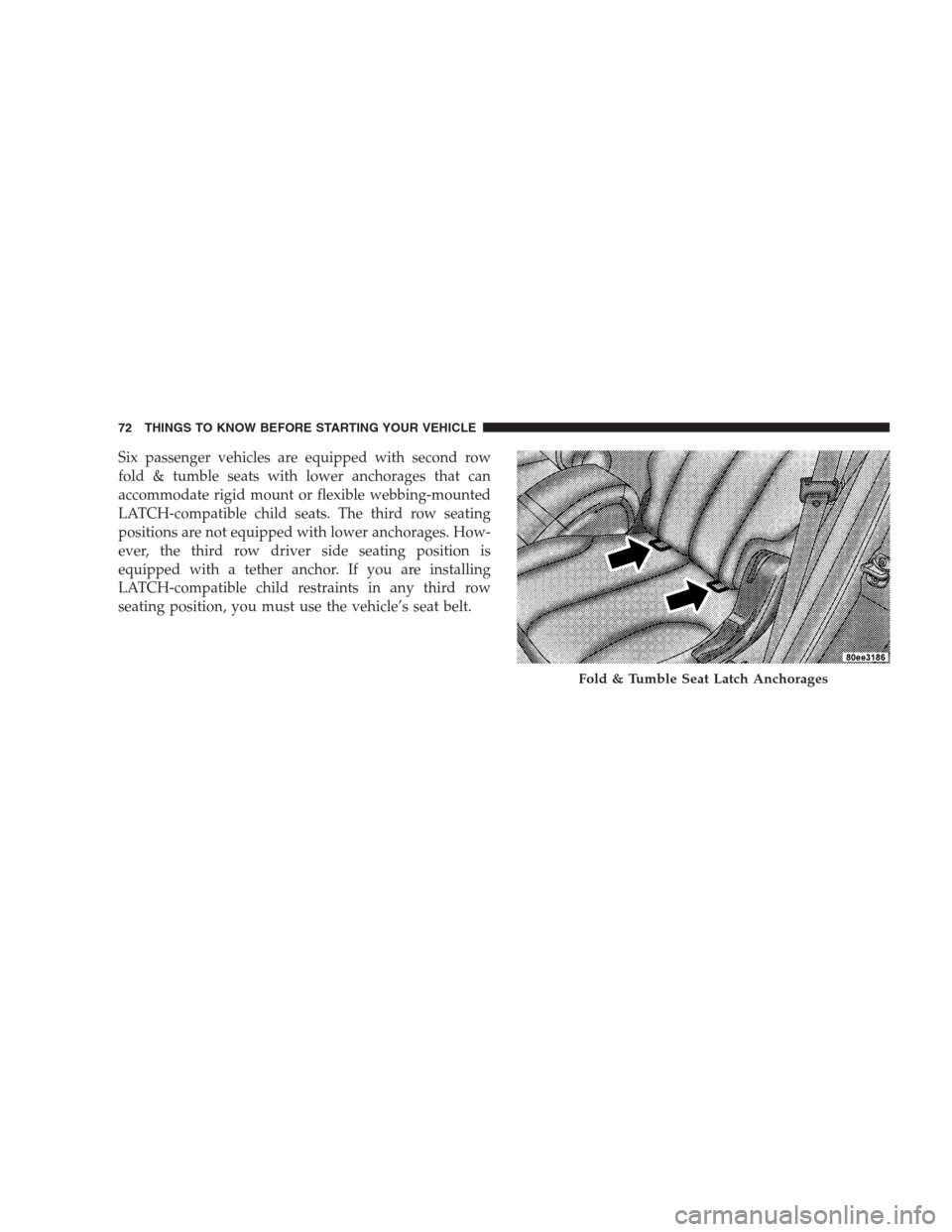
Six passenger vehicles are equipped with second row
fold & tumble seats with lower anchorages that can
accommodate rigid mount or flexible webbing-mounted
LATCH-compatible child seats. The third row seating
positions are not equipped with lower anchorages. How-
ever, the third row driver side seating position is
equipped with a tether anchor. If you are installing
LATCH-compatible child restraints in any third row
seating position, you must use the vehicle’s seat belt.
Fold & Tumble Seat Latch Anchorages
72 THINGS TO KNOW BEFORE STARTING YOUR VEHICLE
Page 73 of 464
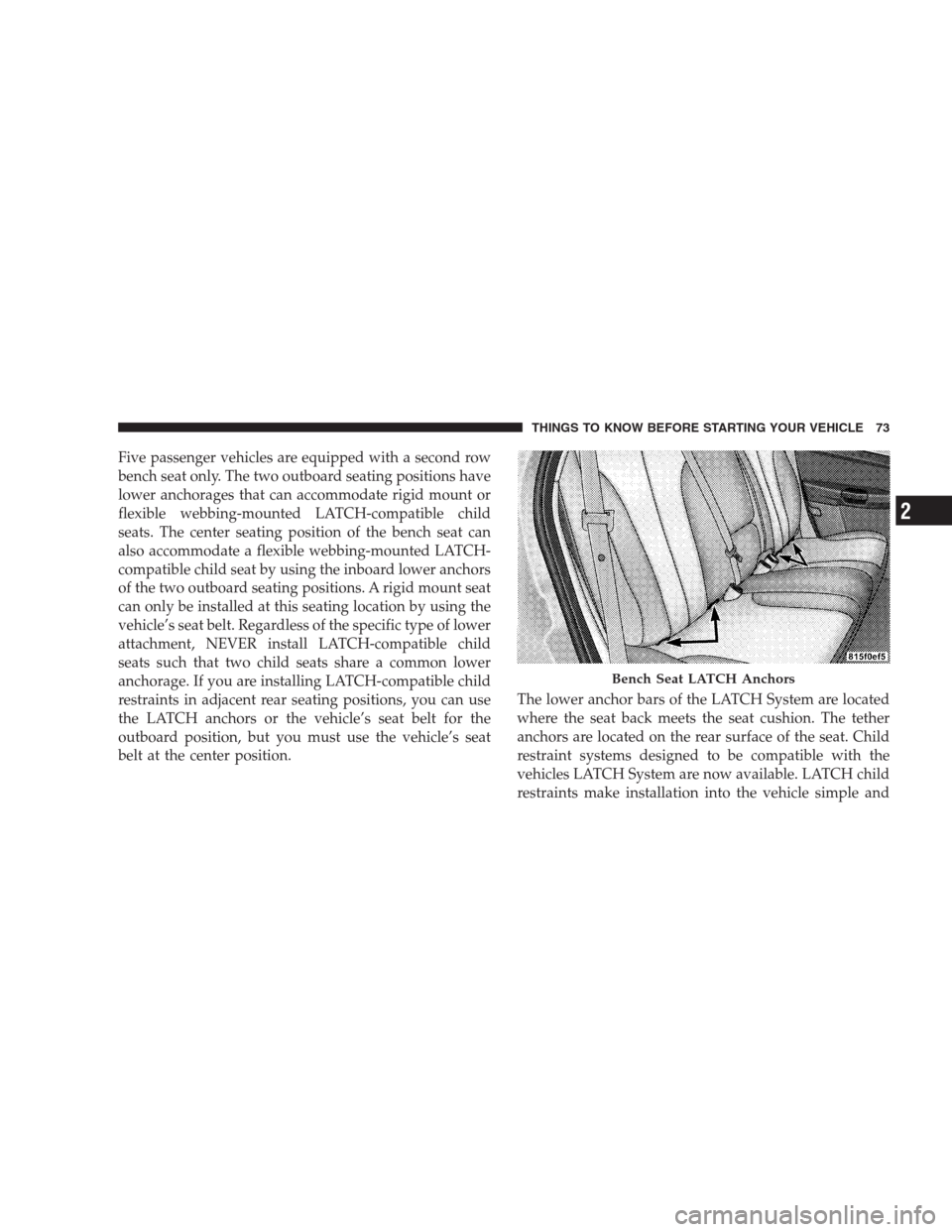
Five passenger vehicles are equipped with a second row
bench seat only. The two outboard seating positions have
lower anchorages that can accommodate rigid mount or
flexible webbing-mounted LATCH-compatible child
seats. The center seating position of the bench seat can
also accommodate a flexible webbing-mounted LATCH-
compatible child seat by using the inboard lower anchors
of the two outboard seating positions. A rigid mount seat
can only be installed at this seating location by using the
vehicle’s seat belt. Regardless of the specific type of lower
attachment, NEVER install LATCH-compatible child
seats such that two child seats share a common lower
anchorage. If you are installing LATCH-compatible child
restraints in adjacent rear seating positions, you can use
the LATCH anchors or the vehicle’s seat belt for the
outboard position, but you must use the vehicle’s seat
belt at the center position.The lower anchor bars of the LATCH System are located
where the seat back meets the seat cushion. The tether
anchors are located on the rear surface of the seat. Child
restraint systems designed to be compatible with the
vehicles LATCH System are now available. LATCH child
restraints make installation into the vehicle simple and
Bench Seat LATCH Anchors
THINGS TO KNOW BEFORE STARTING YOUR VEHICLE 73
2
Page 78 of 464
WARNING!
Improper installation of a child restraint to the
LATCH anchorages can lead to failure of an infant or
child restraint. The child could be badly injured or
killed. Follow the manufacturer’s directions exactly
when installing an infant or child restraint.
Children Too Large For Booster Seats
Children who are large enough to wear the shoulder belt
comfortably, and whose legs are long enough to bend
over the front of the seat when their back is against the
seatback, should use the lap/shoulder belt in a rear seat.
•Make sure that the child is upright in the seat.
•The lap portion should be low on the hips and as snug
as possible.
•Check belt fit periodically. A child’s squirming or
slouching can move the belt out of position.
•If the shoulder belt contacts the face or neck, move the
child closer to the center of the vehicle. Never allow a
child to put the shoulder belt under an arm or behind
their back.
Transporting Pets
Airbags deploying in the front seat could harm your pet.
An unrestrained pet could be thrown about and possibly
injured, or injure a passenger during panic braking or in
a collision.
Pets should be restrained in the rear seat in pet harnesses
or pet carriers that are secured by seat belts.
78 THINGS TO KNOW BEFORE STARTING YOUR VEHICLE
Page 84 of 464
�Seats................................114
▫10–Way Driver’s Power Seat — If Equipped . . 114
▫8–Way Driver’s Power Seat — If Equipped . . . 115
▫4–Way Passenger’s Power Seat............115
▫Adjustable Head Restraints..............115
▫Heated Seats — If Equipped.............116
▫Second Row Manual Seat Recliner —
If Equipped.........................118
▫Second Row Manual Seat Adjuster —
If Equipped.........................119
▫Second Row Bench Seating — If Equipped . . . 120
▫Second Row Fold & Tumble Seats —
If Equipped.........................121
▫Third Row Easy Exit — If Equipped........122▫Third Row Seating — If Equipped.........124
▫Load Floor — If Equipped...............125
▫Plastic Grocery Bag Retainer.............126
�Driver Memory Seat — If Equipped.........127
▫Easy Exit Seat (Available With Memory
Seat Only)..........................130
▫Tilt Mirrors In Reverse (Available With Memory
Seat Only) — If Equipped...............131
�To Open And Close The Hood.............131
�Lights...............................133
▫Overhead Console Map/Reading Lights.....133
▫Interior Lights.......................134
▫Multi-Function Lever...................134
84 UNDERSTANDING THE FEATURES OF YOUR VEHICLE
Page 114 of 464
North American English
Primary Alternate(s)
Zero Oh
Add location Add new
All All of them
Confirmation prompts Confirmations prompts
Delete a name Delete
Language Select language
List names List all
List paired phones List phones
Pager Beeper
Phone pairing Pairing
Phonebook Phone book
Return to main menu Return. Main menu
Select phone select
Set up Phone settings phone set
upSEATS
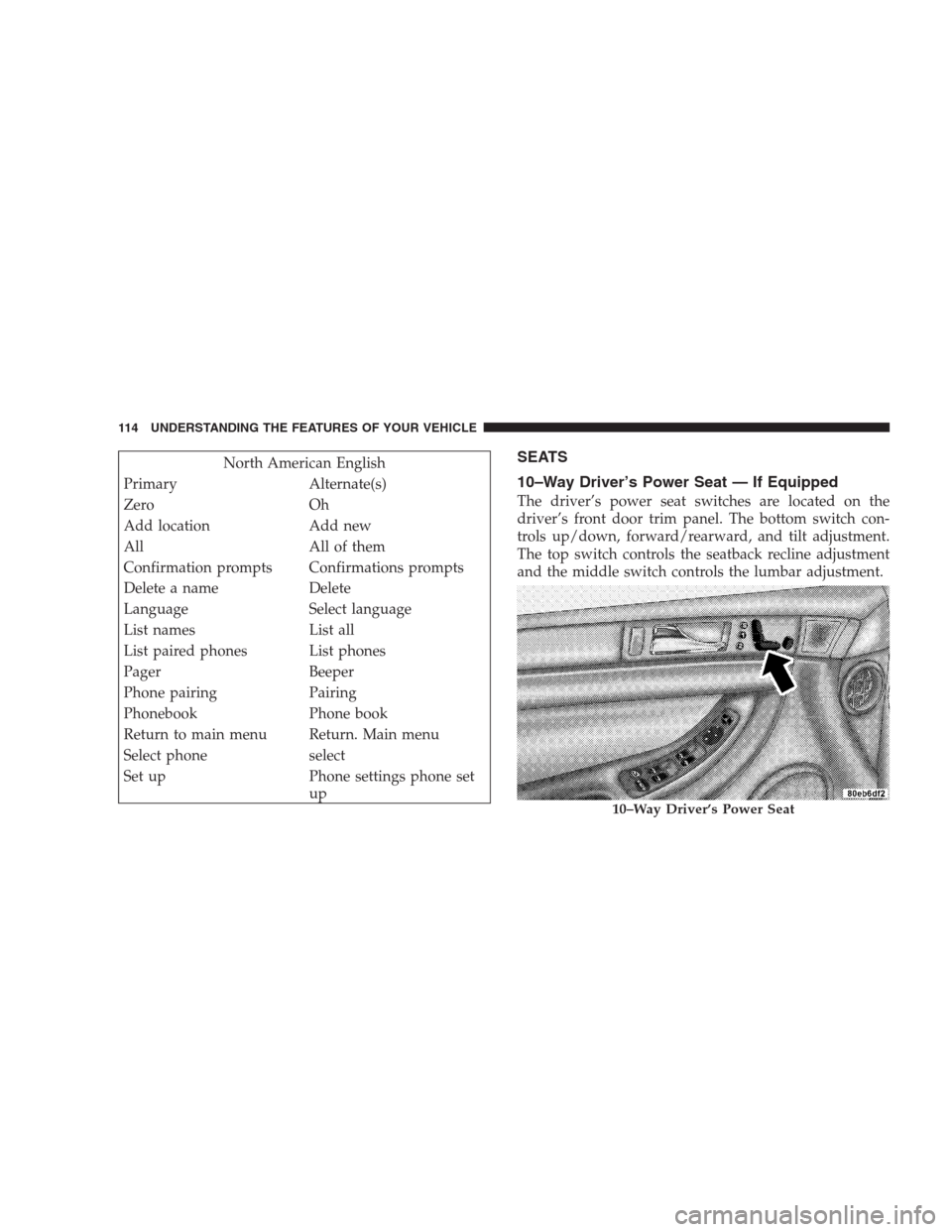
10–Way Driver’s Power Seat — If Equipped
The driver’s power seat switches are located on the
driver’s front door trim panel. The bottom switch con-
trols up/down, forward/rearward, and tilt adjustment.
The top switch controls the seatback recline adjustment
and the middle switch controls the lumbar adjustment.
10–Way Driver’s Power Seat
114 UNDERSTANDING THE FEATURES OF YOUR VEHICLE
Page 116 of 464
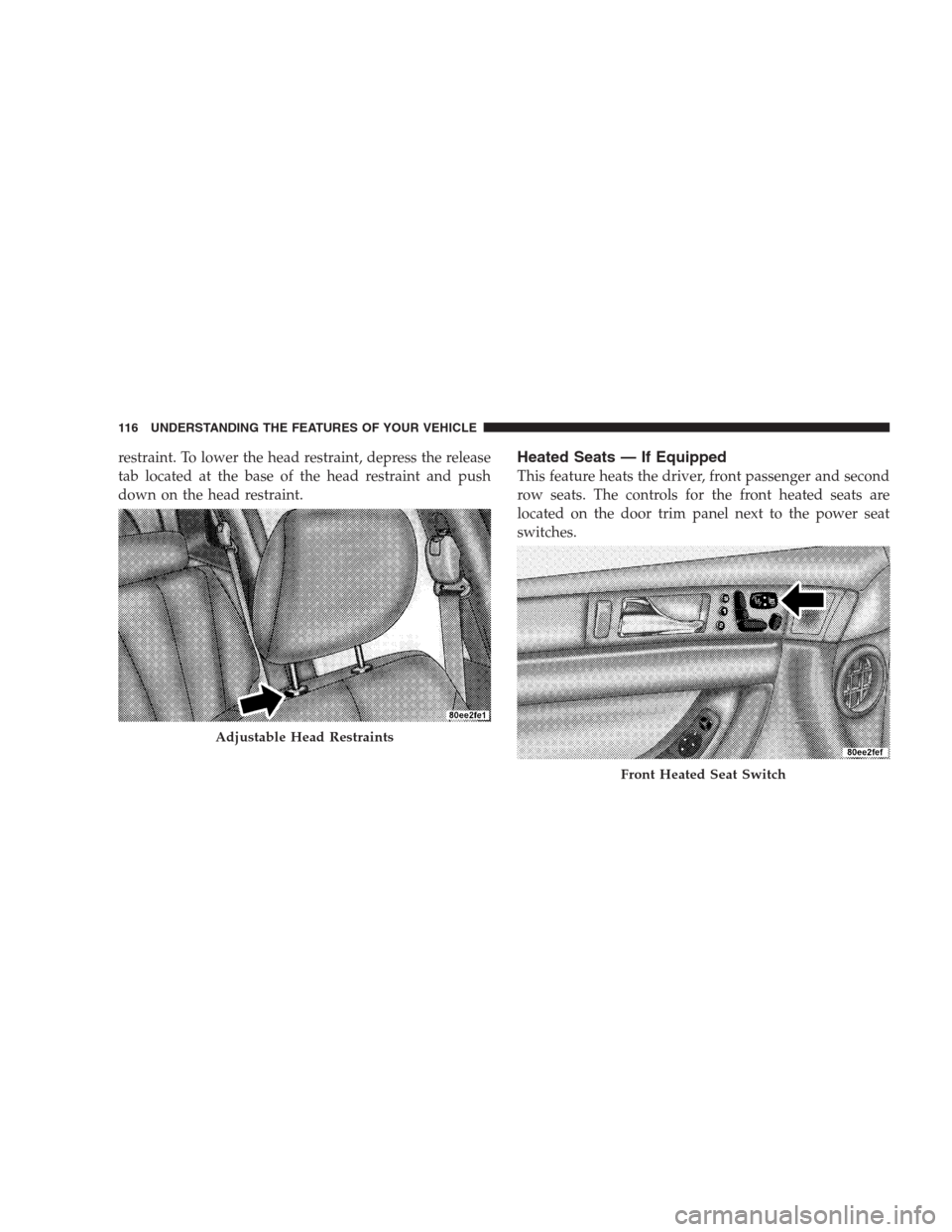
restraint. To lower the head restraint, depress the release
tab located at the base of the head restraint and push
down on the head restraint.Heated Seats — If Equipped
This feature heats the driver, front passenger and second
row seats. The controls for the front heated seats are
located on the door trim panel next to the power seat
switches.
Adjustable Head Restraints
Front Heated Seat Switch
116 UNDERSTANDING THE FEATURES OF YOUR VEHICLE