Page 285 of 472

conditions and more wheel spin than ESP would nor-
mally allow is required to gain traction. TSC (Trailer
Sway Control) is not available when the system is in the
�Partial Off�mode. To turn ESP on again, momentarily
depress the “ESP-Control OFF” Control Switch. This will
restore the normal “ON” mode of operation. ESP always
operates under braking, even with the switch in the
OFF-position.
WARNING!
In the Partial Off mode, the engine torque reduction
and stability features are desensitized. Therefore,
the enhanced vehicle stability offered by ESP is
unavailable.
NOTE:To improve the vehicle’s traction when driving
with snow chains, or starting off in deep snow, sand or
gravel, it may be desirable to switch to the “Partial Off”mode by pressing the ESP Control Switch. Once the
situation requiring ESP to be switched to the “Partial Off”
mode is overcome, turn ESP on by momentarily depress-
ing the “ESP Control Switch”. This may be done with the
vehicle is in motion.
4WD LOW Range
Partial Off
This is the normal operating mode for ESP in 4WD LOW.
Whenever the vehicle is started in 4WD LOW or the
transfer case (if equipped) is shifted from 4WD LOCK or
neutral to 4WD LOW, the ESP system will be in this
mode. In 4WD LOW, ESP function is desensitized until
the vehicle reaches a speed of 30 mph (48 km/h). At 30
mph (48 km/h) the normal ESP stability function returns
and the ESP/TCS Indicator Light” turns off. When the
vehicle speed drops below 25 mph (40 km/h) the ESP
system goes back to Partial Off. ESP is desensitized at low
vehicle speeds in 4WD LOW so that it will not interfere
STARTING AND OPERATING 285
5
Page 286 of 472

with off road driving but ESP function returns to provide
the stability feature at speeds above 30 mph (48 km/h).
The ABS is in a special Off-Road mode that allows wheels
to lock at lower speeds if gravel is detected to shorten
stopping distances.
NOTE:When the vehicle is in 4WD LOW, a feature of
the ESP system remains active whether the ESP is on or
off. This feature functions similar to a limited slip differ-
ential and controls the wheel spin across an axle. If one
wheel on an axle is spinning faster than the other, the
system will apply the brake of the spinning wheel and
allow more engine torque to be applied to the wheel that
is not spinning.WARNING!
In the Partial Off mode, the engine torque reduction
and stability features are desensitized. Therefore,
the enhanced vehicle stability offered by ESP is
unavailable.
ESP/BAS Warning Lamp and ESP/TCS Indicator
Light
The malfunction indicator for the ESP is combined with
the BAS indicator. The yellow “ESP/BAS Warning
Lamp” and the yellow “ESP/TCS Indicator Light” in the
instrument cluster both come on when the ignition
switch is turned to the “ON” position. They should both
go out with the engine running. If the “ESP/BAS Warn-
ing Lamp” comes on continuously with the engine
running, a malfunction has been detected in either the
ESP or BAS system, or both. If this light remains on after
several ignition cycles, and the vehicle has been driven
286 STARTING AND OPERATING
Page 333 of 472

•Safety chains must always be used between your
vehicle and trailer. Always connect the chains to the
frame or hook retainers of the vehicle hitch. Cross the
chains under the trailer tongue and allow enough
slack for turning corners.
•Vehicles with trailers should not be parked on a grade.
When parking, apply the parking brake on the tow
vehicle. Put the tow vehicle automatic transmission in
P for Park. With a manual transmission, shift the
transmission into reverse. And with four-wheel-drive
vehicles, make sure the transfer case is not in neutral.
Always, block or�chock�the trailer wheels.
•GCWR must not be exceeded.
•Total weight must be distributed between the tow
vehicle and the trailer such that the following four
ratings are not exceeded:
1. GVWR2. GTW
3. GAWR
4. Tongue weight rating for the trailer hitch utilized
(This requirement may limit the ability to always
achieve the 10% to 15% range of tongue weight as a
percentage of total trailer weight).
Towing Requirements — Tires
Do not attempt to tow a trailer while using a compact
spare tire.
Proper tire inflation pressures are essential to the safe
and satisfactory operation of your vehicle. Refer to the
Tires–General Information section of this manual on
Tire Pressures for proper tire inflation procedures.
Also, check the trailer tires for proper tire inflation
pressures before trailer usage.
STARTING AND OPERATING 333
5
Page 341 of 472

11. Repeat steps 9 and 10 with the transmission in Drive
(D).
12. Turn ignition key to the unlocked OFF position.
13. Shift automatic transmission into Park (P).
14. Attach vehicle to tow vehicle with tow bar.
NOTE:Items 1 through 5 are requirements that must be
met prior to depressing the Neutral (N) selection button,
and must continue to be met until the 4 seconds elaspes
and the shift has been completed.
If any of these requirements (with the exception of3-Key
ON) are not met prior to depressing the Neutral (N)
button or are no longer met during the 4 second timer,
then the Neutral (N) indicator light will flash continu-
ously until all requirements are met or until the Neutral
(N) button is released.NOTE:The ignition key must be ON for a shift to take
place and for the position indicator lights to be operable.
If the key is not ON, the shift will not take place and no
position indicator lights will be on or flashing.
CAUTION!
Damage to the transmission may occur if the trans-
mission is shifted into Park (P) with the transfer case
in Neutral (N) and the engine RUNNING. With the
transfer case in Neutral (N) ensure that the engine is
OFF prior to shifting the transmission into Park (P)
Shifting OUT of Neutral (N)
Use the following procedure to prepare your vehicle for
normal usage.
1. Bring vehicle to a complete stop.
2. Shut engine OFF.
STARTING AND OPERATING 341
5
Page 346 of 472
HAZARD WARNING FLASHER
The flasher switch is on the top of the steering column,
just behind the steering wheel. Press the flasher switch
and all front and rear directional signals will flash
intermittently.
Press the switch a second time to turn off the emergency
flashers.This is an emergency warning system and should not be
used when the vehicle is in motion. Use it when your
vehicle is disabled and is creating a safety hazard for
other motorists.
If it is necessary to leave the vehicle to go for service, the
flasher system will continue to operate with the ignition
key removed and the vehicle locked.
346 WHAT TO DO IN EMERGENCIES
Page 348 of 472
JACKING INSTRUCTIONS
Removing The Spare Tire
The spare tire on your vehicle is located underneath the
vehicle in the rear.
Remove the spare tire before attempting to jack the truck.1. Remove the rubber plug from the floor in the cargo
area.
2. Engage the jack wrench extension to the spare tire
winch through the hole in the floor.
3. Turn the wrench counterclockwise to lower the spare
tire. Continue to turn the wrench until the spare tire can
be pulled out from under the vehicle.
348 WHAT TO DO IN EMERGENCIES
Page 350 of 472

Preparations
Park the vehicle on a firm level surface, avoiding ice or
slippery areas. Set the parking brake and place the gear
selector in PARK (automatic transmission). On Four
Wheel Drive vehicles, shift the transfer case to the “4L”
position.
WARNING!
Do not attempt to change a tire on the side of the
vehicle close to moving traffic. Pull far enough off
the road to avoid the danger of being hit when
operating the jack or changing the wheel.
•Turn on the Hazard Warning Flasher.
•Block both the front and rear
of the wheel diagonally oppo-
site the jacking position. For
example, if the right front
wheel is being changed, block
the left rear wheel.
•Passengers should not remain in the vehicle when the
vehicle is being jacked.
Instructions
1. Remove the spare wheel, jack, and tools from storage.
2. Using the wheel wrench, loosen, but do not remove,
the wheel nuts by turning them counterclockwise one
turn while the wheel is still on the ground.
350 WHAT TO DO IN EMERGENCIES
Page 352 of 472
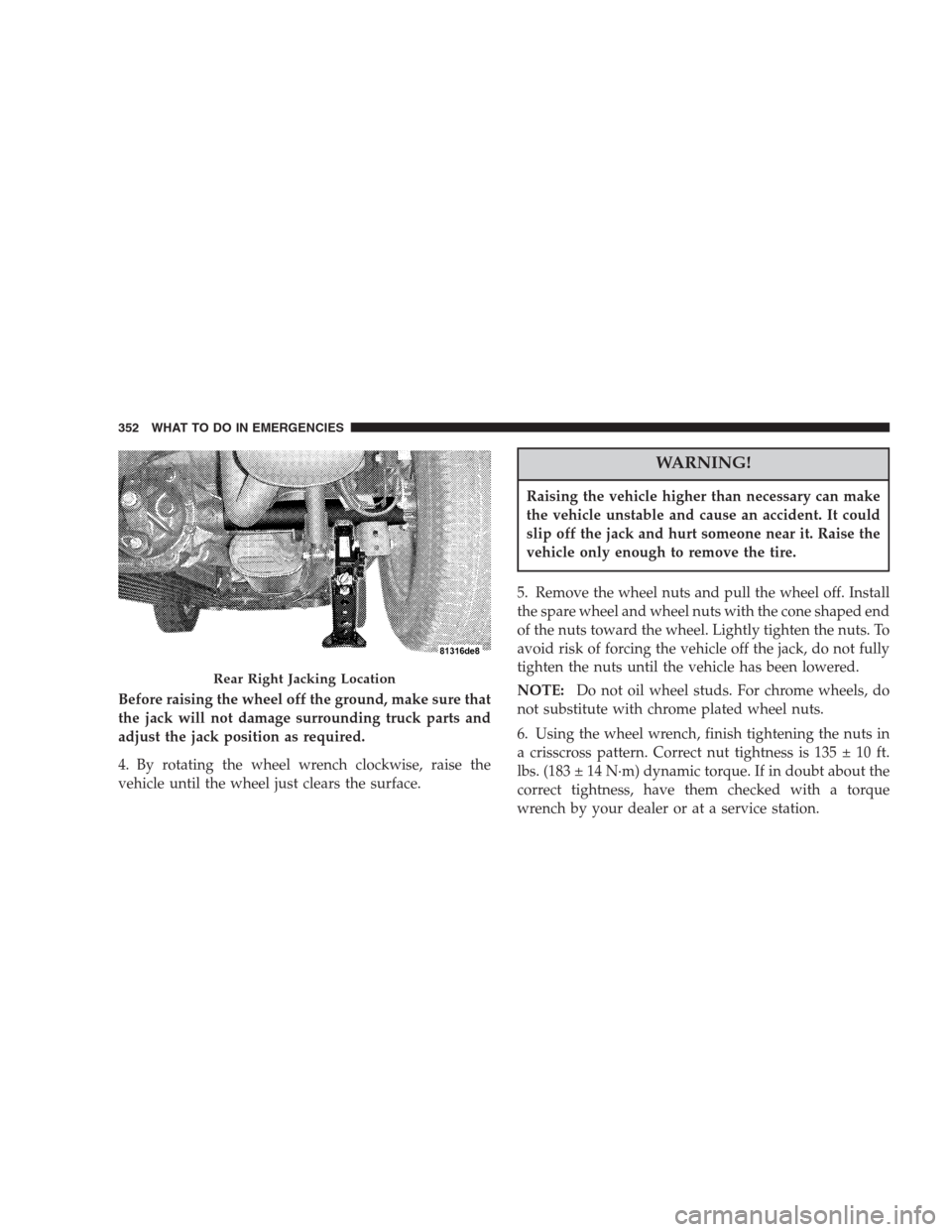
Before raising the wheel off the ground, make sure that
the jack will not damage surrounding truck parts and
adjust the jack position as required.
4. By rotating the wheel wrench clockwise, raise the
vehicle until the wheel just clears the surface.
WARNING!
Raising the vehicle higher than necessary can make
the vehicle unstable and cause an accident. It could
slip off the jack and hurt someone near it. Raise the
vehicle only enough to remove the tire.
5. Remove the wheel nuts and pull the wheel off. Install
the spare wheel and wheel nuts with the cone shaped end
of the nuts toward the wheel. Lightly tighten the nuts. To
avoid risk of forcing the vehicle off the jack, do not fully
tighten the nuts until the vehicle has been lowered.
NOTE:Do not oil wheel studs. For chrome wheels, do
not substitute with chrome plated wheel nuts.
6. Using the wheel wrench, finish tightening the nuts in
a crisscross pattern. Correct nut tightness is 135 ± 10 ft.
lbs. (183 ± 14 N·m) dynamic torque. If in doubt about the
correct tightness, have them checked with a torque
wrench by your dealer or at a service station.
Rear Right Jacking Location
352 WHAT TO DO IN EMERGENCIES

