2007 CHEVROLET TRAIL BLAZER light
[x] Cancel search: lightPage 183 of 574
Fog Lamps
Your vehicle may have this feature. Use your fog
lamps for better vision in foggy or misty conditions.
Your ignition must be in RUN for your fog lamps
to work.
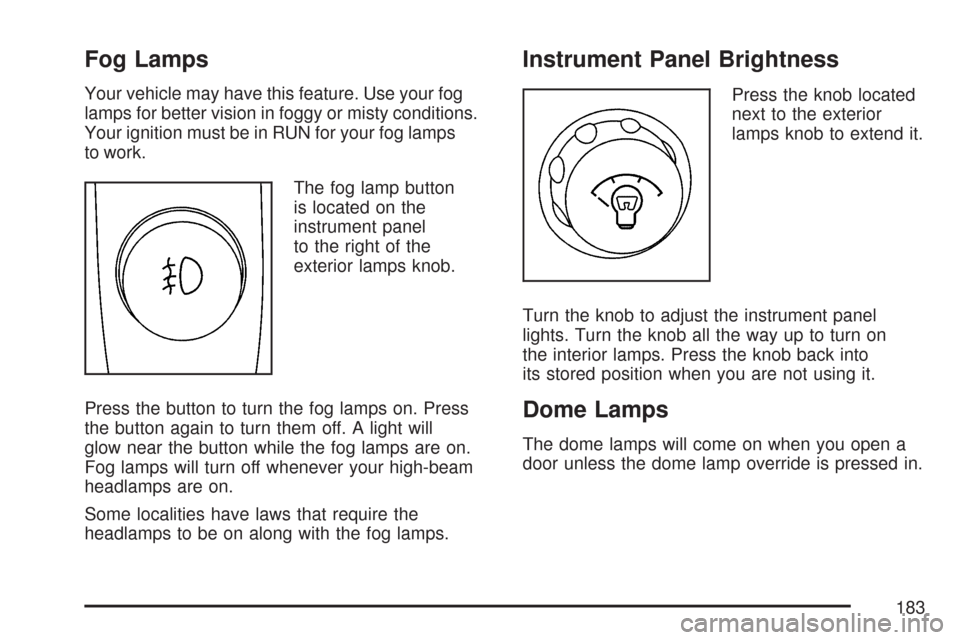
The fog lamp button
is located on the
instrument panel
to the right of the
exterior lamps knob.
Press the button to turn the fog lamps on. Press
the button again to turn them off. A light will
glow near the button while the fog lamps are on.
Fog lamps will turn off whenever your high-beam
headlamps are on.
Some localities have laws that require the
headlamps to be on along with the fog lamps.
Instrument Panel Brightness
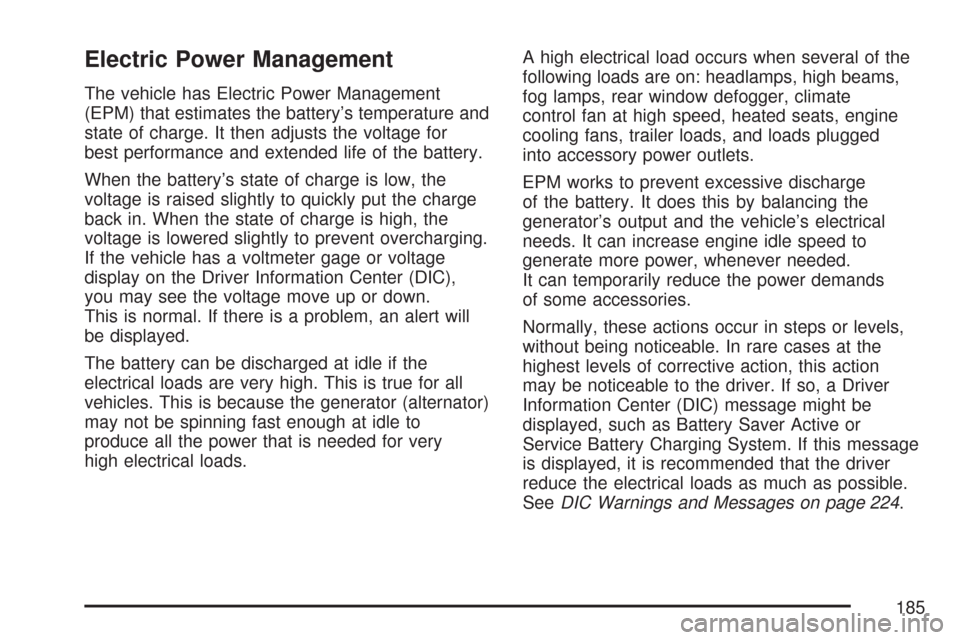
Press the knob located
next to the exterior
lamps knob to extend it.
Turn the knob to adjust the instrument panel
lights. Turn the knob all the way up to turn on
the interior lamps. Press the knob back into
its stored position when you are not using it.
Dome Lamps
The dome lamps will come on when you open a
door unless the dome lamp override is pressed in.
183
Page 184 of 574
Dome Lamp Override
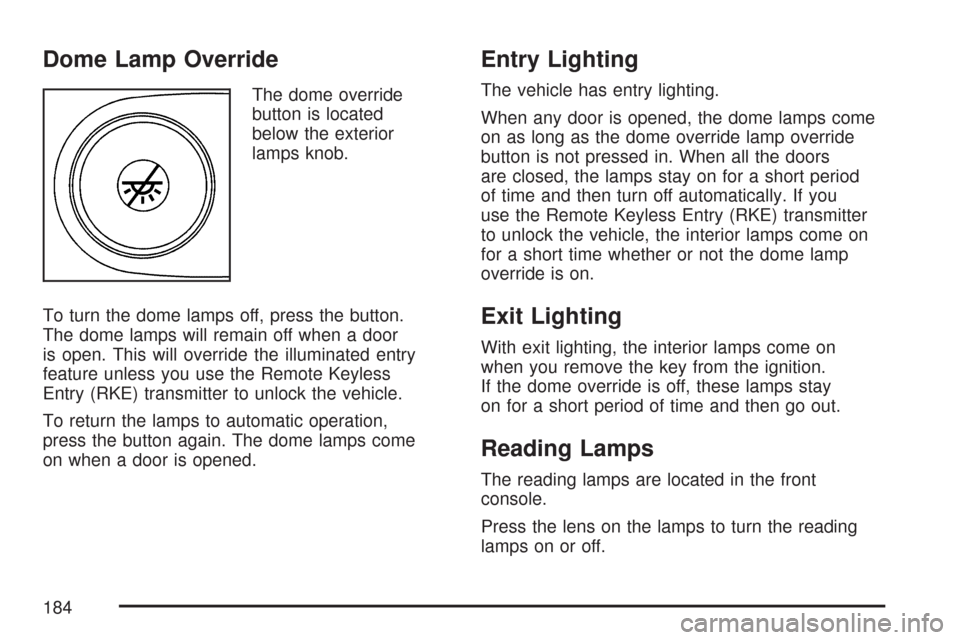
The dome override
button is located
below the exterior
lamps knob.
To turn the dome lamps off, press the button.
The dome lamps will remain off when a door
is open. This will override the illuminated entry
feature unless you use the Remote Keyless
Entry (RKE) transmitter to unlock the vehicle.
To return the lamps to automatic operation,
press the button again. The dome lamps come
on when a door is opened.
Entry Lighting
The vehicle has entry lighting.
When any door is opened, the dome lamps come
on as long as the dome override lamp override
button is not pressed in. When all the doors
are closed, the lamps stay on for a short period
of time and then turn off automatically. If you
use the Remote Keyless Entry (RKE) transmitter
to unlock the vehicle, the interior lamps come on
for a short time whether or not the dome lamp
override is on.
Exit Lighting
With exit lighting, the interior lamps come on
when you remove the key from the ignition.
If the dome override is off, these lamps stay
on for a short period of time and then go out.
Reading Lamps
The reading lamps are located in the front
console.
Press the lens on the lamps to turn the reading
lamps on or off.
184
Page 185 of 574
Electric Power Management
The vehicle has Electric Power Management
(EPM) that estimates the battery’s temperature and
state of charge. It then adjusts the voltage for
best performance and extended life of the battery.
When the battery’s state of charge is low, the
voltage is raised slightly to quickly put the charge
back in. When the state of charge is high, the
voltage is lowered slightly to prevent overcharging.
If the vehicle has a voltmeter gage or voltage
display on the Driver Information Center (DIC),
you may see the voltage move up or down.
This is normal. If there is a problem, an alert will
be displayed.
The battery can be discharged at idle if the
electrical loads are very high. This is true for all
vehicles. This is because the generator (alternator)
may not be spinning fast enough at idle to
produce all the power that is needed for very
high electrical loads.A high electrical load occurs when several of the
following loads are on: headlamps, high beams,
fog lamps, rear window defogger, climate
control fan at high speed, heated seats, engine
cooling fans, trailer loads, and loads plugged
into accessory power outlets.
EPM works to prevent excessive discharge
of the battery. It does this by balancing the
generator’s output and the vehicle’s electrical
needs. It can increase engine idle speed to
generate more power, whenever needed.
It can temporarily reduce the power demands
of some accessories.
Normally, these actions occur in steps or levels,
without being noticeable. In rare cases at the
highest levels of corrective action, this action
may be noticeable to the driver. If so, a Driver
Information Center (DIC) message might be
displayed, such as Battery Saver Active or
Service Battery Charging System. If this message
is displayed, it is recommended that the driver
reduce the electrical loads as much as possible.
SeeDIC Warnings and Messages on page 224.
185
Page 187 of 574
Ashtray(s) and Cigarette Lighter
Your vehicle may have this feature. The ashtray
is removable and ts into the front cupholder.
Notice:If you put papers, pins, or other
ammable items in the ashtray, hot cigarettes
or other smoking materials could ignite
them and possibly damage your vehicle.
Never put ammable items in the ashtray.
To remove the ashtray, pull the covered bin out
of the cupholder.
To use the lighter, press it in all the way, and let
go. When it is ready, it will pop back out by itself.
Notice:Holding a cigarette lighter in while it is
heating will not allow the lighter to back away
from the heating element when it is hot. Damage
from overheating may occur to the lighter or
heating element, or a fuse could be blown. Do
not hold a cigarette lighter in while it is heating.
Do not use equipment exceeding maximum
amperage rating of 20 amperes.
Climate Controls
Dual Climate Control System
With this system you can control the heating,
cooling, and ventilation for your vehicle.
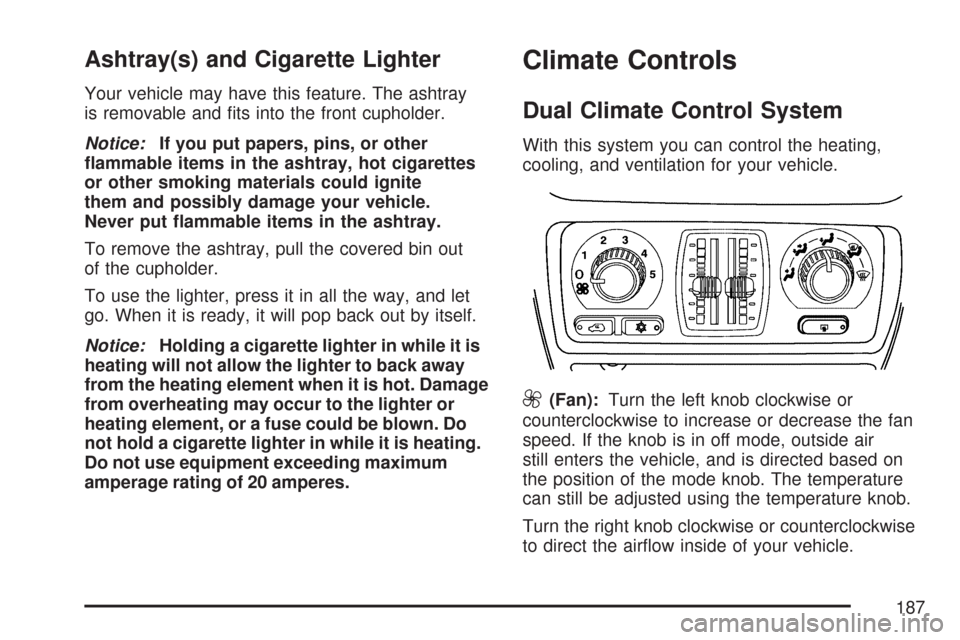
9(Fan):Turn the left knob clockwise or
counterclockwise to increase or decrease the fan
speed. If the knob is in off mode, outside air
still enters the vehicle, and is directed based on
the position of the mode knob. The temperature
can still be adjusted using the temperature knob.
Turn the right knob clockwise or counterclockwise
to direct the airow inside of your vehicle.
187
Page 188 of 574
To change the current mode, select one of the
following:
H(Vent):This mode directs air to the instrument
panel outlets.
)(Bi-Level):This mode directs about half of
the air to the instrument panel outlets; then directs
most of the remaining air to the oor outlets. A little
air is directed toward the windshield and the side
window outlets. Cooler air is directed to the upper
vents and warmer air to the oor outlets.
6(Floor):This mode directs most of the air to the
oor outlets with a little air directed to the windshield
and the side window outlets. The recirculation
button cannot be selected while in oor mode.
@(Recirculation):Recirculation mode is used
to recirculate the air inside of your vehicle. When
this button is pressed, an indicator light in the
button will come on to let you know that it is active.
Use this mode to help prevent outside odors and/or
dust from entering your vehicle or to help cool the
air inside of your vehicle more quickly. The air
conditioning compressor will also come on when
this mode is activated. While in recirculation mode,the windows may fog when the weather is cold and
damp. To clear the fog, select either the defog or
defrost mode and increase fan speed.
Defog and defrost modes are described later in this
section.
Driver’s Side Temperature Lever:The lever on
the left side of the climate control panel is
used to raise or lower the temperature on the
driver’s side of the vehicle. Slide the lever up or
down to adjust the temperature.
Passenger’s Side Temperature Lever:The lever
on the right side of the climate control panel is
used to raise or lower the temperature on the
passenger’s side of the vehicle. Slide the lever up
or down to adjust the temperature. This lever also
adjusts the temperature to the rear seat outlets.
When the temperature outside is 0°F (-18°C) or
lower, use the engine coolant heater, if the vehicle
has one, to provide warmer air, faster to your
vehicle.
#(Air Conditioning):Press this button to turn
the air-conditioning system on or off. When the
button is pressed, an indicator light will come on
and the system will begin to cool and dehumidify
188
Page 189 of 574
the air inside of the vehicle. You may notice a
slight change in engine performance when the
air conditioning compressor shuts off and turns
on again. This is normal.
Defogging and Defrosting
Fog on the inside of windows is a result of
high humidity (moisture) condensing on the
cool window glass. This can be minimized if the
climate control system is used properly. There
are two modes to choose from to clear fog or
frost from your windshield. Use the defog mode to
clear the windows of fog or moisture and warm
the passengers. Use the defrost mode to remove
fog or frost from the windshield more quickly.
Turn the right knob clockwise or counterclockwise
to select one of the following modes:
-(Defog):This mode directs the air to the
oor outlets, windshield and side window outlets.
The recirculation button cannot be selected
while in defog mode.
1(Defrost):This mode directs most of the
air to the windshield and the side window outlets,
with only a little air directed to the oor outlets.The air conditioning compressor may run to
dehumidify the air to prevent window fogging.
The recirculation button cannot be selected while
in defrost mode. Do not drive the vehicle until
all the windows are clear.
Rear Window Defogger
If your vehicle has the rear window defogger
a warming grid is used to remove fog on the
rear window.
<(Rear):Press this button to turn the rear
window defogger on or off. An indicator light in the
button will come on to let you know that the rear
window defogger is active. The rear window
defogger will automatically turn off approximately
ten minutes after the button is pressed.
If your vehicle has heated mirrors, this button will
activate them.
Notice:Do not use anything sharp on the
inside of the rear window. If you do, you could
cut or damage the warming grid, and the repairs
would not be covered by your warranty. Do not
attach a temporary vehicle license, tape, a decal
or anything similar to the defogger grid.
189
Page 192 of 574
Manual Operation
To change the current setting, select one of the
following:
w9x(Fan):This button allows you to manually
adjust the fan speed. Press the up arrow to
increase fan speed and the down arrow to
decrease fan speed. The display will change to
show you the selected fan speed and the driver’s
side temperature setting for ve seconds.
C(Mode):Press this button to manually change
the direction of the airow in your vehicle. Keep
pressing the button until the desired mode appears
on the display. The display will change to show
you the selected air delivery mode and the driver’s
temperature setting for ve seconds.
H(Vent):This mode directs air to the instrument
panel outlets.
)(Bi-Level):This mode directs approximately
half of the air to the instrument panel outlets,
then directs the remaining air to the oor outlets.
A little air is directed toward the windshield
and the side window outlets. Cooler air is directed
to the upper outlets and warmer air to the oor
outlets.
6(Floor):This mode directs most of the air
to the oor outlets. Some air also comes out
of the defroster and side window outlets.
The recirculation button cannot be selected in
oor mode.
@(Recirculation):Press this button to turn
recirculation mode on or off. When this button
is pressed, an indicator light in the button will
also come on to let you know that it is activated.
Recirculation mode is used to recirculate the
air inside of your vehicle. Use this mode to help
prevent outside odors and/or dust from entering
your vehicle or to help cool the air inside of
your vehicle more quickly. Recirculation mode
can be used with vent and bi-level modes, but it
cannot be used with oor, defog or defrost modes.
Defog and defrost modes are described later in
this section.
If recirculation mode is selected with oor,
defog, or defrost modes, the indicator will ash
three times and then turn off indicating the
selection is not available.
192
Page 193 of 574
You may also notice that the air conditioning
compressor will run while in recirculation mode.
This is normal and will help to prevent fogging.
If the weather is cold and damp, the system may
cause the windows to fog while using recirculation
mode. If the windows do start to fog, select
defog or defrost mode and increase fan speed.
Recirculation mode, if selected, will be cleared
when the engine is turned off.
#A/C (Air Conditioning):Press this button
to manually turn the air conditioning system on
or off. When the system is on, the system
will automatically begin to cool and dehumidify
the air inside of your vehicle. The air conditioning
symbol will appear on the display when the
air conditioning is on and will turn off when the
air conditioning is off.If you turn the air conditioning off while in front
defrost or defog mode, the air conditioning symbol
will turn off, however, the A/C compressor will
remain on to help de-humidify the air inside
the vehicle. If one of the other modes is selected
the compressor will then turn the A/C off until
it is selected again or the AUTO button is pressed.
To avoid fogging the inside glass on rainy and
humid days at a temperature above freezing,
press the air conditioning button to run the A/C
compressor. Also it is best to avoid the use of the
recirculation mode except when maximum air
conditioning performance is needed or for short
times to avoid exterior odors.
You may notice a slight change in engine
performance when the air-conditioning compressor
shuts off and turns on again. This is normal.
193