Page 378 of 574
Making Turns
Notice:Making very sharp turns while
trailering could cause the trailer to come in
contact with the vehicle. Your vehicle could be
damaged. Avoid making very sharp turns
while trailering.
When you’re turning with a trailer, make wider
turns than normal. Do this so your trailer
won’t strike soft shoulders, curbs, road signs,
trees or other objects. Avoid jerky or sudden
maneuvers. Signal well in advance.
Turn Signals When Towing a Trailer
The arrows on your instrument panel will
ash whenever you signal a turn or lane change.
Properly hooked up, the trailer lamps will also
ash, telling other drivers you’re about to
turn, change lanes or stop.
When towing a trailer, the arrows on your
instrument panel will ash for turns even if the bulbs
on the trailer are burned out. Thus, you may think
drivers behind you are seeing your signal when
they are not. It’s important to check occasionally to
be sure the trailer bulbs are still working.
Driving On Grades
Reduce speed and shift to a lower gearbefore
you start down a long or steep downgrade. If you
don’t shift down, you might have to use your
brakes so much that they would get hot and no
longer work well.
You can tow in DRIVE (D). You may want to shift
the transmission to THIRD (3) or a lower gear,
under heavy loads or hilly conditions.
When towing at high altitude on steep uphill
grades, consider the following: Engine coolant will
boil at a lower temperature than at normal
altitudes. If you turn your engine off immediately
after towing at high altitude on steep uphill grades,
your vehicle may show signs similar to engine
overheating. To avoid this, let the engine run while
parked (preferably on level ground) with the
automatic transmission in PARK (P) for a few
minutes before turning the engine off. If you do get
the overheat warning, seeEngine Overheating
on page 418.
378
Page 383 of 574
Service........................................................ 386
Accessories and Modications................... 386
California Proposition 65 Warning.............. 386
Doing Your Own Service Work.................. 387
Adding Equipment to the Outside of
Your Vehicle.......................................... 387
Fuel............................................................. 388
Gasoline Octane........................................ 388
Gasoline Specications.............................. 389
California Fuel........................................... 389
Additives................................................... 389
Fuels in Foreign Countries........................ 390
Filling the Tank......................................... 391
Filling a Portable Fuel Container............... 393
Checking Things Under the Hood.............. 394
Hood Release........................................... 394
Engine Compartment Overview.................. 396
Engine Oil................................................. 402
Engine Oil Life System.............................. 408
Engine Air Cleaner/Filter............................ 410Automatic Transmission Fluid.................... 411
Engine Coolant.......................................... 414
Radiator Pressure Cap.............................. 418
Engine Overheating................................... 418
Cooling System......................................... 420
Engine Fan Noise..................................... 425
Power Steering Fluid................................. 426
Windshield Washer Fluid........................... 427
Brakes...................................................... 428
Battery...................................................... 431
Jump Starting............................................ 432
All-Wheel Drive........................................... 438
Rear Axle.................................................... 438
Four-Wheel Drive........................................ 440
Front Axle................................................... 440
Bulb Replacement....................................... 442
Halogen Bulbs........................................... 442
Taillamps and Turn Signal Lamps............. 442
License Plate Lamp................................... 444
Replacement Bulbs................................... 444
Section 5 Service and Appearance Care
383
Page 394 of 574
Checking Things Under
the Hood
{CAUTION:
Things that burn can get on hot engine
parts and start a re. These include
liquids like fuel, oil, coolant, brake uid,
windshield washer and other uids, and
plastic or rubber. You or others could be
burned. Be careful not to drop or spill
things that will burn onto a hot engine.
Hood Release
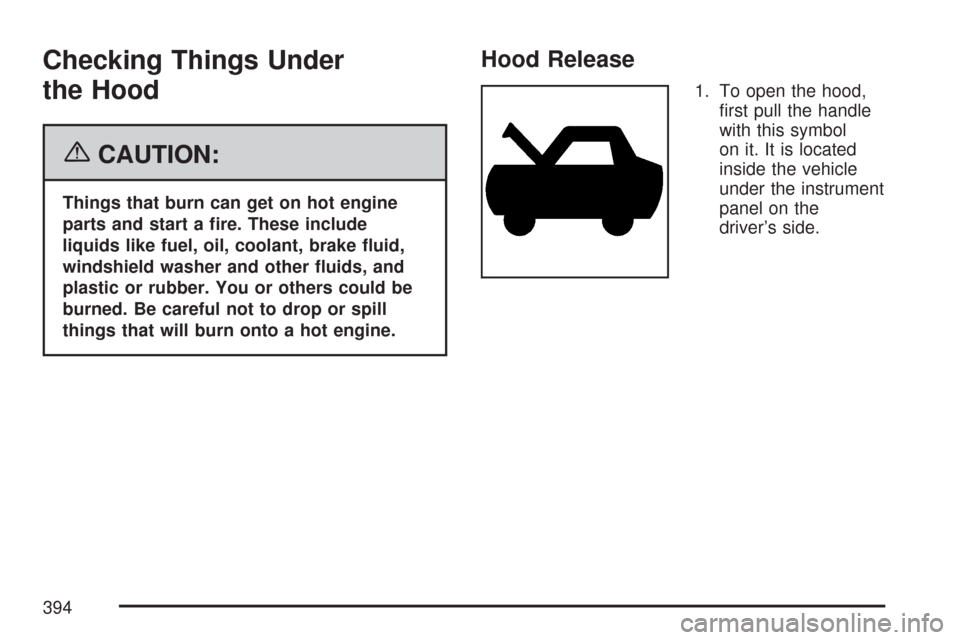
1. To open the hood,
rst pull the handle
with this symbol
on it. It is located
inside the vehicle
under the instrument
panel on the
driver’s side.
394
Page 397 of 574
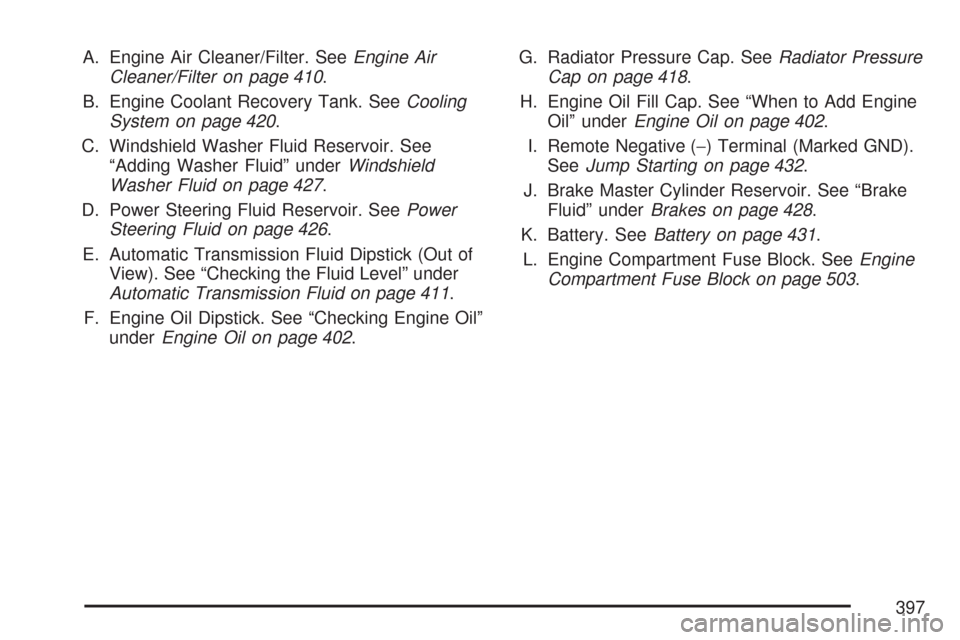
A. Engine Air Cleaner/Filter. SeeEngine Air
Cleaner/Filter on page 410.
B. Engine Coolant Recovery Tank. SeeCooling
System on page 420.
C. Windshield Washer Fluid Reservoir. See
“Adding Washer Fluid” underWindshield
Washer Fluid on page 427.
D. Power Steering Fluid Reservoir. SeePower
Steering Fluid on page 426.
E. Automatic Transmission Fluid Dipstick (Out of
View). See “Checking the Fluid Level” under
Automatic Transmission Fluid on page 411.
F. Engine Oil Dipstick. See “Checking Engine Oil”
underEngine Oil on page 402.G. Radiator Pressure Cap. SeeRadiator Pressure
Cap on page 418.
H. Engine Oil Fill Cap. See “When to Add Engine
Oil” underEngine Oil on page 402.
I. Remote Negative (−) Terminal (Marked GND).
SeeJump Starting on page 432.
J. Brake Master Cylinder Reservoir. See “Brake
Fluid” underBrakes on page 428.
K. Battery. SeeBattery on page 431.
L. Engine Compartment Fuse Block. SeeEngine
Compartment Fuse Block on page 503.
397
Page 399 of 574
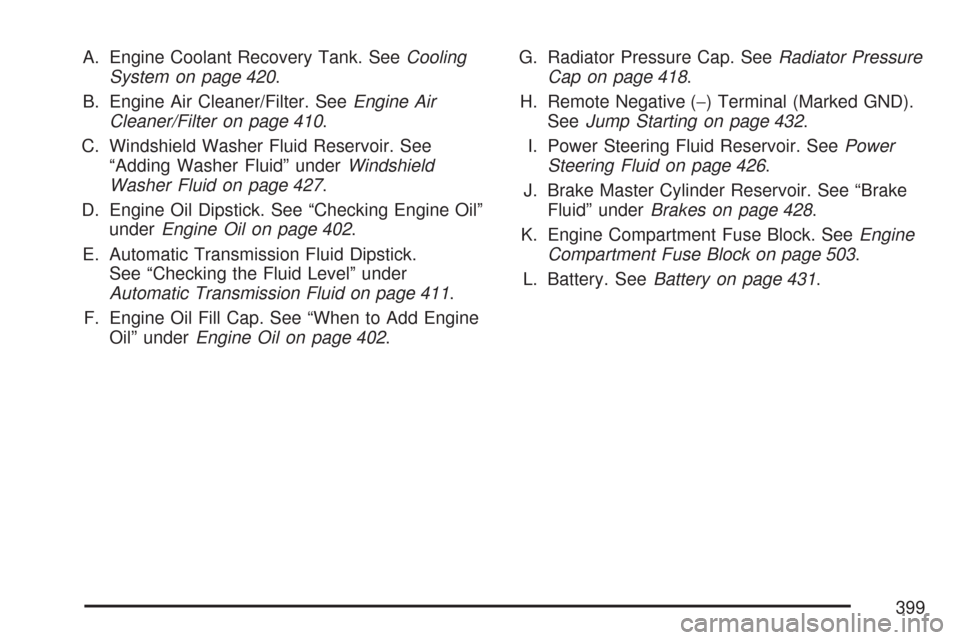
A. Engine Coolant Recovery Tank. SeeCooling
System on page 420.
B. Engine Air Cleaner/Filter. SeeEngine Air
Cleaner/Filter on page 410.
C. Windshield Washer Fluid Reservoir. See
“Adding Washer Fluid” underWindshield
Washer Fluid on page 427.
D. Engine Oil Dipstick. See “Checking Engine Oil”
underEngine Oil on page 402.
E. Automatic Transmission Fluid Dipstick.
See “Checking the Fluid Level” under
Automatic Transmission Fluid on page 411.
F. Engine Oil Fill Cap. See “When to Add Engine
Oil” underEngine Oil on page 402.G. Radiator Pressure Cap. SeeRadiator Pressure
Cap on page 418.
H. Remote Negative (−) Terminal (Marked GND).
SeeJump Starting on page 432.
I. Power Steering Fluid Reservoir. SeePower
Steering Fluid on page 426.
J. Brake Master Cylinder Reservoir. See “Brake
Fluid” underBrakes on page 428.
K. Engine Compartment Fuse Block. SeeEngine
Compartment Fuse Block on page 503.
L. Battery. SeeBattery on page 431.
399
Page 401 of 574
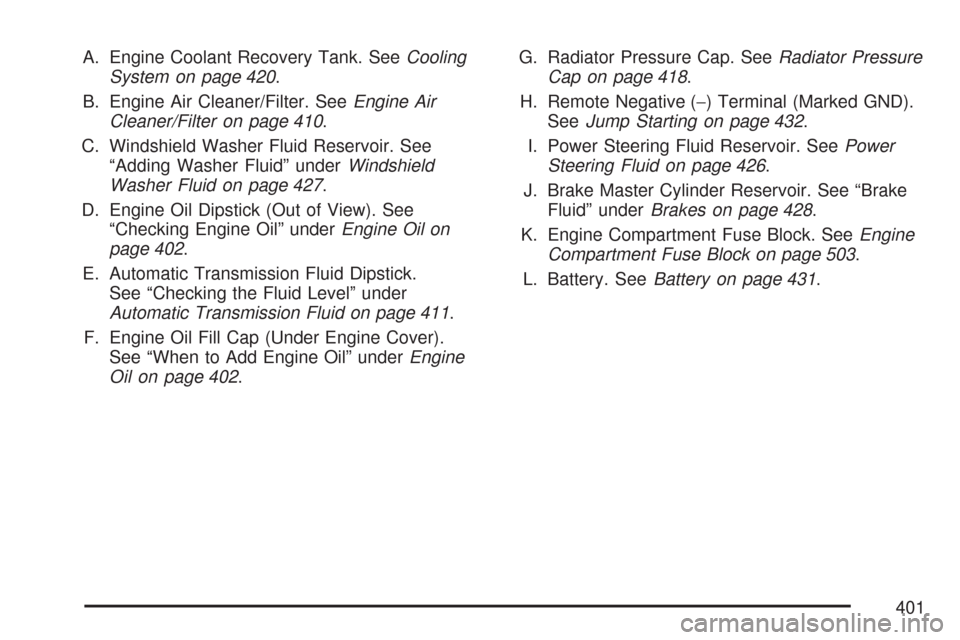
A. Engine Coolant Recovery Tank. SeeCooling
System on page 420.
B. Engine Air Cleaner/Filter. SeeEngine Air
Cleaner/Filter on page 410.
C. Windshield Washer Fluid Reservoir. See
“Adding Washer Fluid” underWindshield
Washer Fluid on page 427.
D. Engine Oil Dipstick (Out of View). See
“Checking Engine Oil” underEngine Oil on
page 402.
E. Automatic Transmission Fluid Dipstick.
See “Checking the Fluid Level” under
Automatic Transmission Fluid on page 411.
F. Engine Oil Fill Cap (Under Engine Cover).
See “When to Add Engine Oil” underEngine
Oil on page 402.G. Radiator Pressure Cap. SeeRadiator Pressure
Cap on page 418.
H. Remote Negative (−) Terminal (Marked GND).
SeeJump Starting on page 432.
I. Power Steering Fluid Reservoir. SeePower
Steering Fluid on page 426.
J. Brake Master Cylinder Reservoir. See “Brake
Fluid” underBrakes on page 428.
K. Engine Compartment Fuse Block. SeeEngine
Compartment Fuse Block on page 503.
L. Battery. SeeBattery on page 431.
401
Page 414 of 574
How to Add Automatic
Transmission Fluid
Refer to the Maintenance Schedule to determine
what kind of transmission uid to use. See
Recommended Fluids and Lubricants on page 529.
Add uid only after checking the transmission
uid while it is hot. A cold check is used only as
a reference. If the uid level is low, add only
enough of the proper uid to bring the level up to
the HOT area for a hot check. It does not take
much uid, generally less than one pint (0.5 L).
Do not overll.
Notice:Use of the incorrect automatic
transmission uid may damage your vehicle,
and the damages may not be covered by
your warranty. Always use the automatic
transmission uid listed inRecommended
Fluids and Lubricants on page 529.
After adding uid, recheck the uid level as
described under “How to Check Automatic
Transmission Fluid,” earlier in this section.
When the correct uid level is obtained, push
the dipstick back in all the way; then ip the
handle down to lock the dipstick in place.
Engine Coolant
The cooling system in your vehicle is lled with
DEX-COOL®engine coolant. This coolant is
designed to remain in your vehicle for ve years or
150,000 miles (240 000 km), whichever occurs
rst, if you add only DEX-COOL
®extended
life coolant.
The following explains your cooling system and
how to add coolant when it is low. If you have
a problem with engine overheating, seeEngine
Overheating on page 418.
A 50/50 mixture of clean, drinkable water and
DEX-COOL
®coolant will:
Give freezing protection down to
−34°F (−37°C).
Give boiling protection up to 265°F (129°C).
Protect against rust and corrosion.
Help keep the proper engine temperature.
Let the warning lights and gages work as
they should.
414
Page 415 of 574
Notice:Using coolant other than DEX-COOL®
may cause premature engine, heater core,
or radiator corrosion. In addition, the engine
coolant may require changing sooner, at
the rst maintenance service after each
30,000 miles (50 000 km) or 24 months,
whichever occurs rst. Any repairs would not
be covered by your warranty. Always use
DEX-COOL
®(silicate-free) coolant in your
vehicle.
What to Use
Use a mixture of one-half clean, drinkable water
and one-half DEX-COOL®coolant. If you use
this coolant mixture, you do not need to add
anything else.
{CAUTION:
Adding only plain water to your cooling
system can be dangerous. Plain water, or
some other liquid such as alcohol, can boil
before the proper coolant mixture will.
Your vehicle’s coolant warning system
is set for the proper coolant mixture.
With plain water or the wrong mixture, your
engine could get too hot but you would not
get the overheat warning. Your engine
could catch re and you or others could be
burned. Use a 50/50 mixture of clean,
drinkable water and DEX-COOL
®coolant.
Notice:If you use an improper coolant
mixture, your engine could overheat and be
badly damaged. The repair cost would not be
covered by your warranty. Too much water
in the mixture can freeze and crack the engine,
radiator, heater core, and other parts.
415