Page 346 of 634
Battery Replacement
To change the remote control batteries, do the
following:
1. Remove the battery compartment door
located on the bottom of the remote control.
2. Replace the two batteries in the compartment.
Make sure that they are installed correctly,
using the diagram on the inside of the battery
compartment.
3. Close the battery door securely.
If the remote control is to be stored for a long
period of time, remove the batteries and keep them
in a cool, dry place.
Problem Recommended Action
No power. The ignition might not be
turned on or in accessory.
The picture does not ll the
screen. There are black
borders on the top and
bottom or on both sides or
it looks stretched out.Check the display mode
settings in the setup menu
by pressing the display
menu button on the remote
control.
In auxiliary mode, the
picture moves or scrolls.Check the auxiliary input
connections at both
devices.
The remote control does
not work.Check to make sure there
is no obstruction between
the remote control and the
transmitter window.
Check the batteries to
make sure they are not
dead or installed
incorrectly.
After stopping the player,
I push Play but sometimes
the DVD starts where I left
off and sometimes at the
beginning.If the stop button was
pressed one time, the DVD
player resumes playing
where the DVD was
stopped. If the stop button
was pressed two times
the DVD player begins to
play from the beginning of
the DVD.
346
Page 374 of 634
Before You Go Off-Roading
There are some things to do before you go out.
For example, be sure to have all necessary
maintenance and service work done. Check to
make sure all underbody shields, if the vehicle has
them, are properly attached. Be sure you read
all the information about your four-wheel-drive or
all-wheel-drive vehicle in this manual. Is there
enough fuel? Is the spare tire fully inated? Are the
uid levels up where they should be? What are
the local laws that apply to off-roading where you
will be driving? If you do not know, you should
check with law enforcement people in the
area. Will you be on someone’s private land? If
so, be sure to get the necessary permission.
Loading Your Vehicle for Off-Road
Driving
{CAUTION:
Cargo on the load oor piled higher
than the seatbacks can be thrown
forward during a sudden stop. You or
your passengers could be injured.
Keep cargo below the top of the
seatbacks.
Unsecured cargo on the load oor can
be tossed about when driving over
rough terrain. You or your passengers
can be struck by ying objects.
Secure the cargo properly.
CAUTION: (Continued)
374
Page 375 of 634
CAUTION: (Continued)
Heavy loads on the roof raise the
vehicle’s center of gravity, making it
more likely to roll over. You can be
seriously or fatally injured if the
vehicle rolls over. Put heavy loads
inside the cargo area, not on the roof.
Keep cargo in the cargo area as far
forward and low as possible.
There are some important things to remember
about how to load your vehicle.
The heaviest things should be on the load
oor and forward of your rear axle. Put
heavier items as far forward as you can.
Be sure the load is secured properly, so
driving on the off-road terrain does not
toss things around.
You will nd other important information in this
manual. SeeLoading Your Vehicle on page 407
andTires on page 507.
Environmental Concerns
Off-road driving can provide wholesome and
satisfying recreation. However, it also raises
environmental concerns. We recognize these
concerns and urge every off-roader to follow these
basic rules for protecting the environment:
Always use established trails, roads, and areas
that have been specially set aside for public
off-road recreational driving; obey all
posted regulations.
Avoid any driving practice that could damage
the environment — shrubs, owers, trees,
grasses — or disturb wildlife. This includes
wheel-spinning, breaking down trees, or
unnecessary driving through streams or over
soft ground.
Always carry a litter bag — make sure all
refuse is removed from any campsite
before leaving.
Take extreme care with open res (where
permitted), camp stoves and lanterns.
Never park your vehicle over dry grass or
other combustible materials that could
catch re from the heat of the vehicle’s
exhaust system.
375
Page 400 of 634
Winter DrivingHere are some tips for winter driving:
Have your vehicle in good shape for winter.
You may want to put winter emergency
supplies in your vehicle.
Also seeTires on page 507.
Include an ice scraper, a small brush or broom, a
supply of windshield washer uid, a rag, some
winter outer clothing, a small shovel, a ashlight, a
red cloth, and a couple of reective warning
triangles. And, if you will be driving under severe
conditions, include a small bag of sand, a
piece of old carpet, or a couple of burlap bags to
help provide traction. Be sure you properly
secure these items in your vehicle.
400
Page 412 of 634

If you put things inside your vehicle — like
suitcases, tools, packages, or anything
else — they go as fast as the vehicle goes.
If you have to stop or turn quickly, or if there is a
crash, they will keep going.
{CAUTION:
Things you put inside your vehicle can
strike and injure people in a sudden stop
or turn, or in a crash.
Put things in the cargo area of your
vehicle. Try to spread the weight
evenly.
Never stack heavier things, like
suitcases, inside the vehicle so that
some of them are above the tops of
the seats.
Do not leave an unsecured child
restraint in your vehicle.
When you carry something inside the
vehicle, secure it whenever you can.
Do not leave a seat folded down
unless you need to.There is also important loading information for
off-road driving in this manual. See “Loading Your
Vehicle for Off-Road Driving” underOff-Road
Driving on page 372.
Adding a Snow Plow or Similar
Equipment
Before installing a snow plow on your vehicle,
here are some things you will need to know:
Notice:If your vehicle does not have the snow
plow prep package, adding a plow can
damage your vehicle, and the repairs would
not be covered by warranty. Unless your
vehicle was built to carry a snow plow, do not
add one to your vehicle. If your vehicle has
the snow plow prep package, called RPO VYU,
then the payload your vehicle can carry will
be reduced when a snow plow is installed.
Your vehicle can be damaged if either the front
or rear axle ratings or the Gross Vehicle
Weight (GVW) are exceeded.
412
Page 413 of 634
Q:How do I know if my vehicle can handle a
snow plow?
A:Some vehicles are built with a special snow
plow prep package, called RPO VYU. If your
vehicle has this option, you can add a
plow to it, provided certain weights, such as
the weights on the vehicle’s axles and
the Gross Vehicle Weight (GVW), are not
exceeded.
Q:How heavy can a snow plow safely be?
A:The plow your vehicle can carry depends on
many things, such as:
The options your vehicle came with, and the
weight of those options.
The weight and number of passengers you
intend to carry.
The weight of items you have added to your
vehicle.
The total weight of any additional cargo you
intend to carry.Say, for example, you have a 700 lb (318 kg)
snow plow. The total weight of all occupants and
cargo inside the cab should not exceed 300 lb
(135 kg). This means that you may only be able to
carry one passenger. But, even this may be too
much if you have got other equipment already
adding to the weight of your vehicle.
Here are some guidelines for safely carrying a
snow plow on your vehicle:
Make sure the weight on the front and rear
axles does not exceed the axle rating for each.
For the front axle, if more cargo or passengers
must be carried, appropriate counter ballast
must be installed rear of the rear axle. Counter
ballast must be properly secured so it will not
move during driving.
Follow the snow plow manufacturer’s
recommendations regarding rear ballast. Rear
ballast may be required to ensure a proper front
and rear weight distribution ratio, even though
the actual weight at the front axle may be less
than the front axle rating.
413
Page 419 of 634
Four-Wheel-Drive Vehicles
Use the following procedure to tow your vehicle:
1. Shift the transmission to PARK (P).
2. Turn the engine off, but leave the ignition on.
3. Firmly set the parking brake.
4. Securely attach the vehicle being towed to the
tow vehicle.
{CAUTION:
Shifting a four-wheel-drive vehicle’s
transfer case into NEUTRAL can cause
your vehicle to roll even if the
transmission is in PARK (P). You or
others could be injured. Make sure the
parking brake is rmly set before you shift
the transfer case to NEUTRAL.
5. Shift the transfer case to NEUTRAL (N). See
Four-Wheel Drive on page 150for the proper
procedure to select the NEUTRAL (N)
position for your vehicle.
6. Release the parking brake only after the
vehicle being towed is rmly attached to
the towing vehicle.
7. Turn the ignition off.
419
Page 420 of 634
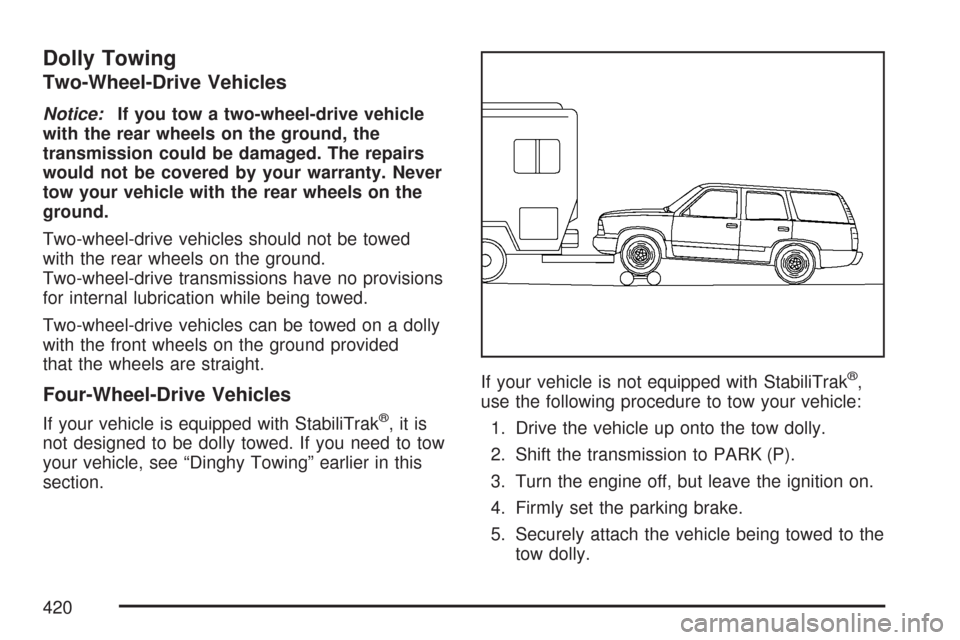
Dolly Towing
Two-Wheel-Drive Vehicles
Notice:If you tow a two-wheel-drive vehicle
with the rear wheels on the ground, the
transmission could be damaged. The repairs
would not be covered by your warranty. Never
tow your vehicle with the rear wheels on the
ground.
Two-wheel-drive vehicles should not be towed
with the rear wheels on the ground.
Two-wheel-drive transmissions have no provisions
for internal lubrication while being towed.
Two-wheel-drive vehicles can be towed on a dolly
with the front wheels on the ground provided
that the wheels are straight.
Four-Wheel-Drive Vehicles
If your vehicle is equipped with StabiliTrak®,itis
not designed to be dolly towed. If you need to tow
your vehicle, see “Dinghy Towing” earlier in this
section.If your vehicle is not equipped with StabiliTrak
®,
use the following procedure to tow your vehicle:
1. Drive the vehicle up onto the tow dolly.
2. Shift the transmission to PARK (P).
3. Turn the engine off, but leave the ignition on.
4. Firmly set the parking brake.
5. Securely attach the vehicle being towed to the
tow dolly.
420