2007 CHEVROLET SUBURBAN parking brake
[x] Cancel search: parking brakePage 111 of 634
Keys............................................................ 113
Remote Keyless Entry (RKE) System........ 114
Remote Keyless Entry (RKE) System
Operation............................................... 115
Doors and Locks........................................ 122
Door Locks................................................ 122
Power Door Locks..................................... 123
Delayed Locking........................................ 123
Programmable Automatic Door Locks........ 123
Rear Door Security Locks......................... 124
Lockout Protection..................................... 124
Liftgate/Liftglass......................................... 125
Power Liftgate........................................... 127
Power Running Boards.............................. 131
Windows...................................................... 132
Power Windows........................................ 133
Sun Visors................................................ 134
Theft-Deterrent Systems............................. 135
Content Theft-Deterrent............................. 135
PASS-Key
®III+......................................... 137
PASS-Key®III+ Operation......................... 137Starting and Operating Your Vehicle......... 139
New Vehicle Break-In................................ 139
Ignition Positions....................................... 140
Retained Accessory Power (RAP)............. 141
Starting the Engine.................................... 141
Adjustable Throttle and Brake Pedal.......... 143
Engine Coolant Heater.............................. 143
Active Fuel Management™........................ 145
Automatic Transmission Operation............. 145
Tow/Haul Mode......................................... 149
Four-Wheel Drive...................................... 150
Parking Brake........................................... 156
Shifting Into Park (P) ................................. 157
Shifting Out of Park (P)............................. 159
Parking Over Things That Burn................. 159
Engine Exhaust......................................... 160
Running the Engine While Parked............. 161
Section 2 Features and Controls
111
Page 146 of 634
PARK (P):This position locks your rear wheels. It
is the best position to use when you start your
engine because your vehicle cannot move easily.
{CAUTION:
It is dangerous to get out of your vehicle
if the shift lever is not fully in PARK (P)
with the parking brake rmly set. Your
vehicle can roll.
Do not leave your vehicle when the engine
is running unless you have to. If you have
left the engine running, the vehicle can
move suddenly. You or others could be
injured. To be sure your vehicle will not
move, even when you are on fairly level
ground, always set your parking brake
and move the shift lever to PARK (P). See
Shifting Into Park (P) on page 157.Ifyou
are pulling a trailer, seeTowing a Trailer
on page 422.
{CAUTION:
If you have four-wheel drive, your vehicle
will be free to roll — even if your shift
lever is in PARK (P) — if your transfer
case is in NEUTRAL. So, be sure the
transfer case is in a drive gear, two-wheel
high, four-wheel high or four-wheel
low — not in NEUTRAL. SeeShifting Into
Park (P) on page 157.
REVERSE (R):Use this gear to back up.
Notice:Shifting to REVERSE (R) while your
vehicle is moving forward could damage the
transmission. The repairs would not be covered
by your warranty. Shift to REVERSE (R) only
after your vehicle is stopped.
To rock your vehicle back and forth to get out of
snow, ice, or sand without damaging your
transmission, seeIf Your Vehicle is Stuck in Sand,
Mud, Ice, or Snow on page 404.
146
Page 152 of 634
4n(Four-Wheel Drive Low):This setting also
engages your front axle and delivers extra
torque. You may never need this setting. It sends
maximum power to all four wheels. You might
choose Four-Wheel Drive Low if you are driving
off-road in deep sand, deep mud, deep snow, and
while climbing or descending steep hills.
StabiliTrak
®will not engage in this mode. See
StabiliTrak®System on page 363for more
information.
{CAUTION:
Shifting the transfer case to NEUTRAL
can cause your vehicle to roll even if the
transmission is in PARK (P). You or
someone else could be seriously injured.
Be sure to set the parking brake before
placing the transfer case in NEUTRAL.
SeeParking Brake on page 156.NEUTRAL (N):Shift the vehicle’s transfer case to
NEUTRAL only when towing your vehicle. See
Recreational Vehicle Towing on page 418or
Towing Your Vehicle on page 417for more
information.
If the SERVICE 4 WHEEL DRIVE message stays
on, you should take your vehicle to your dealer
for service. See “SERVICE 4 WHEEL DRIVE
message” underDIC Warnings and Messages on
page 270.
Shifting Into Four-Wheel Drive High or
AUTO (Automatic Four-Wheel Drive)
Turn the knob to the Four-Wheel High or AUTO
position. This can be done at any speed,
except when shifting from Four-Wheel Drive Low.
The indicator light will ash while shifting. It will
remain on when the shift is completed.
152
Page 154 of 634
Shifting Out of Four-Wheel Drive Low
To shift from Four-Wheel Drive Low to Four-Wheel
Drive High, AUTO, or Two-Wheel Drive High, your
vehicle must be stopped or moving less than 3 mph
(5 km/h) with the transmission in NEUTRAL (N) and
the ignition in RUN. The preferred method for
shifting out of Four-Wheel Drive Low is to have your
vehicle moving 1 to 2 mph (1.6 to 3.2 km/h). Turn
the knob to the Four-Wheel Drive High, AUTO, or
Two-Wheel Drive High position. You must wait for
the Four-Wheel Drive High, AUTO, or Two-Wheel
Drive High indicator light to stop ashing and
remain on before shifting your transmission
into gear.
Notice:Shifting the transmission into gear
before the Four-Wheel Drive Low indicator light
has stopped ashing could damage the
transfer case. To help avoid damaging your
vehicle, always wait for the Four-Wheel
Drive Low indicator light to stop ashing
before shifting the transmission into gear.
The vehicle may have signicant engagement
noise and bump when shifting between
Four-Wheel Drive Low and Four-Wheel Drive High
ranges or from NEUTRAL while the engine is
running.If the knob is turned to the Four-Wheel Drive High,
AUTO, or Two-Wheel Drive High switch position
when your vehicle is in gear and/or moving,
the Four-Wheel Drive High, AUTO or Two-Wheel
Drive High indicator light will ash for 30 seconds
but will not complete the shift unless your
vehicle is moving less than 3 mph (5 km/h) and
the transmission is in NEUTRAL (N).
Shifting into NEUTRAL
To shift the transfer case to NEUTRAL do the
following:
1. Make sure the vehicle is parked so that it will
not roll.
2. Set the parking brake and apply the regular
brake pedal. SeeParking Brake on page 156
for more information.
3. Start the vehicle or turn the ignition to RUN.
4. Put the transmission in NEUTRAL (N).
5. Shift the transfer case to Two-Wheel
Drive High.
154
Page 155 of 634

6. Turn the transfer case dial clockwise to
NEUTRAL till it stops and hold it for
10 seconds. Then slowly release the dial to
the four low position. The NEUTRAL light will
come on when the transfer case shift to
NEUTRAL is complete.
7. If the engine is running, verify that the
transmission is in NEUTRAL (N) by shifting the
transmission to REVERSE (R) for one second,
then shift the transmission to DRIVE (D) for
one second.
8. Turn the ignition to ACCESSORY, which will
turn the engine off.
9. Place the transmission shift lever in PARK (P).
10. Release the parking brake prior to moving
the vehicle.
11. Turn the ignition to LOCK.
Shifting Out of NEUTRAL
To shift out of NEUTRAL do the following:
1. Set the parking brake and apply the regular
brake pedal.
2. Shift the transmission to NEUTRAL (N) and
turn the ignition to RUN with the engine off.3. Turn the transfer case dial to the desired
transfer case shift position (Two-Wheel
Drive High, Four-Wheel Drive High, AUTO).
After the transfer case has shifted out of
NEUTRAL the NEUTRAL light will go out.
4. Release the parking brake prior to moving the
vehicle.
Notice:Shifting the transmission into gear
before the Four-Wheel Drive Low indicator light
has stopped ashing could damage the
transfer case. To help avoid damaging your
vehicle, always wait for the Four-Wheel
Drive Low indicator light to stop ashing
before shifting the transmission into gear.
5. Start the engine and shift the transmission to
the desired position.
Excessively shifting the transfer case into or out of
the different modes may cause the transfer
case to enter the shift protection mode. This will
protect the transfer case from possible damage
and will only allow the transfer case to respond to
one shift per 10 seconds. The transfer case
may stay in this mode for up to three minutes.
155
Page 156 of 634
Parking Brake
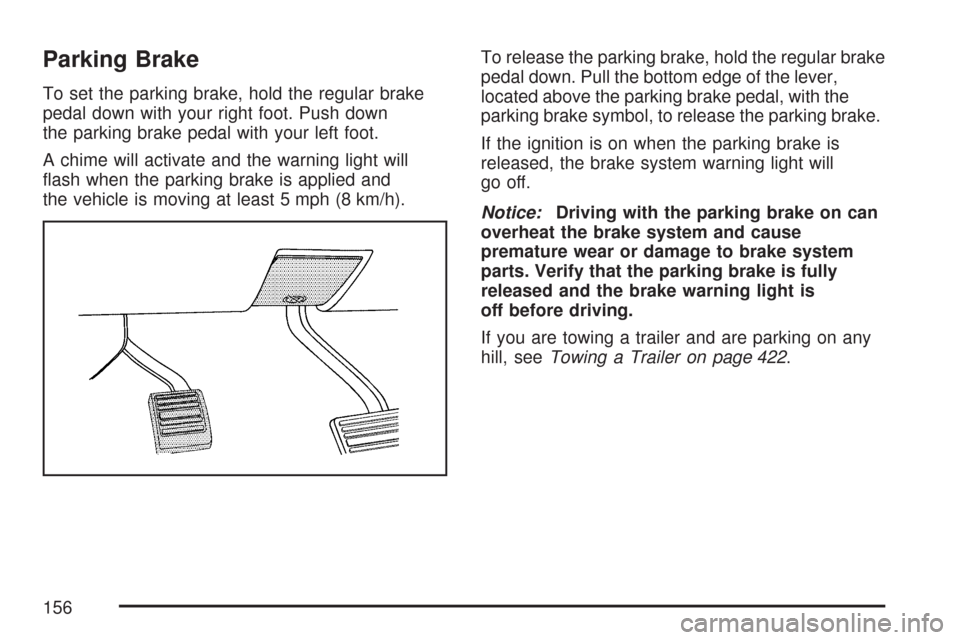
To set the parking brake, hold the regular brake
pedal down with your right foot. Push down
the parking brake pedal with your left foot.
A chime will activate and the warning light will
ash when the parking brake is applied and
the vehicle is moving at least 5 mph (8 km/h).To release the parking brake, hold the regular brake
pedal down. Pull the bottom edge of the lever,
located above the parking brake pedal, with the
parking brake symbol, to release the parking brake.
If the ignition is on when the parking brake is
released, the brake system warning light will
go off.
Notice:Driving with the parking brake on can
overheat the brake system and cause
premature wear or damage to brake system
parts. Verify that the parking brake is fully
released and the brake warning light is
off before driving.
If you are towing a trailer and are parking on any
hill, seeTowing a Trailer on page 422.
156
Page 157 of 634

Shifting Into Park (P)
{CAUTION:
It can be dangerous to get out of your
vehicle if the shift lever is not fully in
PARK (P) with the parking brake rmly set.
Your vehicle can roll. If you have left the
engine running, the vehicle can move
suddenly. You or others could be injured.
To be sure your vehicle will not move, even
when you are on fairly level ground, use
the steps that follow. With four-wheel drive,
if your transfer case is in NEUTRAL, your
vehicle will be free to roll, even if your shift
lever is in PARK (P). So, be sure the
transfer case is in a drive gear — not in
NEUTRAL. If you are pulling a trailer, see
Towing a Trailer on page 422.1. Hold the brake pedal down with your right foot
and set the parking brake.
2. Move the shift lever into the PARK (P)
position by pulling the shift lever toward
you and moving it up as far as it will go.
3. Be sure the transfer case is in a drive
gear — not in NEUTRAL (N).
4. Turn the ignition key to LOCK.
5. Remove the key and take it with you. If you
can leave your vehicle with the ignition key in
your hand, your vehicle is in PARK (P).
157
Page 158 of 634

Leaving Your Vehicle With the Engine
Running
{CAUTION:
It can be dangerous to leave your vehicle
with the engine running. Your vehicle
could move suddenly if the shift lever is
not fully in PARK (P) with the parking
brake rmly set.
If you have four-wheel drive and your
transfer case is in NEUTRAL, your vehicle
will be free to roll, even if your shift lever
is in PARK (P). So be sure the transfer
case is in a drive gear — not in NEUTRAL.
And, if you leave the vehicle with the
engine running, it could overheat and
even catch re. You or others could be
injured. Do not leave your vehicle with the
engine running unless you have to.If you have to leave your vehicle with the engine
running, be sure your vehicle is in PARK (P)
and the parking brake is rmly set before
you leave it. After you move the shift lever into
PARK (P), hold the regular brake pedal down.
Then, see if you can move the shift lever away
from PARK (P) without rst pulling it toward you. If
you can, it means that the shift lever was not
fully locked into PARK (P).
Torque Lock
If you are parking on a hill and you do not shift
your transmission into PARK (P) properly,
the weight of the vehicle may put too much force
on the parking pawl in the transmission. You
may nd it difficult to pull the shift lever out
of PARK (P). This is called torque lock. To prevent
torque lock, set the parking brake and then shift
into PARK (P) properly before you leave the
driver’s seat. To nd out how, seeShifting Into
Park (P) on page 157.
When you are ready to drive, move the shift lever
out of PARK (P) before you release the parking
brake.
158