Page 434 of 634
Before you start, check all trailer hitch parts and
attachments, safety chains, electrical connector,
lamps, tires and mirror adjustment. If the trailer has
electric brakes, start your vehicle and trailer
moving and then apply the trailer brake controller
by hand to be sure the brakes are working.
This lets you check your electrical connection at
the same time.
During your trip, check occasionally to be sure
that the load is secure, and that the lamps and any
trailer brakes are still working.
Following Distance
Stay at least twice as far behind the vehicle ahead
as you would when driving your vehicle without
a trailer. This can help you avoid situations
that require heavy braking and sudden turns.
Passing
You’ll need more passing distance up ahead when
you’re towing a trailer. And, because you’re a
good deal longer, you’ll need to go much farther
beyond the passed vehicle before you can
return to your lane.
Backing Up
Hold the bottom of the steering wheel with one
hand. Then, to move the trailer to the left,
just move that hand to the left. To move the trailer
to the right, move your hand to the right. Always
back up slowly and, if possible, have someone
guide you.
Making Turns
Notice:Making very sharp turns while
trailering could cause the trailer to come in
contact with the vehicle. Your vehicle could be
damaged. Avoid making very sharp turns
while trailering.
When you’re turning with a trailer, make wider
turns than normal. Do this so your trailer
won’t strike soft shoulders, curbs, road signs,
trees or other objects. Avoid jerky or sudden
maneuvers. Signal well in advance.
434
Page 473 of 634
Coolant Surge Tank Pressure Cap
Notice:If the pressure cap is not tightly
installed, coolant loss and possible engine
damage may occur. Be sure the cap is properly
and tightly secured.
The coolant surge tank pressure cap must be fully
installed on the coolant surge tank. SeeEngine
Compartment Overview on page 458for more
information on location.
Engine Overheating
You will nd a coolant temperature gage on your
vehicle’s instrument panel. SeeEngine Coolant
Temperature Gage on page 252.
In addition, you will nd an ENGINE
OVERHEATED STOP ENGINE, ENGINE
OVERHEATED IDLE ENGINE, and an ENGINE
POWER IS REDUCED message in the Driver
Information Center (DIC) on the instrument panel.
SeeDIC Warnings and Messages on page 270.
473
Page 521 of 634

Federal Communications Commission
(FCC) and Industry and Science
Canada
The Tire Pressure Monitor System (TPMS)
operates on a radio frequency and complies with
Part 15 of the FCC Rules. Operation is subject
to the following two conditions:
1. This device may not cause harmful
interference.
2. This device must accept any interference
received, including interference that may
cause undesired operation.
The Tire Pressure Monitor System (TPMS)
operates on a radio frequency and complies with
RSS-210 of Industry and Science Canada.
Operation is subject to the following two
conditions:
1. This device may not cause interference.
2. This device must accept any interference
received, including interference that may
cause undesired operation of the device.
Changes or modications to this system by other
than an authorized service facility could void
authorization to use this equipment.
Tire Inspection and Rotation
Tires should be rotated every 5,000 to 8,000 miles
(8 000 to 13 000 km).
Any time you notice unusual wear, rotate your
tires as soon as possible and check wheel
alignment. Also check for damaged tires or wheels.
SeeWhen It Is Time for New Tires on page 523
andWheel Replacement on page 528for
more information.
Make sure the spare tire is stored securely. Push,
pull, and then try to rotate or turn the tire. If it
moves, use the ratchet/wheel wrench to tighten the
cable. SeeChanging a Flat Tire on page 532.
The purpose of regular rotation is to achieve more
uniform wear for all tires on the vehicle. The
rst rotation is the most important. SeeScheduled
Maintenance on page 579.
521
Page 530 of 634
Tire Chains
{CAUTION:
If your vehicle has P265/65R18 or
P275/55R20 size tires, do not use tire
chains. They can damage your vehicle
because there is not enough clearance.
Tire chains used on a vehicle without the
proper amount of clearance can cause
damage to the brakes, suspension, or
other vehicle parts. The area damaged by
the tire chains could cause you to lose
control of your vehicle and you or others
may be injured in a crash.
Use another type of traction device only if
its manufacturer recommends it for use
on your vehicle and tire size combination
and road conditions. Follow that
manufacturer’s instructions.
CAUTION: (Continued)
CAUTION: (Continued)
To help avoid damage to your vehicle,
drive slowly, readjust or remove the
device if it is contacting your vehicle, and
do not spin your vehicle’s wheels.
If you do nd traction devices that will t,
install them on the rear tires.
Notice:If your vehicle has P265/70R17 size
tires, use tire chains only where legal and only
when you must. Use chains that are the proper
size for your vehicle’s tires. Install them on the
rear tires only.
Do not use chains on the front tires.
Tighten them as tightly as possible with the
ends securely fastened. Drive slowly and follow
the chain manufacturer’s instructions. If you
can hear the chains contacting your vehicle,
stop and retighten them. If the contact
continues, slow down until it stops. Driving
too fast or spinning the wheels with chains on
will damage your vehicle.
530
Page 544 of 634
2. If it is visible, rst try to tighten the cable by
turning the wheel wrench clockwise until you
hear two clicks or feel it skip twice. You
cannot overtighten the cable.
3. Loosen the cable by turning the wheel wrench
counterclockwise three or four turns.
4. Repeat this procedure at least two times. If
the spare tire lowers to the ground, continue
with Step 5 ofRemoving the Spare Tire
and Tools on page 533.
5. If the spare tire does not lower, turn the wheel
wrench counterclockwise until approximately
6 inches (15 cm) of cable is exposed.
6. Stand the wheel blocks on their shortest ends,
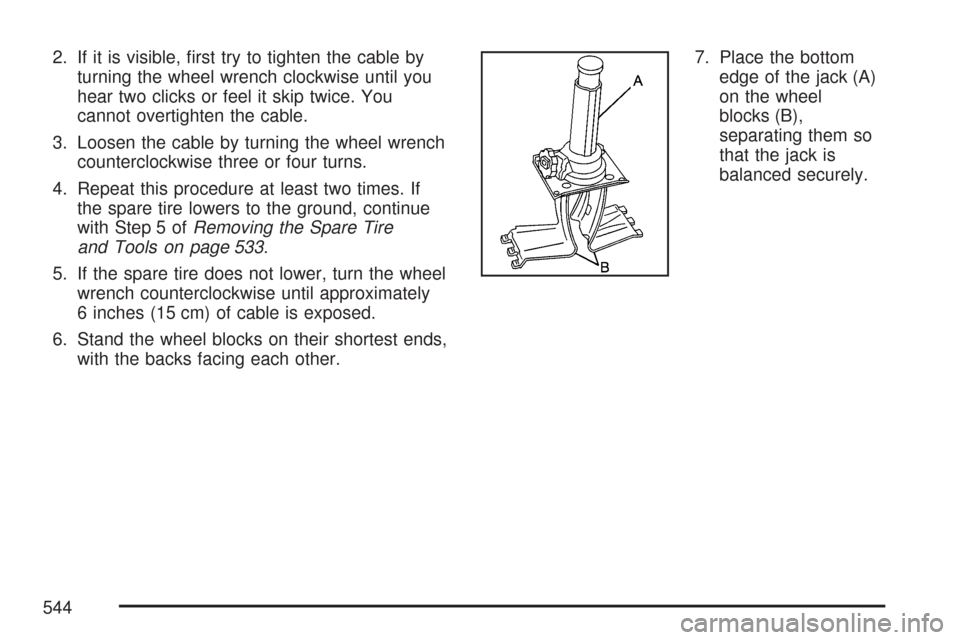
with the backs facing each other.7. Place the bottom
edge of the jack (A)
on the wheel
blocks (B),
separating them so
that the jack is
balanced securely.
544
Page 550 of 634
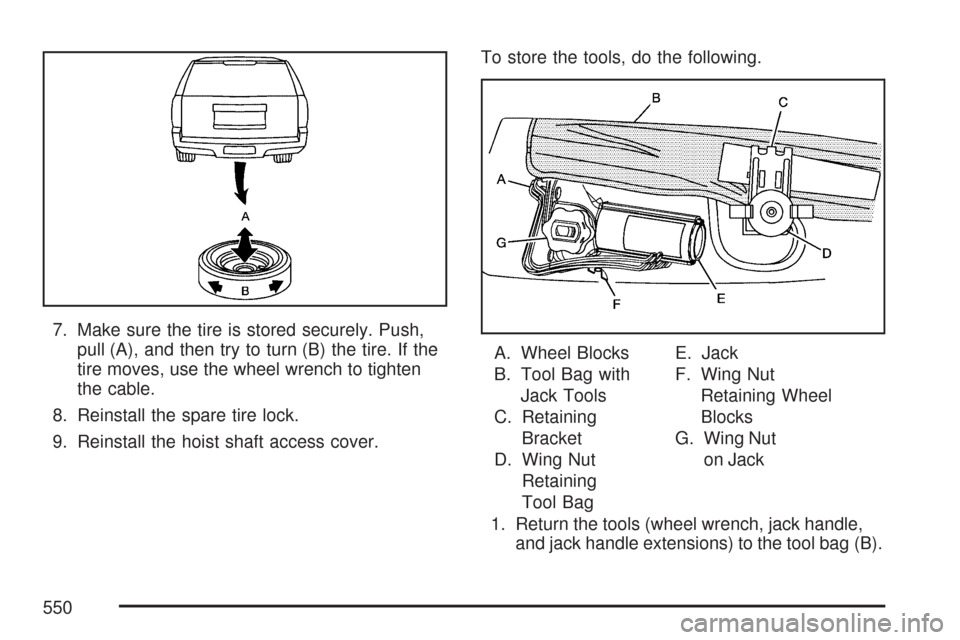
7. Make sure the tire is stored securely. Push,
pull (A), and then try to turn (B) the tire. If the
tire moves, use the wheel wrench to tighten
the cable.
8. Reinstall the spare tire lock.
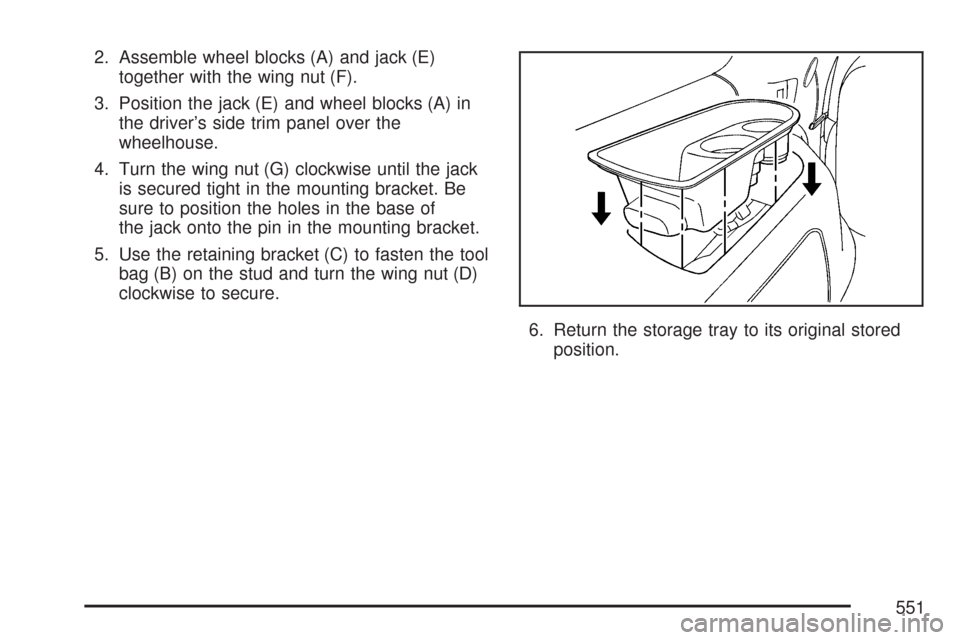
9. Reinstall the hoist shaft access cover.To store the tools, do the following.
A. Wheel Blocks
B. Tool Bag with
Jack Tools
C. Retaining
Bracket
D. Wing Nut
Retaining
Tool BagE. Jack
F. Wing Nut
Retaining Wheel
Blocks
G. Wing Nut
on Jack
1. Return the tools (wheel wrench, jack handle,
and jack handle extensions) to the tool bag (B).
550
Page 551 of 634
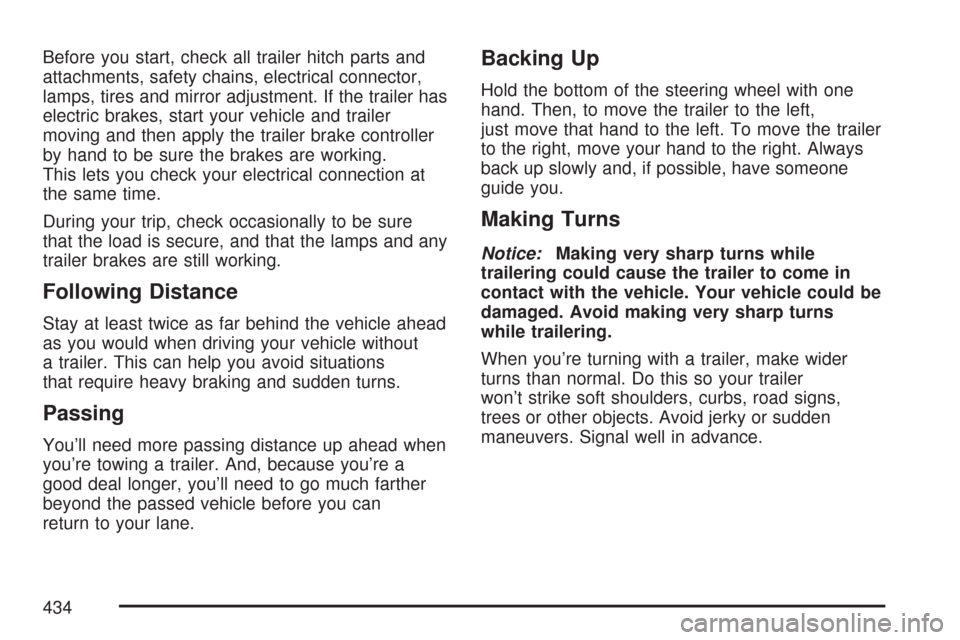
2. Assemble wheel blocks (A) and jack (E)
together with the wing nut (F).
3. Position the jack (E) and wheel blocks (A) in
the driver’s side trim panel over the
wheelhouse.
4. Turn the wing nut (G) clockwise until the jack
is secured tight in the mounting bracket. Be
sure to position the holes in the base of
the jack onto the pin in the mounting bracket.
5. Use the retaining bracket (C) to fasten the tool
bag (B) on the stud and turn the wing nut (D)
clockwise to secure.
6. Return the storage tray to its original stored
position.
551
Page 587 of 634

At Least Once a Month
Tire Ination Check
Visually inspect your vehicle’s tires and make sure
they are inated to the correct pressures. Do not
forget to check the spare tire. SeeInation - Tire
Pressure on page 515. Check to make sure the
spare tire is stored securely. SeeChanging a Flat
Tire on page 532.
Tire Wear Inspection
Tire rotation may be required for high mileage
highway drivers prior to the Engine Oil Life System
service notication. Check the tires for wear
and, if necessary, rotate the tires. SeeTire
Inspection and Rotation on page 521.
At Least Once a Year
Starter Switch Check
{CAUTION:
When you are doing this inspection, the
vehicle could move suddenly. If the
vehicle moves, you or others could be
injured.
1. Before you start, be sure you have enough
room around the vehicle.
2. Firmly apply both the parking brake and the
regular brake. SeeParking Brake on
page 156.
Do not use the accelerator pedal, and be
ready to turn off the engine immediately if
it starts.
3. Try to start the engine in each gear. The
vehicle should start only in PARK (P) or
NEUTRAL (N). If the vehicle starts in any
other position, contact your GM Goodwrench
®
dealer for service.
587