Page 568 of 684

Federal Communications Commission
(FCC) and Industry and Science
Canada
The Tire Pressure Monitor System (TPMS)
operates on a radio frequency and complies with
Part 15 of the FCC Rules. Operation is subject
to the following two conditions:
1. This device may not cause harmful
interference.
2. This device must accept any interference
received, including interference that may
cause undesired operation.
The Tire Pressure Monitor System (TPMS)
operates on a radio frequency and complies with
RSS-210 of Industry and Science Canada.
Operation is subject to the following two
conditions:
1. This device may not cause interference.
2. This device must accept any interference
received, including interference that may
cause undesired operation of the device.
Changes or modications to this system by other
than an authorized service facility could void
authorization to use this equipment.
Tire Inspection and Rotation
Tires should be rotated every 5,000 to 8,000 miles
(8 000 to 13 000 km).
Any time you notice unusual wear, rotate your
tires as soon as possible and check wheel
alignment. Also check for damaged tires or wheels.
SeeWhen It Is Time for New Tires on page 571
andWheel Replacement on page 576for
more information.
Make sure the spare tire is stored securely. Push,
pull, and then try to rotate or turn the tire. If it
moves, use the wheel wrench/hoist shaft to tighten
the cable. SeeChanging a Flat Tire on page 580.
If your vehicle has dual rear wheels, also see
Dual Tire Operation on page 562.
The purpose of regular rotation is to achieve more
uniform wear for all tires on the vehicle. The
rst rotation is the most important. SeeScheduled
Maintenance (Gasoline Engine) on page 627.
568
Page 581 of 684
CAUTION: (Continued)
3. If you have a four-wheel-drive vehicle,
be sure the transfer case is in a drive
gear – not in NEUTRAL.
4. Turn off the engine and do not restart
while the vehicle is raised.
5. Do not allow passengers to remain in
the vehicle.
To be even more certain the vehicle will
not move, put blocks at the front and rear
of the tire farthest away from the one
being changed. That would be the tire on
the other side, at the opposite end of the
vehicle.
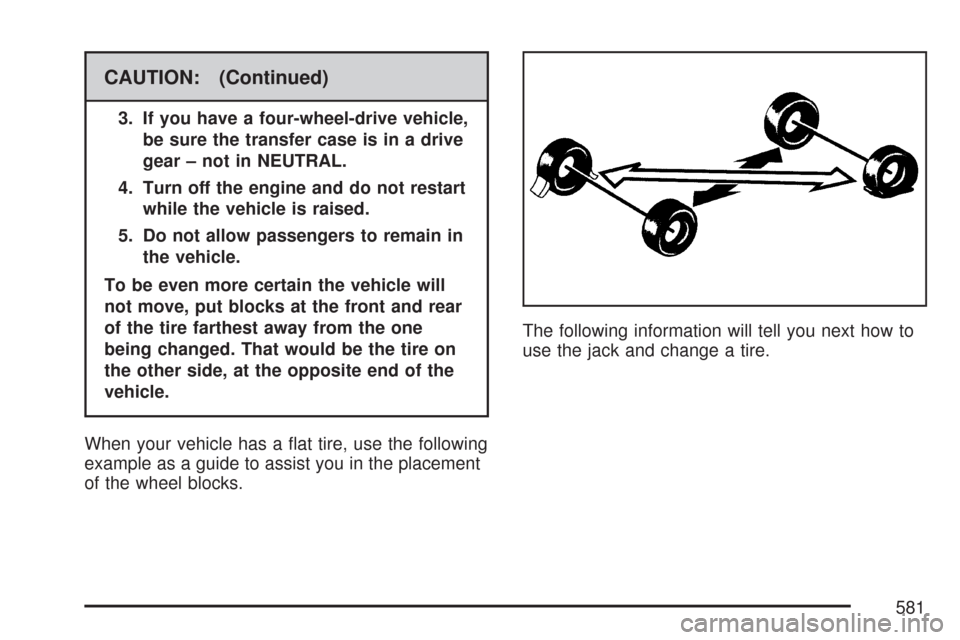
When your vehicle has a at tire, use the following
example as a guide to assist you in the placement
of the wheel blocks.The following information will tell you next how to
use the jack and change a tire.
581
Page 610 of 684
Description Usage
Foaming Tire Shine Low
GlossCleans, shines, and
protects in one step. No
wiping necessary.
Wash Wax ConcentrateMedium foaming
shampoo. Cleans and
lightly waxes.
Biodegradable and
phosphate free.
Spot LifterQuickly removes spots
and stains from carpets,
vinyl, and cloth
upholstery.
Odor EliminatorOdorless spray odor
eliminator used on fabrics,
vinyl, leather and carpet.Vehicle Identication
Vehicle Identication Number (VIN)
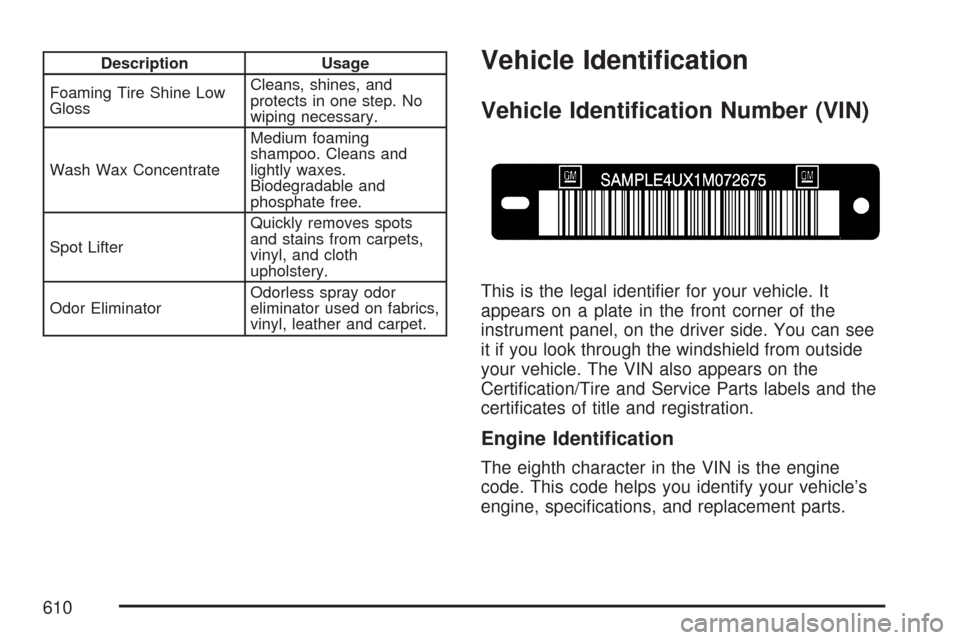
This is the legal identier for your vehicle. It
appears on a plate in the front corner of the
instrument panel, on the driver side. You can see
it if you look through the windshield from outside
your vehicle. The VIN also appears on the
Certication/Tire and Service Parts labels and the
certicates of title and registration.
Engine Identication
The eighth character in the VIN is the engine
code. This code helps you identify your vehicle’s
engine, specications, and replacement parts.
610
Page 615 of 684
Harness
ConnectorUsage
BRAKE
CLUTCHBrake Clutch Harness Connector
SEO/UPFITTERSpecial Equipment Option Uptter
Harness Connector
Circuit Breaker Usage
CB1Passenger’s Side Power Window
Circuit Breaker
CB2 Passenger’s Seat Circuit Breaker
CB3 Driver’s Seat Circuit Breaker
CB4 Not Used
Underhood Fuse Block
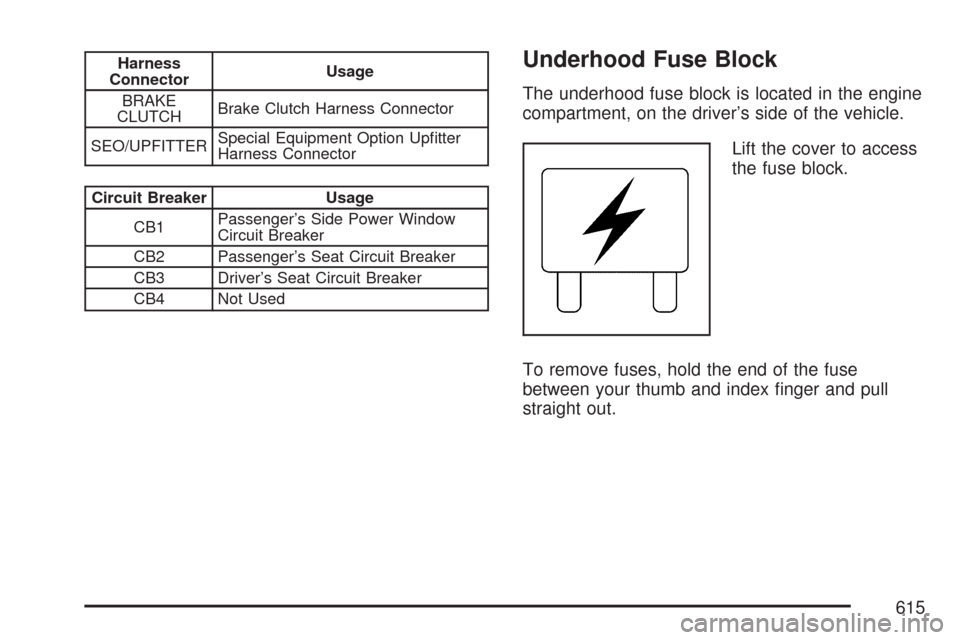
The underhood fuse block is located in the engine
compartment, on the driver’s side of the vehicle.
Lift the cover to access
the fuse block.
To remove fuses, hold the end of the fuse
between your thumb and index nger and pull
straight out.
615
Page 616 of 684
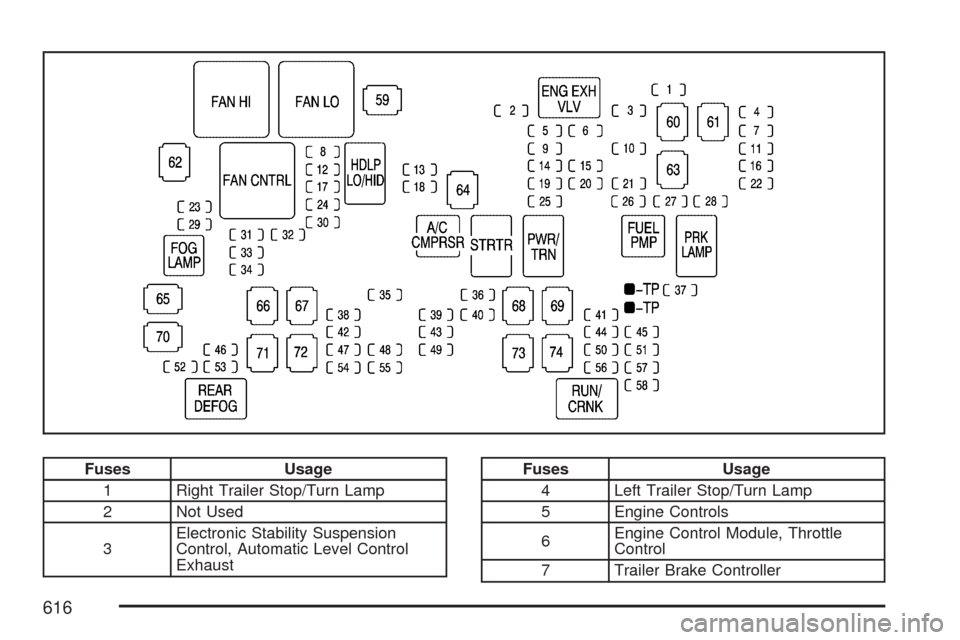
Fuses Usage
1 Right Trailer Stop/Turn Lamp
2 Not Used
3Electronic Stability Suspension
Control, Automatic Level Control
ExhaustFuses Usage
4 Left Trailer Stop/Turn Lamp
5 Engine Controls
6Engine Control Module, Throttle
Control
7 Trailer Brake Controller
616
Page 617 of 684
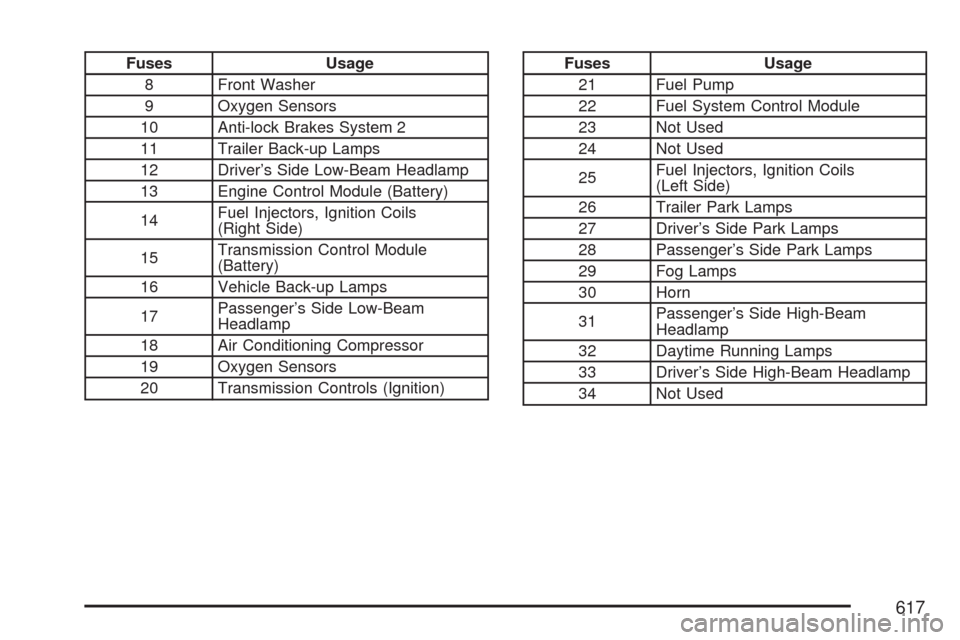
Fuses Usage
8 Front Washer
9 Oxygen Sensors
10 Anti-lock Brakes System 2
11 Trailer Back-up Lamps
12 Driver’s Side Low-Beam Headlamp
13 Engine Control Module (Battery)
14Fuel Injectors, Ignition Coils
(Right Side)
15Transmission Control Module
(Battery)
16 Vehicle Back-up Lamps
17Passenger’s Side Low-Beam
Headlamp
18 Air Conditioning Compressor
19 Oxygen Sensors
20 Transmission Controls (Ignition)Fuses Usage
21 Fuel Pump
22 Fuel System Control Module
23 Not Used
24 Not Used
25Fuel Injectors, Ignition Coils
(Left Side)
26 Trailer Park Lamps
27 Driver’s Side Park Lamps
28 Passenger’s Side Park Lamps
29 Fog Lamps
30 Horn
31Passenger’s Side High-Beam
Headlamp
32 Daytime Running Lamps
33 Driver’s Side High-Beam Headlamp
34 Not Used
617
Page 618 of 684
Fuses Usage
35 Sunroof
36Key Ignition System, Theft Deterrent
System
37 Windshield Wiper
38 SEO B2 Uptter Usage (Battery)
39 Electric Adjustable Pedals
40 Climate Controls (Battery)
41 Airbag System (Ignition)
42 Amplier
43 Audio System
44Miscellaneous (Ignition), Cruise
Control
45 Tailgate Open/Close Assist
46 Airbag System (Battery)
47OnStar
®, Rear Seat Entertainment
Display
Fuses Usage
48 Instrument Panel Cluster
49 Power Take-Off
50Auxiliary Climate Control (Ignition),
Compass-Temperature Mirror
51Center High-Mounted Stoplamp
(CHMSL)
52 Rear Defogger
53 Heated Mirrors
54 SEO B1 Uptter Usage (Battery)
55Cigarette Lighter, Auxiliary Power
Outlet
56Automatic Level Control Compressor
Relay, SEO Uptter Usage
57 Climate Controls (Ignition)
58Engine Control Module, Secondary
Fuel Pump (Ignition)
618
Page 620 of 684
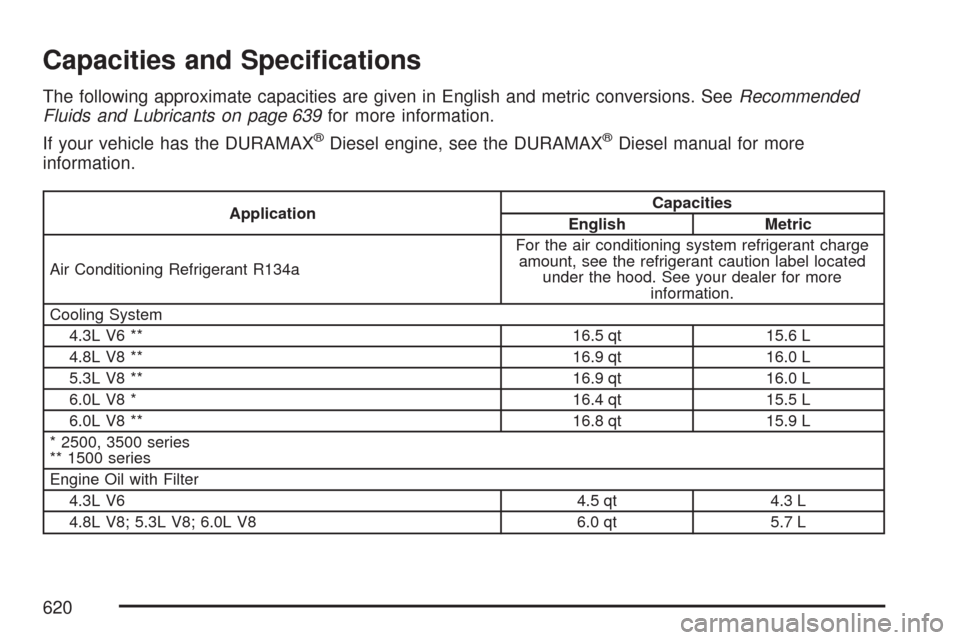
Capacities and Specications
The following approximate capacities are given in English and metric conversions. SeeRecommended
Fluids and Lubricants on page 639for more information.
If your vehicle has the DURAMAX
®Diesel engine, see the DURAMAX®Diesel manual for more
information.
ApplicationCapacities
English Metric
Air Conditioning Refrigerant R134aFor the air conditioning system refrigerant charge
amount, see the refrigerant caution label located
under the hood. See your dealer for more
information.
Cooling System
4.3L V6 ** 16.5 qt 15.6 L
4.8L V8 ** 16.9 qt 16.0 L
5.3L V8 ** 16.9 qt 16.0 L
6.0L V8 * 16.4 qt 15.5 L
6.0L V8 ** 16.8 qt 15.9 L
* 2500, 3500 series
** 1500 series
Engine Oil with Filter
4.3L V6 4.5 qt 4.3 L
4.8L V8; 5.3L V8; 6.0L V8 6.0 qt 5.7 L
620