Page 102 of 422
Express-Down Window
The driver’s window may also have an
express-down feature. This switch is labeled
AUTO. Press the switch then release it and the
driver’s window goes all the way down.
To stop the window while it is lowering, press the
switch again. To raise the window, pull up and
hold the switch.
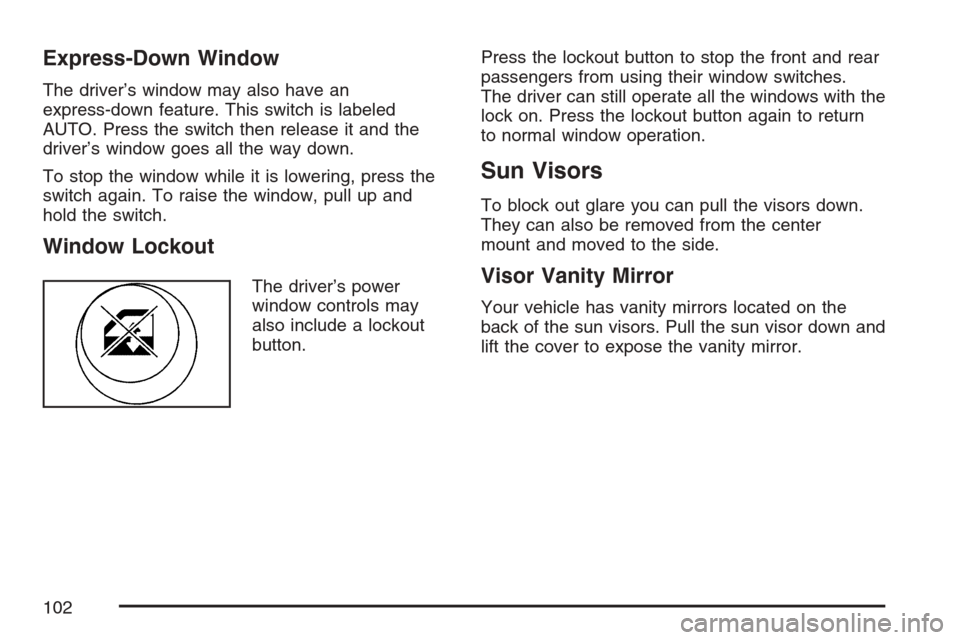
Window Lockout
The driver’s power
window controls may
also include a lockout
button.Press the lockout button to stop the front and rear
passengers from using their window switches.
The driver can still operate all the windows with the
lock on. Press the lockout button again to return
to normal window operation.
Sun Visors
To block out glare you can pull the visors down.
They can also be removed from the center
mount and moved to the side.
Visor Vanity Mirror
Your vehicle has vanity mirrors located on the
back of the sun visors. Pull the sun visor down and
lift the cover to expose the vanity mirror.
102
Page 103 of 422

Theft-Deterrent Systems
Vehicle theft is big business, especially in some
cities. Although your vehicle has a number of
theft-deterrent features, we know that nothing we
put on it can make it impossible to steal.
Theft-Deterrent System
Your vehicle may have a theft-deterrent system.
The theft-deterrent system will not arm when
you lock the doors using the key or the manual
door lock. It activates only when you use the
optional remote keyless entry transmitter.
Arming the System
To arm the system, do the following:
1. Turn the ignition to LOCK and remove the key
from the ignition.
If the key is inserted in the ignition, the
transmitter will not operate the theft-deterrent
system.2. Close the doors, the windows, the hood, and
the trunk or liftgate.
Make sure the windows are closed, as the
system can be activated even if the windows
are open.
3. Lock the door using the remote keyless entry
transmitter. The transmitter must be used to
activate the theft-deterrent system.
•The LED light on the transmitter will
flash once.
•All of the doors will lock.
•The hazard warning lamps will flash once
and the horn will chirp.
•The theft-deterrent mode will activate.
•The security light will flash once every
second to indicate that the theft-deterrent
system is armed. The security light is located
on the base of the driver’s door lock.
103
Page 104 of 422
To avoid activating the alarm by accident, use
one of the following methods:
•Unlock the driver’s or passenger’s door using
the key.
•Press the unlock button on the remote keyless
entry transmitter.
Unlocking a door any other way will activate the
alarm when a door, the trunk or liftgate is opened.
If you do not want to arm the theft-deterrent
system, lock the vehicle using the key or the
manual door locks.
Disarming the System
To disarm the system, use one of the following
methods:
•Unlock the driver’s or passenger’s door using
the key.
•Press the unlock button on the transmitter.
- The LED light on the transmitter will
flash once.
- All of the doors will unlock.
- The hazard warning lamps will flash
twice.
- The theft-deterrent mode will deactivate.
If the door is not opened or if the engine is not
started within 30 seconds after disarming the
system with the transmitter, all of the doors will
automatically lock and the theft-deterrent mode
will reactivate.
104
Page 105 of 422

How the System Alarm is Activated
If a door or the trunk or liftgate is opened without
using the key or the remote keyless entry
transmitter, the horn will sound and the lamps will
flash for up to 30 seconds.
How to Turn Off the System Alarm
If the system alarm is active, it can be deactivated
using one of the following methods:
•Press the lock or unlock button on the remote
keyless entry transmitter.
•Unlock the driver’s or passenger’s front door
using the key.
Otherwise, the alarm will automatically stop after
30 seconds. The system will then lock the
doors and reactivate the theft-deterrent system.
How to Detect a Tamper Condition
If the hazard warning lamps flash once when you
press the lock or unlock buttons on the remote
keyless entry transmitter, that means the
theft-deterrent system alarm was triggered while
you were away, from the vehicle.
Starting and Operating
Your Vehicle
New Vehicle Break-In
Notice:Your vehicle does not need an
elaborate break-in. But it will perform better in
the long run if you follow these guidelines:
Do not drive at any one constant speed,
fast or slow, for the rst 500 miles
(805 km). Do not make full-throttle starts.
Avoid downshifting to brake, or slow,
the vehicle.
Avoid making hard stops for the rst
200 miles (322 km) or so. During this time
your new brake linings are not yet
broken in. Hard stops with new linings can
mean premature wear and earlier
replacement. Follow this breaking-in
guideline every time you get new brake
linings.
Following break-in, engine speed and load can
be gradually increased.
105
Page 106 of 422
Ignition Positions
The ignition switch
can be turned to
four different
positions with
the key.{CAUTION:
On manual transaxle vehicles, turning the
key to LOCK and removing it will lock the
steering column and result in a loss of
ability to steer the vehicle. This could
cause a collision. If you need to turn the
engine off while the vehicle is moving,
turn the key only to ACC. Do not push the
key in while the vehicle is moving.
Notice:Using a tool to force the key from the
ignition switch could cause damage or break
the key. Use the correct key and turn the key
only with your hand. Make sure the key is all the
way in. If it is, turn the steering wheel left and
right while you turn the key hard. If none of this
works, then your vehicle needs service.
106
Page 107 of 422

LOCK:This position locks the steering wheel,
ignition, shift lever and transaxle. This is the only
position in which you can insert or remove the
key. If the steering wheel is locked, move it from
right to left and turn the key to ACC (Accessory).
ACC (Accessory):This position operates
some of the electrical accessories, such as the
radio, but not the climate control system.
ON:This is the position the switch returns after you
start the engine and release the key. The switch
stays in ON when the engine is running. But even
when the engine is not running, you can use ON to
operate the electrical accessories, and to display
some instrument panel warning lights.
START:This position starts the engine. When
the engine starts, release the key. The switch
returns to ON for normal driving. Do not turn
the key to START if the engine is running.
Even if the engine is not running, ACC and ON
allow you to operate electrical accessories,
such as the radio.Starting the Engine
Automatic Transaxle
Move the shift lever to PARK (P) or NEUTRAL (N).
Your engine does not start in any other
position — that is a safety feature. To restart
when the vehicle is already moving, use
NEUTRAL (N) only.
Notice:Shifting into PARK (P) with the vehicle
moving could damage the transaxle. Shift
into PARK (P) only when your vehicle is
stopped.
Manual Transaxle
The gear selector should be in NEUTRAL and the
parking brake engaged. Hold the clutch pedal
to the floor and start the engine. Your vehicle will
not start if the clutch pedal is not all the way
down — that is a safety feature.
107
Page 110 of 422

Automatic Transaxle Operation
If your vehicle has an
automatic transaxle, the
shift lever is located
on the console between
the seats.
Your vehicle may also have an electronic shift
position indicator that displays the position of the
shift lever. This indicator is located to the right
of the trip odometer on the instrument panel
cluster.
Movement between certain positions requires
pushing the shift lever to the passenger side while
shifting. This prevents you from changing
positions unexpectedly by blocking the straight
movement of the shift lever while the vehicle
is moving.PARK (P):This position locks the front wheels.
It is the best position to use when the start
your engine because your vehicle cannot move
easily.
{CAUTION:
It is dangerous to get out of your vehicle
if the shift lever is not fully in PARK (P)
with the parking brake rmly set. Your
vehicle can roll.
Do not leave your vehicle when the engine
is running unless you have to. If you have
left the engine running, the vehicle can
move suddenly. You or others could be
injured. To be sure your vehicle will not
move, even when you are on fairly level
ground, always set your parking brake
and move the shift lever to PARK (P).
SeeShifting Into Park (P) (Automatic
Transaxle) on page 117.
110
Page 111 of 422
Make sure the shift lever is fully in PARK (P)
before starting the engine. Your vehicle has an
automatic transaxle shift lock control system. The
regular brakes must be applied before you can
shift from PARK (P) when the ignition key is in ON.
If you cannot shift out of PARK (P) while holding
the brake pedal down, seeShifting Out of Park (P)
(Automatic Transaxle) on page 118.
REVERSE (R):Use this gear to back up.
When shifting from NEUTRAL (N) to
REVERSE (R), you must press down on the
shift lever while shifting.
Notice:Shifting to REVERSE (R) while your
vehicle is moving forward could damage
the transaxle. The repairs would not be
covered by your warranty. Shift to
REVERSE (R) only after your vehicle is
stopped.
To rock your vehicle back and forth to get out of
snow, ice, or sand without damaging the transaxle,
seeIf Your Vehicle is Stuck in Sand, Mud, Ice,
or Snow on page 235.NEUTRAL (N):In this position, the engine does
not connect with the wheels. To restart while
you are already moving, use NEUTRAL (N) only.
Also, use NEUTRAL (N) when your vehicle is
being towed.
{CAUTION:
Shifting into a drive gear while your
engine is running at high speed is
dangerous. Unless your foot is rmly on
the brake pedal, your vehicle could move
very rapidly. You could lose control and
hit people or objects. Do not shift into a
drive gear while your engine is running at
high speed.
Notice:Shifting out of PARK (P) or
NEUTRAL (N) while the engine is running at
high speed may damage the transaxle.
The repairs would not be covered by your
warranty. Be sure the engine is not running at
high speeds when shifting your vehicle.
111